Back to Home

All News & Updates

Stay updated with the latest news, announcements, and insights from Bluechip Technologies Asia.

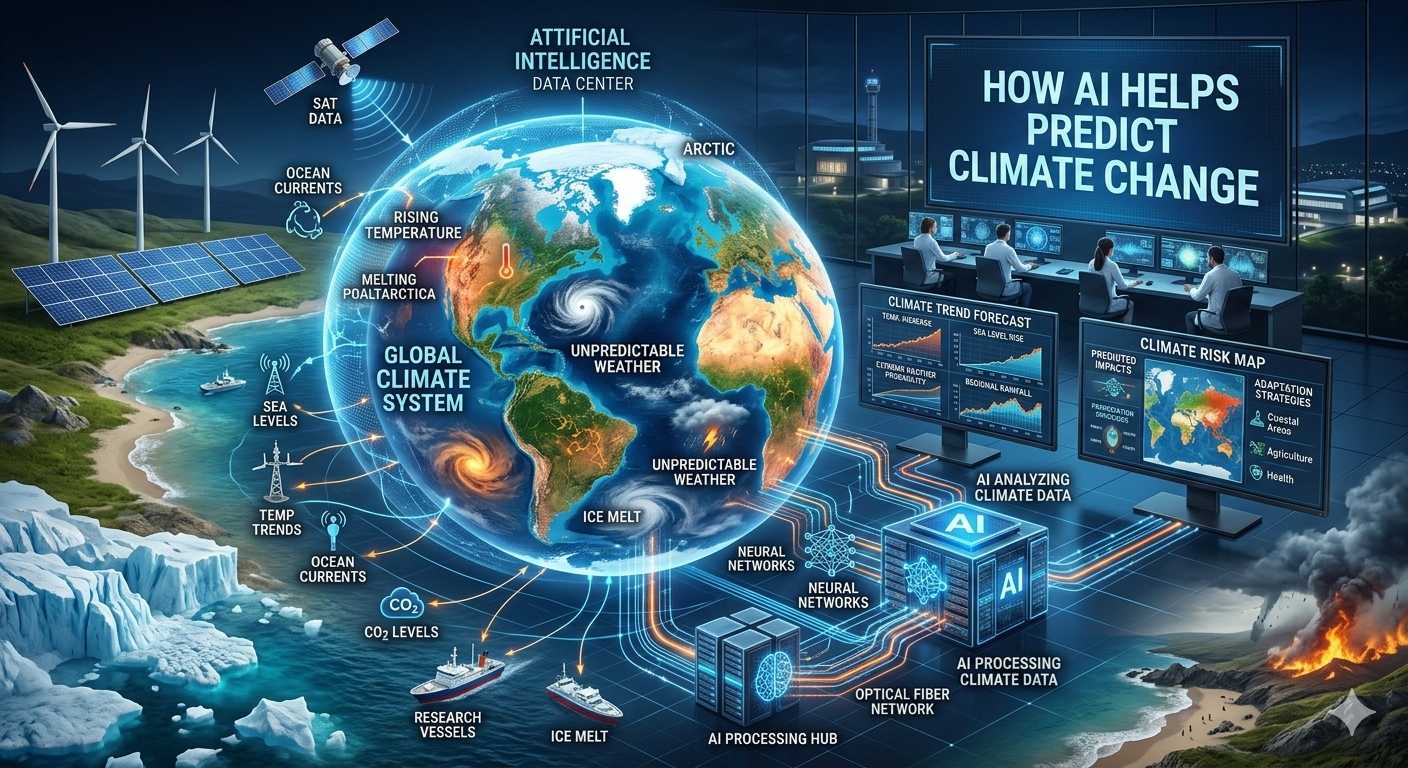
AI in Weather Forecasting
March 10, 2026

AI in Weather Forecasting

Introduction Weather forecasting plays a crucial role in our daily lives. People depend on weather predictions to plan travel, manage agriculture, prepare for natural disasters, and organize everyday activities. Accurate weather forecasting helps governments, businesses, and communities reduce risks and make better decisions. However, predicting the weather is not easy. Weather systems are extremely complex and constantly changing. Small variations in temperature, air pressure, wind patterns, or humidity can significantly affect weather conditions. Traditional forecasting methods rely on mathematical models and large computing systems to analyze atmospheric data, but these methods sometimes struggle to provide highly accurate predictions, especially for extreme weather events. Artificial Intelligence (AI) is now transforming weather forecasting by improving prediction accuracy and processing large volumes of data more efficiently. AI technologies can analyze vast amounts of weather data from satellites, radar systems, and weather stations to detect patterns and make faster predictions. With the help of AI, meteorologists can forecast weather conditions more precisely and provide early warnings for severe weather events. As climate change increases the frequency of extreme weather events, AI-driven forecasting systems are becoming even more important for protecting communities and minimizing environmental and economic damage. Traditional Weather Forecasting Methods Before the introduction of AI, weather forecasting mainly depended on numerical weather prediction models. These models use mathematical equations to simulate atmospheric processes and predict future weather conditions. Meteorologists collect data from multiple sources such as weather stations, satellites, ocean buoys, and radar systems. This data includes temperature, wind speed, atmospheric pressure, humidity, and precipitation levels. Supercomputers then process this information to generate weather forecasts. Although these traditional models are powerful, they have some limitations. Weather systems involve many complex interactions that can be difficult to simulate accurately. In some cases, traditional forecasting models require long processing times and may still produce uncertain results. Additionally, sudden changes in weather patterns can make it difficult for traditional systems to update predictions quickly. These challenges have created a need for more advanced technologies capable of handling large datasets and identifying patterns more effectively. AI helps overcome many of these limitations. How Artificial Intelligence Improves Weather Forecasting Artificial Intelligence improves weather forecasting by analyzing massive datasets and learning from historical weather patterns. AI systems use machine learning algorithms that can study past weather data and identify relationships between different atmospheric variables. For example, AI can analyze how temperature, humidity, and wind patterns interact during storm formation. By learning from previous storms, the system can identify similar patterns in current data and predict the likelihood of future storms. One major advantage of AI is its ability to continuously learn and improve. As new weather data becomes available, AI models update themselves and refine their predictions. AI also helps meteorologists process large volumes of satellite images and radar data quickly. These images contain valuable information about cloud movement, storm development, and atmospheric changes. AI-powered image recognition systems can analyze these images and detect weather patterns faster than traditional methods. As a result, weather predictions become more accurate and timely. Faster Data Processing and Real-Time Analysis Weather forecasting depends on analyzing large amounts of data collected from around the world. Satellites monitor cloud formations and atmospheric conditions, while weather stations measure temperature, wind speed, and rainfall. Processing all this information in real time can be extremely challenging. AI systems are designed to handle large datasets efficiently and perform complex calculations within seconds. AI algorithms can quickly analyze real-time weather data and update forecasts as new information becomes available. This allows meteorologists to respond more quickly to changing weather conditions. Real-time analysis is particularly important during severe weather events. When storms, hurricanes, or heavy rainfall develop rapidly, AI systems can help meteorologists monitor the situation and provide timely warnings to the public. Faster data processing also helps improve short-term forecasts, which are essential for transportation, aviation, and emergency management. Predicting Extreme Weather Events Extreme weather events such as hurricanes, floods, heatwaves, and severe storms can cause significant damage to communities and infrastructure. Accurate forecasting of these events is critical for disaster preparedness and risk reduction. AI plays an important role in predicting extreme weather by identifying early warning signs in atmospheric data. Machine learning models analyze historical records of past disasters and learn the conditions that typically lead to these events. For example, AI can detect patterns that indicate the formation of hurricanes or tropical storms. It can also predict the path and intensity of storms based on ocean temperature, wind patterns, and atmospheric pressure. Similarly, AI can analyze rainfall data and identify regions at risk of flooding. Early flood predictions allow authorities to evacuate vulnerable areas and implement protective measures. Heatwaves are another growing concern due to climate change. AI systems can monitor temperature trends and forecast prolonged periods of extreme heat, helping communities prepare and protect vulnerable populations. By providing early warnings, AI helps reduce the impact of natural disasters and save lives. Benefits for Agriculture and Transportation Weather forecasting is extremely important for many industries, especially agriculture and transportation. Farmers rely on accurate weather predictions to plan planting, irrigation, and harvesting. Unexpected rainfall, drought, or temperature changes can significantly affect crop production. AI-powered forecasting systems help farmers make informed decisions and improve agricultural productivity. For example, AI can predict rainfall patterns and soil moisture levels, allowing farmers to adjust irrigation schedules and conserve water resources. Transportation systems also benefit from AI-driven weather forecasting. Airlines use weather predictions to plan flight routes and avoid severe weather conditions. Accurate forecasts help reduce flight delays and improve passenger safety. Shipping companies and maritime industries rely on weather forecasts to navigate safely through oceans and avoid storms. Road transportation systems also use weather predictions to prepare for snow, heavy rain, or fog conditions that may affect driving safety. Supporting Climate Research and Environmental Monitoring AI-driven weather forecasting also contributes to climate research. By analyzing long-term weather patterns, AI systems help scientists understand how climate change is affecting global weather conditions. Researchers can study trends such as rising temperatures, changing rainfall patterns, and increasing storm intensity. These insights help scientists understand the relationship between climate change and extreme weather events. AI also helps monitor environmental changes by analyzing satellite imagery and atmospheric data. Scientists can track deforestation, glacier melting, and ocean temperature changes more effectively using AI tools. These insights support global efforts to address climate change and protect the environment. Challenges of AI in Weather Forecasting Although AI has many advantages, there are also challenges in using it for weather forecasting. One challenge is the quality and availability of data. AI systems depend on large datasets to learn and make predictions. If the data is incomplete or inaccurate, the predictions may not be reliable. Another challenge is the complexity of weather systems. Even with advanced AI models, it is still difficult to predict certain weather events with complete accuracy. There are also technical challenges related to computational power and data storage. Weather forecasting requires processing enormous amounts of information, which demands powerful computing infrastructure. Despite these challenges, continuous improvements in AI technology are helping scientists develop more accurate and reliable forecasting systems. The Future of AI in Weather Forecasting The future of weather forecasting is expected to be strongly influenced by Artificial Intelligence. Advances in machine learning, deep learning, and data analytics will enable scientists to develop more advanced forecasting systems. In the coming years, AI systems may be able to generate highly precise weather predictions for specific locations and time periods. These systems could provide hyper-local forecasts that help communities prepare for sudden weather changes. AI may also integrate data from multiple sources such as satellites, drones, ocean sensors, and climate monitoring stations. This integration will improve the accuracy of global weather models and help scientists better understand climate patterns. With continuous technological advancements, AI will play a key role in improving weather forecasting and protecting societies from weather-related risks. Conclusion Artificial Intelligence is revolutionizing the field of weather forecasting. By analyzing large volumes of atmospheric data, identifying complex weather patterns, and improving prediction accuracy, AI helps meteorologists provide faster and more reliable forecasts. AI-powered forecasting systems support disaster preparedness, agricultural planning, transportation safety, and climate research. As climate change continues to affect global weather patterns, the importance of accurate forecasting will continue to grow. In the future, AI will become an essential tool in helping societies understand weather systems and respond effectively to environmental challenges.

Read More →
Using AI to Monitor Global Warming
March 10, 2026

Using AI to Monitor Global Warming

Introduction Global warming is one of the most serious environmental issues facing the world today. It refers to the gradual increase in the Earth’s average temperature caused mainly by human activities such as burning fossil fuels, deforestation, and industrial pollution. These activities release large amounts of greenhouse gases like carbon dioxide and methane into the atmosphere, which trap heat and warm the planet. The effects of global warming are already visible across the world. Rising temperatures, melting glaciers, changing weather patterns, and increasing sea levels are clear signs that the Earth’s climate is changing. Monitoring these changes is extremely important for scientists and policymakers because it helps them understand how fast the planet is warming and what actions are needed to reduce environmental damage. However, tracking global warming is not a simple task. The Earth is a complex system, and climate data comes from many sources such as satellites, weather stations, ocean sensors, and research centers. The amount of data collected every day is enormous, making it difficult to analyze using traditional methods alone. Artificial Intelligence (AI) is now helping scientists monitor global warming more effectively. AI can analyze large volumes of environmental data, detect patterns, and provide insights that help researchers understand how the planet is changing. By using AI technologies, scientists can track global warming in real time and develop better strategies to protect the environment. Understanding the Scale of Global Warming Global warming affects every part of the planet. It influences air temperature, ocean conditions, ice coverage, ecosystems, and weather patterns. Scientists need to monitor many environmental indicators to understand the full impact of climate change. Some of the key indicators of global warming include: •Rising global temperatures •Increasing greenhouse gas concentrations •Melting glaciers and polar ice caps •Rising sea levels •Changes in rainfall patterns •Ocean temperature increases •Coral reef bleaching These environmental changes occur over long periods and across large geographical areas. Monitoring them requires collecting and analyzing massive amounts of data from different regions of the world. AI systems are particularly effective in handling this type of large-scale data analysis. They can quickly process environmental information and identify long-term trends that indicate global warming. AI and Satellite Data Analysis Satellites play a crucial role in monitoring global warming. They provide detailed images and measurements of the Earth’s atmosphere, oceans, forests, and ice regions. Satellites collect data on temperature changes, ice sheet thickness, cloud movement, sea levels, and many other environmental factors. However, satellite systems generate enormous amounts of data every day. Analyzing this data manually would take an extremely long time. AI-powered systems help scientists process satellite data quickly and accurately. Machine learning algorithms can analyze satellite images to detect environmental changes such as: •Shrinking glaciers •Deforestation •Ocean temperature changes •Expansion of desert regions •Loss of polar ice By comparing current satellite images with historical data, AI systems can track how the environment is changing over time. This helps scientists understand the speed and impact of global warming. AI image recognition technology is particularly useful in detecting small changes that may not be easily visible to human observers. Tracking Temperature Changes One of the most important indicators of global warming is the increase in global temperature. Scientists collect temperature data from thousands of weather stations located around the world. This data provides valuable information about regional and global climate trends. AI systems can analyze decades of temperature records and identify long-term warming patterns. These systems are capable of detecting subtle temperature changes that may indicate shifts in climate conditions. For example, AI models can compare temperature data from different decades to determine how quickly global temperatures are rising. They can also identify regions that are warming faster than others. This information is important for understanding which areas are most vulnerable to climate change and where environmental protection efforts should be focused. AI can also combine temperature data with other environmental indicators such as humidity, wind patterns, and ocean temperatures to create more comprehensive climate analyses. Monitoring Polar Ice and Glaciers Polar ice caps and glaciers are among the most sensitive indicators of global warming. As global temperatures rise, ice in polar regions and mountain glaciers begins to melt. This melting contributes to rising sea levels and can affect global weather patterns. AI helps scientists monitor ice loss more accurately by analyzing satellite images of polar regions. Machine learning algorithms can measure the thickness and size of ice sheets and track changes over time. For example, AI can identify how much ice has melted in specific regions of Antarctica or Greenland. It can also track seasonal changes in ice coverage and detect unusual melting patterns. Monitoring glacier movement is also important because glaciers supply freshwater to many rivers around the world. AI-powered monitoring systems help researchers understand how glacier melting may affect water availability for millions of people. Monitoring Ocean Conditions Oceans play a major role in regulating the Earth’s climate. They absorb a large portion of the heat and carbon dioxide produced by human activities. However, global warming is causing ocean temperatures to rise and altering marine ecosystems. AI systems analyze ocean data collected from satellites, underwater sensors, and research vessels. This data helps scientists track ocean temperature changes, sea level rise, and ocean circulation patterns. One important application of AI is monitoring coral reef health. Rising ocean temperatures can cause coral bleaching, which damages marine ecosystems. AI can analyze underwater images to detect coral bleaching and monitor the health of coral reefs over time. AI also helps scientists track ocean currents and understand how warming oceans may affect global climate systems. Predicting Future Climate Trends Monitoring global warming is not only about observing current changes. Scientists also need to predict how the climate may change in the future. AI plays an important role in improving climate prediction models. Machine learning algorithms can analyze historical climate data and identify patterns that influence future climate conditions. These patterns are then used to create predictive models that estimate future temperature increases, sea level rise, and environmental changes. For example, AI can predict how rising temperatures may affect rainfall patterns or increase the likelihood of extreme weather events. These predictions help governments and organizations plan climate adaptation strategies. By providing more accurate climate forecasts, AI supports long-term environmental planning and sustainable development. Supporting Environmental Policy and Decision Making Accurate climate monitoring is essential for governments and policymakers who are responsible for addressing climate change. AI-generated insights help decision-makers understand environmental risks and develop policies that reduce greenhouse gas emissions. For example, AI can identify regions where deforestation is increasing or where industrial pollution levels are rising. Governments can use this information to enforce environmental regulations and promote sustainable practices. AI can also help evaluate the effectiveness of climate policies by monitoring environmental improvements over time. By providing reliable environmental data, AI supports informed decision-making and helps countries achieve their climate goals. Challenges and Limitations Although AI provides many advantages in monitoring global warming, there are also challenges that researchers must address. One challenge is the availability and quality of environmental data. AI systems depend on accurate and consistent data from satellites and sensors. If the data is incomplete or contains errors, the results produced by AI may be less reliable. Another challenge is the complexity of climate systems. Global warming is influenced by many natural and human factors, making it difficult to predict every environmental change with complete accuracy. Additionally, advanced AI systems require significant computing power and technical expertise. Developing and maintaining these systems can be costly. Despite these challenges, technological advancements continue to improve the capabilities of AI in climate monitoring. The Role of AI in Future Climate Protection As climate change continues to affect the planet, the role of AI in environmental monitoring will become even more important. Future AI systems may integrate data from satellites, drones, ocean sensors, and climate research stations to create highly detailed climate monitoring networks. These systems could provide real-time environmental insights that help scientists detect climate risks earlier and respond more effectively. AI may also support global climate cooperation by enabling researchers from different countries to share and analyze environmental data more easily. With continued technological innovation, AI has the potential to become one of the most powerful tools in the fight against global warming. Conclusion Monitoring global warming is essential for understanding how the Earth’s climate is changing and for developing strategies to protect the environment. Artificial Intelligence has become a valuable tool in this effort by helping scientists analyze large datasets, monitor environmental changes, and predict future climate trends. From analyzing satellite imagery to tracking temperature changes and monitoring ocean conditions, AI enables researchers to study global warming more efficiently and accurately. As technology continues to advance, AI will play an even greater role in climate monitoring and environmental protection. By providing deeper insights into climate change, AI can help humanity make informed decisions and work toward a more sustainable future.

Read More →
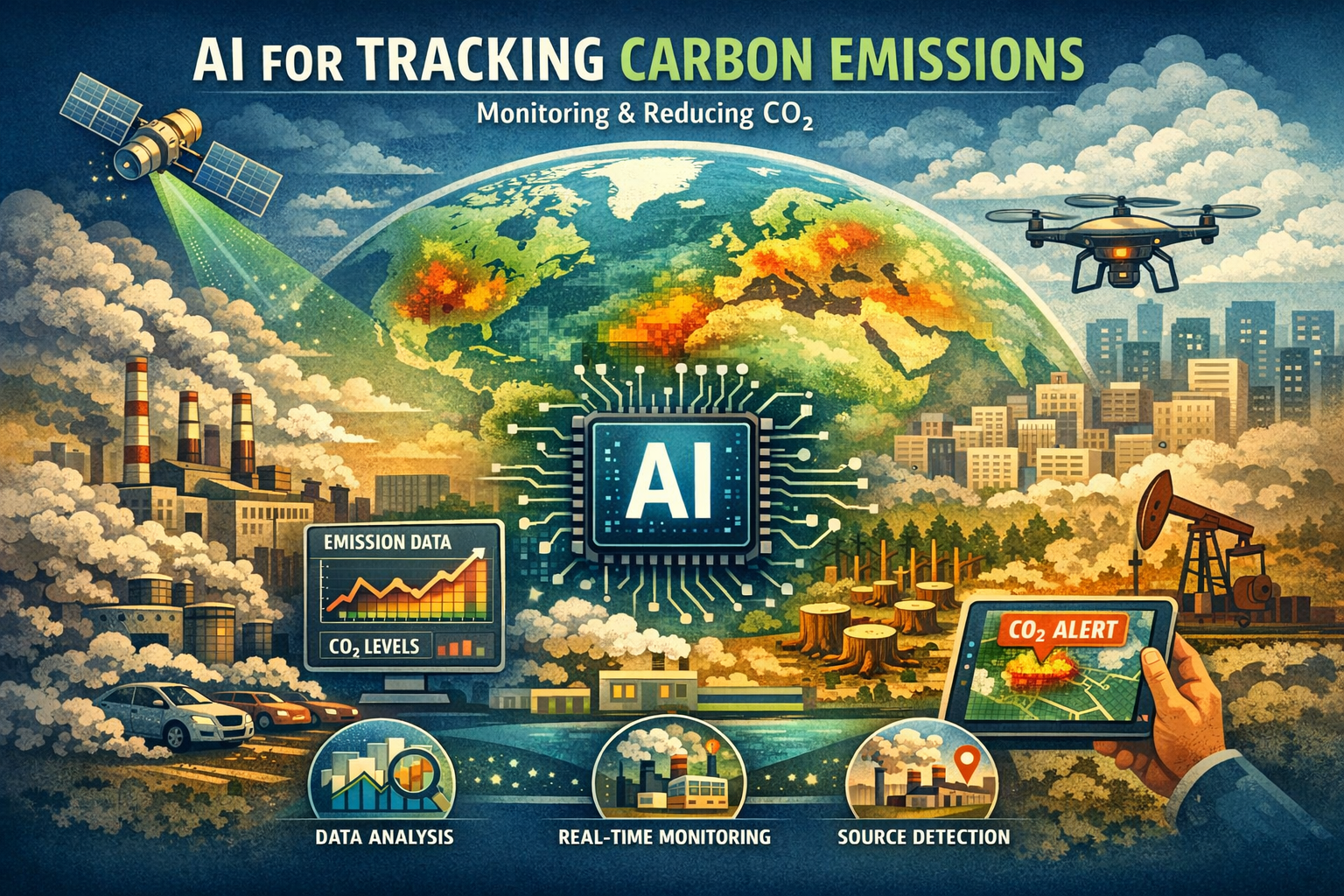
AI for Tracking Carbon Emissions
March 10, 2026

AI for Tracking Carbon Emissions

Introduction Carbon emissions are one of the main causes of climate change and global warming. Carbon dioxide (CO₂) and other greenhouse gases are released into the atmosphere through activities such as burning fossil fuels, industrial production, transportation, and deforestation. These gases trap heat in the Earth’s atmosphere, causing global temperatures to rise and leading to serious environmental problems. Reducing carbon emissions has become a major global priority. Governments, organizations, and environmental groups around the world are working to monitor and reduce the amount of carbon released into the atmosphere. However, tracking carbon emissions accurately can be very challenging. Carbon emissions come from many different sources, including factories, vehicles, power plants, and even household energy use. Traditional methods of monitoring emissions often rely on manual reporting and periodic measurements. These methods may not always provide real-time information, and in some cases, the data may be incomplete or inaccurate. Because of these limitations, new technological solutions are needed to track emissions more effectively. Artificial Intelligence (AI) is now playing an important role in monitoring and managing carbon emissions. AI systems can analyze large amounts of environmental data, detect emission sources, and help organizations measure their carbon footprint more accurately. By providing better insights into emission patterns, AI helps governments and businesses take meaningful steps toward reducing their environmental impact. Understanding Carbon Emissions Carbon emissions are produced whenever fossil fuels such as coal, oil, and natural gas are burned. These fuels are commonly used in electricity generation, transportation, manufacturing, and heating. When fossil fuels are burned, they release carbon dioxide into the atmosphere. Other human activities also contribute to carbon emissions. Deforestation, for example, releases stored carbon from trees and reduces the number of trees available to absorb carbon dioxide. Agriculture and industrial processes can also release greenhouse gases that contribute to global warming. Because carbon emissions come from many different sources, monitoring them requires collecting large amounts of data from various industries and geographic regions. Scientists and environmental agencies need accurate information about where emissions are coming from and how much is being released. AI technologies help improve this monitoring process by analyzing emission data more efficiently and identifying patterns that may not be easily visible through traditional analysis methods. How AI Helps Track Carbon Emissions Artificial Intelligence can process large datasets from multiple sources such as satellites, environmental sensors, industrial monitoring systems, and transportation networks. By analyzing this information, AI systems can detect emission sources and estimate how much carbon is being released. Machine learning algorithms are especially useful for identifying emission patterns. These algorithms can analyze historical data and compare it with current environmental conditions to determine trends in carbon emissions. For example, AI systems can track emissions from power plants by analyzing energy production data and fuel consumption patterns. They can also estimate emissions from transportation by studying traffic data, vehicle activity, and fuel usage. Another important feature of AI is its ability to monitor emissions in real time. Instead of waiting for periodic reports, AI systems can continuously analyze environmental data and detect sudden increases in emissions. This real-time monitoring allows authorities to take immediate action if unusual emission levels are detected. Using Satellite Technology with AI Satellites provide valuable information about environmental conditions across the planet. They can detect changes in atmospheric gases, monitor industrial activity, and observe environmental changes from space. However, satellites generate massive amounts of data that must be analyzed quickly. AI systems are used to process satellite images and identify areas with high carbon emissions. For instance, AI algorithms can analyze satellite images to detect pollution clouds from factories or power plants. They can also monitor forest areas to identify deforestation activities that may increase carbon emissions. By combining satellite technology with AI, scientists can create detailed global maps showing where emissions are occurring and how they are changing over time. These insights help governments and organizations develop more effective climate policies. Helping Industries Reduce Their Carbon Footprint Many industries are responsible for large amounts of carbon emissions. Manufacturing plants, energy companies, and transportation systems all contribute to greenhouse gas emissions. Monitoring and managing these emissions is essential for achieving global climate goals. AI helps industries track their carbon footprint by analyzing operational data and identifying areas where emissions can be reduced. For example, AI systems can monitor energy consumption in factories and recommend ways to improve efficiency. In the transportation sector, AI can analyze traffic patterns and vehicle usage to identify ways to reduce fuel consumption. Smart logistics systems powered by AI can optimize delivery routes, reducing travel distances and lowering emissions. Energy companies also use AI to monitor power generation systems and identify opportunities to switch to cleaner energy sources. These improvements not only reduce emissions but also help organizations lower operational costs. Supporting Governments and Environmental Policies Governments need reliable data to create effective environmental policies. Without accurate emission monitoring, it is difficult to determine whether climate policies are working. AI provides governments with powerful tools for analyzing emission trends and monitoring environmental performance. By studying large datasets, AI systems can identify regions with high emission levels and evaluate the effectiveness of environmental regulations. For example, AI can monitor pollution levels in urban areas and determine whether emission reduction policies are improving air quality. It can also track changes in industrial emissions after new environmental regulations are introduced. This data-driven approach allows policymakers to make informed decisions and develop strategies that effectively reduce greenhouse gas emissions. Encouraging Corporate Environmental Responsibility In recent years, many companies have committed to reducing their carbon footprint as part of their sustainability goals. Businesses are increasingly expected to report their environmental impact and demonstrate efforts to reduce emissions. AI helps organizations measure and report their carbon emissions more accurately. By analyzing operational data, AI systems can calculate the total emissions generated by a company’s activities. These insights allow companies to identify areas where improvements can be made. For example, businesses may choose to adopt renewable energy sources, improve energy efficiency, or reduce waste in their operations. Transparent emission tracking also helps companies build trust with customers, investors, and regulatory agencies. Challenges in AI-Based Carbon Monitoring Although AI offers many advantages in tracking carbon emissions, there are also some challenges to consider. One challenge is data availability. Accurate emission tracking requires high-quality data from many different sources. In some regions, environmental monitoring systems may be limited, making it difficult to collect reliable data. Another challenge is the complexity of emission sources. Some emissions are easy to detect, such as those from large industrial facilities, but others are more difficult to measure, such as emissions from small businesses or individual households. AI systems also require advanced computing infrastructure and skilled professionals to develop and maintain them. Implementing these systems can involve significant costs and technical expertise. Despite these challenges, ongoing technological advancements are making AI-based emission monitoring more effective and accessible. The Future of AI in Carbon Emission Tracking As climate concerns continue to grow, the use of AI in carbon emission monitoring is expected to expand significantly. New technologies such as advanced sensors, satellite systems, and data analytics platforms will provide even more detailed environmental information. Future AI systems may be able to create real-time global emission monitoring networks. These systems could track emissions from various sources and provide immediate alerts when unusual emission levels occur. AI may also help develop predictive models that estimate future emission trends based on economic activity, energy consumption, and environmental policies. These predictions can help governments and organizations plan long-term climate strategies. By integrating AI with renewable energy systems, smart cities, and sustainable industries, it may be possible to significantly reduce global carbon emissions in the coming decades. Conclusion Tracking carbon emissions is essential for addressing climate change and protecting the environment. Artificial Intelligence is transforming the way scientists, governments, and organizations monitor emissions and understand their environmental impact. By analyzing large datasets, processing satellite imagery, and identifying emission patterns, AI provides valuable insights into where and how carbon emissions are produced. These insights support more effective climate policies, encourage corporate responsibility, and help industries reduce their carbon footprint. As AI technologies continue to evolve, they will play an increasingly important role in global efforts to reduce greenhouse gas emissions and create a more sustainable future for the planet.

Read More →
How AI Helps Reduce Air Pollution
March 10, 2026

How AI Helps Reduce Air Pollution

Introduction Air pollution is one of the most serious environmental problems affecting the world today. It occurs when harmful substances such as gases, dust particles, smoke, and chemicals enter the atmosphere and reduce the quality of the air we breathe. Air pollution can come from many sources, including vehicle emissions, industrial activities, burning fossil fuels, construction work, and agricultural practices. Poor air quality has a direct impact on human health and the environment. According to global environmental studies, air pollution contributes to respiratory diseases, heart problems, and other serious health conditions. It also damages ecosystems, affects plant growth, and contributes to climate change. Because of these risks, monitoring and reducing air pollution has become a priority for governments, scientists, and environmental organizations around the world. However, managing air pollution is a complex challenge because pollution levels can change quickly depending on weather conditions, traffic activity, and industrial operations. Artificial Intelligence (AI) is now emerging as a powerful tool in the fight against air pollution. AI technologies can analyze environmental data, monitor pollution levels, and help develop smarter solutions to improve air quality. By combining advanced data analysis with environmental monitoring systems, AI helps communities better understand pollution patterns and take action to reduce harmful emissions. Understanding the Causes of Air Pollution Air pollution is caused by both natural and human activities. Natural sources such as volcanic eruptions, wildfires, and dust storms can release pollutants into the atmosphere. However, most air pollution today is caused by human activities. Some of the major sources of air pollution include: •Vehicle emissions from cars, buses, and trucks •Smoke and gases released from factories and industrial plants •Burning coal and fossil fuels for electricity production •Agricultural activities such as burning crop waste •Construction work that releases dust particles into the air These activities release harmful substances such as carbon monoxide, nitrogen oxides, sulfur dioxide, and tiny particles known as particulate matter (PM2.5 and PM10). These pollutants can travel long distances in the atmosphere and affect air quality in large regions. To reduce air pollution effectively, scientists must first understand where pollutants are coming from and how they spread in the environment. This is where AI becomes extremely useful. Smart Air Quality Monitoring with AI One of the most important ways AI helps reduce air pollution is through advanced air quality monitoring systems. Cities around the world use air quality sensors to measure pollution levels in different locations. These sensors collect data such as: •Concentration of harmful gases in the air •Levels of particulate matter •Temperature and humidity conditions •Wind speed and direction The challenge is that these sensors generate large volumes of data every day. AI systems are capable of analyzing this data quickly and identifying pollution patterns that may not be obvious to human analysts. Machine learning algorithms can study historical air quality data and detect trends in pollution levels. For example, AI may discover that pollution increases during certain times of the day due to heavy traffic or industrial activity. With this information, city authorities can take steps to control pollution sources and improve air quality. Predicting Pollution Levels Before They Occur Another powerful capability of AI is its ability to predict future pollution levels. By analyzing past environmental data and weather patterns, AI systems can forecast when and where pollution levels are likely to increase. For instance, AI models can predict how wind direction, temperature, and traffic activity will influence pollution levels in a city. If the system predicts that pollution levels will rise in a particular area, authorities can issue warnings to the public. This type of prediction is especially important for protecting vulnerable populations such as children, elderly people, and individuals with respiratory diseases. Early warnings allow people to limit outdoor activities during periods of high pollution. Cities can also take preventive actions such as restricting vehicle access, adjusting traffic signals, or temporarily reducing industrial operations. AI in Traffic Management Transportation is one of the largest contributors to air pollution, especially in urban areas. Vehicles release harmful gases such as carbon dioxide, nitrogen oxides, and particulate matter that contribute to poor air quality. AI-powered traffic management systems help reduce pollution by improving the flow of vehicles on roads. These systems use data from cameras, sensors, and GPS devices to monitor traffic conditions in real time. By analyzing this data, AI systems can adjust traffic signals to reduce congestion and prevent traffic jams. When vehicles spend less time idling in traffic, they consume less fuel and produce fewer emissions. AI can also support the development of smart transportation systems. For example, ride-sharing platforms and smart navigation apps use AI to recommend efficient routes that reduce travel time and fuel consumption. Electric and autonomous vehicles are also being integrated with AI systems to create cleaner and more efficient transportation networks. Improving Industrial Emission Control Factories and industrial plants are another major source of air pollution. Industrial activities often release smoke, chemical gases, and fine particles into the atmosphere. AI helps industries monitor their emissions more effectively by analyzing data from environmental sensors and production systems. These AI systems can detect unusual emission levels and identify the processes that are causing excessive pollution. For example, if a factory machine begins producing higher-than-normal emissions, an AI system can alert engineers so that they can quickly investigate and fix the problem. AI can also help industries optimize their production processes to reduce waste and energy consumption. By improving efficiency, companies can lower both operational costs and environmental impact. Many organizations are now using AI-based monitoring systems as part of their sustainability strategies. Supporting Urban Planning and Smart Cities Urban areas often experience the highest levels of air pollution because of dense populations, heavy traffic, and industrial activities. Smart city initiatives are using AI technologies to create healthier urban environments. AI systems can analyze environmental data across different parts of a city and identify pollution hotspots. These insights help urban planners design better infrastructure and reduce pollution sources. For example, city planners may decide to create green spaces, plant more trees, or restrict vehicle access in areas with high pollution levels. Trees and vegetation help absorb pollutants and improve air quality. AI can also support the development of energy-efficient buildings and renewable energy systems that reduce dependence on fossil fuels. By integrating AI into urban planning, cities can create cleaner and more sustainable environments for their residents. Challenges and Limitations Although AI provides many benefits in reducing air pollution, there are still challenges to overcome. One challenge is the availability of accurate environmental data. In some regions, air quality monitoring systems may be limited or outdated. Another challenge is the cost of implementing advanced AI technologies. Developing and maintaining AI-based monitoring systems requires investment in sensors, computing infrastructure, and skilled professionals. There are also technical challenges related to integrating data from different sources such as weather stations, traffic systems, and industrial monitoring devices. Despite these challenges, technological advancements are making AI systems more affordable and accessible, allowing more cities and organizations to benefit from these solutions. Looking Ahead: AI for Cleaner Air The future of AI in environmental protection looks promising. As technology continues to evolve, AI systems will become even more effective at monitoring and controlling air pollution. New developments in sensor technology, satellite monitoring, and machine learning will provide more accurate and real-time environmental data. These advancements will help governments and organizations respond more quickly to pollution problems. AI may also play a major role in developing innovative environmental solutions such as smart energy systems, sustainable transportation networks, and advanced pollution control technologies. By combining AI with strong environmental policies and public awareness, societies can work toward cleaner air and healthier communities. Conclusion Air pollution is a major environmental and public health challenge that requires innovative solutions. Artificial Intelligence is helping address this challenge by providing advanced tools for monitoring, predicting, and reducing pollution levels. From analyzing air quality data to optimizing traffic systems and improving industrial emission control, AI is transforming the way we manage environmental problems. These technologies enable governments, industries, and communities to make informed decisions that protect both people and the planet. As AI continues to advance, it will play an increasingly important role in creating cleaner and more sustainable environments for future generations.

Read More →
AI in Renewable Energy Management
March 10, 2026

AI in Renewable Energy Management

Introduction The world is currently facing serious environmental challenges due to climate change and the excessive use of fossil fuels. Traditional energy sources such as coal, oil, and natural gas produce large amounts of greenhouse gases that contribute to global warming and environmental pollution. Because of these problems, many countries are now focusing on renewable energy sources such as solar power, wind energy, hydroelectric power, and geothermal energy. Renewable energy is considered a cleaner and more sustainable alternative to fossil fuels. These energy sources generate electricity without producing harmful emissions that damage the environment. However, managing renewable energy systems is not always simple. Unlike fossil fuel power plants that produce a constant supply of energy, renewable energy sources depend heavily on natural conditions such as sunlight, wind speed, and water flow. This is where Artificial Intelligence (AI) plays an important role. AI technologies help manage renewable energy systems more efficiently by analyzing large amounts of data, predicting energy production, and optimizing energy distribution. By improving the performance of renewable energy systems, AI helps make clean energy more reliable and accessible for communities around the world. The Growing Importance of Renewable Energy As the global demand for electricity continues to increase, the need for sustainable energy solutions has become more urgent. Renewable energy sources offer several advantages compared to traditional energy sources. They are environmentally friendly, naturally replenished, and capable of reducing dependence on fossil fuels. Solar panels convert sunlight into electricity, wind turbines generate power from wind movement, and hydroelectric plants produce energy from flowing water. These technologies have already been adopted in many countries as part of efforts to reduce carbon emissions and protect the environment. Despite these benefits, renewable energy systems also face certain challenges. One of the main difficulties is the variability of natural energy sources. Solar panels produce electricity only when sunlight is available, and wind turbines depend on wind speed to generate power. Because these energy sources are not always consistent, managing energy production and supply can be complicated. AI helps solve this problem by predicting energy generation and improving energy management strategies. Forecasting Renewable Energy Production One of the most valuable contributions of AI in renewable energy management is its ability to predict energy production. Renewable energy generation depends on environmental conditions such as sunlight intensity, cloud cover, wind speed, and temperature. AI systems can analyze weather data, historical energy production records, and environmental conditions to forecast how much energy will be generated by renewable sources. For example, AI algorithms can predict how much electricity a solar farm will produce based on weather forecasts and past sunlight patterns. Similarly, AI can estimate wind power generation by analyzing wind speed data and atmospheric conditions. These predictions help energy providers plan electricity distribution more effectively and maintain a stable energy supply. Accurate energy forecasting is essential because electricity demand and energy production must be balanced at all times. If energy production suddenly drops due to cloudy weather or low wind speeds, power systems need to adjust quickly to maintain stability. AI helps energy providers prepare for these fluctuations and ensure that renewable energy systems operate efficiently. Smart Energy Grids Powered by AI Modern energy systems are becoming increasingly complex as more renewable energy sources are connected to the power grid. Traditional power grids were designed mainly for centralized energy production from large power plants. However, renewable energy systems are often distributed across many locations. Solar panels may be installed on rooftops, wind farms may be located in rural areas, and small hydroelectric plants may operate in different regions. AI supports the development of smart grids, which are advanced electricity networks that use digital technology to monitor and manage energy flows. Smart grids collect real-time data from various energy sources, storage systems, and consumers. AI analyzes this data to determine how electricity should be distributed across the network. For example, if one region is producing excess solar power during the daytime, AI systems can redirect that energy to other areas where electricity demand is higher. This intelligent management helps reduce energy waste and improves the reliability of renewable energy systems. Improving Energy Storage Systems Energy storage is another critical component of renewable energy management. Because renewable energy production can fluctuate, storing excess energy is important for maintaining a continuous electricity supply. Batteries and other energy storage technologies allow surplus energy generated during periods of high production to be stored and used later when demand increases. For example, solar energy generated during the daytime can be stored and used at night. AI helps optimize the performance of energy storage systems by determining the best times to store and release energy. Machine learning algorithms analyze electricity demand patterns and predict when stored energy will be needed. This intelligent management helps ensure that renewable energy is used efficiently and reduces reliance on backup fossil fuel power plants. Enhancing Efficiency of Renewable Energy Facilities Renewable energy facilities such as solar farms and wind farms require continuous monitoring and maintenance to operate efficiently. Equipment failures or performance issues can reduce energy production and increase operational costs. AI technologies help improve the efficiency of these facilities through predictive maintenance. Sensors installed in renewable energy equipment collect data about performance, temperature, vibration, and other operational conditions. AI systems analyze this data to detect early signs of equipment problems. For example, if a wind turbine begins operating abnormally, the AI system can alert engineers before the issue becomes serious. This proactive maintenance approach helps reduce downtime and ensures that renewable energy facilities operate at maximum efficiency. Supporting Sustainable Energy Policies Governments around the world are developing policies to promote renewable energy and reduce carbon emissions. These policies often include incentives for solar installations, wind energy projects, and energy efficiency programs. AI provides valuable insights that help policymakers understand energy trends and evaluate the effectiveness of renewable energy initiatives. By analyzing large datasets related to energy production, consumption, and environmental impact, AI helps identify the most effective strategies for expanding renewable energy adoption. AI can also simulate different energy scenarios to predict how changes in energy policy may affect electricity supply and environmental outcomes. These insights support better decision-making and long-term energy planning. Challenges in Using AI for Renewable Energy Management Although AI offers many benefits for renewable energy systems, there are also challenges to consider. Implementing AI technologies requires advanced infrastructure, including sensors, communication networks, and powerful computing systems. Collecting accurate and reliable data is also essential for effective AI analysis. In some regions, limited monitoring systems may make it difficult to gather the necessary environmental and energy data. Additionally, integrating AI systems with existing energy infrastructure can be technically complex. Energy companies must invest in training and technological development to fully benefit from AI-driven solutions. Despite these challenges, continuous innovation in technology is making AI applications more accessible and cost-effective. Future Opportunities The future of renewable energy management is closely connected with the continued development of Artificial Intelligence. As AI technologies become more advanced, they will provide even greater support for sustainable energy systems. In the coming years, AI may enable fully automated energy networks where power generation, storage, and distribution are managed intelligently without human intervention. These systems will respond instantly to changes in weather conditions and electricity demand. AI will also support the growth of decentralized energy systems, where communities generate and manage their own renewable energy through local solar panels, wind turbines, and storage systems. Such advancements will help create a more resilient and environmentally friendly energy system. Conclusion Renewable energy is essential for building a sustainable future and reducing the environmental impact of fossil fuels. However, managing renewable energy systems requires advanced technologies capable of handling complex data and changing environmental conditions. Artificial Intelligence is playing a key role in improving renewable energy management by forecasting energy production, optimizing power distribution, supporting smart grids, and enhancing equipment performance. As technology continues to evolve, AI will help make renewable energy systems more reliable, efficient, and accessible. By integrating AI with renewable energy technologies, societies can move closer to achieving global climate goals and creating a cleaner, more sustainable planet.

Read More →
Using AI to Prevent Wildfires
March 10, 2026

Using AI to Prevent Wildfires

Introduction Wildfires are one of the most destructive natural disasters affecting forests, wildlife, and human communities around the world. Every year, thousands of wildfires occur in different regions, destroying large areas of land and causing serious environmental damage. These fires can spread very quickly, especially during hot and dry weather conditions, making them difficult to control once they start. Wildfires not only destroy forests but also release large amounts of carbon dioxide into the atmosphere, which contributes to climate change. They can also damage homes, threaten human lives, and disrupt ecosystems that take many years to recover. Because of these risks, preventing wildfires has become a major priority for governments and environmental organizations. Traditionally, wildfire monitoring has relied on human observation, satellite images, and weather reports. While these methods are useful, they often detect fires only after they have already started spreading. Early detection is extremely important because it allows firefighters and authorities to respond quickly before the fire becomes uncontrollable. Artificial Intelligence (AI) is now helping improve wildfire prevention and monitoring systems. By analyzing large amounts of environmental data, AI can identify potential fire risks, detect early signs of fires, and support faster response strategies. These technologies are helping protect forests and communities from the growing threat of wildfires. Understanding the Causes of Wildfires Wildfires can start for many different reasons. Some fires are caused by natural factors such as lightning strikes, while others are the result of human activities. Human-related causes may include unattended campfires, burning agricultural waste, discarded cigarettes, and electrical equipment failures. Environmental conditions also play a major role in wildfire risk. High temperatures, dry vegetation, strong winds, and low humidity create conditions where fires can start easily and spread rapidly. Climate change has increased the frequency of extreme weather conditions, which has led to more frequent and intense wildfires in many parts of the world. Monitoring all of these factors simultaneously can be challenging for traditional systems. However, AI systems can analyze multiple environmental variables at the same time, making them highly effective tools for wildfire prevention. Early Fire Detection with AI One of the most important uses of AI in wildfire management is early fire detection. Detecting a fire in its early stages allows emergency services to respond quickly and prevent it from spreading across large areas. AI-powered monitoring systems use cameras, sensors, drones, and satellites to observe forests and natural areas. These devices continuously collect images and environmental data. AI algorithms then analyze this information in real time to identify unusual patterns that may indicate a fire. For example, AI systems can detect smoke patterns, temperature increases, or sudden changes in vegetation color. If the system identifies signs of a potential fire, it immediately sends alerts to authorities so that action can be taken. Compared to manual monitoring methods, AI detection systems are faster and more accurate. They can monitor large forest areas continuously without requiring human observation. Predicting Wildfire Risk In addition to detecting fires, AI can also help predict where wildfires are most likely to occur. By analyzing historical wildfire data along with environmental conditions, AI models can estimate the probability of fires in specific locations. These predictions are based on several factors, including temperature, rainfall levels, soil moisture, vegetation density, and wind patterns. AI systems combine these variables to identify high-risk areas where fires may start. This information helps environmental agencies focus their prevention efforts in vulnerable regions. For example, authorities may increase surveillance, restrict certain human activities, or deploy firefighting resources in high-risk zones. Predictive models powered by AI allow communities to prepare in advance and reduce the likelihood of severe wildfire outbreaks. Monitoring Forest Conditions Forests contain vast ecosystems that require careful monitoring to prevent environmental damage. AI technologies help scientists monitor forest health by analyzing satellite images and environmental data. For instance, AI can detect areas where vegetation has become extremely dry. Dry vegetation acts as fuel for wildfires, increasing the risk of fire ignition. By identifying these areas early, forest management teams can take preventive actions such as controlled burning or clearing excess vegetation. AI can also monitor illegal activities such as unauthorized land clearing or deforestation, which may increase wildfire risks. Detecting these activities quickly allows authorities to enforce environmental protection laws more effectively. Through continuous monitoring, AI helps maintain healthier forest ecosystems and reduce fire hazards. Supporting Firefighting Operations When wildfires do occur, AI technologies can assist firefighters in controlling the situation more effectively. AI systems can analyze weather conditions, terrain data, and fire behavior patterns to predict how a wildfire may spread. These predictions help firefighting teams plan their strategies and allocate resources efficiently. For example, AI models may identify the direction in which the fire is likely to move based on wind speed and landscape conditions. Drones equipped with AI-powered cameras can also provide real-time images of wildfire areas. These aerial views help emergency teams understand the scale of the fire and determine the best methods to contain it. By providing accurate and timely information, AI helps firefighters make faster and safer decisions during emergency situations. Protecting Communities and Wildlife Wildfires not only damage forests but also threaten human settlements and wildlife habitats. Many communities located near forests face serious risks during wildfire seasons. AI-based early warning systems can notify residents about potential fire dangers before the situation becomes critical. These systems may send alerts through mobile apps, emergency communication systems, or local authorities. Early warnings allow communities to evacuate safely and prepare for emergency situations. In addition, wildlife protection organizations can use AI data to identify endangered habitats and develop conservation strategies. By improving preparedness and response, AI technologies help reduce the impact of wildfires on both people and wildlife. Challenges in AI-Based Wildfire Prevention Although AI provides powerful tools for wildfire prevention, implementing these technologies also involves certain challenges. Building effective monitoring systems requires a large network of sensors, cameras, satellites, and data communication systems. In remote forest areas, installing and maintaining this infrastructure can be difficult. AI systems also require high-quality data to produce accurate predictions. If the data collected from sensors or satellites is incomplete, the reliability of AI predictions may decrease. Additionally, developing advanced AI systems requires technical expertise and financial investment. Many developing regions may face difficulties in adopting these technologies on a large scale. However, ongoing technological advancements are gradually reducing these barriers, making AI solutions more accessible for wildfire management. The Future of AI in Wildfire Prevention The role of AI in wildfire prevention is expected to grow significantly in the coming years. As climate change increases the risk of extreme weather events, the need for advanced wildfire monitoring systems will continue to rise. Future AI technologies may combine satellite monitoring, drone surveillance, weather forecasting, and environmental sensors into a single integrated system. These systems could provide real-time insights into wildfire risks across entire regions. Researchers are also developing AI models that can simulate wildfire behavior more accurately, allowing authorities to plan prevention strategies well in advance. With continued research and innovation, AI will become an essential tool for protecting forests, ecosystems, and human communities from wildfire disasters. Conclusion Wildfires pose a serious threat to the environment, wildlife, and human safety. Preventing and controlling these fires requires advanced technologies capable of monitoring large natural areas and analyzing complex environmental data. Artificial Intelligence is transforming wildfire management by enabling early fire detection, predicting wildfire risks, monitoring forest conditions, and supporting firefighting operations. These capabilities allow authorities to respond more quickly and reduce the impact of wildfires. As AI technologies continue to develop, they will play an increasingly important role in protecting forests and communities from the devastating effects of wildfires. By combining technology, environmental awareness, and effective policies, societies can work toward reducing wildfire risks and preserving natural ecosystems for future generations.

Read More →
AI for Flood Prediction
March 10, 2026

AI for Flood Prediction

Introduction Floods are among the most common and destructive natural disasters in the world. They occur when large amounts of water overflow onto land that is normally dry. Floods can be caused by heavy rainfall, river overflow, dam failures, melting snow, or strong storms. When floods happen, they can damage homes, destroy infrastructure, disrupt transportation, and threaten human lives. In many countries, floods also affect agriculture, water supply, and local economies. Communities located near rivers, lakes, and coastal areas are especially vulnerable. Because floods can occur suddenly and spread quickly, early prediction and warning systems are extremely important. Traditional flood monitoring methods rely on weather reports, river level measurements, and manual observation. While these methods provide useful information, they may not always detect flood risks early enough to prevent major damage. Today, Artificial Intelligence (AI) is helping improve flood prediction systems by analyzing large amounts of environmental data and identifying patterns that indicate potential flooding. By combining data from weather forecasts, satellite images, and water monitoring systems, AI can help scientists and authorities predict floods earlier and respond more effectively. The Growing Risk of Flooding Climate change has increased the frequency and intensity of extreme weather events around the world. Heavy rainfall and severe storms are becoming more common in many regions, which increases the risk of flooding. Rising sea levels also contribute to coastal flooding, especially during storms and high tides. Urban development can also increase flood risks. When cities expand, natural land surfaces such as forests and grasslands are often replaced with roads, buildings, and concrete structures. These surfaces do not absorb water easily, causing rainwater to flow quickly into drainage systems and rivers. When drainage systems cannot handle the large volume of water, flooding occurs. Because many factors influence flood events, predicting floods requires analyzing complex environmental data. AI technologies are especially useful for handling these complex calculations and identifying patterns in large datasets. How AI Helps Predict Floods Artificial Intelligence uses advanced algorithms and machine learning techniques to analyze environmental data and identify patterns related to flooding. AI systems can study information from various sources such as weather stations, rainfall records, river water levels, soil moisture sensors, and satellite imagery. By examining historical flood data, AI models can learn how certain environmental conditions lead to flooding. For example, if heavy rainfall occurs in a region where soil is already saturated with water, the risk of flooding increases significantly. AI systems can detect these conditions and predict the likelihood of flooding in advance. These predictions help authorities prepare for potential disasters by taking preventive measures and issuing warnings to communities at risk. Real-Time Monitoring of Water Levels Another important advantage of AI in flood prediction is its ability to monitor water conditions in real time. Sensors placed in rivers, reservoirs, and drainage systems continuously collect information about water levels, flow rates, and rainfall intensity. AI systems analyze this data instantly and detect sudden changes that may indicate a flood risk. For example, if water levels in a river begin rising rapidly after heavy rainfall, the AI system can alert emergency management teams. This real-time monitoring allows authorities to respond quickly and take actions such as opening flood gates, strengthening flood barriers, or evacuating residents from dangerous areas. Real-time data analysis also helps emergency teams track flood progression and make better decisions during disaster response. Using Satellite Data and Remote Sensing Satellites play a crucial role in monitoring environmental conditions on a global scale. They capture images and collect data about rainfall patterns, river systems, land use, and weather conditions. However, satellite data is extremely large and complex. AI technologies help process this data quickly and accurately. Machine learning algorithms analyze satellite images to detect changes in water bodies, identify flooded areas, and monitor storm development. For example, AI can compare satellite images taken at different times to detect changes in river width or water coverage. If a river begins expanding beyond its normal boundaries, the system can identify the early signs of flooding. This capability is especially useful in remote or rural areas where ground-based monitoring systems may be limited. Supporting Disaster Preparedness Flood prediction systems powered by AI provide valuable information that helps communities prepare for potential disasters. Early warnings allow governments and emergency agencies to take preventive actions before floods occur. These actions may include reinforcing flood barriers, preparing evacuation plans, protecting critical infrastructure, and informing residents about safety measures. AI-based flood prediction systems can also help authorities identify the most vulnerable areas. By analyzing geographic data and population information, AI can determine which communities are most at risk during a flood event. This information allows disaster management teams to allocate resources effectively and focus on protecting high-risk areas. Benefits for Agriculture and Water Management Flood prediction is not only important for protecting communities but also for supporting agriculture and water management. Farmers depend on stable weather conditions to grow crops, and sudden flooding can destroy entire harvests. AI systems can provide farmers with early warnings about potential flooding in their fields. This allows them to take preventive actions such as moving equipment, protecting livestock, or adjusting irrigation systems. Water resource managers also use AI to monitor reservoirs and dams. By predicting heavy rainfall and rising water levels, they can release water gradually to prevent sudden overflow and flooding downstream. These measures help protect both agricultural lands and surrounding communities. Challenges in AI-Based Flood Prediction Although AI offers many advantages for flood prediction, there are still some challenges to address. Accurate predictions depend on high-quality environmental data collected from sensors, weather stations, and satellite systems. In some regions, monitoring infrastructure may be limited or outdated, which can reduce the accuracy of AI predictions. In addition, integrating data from different sources requires advanced technological systems and expertise. Developing AI models for flood prediction also requires significant computing power and skilled professionals who can design and maintain these systems. Despite these challenges, improvements in technology and data collection are gradually making AI-based flood prediction systems more reliable and accessible. Future Developments The use of AI in flood prediction is expected to expand significantly in the future. Advances in sensor technology, satellite monitoring, and machine learning algorithms will provide more accurate environmental data. In the coming years, AI systems may be able to create highly detailed flood risk maps that update in real time. These maps could show which areas are at risk during heavy rainfall or storm events. AI may also be integrated with smart city infrastructure, allowing urban drainage systems to respond automatically to changing water levels. By combining AI technology with effective disaster management strategies, societies can reduce the damage caused by floods and protect vulnerable communities. Conclusion Floods are natural disasters that can cause serious damage to communities, infrastructure, and ecosystems. Predicting floods early is essential for reducing risks and protecting human lives. Artificial Intelligence is transforming flood prediction by analyzing large amounts of environmental data, monitoring water levels in real time, and identifying patterns that indicate potential flooding. These technologies help governments and emergency teams prepare for disasters and respond more effectively. As AI technology continues to improve, it will play an increasingly important role in disaster management and environmental protection. By using AI-powered flood prediction systems, societies can build safer and more resilient communities.

Read More →
AI for Drought Monitoring
March 10, 2026

AI for Drought Monitoring

Introduction Drought is one of the most serious environmental challenges affecting many regions around the world today. It occurs when an area experiences a long period of low rainfall, resulting in water shortages that can damage agriculture, ecosystems, and human life. Climate change has increased the frequency and severity of droughts in many parts of the world. Rising temperatures, irregular rainfall patterns, and increased evaporation have made drought conditions more difficult to predict and manage. In the past, drought monitoring depended mainly on weather observations and historical climate data. While these traditional methods were useful, they were often slow and sometimes inaccurate. Today, Artificial Intelligence (AI) is transforming how scientists monitor, predict, and manage drought conditions. By analyzing large volumes of environmental data, AI can identify early signs of drought and help governments, farmers, and organizations take action before the situation becomes severe. AI technologies are helping experts better understand soil moisture levels, rainfall patterns, vegetation health, and water availability. These insights allow communities to prepare for drought conditions and reduce the negative impacts on agriculture, water resources, and food security. Understanding Drought and Its Impact Drought affects many aspects of life, especially agriculture and water supply. When rainfall decreases for a long period, rivers, lakes, and reservoirs begin to dry up. Farmers struggle to grow crops because there is not enough water for irrigation. Livestock may suffer from lack of water and food, and communities may face serious water shortages. There are several types of drought: •Meteorological drought, which occurs when rainfall is significantly below normal levels. •Agricultural drought, which happens when soil moisture becomes too low to support crop growth. •Hydrological drought, which affects water levels in rivers, lakes, and groundwater sources. Climate change has increased the risk of all these types of drought. Higher temperatures cause more evaporation, meaning that water disappears from soil and water bodies more quickly. This makes it even more important to monitor drought conditions accurately and respond quickly. How AI Improves Drought Monitoring Artificial Intelligence plays an important role in analyzing environmental data to detect drought conditions early. AI systems can process huge amounts of information from satellites, weather stations, soil sensors, and climate models. This allows researchers to observe changes in the environment that may indicate the beginning of drought. Machine learning algorithms can study patterns in rainfall, temperature, soil moisture, and vegetation health. By identifying unusual patterns, AI can warn experts about possible drought conditions before they become severe. Early warnings allow governments and communities to prepare and reduce potential damage. For example, satellite images can show changes in vegetation color and growth. When plants begin to lose moisture, their color changes slightly. AI systems can analyze these images and detect signs of plant stress much earlier than humans can. This helps experts understand which areas are at risk of drought. AI can also monitor soil moisture levels. Sensors placed in the soil collect data about how much water is available for crops. AI analyzes this data and identifies areas where soil is drying faster than expected. AI and Satellite Technology Satellite technology plays a major role in drought monitoring, and AI helps analyze the large amount of data collected from satellites. Earth observation satellites continuously capture images of forests, farmland, rivers, and lakes around the world. AI algorithms can study these satellite images to measure vegetation health, water levels, and land surface temperatures. By comparing images taken over time, AI can identify areas where drought conditions are developing. For example, when plants do not receive enough water, their growth slows down. AI can detect these small changes in vegetation and send alerts to scientists and agricultural experts. This information helps them take early action to protect crops and manage water resources. Satellite-based AI systems are especially useful for monitoring remote areas where ground-based observations are limited. This makes drought monitoring more effective on a global scale. Supporting Farmers with AI Drought Monitoring Farmers are among the groups most affected by drought. When water becomes scarce, crop production decreases, leading to financial losses and food shortages. AI-powered drought monitoring tools help farmers make better decisions about irrigation and crop management. By analyzing weather forecasts, soil moisture levels, and crop conditions, AI systems can provide farmers with recommendations on when and how much to irrigate their fields. This helps farmers use water more efficiently and avoid wasting valuable resources. Some modern farming platforms use AI to send alerts to farmers through mobile apps. These alerts inform farmers about potential drought risks, allowing them to prepare in advance. For example, farmers may choose drought-resistant crops or adjust planting schedules to reduce the impact of water shortages. AI-based drought monitoring can also help governments support farmers by identifying regions that need emergency assistance or irrigation support. Water Resource Management Using AI AI is also improving how governments and organizations manage water resources during drought conditions. Water managers need to make important decisions about how to distribute limited water supplies among agriculture, industries, and communities. AI systems can analyze water consumption patterns, rainfall predictions, and reservoir levels to help authorities plan water usage more effectively. By predicting future water shortages, AI allows governments to take preventive actions such as water conservation measures or infrastructure improvements. For example, AI can help manage reservoirs by predicting how much water will be needed in the coming months. This allows water managers to release water carefully and maintain sufficient supplies for future needs. In cities, AI-based systems can also detect water leaks and inefficiencies in water distribution networks. Fixing these issues helps reduce water loss and improve overall water management during drought periods. Global Drought Monitoring Systems Several global organizations are already using AI to monitor drought conditions worldwide. AI-based drought monitoring platforms combine data from satellites, weather stations, and climate models to provide accurate drought forecasts. These systems help scientists track drought conditions across continents and identify regions that need urgent attention. International organizations use this information to plan humanitarian aid, support agriculture, and manage water resources more effectively. By sharing data across countries and research institutions, AI-powered monitoring systems are improving global cooperation in dealing with drought challenges. Challenges of Using AI in Drought Monitoring Although AI offers many advantages, there are also challenges in using these technologies for drought monitoring. One major challenge is the availability of reliable data. AI systems require large amounts of high-quality data to produce accurate predictions. In some developing regions, there may be limited weather stations or environmental sensors. This makes it more difficult to collect the data needed for AI analysis. Another challenge is the cost of implementing advanced AI technologies and satellite monitoring systems. Some countries may lack the financial resources or technical expertise required to develop these systems. However, as technology continues to improve and become more affordable, more countries are expected to adopt AI-based drought monitoring solutions. The Future of AI in Drought Monitoring The future of drought monitoring looks promising with the continued development of Artificial Intelligence. Advances in machine learning, satellite technology, and environmental sensors will allow scientists to detect drought conditions earlier and more accurately. AI systems may soon be able to predict drought months or even years in advance by analyzing long-term climate patterns. This will give governments and farmers more time to prepare and reduce the impacts of water shortages. Smart farming technologies will also become more common, allowing farmers to automatically adjust irrigation systems based on AI recommendations. This will help conserve water while maintaining crop productivity. In addition, international collaboration and data sharing will improve global drought monitoring efforts. By combining data from multiple sources, AI systems will provide a clearer picture of global water resources and climate conditions. Conclusion Drought is a major challenge that threatens agriculture, water supply, and food security around the world. Climate change has made drought conditions more frequent and unpredictable, increasing the need for advanced monitoring solutions. Artificial Intelligence is playing a crucial role in improving drought monitoring and management. By analyzing environmental data, satellite images, and climate models, AI helps scientists detect early signs of drought and provide accurate predictions. These technologies support farmers, governments, and water managers in making better decisions about water use and agricultural planning. Although there are still challenges in implementing AI systems, continued technological advancements will make drought monitoring more effective in the future. By combining AI with global cooperation and sustainable water management practices, societies can reduce the risks associated with drought and protect vital natural resources for future generations.

Read More →
AI in Forest Protection – A New Era of Environmental Conservation
March 10, 2026

AI in Forest Protection – A New Era of Environmental Conservation

Opening Perspective Forests are the lungs of our planet. They absorb carbon dioxide, produce oxygen, regulate climate, and provide habitats for millions of species. Yet every year, large areas of forests are destroyed due to deforestation, illegal logging, wildfires, and environmental degradation. The consequences of forest loss are severe—biodiversity declines, soil erosion increases, and climate change accelerates. Traditional forest protection methods rely on human patrols, satellite imagery, and periodic inspections. While these methods are valuable, they often fail to detect environmental threats early enough. Forests cover vast areas, and monitoring them manually is both time-consuming and resource-intensive. Artificial Intelligence (AI) is transforming forest conservation by enabling real-time monitoring, predictive analysis, and automated threat detection. AI-powered systems can analyze satellite data, drone imagery, and environmental sensors to identify illegal activities and ecological risks. These technologies help governments and conservation organizations protect forests more effectively. In an era where environmental sustainability is a global priority, AI-driven forest protection represents a powerful solution for preserving natural ecosystems. The Importance of Forest Conservation Forests play a critical role in maintaining ecological balance. They act as carbon sinks, absorbing large amounts of carbon dioxide and helping reduce greenhouse gases in the atmosphere. This makes forests essential in combating climate change. Forests also support biodiversity. Millions of plant and animal species depend on forest ecosystems for survival. When forests are destroyed, wildlife habitats disappear, leading to species extinction and ecological imbalance. In addition, forests contribute to human well-being. They provide timber, medicinal resources, and economic opportunities for communities. Forests also help regulate water cycles by absorbing rainfall and preventing soil erosion. Despite their importance, forests are under constant threat. Illegal logging, agricultural expansion, and urban development continue to reduce forest coverage. Climate change has also increased the risk of wildfires, further accelerating forest loss. Protecting forests requires advanced monitoring and early intervention strategies—areas where AI is making a significant impact. How AI Enhances Forest Monitoring AI-powered forest monitoring systems use data from satellites, drones, and environmental sensors to observe forest conditions in real time. These technologies enable continuous surveillance over large areas, making it possible to detect environmental changes early. Satellite imagery provides detailed information about forest coverage and land use patterns. AI algorithms analyze these images to identify deforestation activities and illegal logging operations. If trees are removed in unauthorized areas, the system generates alerts so that authorities can take immediate action. Drones equipped with AI cameras offer additional monitoring capabilities. They can capture high-resolution images of forest regions that are difficult to access on foot. AI analyzes drone footage to detect signs of illegal activity, such as logging equipment or unauthorized clearings. Environmental sensors placed in forests measure factors such as temperature, humidity, and soil conditions. AI systems analyze this data to identify environmental changes that may indicate ecological stress. By combining data from multiple sources, AI creates a comprehensive monitoring network that improves forest protection efforts. Detecting Illegal Logging and Deforestation Illegal logging is one of the major contributors to forest destruction. In many regions, trees are cut down without authorization, leading to environmental damage and economic losses. AI helps combat illegal logging by detecting deforestation activities in real time. Satellite images are continuously analyzed to identify areas where tree coverage is decreasing. If unauthorized logging is detected, authorities can investigate and take legal action. Machine learning algorithms improve detection accuracy by learning from historical deforestation data. Over time, AI systems become better at recognizing patterns associated with illegal activities. This proactive approach helps prevent environmental damage before it becomes extensive. Wildfire Prevention and Early Detection Wildfires are another significant threat to forests. They can spread rapidly, destroying large areas of vegetation and releasing carbon emissions into the atmosphere. AI plays a crucial role in wildfire prevention and early detection. Forest monitoring systems use cameras and environmental sensors to detect smoke, heat, and unusual temperature increases. If potential fire conditions are identified, alerts are sent to emergency response teams. AI also helps predict wildfire risks by analyzing weather conditions and vegetation data. For example, prolonged dry periods increase the likelihood of fires. AI systems can forecast high-risk conditions and recommend preventive measures. Early detection and prediction allow authorities to respond quickly, reducing the impact of wildfires. Protecting Biodiversity with AI Biodiversity is essential for ecosystem stability. Forests provide habitats for countless species, and their destruction threatens wildlife survival. AI supports biodiversity conservation by monitoring wildlife populations and habitat conditions. Camera traps and environmental sensors collect data about animal movement and species distribution. AI analyzes this information to identify changes in wildlife behavior. For example, if certain species are disappearing from an area, it may indicate habitat degradation. Conservation organizations can use this data to develop protection strategies and restore ecosystems. AI also helps identify illegal wildlife activities, such as poaching. By analyzing movement patterns and surveillance data, AI systems can detect suspicious activities and alert authorities. These capabilities contribute to long-term biodiversity preservation. Supporting Sustainable Forest Management Forest conservation is not only about preventing destruction but also about promoting sustainable management. Responsible forest management ensures that resources are used in ways that do not harm ecosystems. AI helps forestry organizations plan sustainable practices by analyzing environmental and economic data. For example, AI can optimize timber harvesting schedules to minimize ecological impact. Instead of cutting large areas of forest at once, sustainable practices involve selective logging and reforestation. AI systems provide data-driven insights that help organizations balance economic development with environmental responsibility. Reforestation efforts also benefit from AI technology. Machine learning models can identify areas suitable for tree planting and recommend species that are best suited to local conditions. These strategies support ecosystem restoration and environmental resilience. Challenges in AI-Based Forest Protection While AI offers powerful solutions, there are challenges in implementing forest protection systems. One major challenge is data availability. AI systems rely on satellite images, sensor data, and environmental records. In some regions, monitoring infrastructure may be limited. Another challenge is the cost of advanced technology. Deploying AI systems requires investment in satellites, drones, and computing infrastructure. Developing countries may face financial constraints in adopting these solutions. Additionally, human expertise remains essential. AI systems provide valuable insights, but environmental professionals and policymakers must interpret data and implement effective conservation strategies. Despite these challenges, technological advancements are making AI solutions more accessible and cost-effective. The Future of AI in Forest Conservation The future of forest protection will increasingly rely on AI and data-driven solutions. Advances in satellite technology, machine learning, and environmental sensors will enhance monitoring capabilities. AI systems may soon provide real-time global forest surveillance, allowing conservation organizations to track environmental changes across continents. Predictive models will help anticipate deforestation risks and guide preventive measures. Smart conservation initiatives will integrate AI with community participation. Local communities play a vital role in forest protection, and technology can support their efforts by providing information and resources. By combining innovation with environmental stewardship, societies can protect forests for future generations. Closing Thoughts Forest protection is essential for environmental sustainability and climate stability. As deforestation and ecological threats continue to grow, traditional conservation methods must evolve. Artificial Intelligence offers powerful tools for monitoring, detecting, and preventing environmental damage. From deforestation detection to wildfire prevention and biodiversity conservation, AI is transforming forest management. However, technology alone is not enough. Successful conservation requires collaboration between governments, organizations, and communities. AI provides the data and insights needed for informed decision-making, but human commitment remains essential. By embracing AI-driven solutions and sustainable practices, we can protect forests and preserve natural ecosystems for the benefit of future generations.

Read More →
Using AI to Study Ice Melting – Understanding a Changing Planet
March 10, 2026

Using AI to Study Ice Melting – Understanding a Changing Planet

Opening Perspective Ice melting in polar regions and glaciers is one of the clearest indicators of climate change. The Arctic and Antarctic regions contain vast ice sheets that regulate global sea levels and climate patterns. As temperatures rise, these ice sheets are shrinking at an unprecedented rate. Melting ice has serious environmental consequences. Rising sea levels threaten coastal communities, increased freshwater input affects ocean ecosystems, and changes in ice coverage influence global weather patterns. Scientists have been studying these changes for decades, but traditional research methods often struggle to capture the full complexity of ice dynamics. Artificial Intelligence (AI) is transforming the way researchers study ice melting. By analyzing satellite imagery, climate data, and environmental models, AI provides deeper insights into how and why ice is changing. These insights help scientists predict future trends and develop strategies to address climate challenges. In a world where environmental knowledge drives effective decision-making, AI-powered ice research represents a major advancement in climate science. The Importance of Studying Ice Melting Ice sheets and glaciers play a crucial role in the Earth’s climate system. They reflect sunlight, helping regulate global temperatures. When ice melts, darker surfaces such as ocean water or land are exposed, absorbing more heat and accelerating warming. This process, known as the albedo effect, contributes to climate change. Melting ice also influences sea levels. As glaciers and polar ice sheets lose mass, water flows into oceans, causing sea levels to rise. Coastal cities and island nations are particularly vulnerable to this phenomenon. Even small increases in sea levels can lead to flooding, infrastructure damage, and population displacement. Additionally, ice melting affects ocean circulation. Large amounts of freshwater from melting ice can disrupt ocean currents, which play a key role in regulating global climate. Changes in these currents may impact weather patterns and ecosystems. Understanding ice melting is therefore essential for predicting environmental changes and developing climate adaptation strategies. How AI Enhances Ice Research Studying ice dynamics requires analyzing vast amounts of environmental data. Satellite images, temperature records, and climate models generate enormous datasets that are difficult to process using traditional methods. AI excels at analyzing large datasets and identifying patterns. Machine learning algorithms can process satellite imagery to detect changes in ice coverage and movement. By comparing images taken over time, AI systems measure how ice sheets are shrinking or shifting. For example, satellites capture high-resolution images of glaciers and polar regions. AI analyzes these images to identify areas where ice is melting. Researchers can then quantify ice loss and track trends across different regions. AI also integrates data from multiple sources. Temperature measurements, ocean conditions, and atmospheric data are combined to create comprehensive models of ice behavior. This holistic approach improves scientific understanding of ice dynamics. By automating data analysis, AI allows researchers to focus on interpretation and strategy rather than manual data processing. Satellite Technology and AI-Driven Analysis Satellites provide essential information about Earth’s environment. They monitor ice coverage, surface temperatures, and geological changes across vast regions. However, satellite data is complex and requires advanced analysis techniques. AI-powered systems process satellite imagery to detect subtle environmental changes. For instance, small cracks in ice sheets may indicate structural instability. AI algorithms can identify these cracks and assess the risk of further ice breakup. Machine learning models also measure ice thickness and movement. By analyzing radar and laser-based satellite data, AI estimates how much ice is being lost and how quickly it is melting. This capability is particularly valuable in remote polar regions where ground-based observations are limited. Satellite data combined with AI analysis provides scientists with continuous, global monitoring of ice conditions. Such insights enhance climate research and improve predictions of future environmental changes. Predicting Future Ice Loss One of AI’s most important contributions to climate science is predictive modeling. By studying historical data and current environmental conditions, AI systems can forecast future trends in ice melting. Machine learning algorithms analyze relationships between temperature changes, ocean conditions, and ice behavior. These models help scientists estimate how ice sheets may respond to rising global temperatures. For example, if historical data shows that ice melting accelerates during specific temperature thresholds, AI can use this information to predict future melting scenarios. Researchers can then assess potential impacts on sea levels and ecosystems. Predictive models support long-term environmental planning. Governments and organizations can use these insights to develop adaptation strategies, such as infrastructure improvements and coastal protection measures. AI-driven predictions help societies prepare for environmental changes before they become severe. Supporting Climate Research and Environmental Policy Scientific research informs environmental policy. Governments rely on accurate data to develop strategies for climate adaptation and sustainability. AI enhances this process by providing detailed insights into environmental trends. Researchers use AI-generated data to study climate patterns and evaluate policy effectiveness. For example, if a region implements climate mitigation measures, AI can analyze environmental data to determine whether those measures are reducing ice loss. These insights support evidence-based decision-making. Policymakers can use AI-driven research to develop strategies that address climate challenges effectively. International collaboration also benefits from AI technology. Researchers and institutions around the world share data and models, improving global understanding of climate systems. By fostering scientific cooperation, AI contributes to collective environmental progress. Challenges in AI-Based Ice Research Although AI offers powerful analytical capabilities, there are challenges in its application. High-quality environmental data is essential for accurate analysis. In some regions, limited monitoring infrastructure may restrict data availability. Satellite systems and environmental sensors provide valuable information, but data gaps can affect predictive accuracy. Researchers must continuously improve data collection methods to enhance AI performance. Computational resources are another consideration. AI models require significant processing power to analyze large datasets. Developing efficient algorithms and infrastructure is important for scalable solutions. Additionally, AI is a tool that complements human expertise rather than replacing it. Scientists and environmental professionals interpret data and apply knowledge to real-world challenges. Successful ice research requires collaboration between technology and human expertise. The Future of AI in Climate Science The role of AI in environmental research will continue to expand. Advances in machine learning, satellite technology, and data analytics will improve scientific understanding of climate systems. Future AI models may provide real-time global monitoring of ice conditions. Continuous data analysis will enable scientists to detect environmental changes early and respond effectively. Integration with other technologies will further enhance research capabilities. Drones, autonomous sensors, and advanced climate models will complement AI-driven analysis. These innovations will support more accurate predictions and informed environmental strategies. By advancing scientific knowledge, AI contributes to global efforts to address climate change and protect natural ecosystems. Closing Thoughts Ice melting is a critical indicator of environmental change. Understanding its causes and consequences is essential for climate science and policy development. Artificial Intelligence is transforming ice research by analyzing complex datasets and providing deeper insights into environmental trends. From satellite imagery to predictive modeling, AI enhances scientific capabilities and improves decision-making. However, technology alone is not sufficient. Effective climate action requires collaboration between governments, researchers, and communities. AI provides valuable information, but human commitment drives meaningful environmental progress. By combining innovation with sustainable practices, societies can address climate challenges and work toward a more resilient future.

Read More →
AI for Monitoring Sea Level Rise – A Data-Driven Approach to Climate Challenges
March 10, 2026

AI for Monitoring Sea Level Rise – A Data-Driven Approach to Climate Challenges

Introduction Sea level rise is one of the most significant consequences of climate change. As global temperatures increase, glaciers and ice sheets melt, adding more water to the oceans. Additionally, warmer ocean temperatures cause water to expand, further contributing to rising sea levels. Rising sea levels pose serious risks to coastal communities, infrastructure, and ecosystems. Cities located near coastlines face increased flooding, erosion, and storm surge impacts. Small island nations are particularly vulnerable, with some facing the possibility of partial or complete submergence in the coming decades. Monitoring sea level changes is essential for understanding climate trends and preparing for future environmental challenges. Traditional measurement techniques, such as tide gauges and satellite observations, have provided valuable data. However, analyzing sea level trends across vast geographic regions and long time periods requires advanced computational tools. Artificial Intelligence (AI) is transforming sea level monitoring by enabling large-scale data analysis and predictive modeling. AI systems process information from satellites, ocean sensors, and climate models to detect patterns and forecast future changes. These capabilities enhance scientific understanding and support evidence-based decision-making. Why Sea Level Monitoring Matters Sea level rise affects both natural and human systems. Coastal erosion gradually removes land, threatening infrastructure and ecosystems. Flooding becomes more frequent, increasing risks to homes and businesses. Storm surges—temporary rises in sea level caused by storms—become more destructive when baseline sea levels are higher. Economic impacts are also significant. Ports, tourism industries, and fisheries depend on stable coastal environments. Rising sea levels can disrupt these industries, leading to financial losses and employment challenges. Understanding sea level trends helps governments and organizations develop adaptation strategies. Infrastructure improvements, coastal defenses, and urban planning measures can reduce vulnerability to flooding and erosion. AI enhances these efforts by providing accurate, real-time insights into environmental changes. How AI Improves Sea Level Data Analysis Sea level monitoring generates vast amounts of data from multiple sources. Satellites measure ocean height from space, while tide gauges record local water levels. Oceanographic sensors provide additional information about temperature and salinity—factors that influence water volume. AI systems process this data efficiently, identifying trends and anomalies. Machine learning algorithms analyze satellite imagery to detect subtle changes in ocean height. By comparing historical data with current measurements, AI models assess long-term sea level trends. This capability is important because sea level changes occur gradually. Small variations may not be immediately noticeable, but they provide critical insights into climate dynamics. AI also integrates data from different sources. Satellite observations, tide gauge readings, and climate models are combined to create comprehensive sea level assessments. This holistic approach improves accuracy and scientific understanding. Predictive Modeling and Future Sea Level Projections One of AI’s most valuable contributions is predictive modeling. By analyzing historical trends and environmental variables, AI systems forecast future sea level changes. Machine learning algorithms identify relationships between temperature increases, ice melt rates, and ocean expansion. These relationships help scientists estimate how sea levels may rise under different climate scenarios. For example, if global emissions continue to increase, AI models can project corresponding sea level changes. These projections support strategic planning and risk assessment. Predictive modeling is particularly important for coastal planning. Governments and urban planners use AI-generated insights to evaluate infrastructure risks and develop adaptation strategies. Elevation mapping, flood risk assessments, and coastal defense planning benefit from data-driven analysis. By anticipating future challenges, societies can implement proactive solutions. Supporting Coastal Infrastructure Planning Coastal infrastructure is vulnerable to sea level rise. Roads, bridges, and buildings located near shorelines face increased flooding risks. Damage to infrastructure disrupts transportation, commerce, and essential services. AI helps urban planners and engineers assess infrastructure vulnerability. By analyzing geographic data and sea level projections, AI systems identify high-risk areas. This information guides infrastructure design and development. For example, cities may prioritize flood-resistant construction techniques and elevated building designs. Coastal defenses, such as sea walls and natural barriers, can reduce flooding impacts. AI-driven insights support sustainable urban development. Data-informed planning improves resilience and reduces long-term economic risks. Monitoring Coastal Ecosystems Coastal ecosystems, including mangroves, wetlands, and coral reefs, provide important environmental benefits. These ecosystems support biodiversity, protect shorelines, and improve water quality. Sea level rise threatens coastal ecosystems by altering habitats and increasing salinity levels. Wetlands may become submerged, reducing their ecological functions. Coral reefs are sensitive to environmental changes, and rising ocean temperatures exacerbate bleaching events. AI helps monitor ecosystem health by analyzing satellite imagery and environmental data. Machine learning models detect changes in vegetation, water levels, and habitat conditions. Early detection enables conservation efforts and ecological restoration. Protecting coastal ecosystems is essential for environmental sustainability and climate resilience. Real-Time Monitoring and Early Warning Systems Flooding is one of the most immediate risks associated with sea level rise. Storm surges and high tides can inundate coastal areas, causing property damage and safety concerns. AI-powered monitoring systems provide real-time data on ocean conditions. Sensors and satellite observations detect changes in water levels and weather patterns. If flooding risks increase, early warning systems alert communities and emergency responders. These warnings allow for timely preparation. Residents can evacuate if necessary, and authorities can implement flood mitigation measures. Real-time information improves disaster response and reduces risks to human life. AI-driven monitoring enhances public safety and environmental management. Challenges in Sea Level Monitoring Despite technological advancements, monitoring sea level changes presents challenges. Data availability and quality vary across regions. Remote areas may lack sufficient monitoring infrastructure, limiting data collection. Climate systems are also complex. Sea level changes result from multiple factors, including ice melt, ocean expansion, and regional variations. Accurately modeling these interactions requires sophisticated analytical tools. AI helps address these challenges by improving data integration and analysis. However, continued investment in monitoring infrastructure and research is essential. Scientific collaboration and technological innovation support progress in climate science. The Role of AI in Climate Adaptation Sea level rise is a long-term environmental challenge. While mitigation efforts aim to reduce greenhouse gas emissions, adaptation strategies help communities manage existing risks. AI contributes to climate adaptation by providing actionable insights. Urban planners, policymakers, and environmental organizations use AI-generated data to develop resilience strategies. Flood-resistant infrastructure, sustainable land use planning, and coastal protection measures reduce vulnerability. Data-driven decision-making enhances environmental management and community preparedness. AI is not a solution to climate change on its own, but it is a powerful tool for understanding and addressing environmental challenges. Looking Ahead The future of sea level monitoring will increasingly rely on advanced technologies. AI, satellite systems, and environmental sensors will continue to improve data accuracy and predictive capabilities. Real-time monitoring networks may provide continuous global insights into sea level trends. These systems will support scientific research and policy development. International cooperation is also important. Climate change is a global challenge, and data sharing enhances collective understanding. By combining technological innovation with environmental stewardship, societies can address sea level risks and promote sustainability. Conclusion Sea level rise is a significant consequence of climate change with far-reaching implications. Monitoring and understanding these changes is essential for environmental management and urban planning. Artificial Intelligence enhances sea level monitoring by analyzing large datasets and identifying trends. Predictive modeling and real-time data analysis improve scientific understanding and decision-making. However, technology alone is not sufficient. Effective climate action requires collaboration between governments, researchers, and communities.

Read More →
AI in Climate Disaster Management – Enhancing Preparedness and Response
March 10, 2026

AI in Climate Disaster Management – Enhancing Preparedness and Response

Introduction Climate disasters such as floods, hurricanes, wildfires, and heatwaves are becoming more frequent and severe due to climate change. These events can cause massive damage to infrastructure, disrupt economies, and threaten human lives. Traditional disaster management systems rely on historical data, weather reports, and human coordination. While effective to some extent, these methods often struggle to provide real-time insights and rapid response capabilities. Artificial Intelligence (AI) is transforming climate disaster management by enabling faster data analysis, predictive modeling, and automated decision-making. AI-powered systems help governments, emergency services, and communities prepare for disasters and respond more effectively when they occur. By analyzing environmental data and identifying risk patterns, AI improves disaster preparedness and reduces the impact of extreme weather events. Understanding Climate Disasters and Their Impact Climate disasters occur when extreme weather conditions cause widespread damage. Floods can destroy homes and infrastructure, hurricanes can disrupt transportation and energy systems, and wildfires can devastate forests and communities. Heatwaves pose serious health risks, particularly for vulnerable populations. The economic consequences of climate disasters are also significant. Businesses may suffer financial losses, agricultural production can decline, and rebuilding efforts require substantial investment. In many cases, disaster recovery takes years. As climate change continues, the frequency and intensity of these events are expected to increase. This makes effective disaster management more important than ever. How AI Improves Disaster Prediction One of AI’s most valuable contributions to disaster management is predictive analysis. By examining large datasets from weather stations, satellites, and environmental sensors, AI systems identify patterns that indicate potential disasters. Machine learning algorithms analyze historical disaster data and current environmental conditions. For example, AI can predict the likelihood of flooding by studying rainfall patterns, soil moisture levels, and river water levels. If conditions suggest a high flood risk, authorities can issue early warnings and take preventive measures. Similarly, AI models can forecast hurricane development by analyzing ocean temperatures and atmospheric conditions. These predictions help governments prepare for storms and reduce potential damage. Early prediction is crucial because it allows communities to respond before disasters reach their peak intensity. Real-Time Monitoring and Decision Support During a disaster, real-time information is essential for effective response. AI-powered monitoring systems collect and analyze data from multiple sources, including satellites, drones, and environmental sensors. For example, during a flood, AI systems monitor water levels and predict how the flood may spread. This information helps emergency teams determine evacuation routes and deploy resources where they are needed most. AI also supports decision-making by providing actionable insights. Emergency managers can use AI-generated data to prioritize rescue operations and allocate resources efficiently. This improves response times and reduces the impact of disasters. Real-time monitoring enhances situational awareness and supports coordinated disaster management efforts. AI in Early Warning Systems Early warning systems play a critical role in disaster preparedness. When communities receive timely alerts, they can take protective actions such as evacuation and emergency planning. AI enhances early warning systems by analyzing environmental data and detecting risk indicators. For example, if heavy rainfall increases the likelihood of flooding, AI systems can send alerts to authorities and residents. These warnings provide valuable time for preparation. Communities can secure property, move to safer locations, and follow emergency guidelines. AI-driven warning systems improve public safety and disaster resilience. Disaster Response and Resource Management Effective disaster response requires efficient resource allocation. Emergency teams must provide medical assistance, food, water, and shelter to affected populations. AI helps optimize resource distribution by analyzing disaster impact data. For example, AI systems can identify areas with the greatest need for assistance and recommend resource deployment strategies. Drones equipped with AI cameras also support search and rescue operations. They can capture aerial images of disaster zones and identify survivors or damaged infrastructure. This information helps emergency teams respond more effectively. By improving resource management, AI enhances disaster recovery efforts. Supporting Infrastructure Resilience Infrastructure damage is a common consequence of climate disasters. Roads, bridges, and buildings may be destroyed or rendered unsafe. AI helps infrastructure planners assess risk and design resilient systems. Predictive models analyze environmental data to identify areas vulnerable to disasters. Engineers can use this information to build structures that withstand extreme weather conditions. For example, flood-resistant construction techniques and elevated infrastructure reduce vulnerability to water damage. AI-driven insights support sustainable urban development and long-term resilience. Investing in resilient infrastructure reduces economic losses and improves community safety. Challenges in AI-Based Disaster Management While AI offers significant benefits, challenges remain in its implementation. Disaster management systems require high-quality data for accurate predictions. In some regions, limited monitoring infrastructure may restrict data availability. Data privacy and security are also important considerations. Disaster response systems must handle sensitive information responsibly and protect individual privacy. Additionally, human expertise remains essential. AI provides valuable insights, but emergency professionals interpret data and make critical decisions. Successful disaster management requires collaboration between technology and human coordination. The Future of AI in Disaster Preparedness The role of AI in disaster management will continue to grow as technology advances. Machine learning models will become more accurate, and real-time monitoring systems will provide deeper insights into environmental risks. Future AI systems may integrate data from multiple sources to create comprehensive disaster prediction networks. These networks will enhance early warning capabilities and improve response strategies. Smart cities and infrastructure projects will also benefit from AI-driven disaster planning. Urban areas can incorporate resilient design principles and data-informed decision-making. By leveraging technology, societies can build stronger disaster management systems and reduce the impact of climate-related events. Conclusion Climate disasters pose serious risks to communities and economies. Effective disaster management requires advanced tools that enhance prediction, monitoring, and response capabilities. Artificial Intelligence is transforming disaster management by providing data-driven insights and real-time analysis. Predictive modeling helps authorities prepare for potential disasters, while monitoring systems support rapid response efforts. However, technology alone is not sufficient. Successful disaster management requires coordination between governments, organizations, and communities. AI is a powerful tool, but human commitment drives meaningful progress. By combining innovation with strategic planning, societies can improve disaster resilience and protect lives.

Read More →
AI in Helping Farmers Face Climate Change – A Data-Driven Agricultural Revolution
March 10, 2026

AI in Helping Farmers Face Climate Change – A Data-Driven Agricultural Revolution

Introduction Climate change is transforming agriculture in ways that were once difficult to imagine. Rising temperatures, unpredictable rainfall, prolonged droughts, and extreme weather events are affecting crop yields and agricultural productivity. Farmers, especially in developing regions, face increasing challenges in maintaining stable food production. Traditional farming methods relied on historical knowledge and seasonal patterns. However, climate change has disrupted these patterns, making agriculture more uncertain. Farmers now require advanced tools and data-driven insights to adapt to new environmental conditions. Artificial Intelligence (AI) is playing a transformative role in modern agriculture. By analyzing environmental data, predicting weather patterns, and optimizing farming practices, AI helps farmers make informed decisions. These technologies improve crop productivity, conserve resources, and enhance agricultural resilience in a changing climate. The Impact of Climate Change on Agriculture Agriculture depends heavily on environmental stability. Crops require suitable temperatures, adequate rainfall, and healthy soil conditions. When these factors change unpredictably, agricultural productivity declines. Rising temperatures can reduce crop yields by increasing water evaporation and stressing plants. Drought conditions limit water availability, making irrigation more challenging. Floods and storms can damage crops and soil, leading to financial losses for farmers. Additionally, climate change has increased the prevalence of pests and plant diseases. Warmer conditions create environments where harmful insects and pathogens thrive, further threatening agricultural output. Food security is closely linked to agricultural stability. If crop production declines, food prices may rise, affecting communities worldwide. Addressing these challenges requires innovative solutions that support farmers and enhance agricultural resilience. AI provides powerful tools to meet these needs. How AI Supports Modern Agriculture AI enhances agriculture by analyzing large datasets and providing actionable insights. These datasets include weather information, soil conditions, satellite imagery, and crop health data. Machine learning algorithms process this information to identify patterns and recommend optimal farming strategies. For example, AI systems can predict rainfall patterns and help farmers plan irrigation schedules. If heavy rainfall is expected, farmers may reduce irrigation to conserve water. If drought conditions are forecasted, they can implement water-saving strategies. AI also analyzes soil data to determine nutrient levels. Based on this analysis, farmers can apply fertilizers more efficiently, improving soil health and crop productivity. These capabilities allow farmers to make data-driven decisions that enhance agricultural outcomes. Precision Agriculture and Resource Optimization Precision agriculture is one of the most significant applications of AI in farming. This approach uses data and technology to optimize agricultural practices and reduce resource waste. Traditional farming methods often apply water, fertilizers, and pesticides uniformly across fields. However, different areas of a field may have varying soil conditions and nutrient requirements. Uniform application can lead to resource inefficiencies. AI-driven precision agriculture systems analyze field data to determine specific requirements for different areas. For example, some sections of a field may need more water, while others require additional nutrients. By targeting resources where they are needed most, precision agriculture reduces waste and improves efficiency. This approach supports sustainable farming practices and reduces environmental impact. Predicting Weather and Environmental Conditions Weather variability is a major challenge for farmers. Unpredictable rainfall and extreme temperatures can disrupt crop growth and reduce yields. Accurate weather predictions help farmers plan agricultural activities more effectively. AI-powered weather models analyze historical climate data and real-time environmental information. These models forecast weather conditions with greater accuracy, providing farmers with valuable insights. For example, if AI predicts a period of heavy rainfall, farmers can delay planting or harvest crops before storms arrive. If drought conditions are expected, they can adjust irrigation schedules and implement water-saving techniques. Early weather predictions support proactive decision-making and reduce agricultural risks. Monitoring Crop Health with AI Crop health monitoring is essential for identifying agricultural problems early. Plant diseases, nutrient deficiencies, and pest infestations can reduce crop yields if not addressed promptly. AI-powered monitoring systems use satellite imagery and drone technology to assess crop conditions. These systems analyze images to detect signs of plant stress, discoloration, or disease. For example, changes in plant color may indicate nutrient deficiencies or disease. AI algorithms identify these changes and alert farmers to potential problems. Early detection allows farmers to take corrective actions before issues become severe. This improves crop health and productivity. AI and Sustainable Farming Practices Sustainability is a key consideration in modern agriculture. Excessive use of water, fertilizers, and pesticides can harm ecosystems and deplete natural resources. AI helps farmers adopt sustainable practices by optimizing resource use. For instance, AI systems can recommend precise fertilizer application based on soil analysis. Instead of applying large quantities of fertilizer, farmers can use targeted treatments that meet crop needs. Water management is another important aspect of sustainable agriculture. AI-driven irrigation systems adjust water usage based on environmental conditions and soil moisture levels. This reduces water waste and supports efficient farming. Sustainable practices benefit both agriculture and the environment. They enhance productivity while minimizing ecological impact. Supporting Small-Scale Farmers Small-scale farmers play a vital role in food production, especially in developing regions. However, they often face challenges related to resource availability and access to technology. AI solutions are becoming more accessible to small-scale farmers through mobile applications and digital platforms. These tools provide agricultural advice, weather forecasts, and market information. For example, farmers can use mobile apps to receive recommendations about crop management and irrigation. AI-driven platforms also provide market insights, helping farmers make informed decisions about crop sales. By democratizing access to agricultural knowledge, AI supports rural development and economic growth. Challenges in AI Adoption in Agriculture While AI offers significant benefits, challenges remain in its adoption. Access to technology and data infrastructure varies across regions. Some farmers may lack internet connectivity or digital tools. Additionally, implementing AI systems requires training and technical knowledge. Farmers must learn how to use digital platforms and interpret data effectively. Cost considerations are also important. Advanced agricultural technologies may require investment, which can be challenging for small-scale farmers. Addressing these challenges requires collaboration between governments, technology providers, and agricultural organizations. Education and infrastructure development play key roles in expanding AI adoption. The Future of AI in Agriculture The future of agriculture will increasingly rely on technology and data-driven solutions. AI systems will become more advanced, providing deeper insights into farming practices and environmental conditions. Smart farming technologies will integrate AI with sensors, drones, and automation systems. These innovations will enhance agricultural efficiency and productivity. Predictive analytics will further improve decision-making. Farmers will have access to accurate forecasts and recommendations that support sustainable practices. As technology evolves, agriculture will become more resilient to climate challenges. AI-driven solutions will help farmers adapt to changing conditions and ensure food security. Conclusion Climate change presents significant challenges for agriculture, but technology offers solutions. Artificial Intelligence is transforming farming by providing data-driven insights and optimizing agricultural practices. From weather prediction to precision agriculture and crop monitoring, AI enhances productivity and sustainability. These technologies support farmers in adapting to environmental changes and improving resource efficiency. However, technology alone is not sufficient. Successful agricultural transformation requires collaboration between governments, organizations, and communities. By combining innovation with sustainable practices, societies can strengthen food security and build resilient agricultural systems for the future.

Read More →
AI in Smart Cities for Climate Control – Building Sustainable Urban Environments
March 10, 2026

AI in Smart Cities for Climate Control – Building Sustainable Urban Environments

Introduction Urban areas are growing rapidly, and cities now house more than half of the world’s population. While cities drive economic growth and innovation, they also consume large amounts of energy and contribute significantly to environmental pollution. Buildings, transportation systems, and industrial activities generate greenhouse gas emissions that affect climate conditions. Managing urban environments in a sustainable way is essential for reducing environmental impact and improving quality of life. Traditional city management systems often rely on manual processes and static infrastructure. However, modern cities require dynamic solutions that respond to real-time environmental conditions. Artificial Intelligence (AI) is transforming urban management through the concept of smart cities. AI-powered technologies help cities optimize energy consumption, improve transportation systems, and enhance environmental sustainability. By analyzing data and automating decision-making, AI supports climate-friendly urban development. Understanding Smart Cities and Climate Control A smart city uses digital technologies to improve urban services and infrastructure. Sensors, data analytics, and automation systems collect information about traffic, energy usage, air quality, and public services. This data helps city administrators make informed decisions. Climate control is a critical aspect of smart city development. Urban areas experience unique environmental challenges such as heat islands, air pollution, and energy inefficiency. The urban heat island effect occurs when cities become significantly warmer than surrounding rural areas due to human activities and infrastructure. Buildings and roads absorb heat during the day and release it at night, increasing local temperatures. Higher temperatures lead to increased energy consumption for cooling systems and contribute to greenhouse gas emissions. AI helps address these challenges by optimizing urban systems and reducing environmental impact. Smart cities use AI to improve energy efficiency, manage resources, and create sustainable urban environments. AI and Energy Efficiency in Urban Areas Energy consumption is one of the largest contributors to urban emissions. Buildings require electricity for lighting, heating, and cooling, while transportation systems depend on fuel and energy. AI enhances energy efficiency by analyzing consumption patterns and optimizing energy distribution. Smart building systems use AI to monitor temperature and occupancy levels. Based on this data, heating and cooling systems adjust automatically to minimize energy waste. For example, if a building is unoccupied, AI systems can reduce energy usage by lowering heating or turning off non-essential systems. This approach reduces electricity consumption and lowers operational costs. Smart grids are another important application of AI in energy management. A smart grid uses data analytics to balance electricity supply and demand. AI systems monitor energy usage patterns and distribute electricity efficiently across the network. By improving energy management, smart cities reduce environmental impact and support sustainable urban development. AI in Transportation and Traffic Management Transportation systems play a major role in urban emissions. Vehicles produce greenhouse gases and contribute to air pollution. Traffic congestion further increases emissions by causing vehicles to idle in traffic. AI helps cities optimize transportation systems and reduce emissions. Smart traffic management systems use sensors and data analytics to monitor traffic flow. AI algorithms analyze this data and adjust traffic signals to reduce congestion. For example, if traffic density increases in a particular area, AI systems can modify signal timing to improve traffic movement. This reduces vehicle idling time and lowers fuel consumption. Public transportation systems also benefit from AI technology. Predictive analytics helps transportation planners optimize bus and train schedules based on passenger demand. Efficient public transportation reduces reliance on private vehicles and decreases urban emissions. By improving transportation efficiency, AI contributes to sustainable urban mobility. AI and Environmental Monitoring Monitoring environmental conditions is essential for climate control in smart cities. Air quality, temperature, and pollution levels affect public health and environmental sustainability. AI-powered environmental sensors collect data about urban conditions. These sensors measure air pollution, temperature, and humidity in real time. AI systems analyze this information to identify environmental trends and potential risks. For example, if air pollution levels increase, city authorities can implement measures to reduce emissions. Traffic restrictions, industrial regulations, and public awareness campaigns help improve air quality. AI also supports urban planning by identifying areas that require environmental improvements. Data-driven insights help city administrators develop strategies for sustainable development. Environmental monitoring enhances urban resilience and climate adaptation. Smart Buildings and Sustainable Infrastructure Buildings are significant contributors to urban energy consumption. Heating, cooling, and lighting systems require large amounts of electricity. Traditional infrastructure often lacks efficiency, leading to energy waste. Smart buildings use AI to optimize energy usage and improve environmental performance. Sensors monitor temperature, occupancy, and energy consumption. AI systems analyze this data and adjust building operations automatically. For example, lighting systems can turn off in unused areas, and climate control systems can adapt to occupancy levels. These adjustments reduce energy consumption without compromising comfort. Sustainable infrastructure design also supports climate control. Urban planners use AI-driven insights to design energy-efficient buildings and public spaces. Green architecture and renewable energy systems further enhance sustainability. Smart infrastructure development promotes long-term environmental benefits. Data-Driven Decision Making in Urban Management Effective urban management requires data-driven decision-making. AI collects and analyzes information about city operations, providing insights that support strategic planning. For example, data analytics helps city administrators understand population trends and infrastructure needs. This information guides urban development and resource allocation. AI also improves public services by identifying areas for optimization. Waste management systems use data to optimize collection routes and reduce operational costs. Water management systems monitor usage patterns and prevent resource waste. Data-driven solutions enhance urban efficiency and sustainability. Challenges in Implementing Smart City Technologies While AI offers significant benefits, implementing smart city technologies presents challenges. Infrastructure development requires investment in sensors, networks, and data systems. Developing countries may face financial constraints in adopting advanced technologies. Data privacy and security are also important considerations. Smart city systems collect large amounts of information, and protecting sensitive data is essential. Additionally, technology alone cannot solve urban challenges. Human expertise and policy frameworks play critical roles in urban development. Successful smart city initiatives require collaboration between governments, technology providers, and communities. The Future of Smart Cities and Climate Control The future of urban development will increasingly rely on AI and sustainable technologies. Smart cities will integrate advanced data systems to optimize environmental performance. Autonomous systems may manage urban infrastructure, improving efficiency and reducing human intervention. AI-driven urban planning will support sustainable growth and resource management. Renewable energy integration will further enhance climate control. Solar panels, wind energy, and energy storage systems will power urban infrastructure. By combining innovation and sustainability, cities can reduce environmental impact and improve quality of life. Conclusion Urbanization presents both opportunities and challenges. Cities drive economic progress, but they also contribute to environmental issues. Sustainable urban development is essential for addressing climate change. Artificial Intelligence is transforming smart cities by optimizing energy usage, improving transportation systems, and enhancing environmental monitoring. These technologies support climate control and sustainable urban growth. However, technology alone is not sufficient. Effective urban development requires collaboration between governments, organizations, and communities. By embracing AI-driven solutions and sustainable practices, cities can create resilient and environmentally friendly urban environments for the future.

Read More →
AI in Saving Water Resources – A Smarter Approach to Water Sustainability
March 10, 2026

AI in Saving Water Resources – A Smarter Approach to Water Sustainability

Introduction Water is one of the most essential natural resources for human life, agriculture, and industrial activities. However, global water scarcity is becoming a serious concern due to population growth, climate change, and inefficient water management. Many regions experience water shortages, while others waste large amounts of water through leaks and overconsumption. Traditional water management systems often rely on manual monitoring and periodic inspections. These methods are useful but may not detect inefficiencies in real time. Water loss from pipelines, irrigation systems, and urban distribution networks contributes to resource wastage. Artificial Intelligence (AI) is transforming water management by providing data-driven solutions for conservation and efficiency. AI-powered systems monitor water usage, detect leaks, and optimize distribution. By analyzing environmental data, AI helps governments, industries, and communities use water resources more responsibly. The Importance of Water Conservation Water is essential for drinking, agriculture, sanitation, and industrial production. Despite its importance, freshwater resources are limited. Only a small percentage of the Earth’s water is suitable for human consumption. Climate change has further intensified water challenges. Rising temperatures increase evaporation, reducing water availability in rivers and reservoirs. Irregular rainfall patterns create drought conditions in many regions. Agriculture is one of the largest consumers of water. Irrigation systems require significant water resources to grow crops. If water is used inefficiently, agricultural productivity may decline. Urban populations also contribute to water demand. Cities require water for households, businesses, and public services. As populations grow, water consumption increases. Conserving water resources is essential for environmental sustainability and long-term resource management. AI provides innovative solutions to address these challenges. AI in Water Usage Monitoring Monitoring water consumption is the first step toward conservation. Traditional systems often rely on manual measurements and periodic reporting. These methods may not detect inefficiencies in real time. AI-powered monitoring systems use sensors and data analytics to track water usage continuously. Smart water meters measure consumption and provide detailed insights into usage patterns. For example, AI systems can detect unusual spikes in water consumption. If water usage increases unexpectedly, it may indicate leaks or inefficient usage. Early detection allows authorities to take corrective action. Smart monitoring systems also help consumers understand their water usage. By providing real-time feedback, individuals and organizations can adopt water-saving practices. Data-driven monitoring enhances water conservation efforts and reduces resource wastage. Detecting and Preventing Water Leaks Water leaks are a major source of resource loss. In urban distribution networks, leaks can occur due to damaged pipelines and infrastructure failures. Even small leaks can result in significant water wastage over time. AI helps detect leaks by analyzing water flow data and pressure patterns. Smart sensors monitor pipeline conditions and identify anomalies. If unusual changes are detected, AI systems generate alerts. For example, if water pressure drops suddenly, it may indicate a pipeline leak. Authorities can investigate and repair the issue before substantial water loss occurs. AI-driven leak detection improves infrastructure maintenance and resource efficiency. Preventing water loss supports sustainable water management. Optimizing Agricultural Water Use Agriculture consumes large quantities of water for irrigation. Traditional irrigation methods often apply water uniformly across fields. However, different areas of farmland may have varying moisture requirements. AI-powered precision irrigation systems optimize water usage based on environmental conditions. Sensors measure soil moisture levels and provide data to AI systems. Based on this information, irrigation schedules are adjusted. For example, if soil moisture is sufficient, irrigation can be reduced. If crops require additional water, systems deliver targeted irrigation. This approach conserves water while maintaining agricultural productivity. Precision irrigation supports sustainable farming practices and resource efficiency. AI also helps farmers plan irrigation schedules based on weather forecasts. If rainfall is expected, water usage can be reduced to avoid unnecessary irrigation. Data-driven agriculture improves water conservation and environmental sustainability. Urban Water Management and Smart Distribution Cities face significant water management challenges due to population growth and infrastructure demands. Urban water distribution networks must deliver clean water efficiently while minimizing losses. AI enhances urban water management by optimizing distribution systems. Smart networks monitor water flow and identify inefficiencies. Data analytics help authorities allocate resources effectively. For example, AI systems can detect areas with high water demand and adjust distribution accordingly. This ensures that water resources are used efficiently and equitably. Urban water management also benefits from predictive analytics. AI models forecast water demand based on population trends and consumption patterns. This information supports infrastructure planning and resource allocation. Smart water management systems enhance sustainability and operational efficiency. Reducing Industrial Water Consumption Industries require water for manufacturing and processing activities. If water is used inefficiently, resource consumption increases and environmental impact grows. AI helps industries optimize water usage by analyzing operational data. Manufacturing processes are monitored to identify opportunities for conservation. For example, AI systems can recommend water recycling and reuse strategies. Industrial wastewater can be treated and reused in production processes, reducing freshwater demand. Water-efficient industrial practices support environmental sustainability and operational efficiency. AI-driven solutions help industries reduce resource consumption while maintaining productivity. Environmental Benefits of Water Conservation Water conservation has significant environmental benefits. Sustainable water management supports ecosystem health and reduces pressure on natural resources. Rivers, lakes, and wetlands depend on adequate water levels to maintain biodiversity. Overconsumption and resource depletion can harm ecosystems. AI-driven conservation strategies help protect natural water sources. By reducing wastage and improving efficiency, environmental sustainability is enhanced. Water conservation also contributes to climate resilience. Efficient resource management helps communities adapt to environmental changes. AI supports long-term environmental protection and resource sustainability. Challenges in AI-Based Water Management While AI offers powerful solutions, challenges remain in implementation. Data availability is essential for effective monitoring and analysis. In some regions, monitoring infrastructure may be limited. Additionally, integrating AI systems with existing infrastructure requires investment and technical expertise. Governments and organizations must prioritize infrastructure development. Public awareness is also important. Water conservation requires collective effort from individuals, communities, and organizations. Education and engagement support sustainable resource management. The Future of Water Sustainability The future of water management will increasingly rely on technology and innovation. AI systems will become more advanced, providing deeper insights into resource usage. Smart cities and infrastructure projects will integrate AI-driven water management solutions. Real-time monitoring and predictive analytics will enhance efficiency. Global collaboration is also essential. Water scarcity is a worldwide challenge, and shared knowledge supports sustainable solutions. By leveraging technology and sustainable practices, societies can address water challenges and protect valuable resources. Conclusion Water is essential for life, but resource scarcity and inefficiency pose significant challenges. Sustainable water management is critical for environmental and societal well-being. Artificial Intelligence is transforming water conservation by providing data-driven solutions. Monitoring systems, leak detection, precision irrigation, and predictive analytics enhance resource efficiency. However, technology alone is not sufficient. Successful water management requires collaboration between governments, organizations, and communities. By embracing AI-driven solutions and sustainable practices, societies can conserve water resources and ensure long-term environmental sustainability.

Read More →
AI in Ocean and Marine Protection – Safeguarding the Blue Planet
March 10, 2026

AI in Ocean and Marine Protection – Safeguarding the Blue Planet

Introduction The oceans cover more than 70% of the Earth’s surface and play a crucial role in maintaining ecological balance. They regulate climate, support biodiversity, and provide food and economic resources for millions of people. Marine ecosystems, including coral reefs, mangroves, and fisheries, contribute to environmental stability and human well-being. However, oceans are facing increasing threats from pollution, overfishing, climate change, and habitat destruction. Plastic waste and chemical pollutants harm marine life, while rising ocean temperatures affect ecosystems. Overfishing disrupts marine biodiversity, reducing fish populations and impacting food security. Traditional marine conservation methods rely on field research, satellite monitoring, and environmental regulations. While these approaches are valuable, managing ocean ecosystems requires advanced data analysis and real-time monitoring. Artificial Intelligence (AI) is transforming marine protection by providing powerful tools for environmental monitoring and analysis. AI systems process large datasets from satellites, underwater sensors, and oceanographic research to identify environmental trends. These insights support conservation efforts and sustainable marine management. Understanding the Importance of Marine Conservation Marine ecosystems are essential for environmental sustainability. Oceans absorb carbon dioxide and help regulate global temperatures. Coral reefs and mangroves provide habitats for marine species and protect coastal areas from erosion. Fisheries support livelihoods and food security. Many communities depend on marine resources for economic activity and nutrition. If fish populations decline due to overfishing and environmental degradation, food systems may face significant challenges. Pollution is another major threat. Plastic waste accumulates in oceans, harming marine animals and ecosystems. Microplastics—tiny plastic particles—enter the food chain and pose environmental risks. Protecting marine environments is essential for ecological stability and sustainable development. AI-driven solutions enhance conservation efforts by improving data analysis and environmental monitoring. AI in Ocean Monitoring and Environmental Analysis Monitoring ocean conditions requires large-scale data collection and analysis. Satellites and underwater sensors provide information about sea temperatures, pollution levels, and marine biodiversity. AI systems process this data efficiently, identifying environmental changes and trends. Machine learning algorithms analyze satellite imagery to detect pollution patterns and habitat degradation. For example, AI can monitor ocean surface conditions and identify areas affected by plastic pollution. Satellite images reveal waste accumulation zones, allowing conservation organizations to target cleanup efforts. AI also analyzes ocean temperature data to study climate impacts. Rising sea temperatures affect marine ecosystems, leading to coral bleaching and habitat loss. By monitoring temperature trends, scientists gain insights into environmental changes. Data-driven analysis enhances marine conservation and environmental protection. Combating Ocean Pollution with AI Plastic pollution is one of the most pressing challenges facing marine ecosystems. Millions of tons of plastic waste enter oceans each year, harming wildlife and ecosystems. AI helps address pollution by analyzing environmental data and identifying waste patterns. Satellite systems detect plastic accumulation zones, enabling targeted cleanup operations. Drones and underwater robots equipped with AI technology further enhance pollution monitoring. These devices collect images and data from marine environments, identifying waste and environmental hazards. Machine learning models classify different types of marine pollution. By analyzing patterns, AI systems support effective environmental management strategies. Reducing pollution requires collaboration between governments, organizations, and communities. AI-driven solutions enhance environmental protection efforts. AI and Sustainable Fisheries Management Overfishing is a major threat to marine biodiversity. Excessive fishing reduces fish populations and disrupts ecosystems. Sustainable fisheries management is essential for environmental and economic stability. AI helps monitor fishing activities and enforce regulations. Satellite tracking systems detect illegal fishing operations and unauthorized activities. Authorities can take action to prevent environmental violations. AI also supports sustainable fisheries by analyzing population trends. Data-driven insights help fisheries management organizations set responsible catch limits. For example, if fish populations decline, fishing quotas can be adjusted to support ecosystem recovery. Sustainable management ensures long-term resource availability. AI-driven solutions balance economic activity with environmental protection. Protecting Coral Reefs with AI Coral reefs are among the most diverse marine ecosystems. They provide habitats for marine species and protect coastal areas from erosion. However, coral reefs are highly sensitive to environmental changes. Rising ocean temperatures and pollution contribute to coral bleaching. When coral reefs experience stress, they lose their vibrant colors and ecological functions. AI helps monitor coral reef health by analyzing underwater imagery and environmental data. Machine learning algorithms detect changes in coral conditions and identify areas at risk. For example, AI systems analyze images captured by underwater cameras. If coral bleaching is detected, conservation organizations can implement protective measures. Early detection supports ecosystem preservation and environmental sustainability. AI in Marine Biodiversity Conservation Marine biodiversity is essential for ecosystem stability. Oceans support a wide variety of species, from microscopic organisms to large marine mammals. Human activities and environmental changes threaten biodiversity. Habitat destruction and pollution reduce species populations and ecological diversity. AI enhances biodiversity monitoring by analyzing environmental data. Satellite systems and underwater sensors track species distribution and habitat conditions. For example, AI can identify migration patterns of marine animals. Understanding movement trends supports conservation strategies and habitat protection. Data-driven biodiversity monitoring improves environmental management and ecological preservation. Supporting Climate Research and Ocean Science Oceans play a critical role in climate regulation. They absorb carbon dioxide and influence weather patterns. Climate change affects ocean conditions, leading to rising sea levels and ecosystem disruptions. AI supports climate research by analyzing oceanographic data. Machine learning models study temperature trends, sea level changes, and environmental interactions. For example, AI can predict how climate change impacts marine ecosystems. These insights help scientists develop strategies for environmental adaptation. Ocean science benefits from technological innovation. AI-driven research enhances understanding of climate systems and ecological dynamics. Challenges in AI-Based Marine Conservation While AI offers powerful solutions, challenges remain in implementation. Data availability and quality are essential for accurate analysis. Monitoring ocean environments requires extensive infrastructure. In some regions, limited resources restrict environmental monitoring capabilities. Expanding data collection systems supports effective conservation efforts. Additionally, human expertise remains essential. AI provides insights, but environmental professionals interpret data and develop strategies. Collaboration between technology and conservation organizations enhances marine protection. The Future of Marine Conservation The future of ocean protection will increasingly rely on technology and innovation. AI systems will become more advanced, providing real-time environmental monitoring and predictive analysis. Smart conservation networks will integrate satellite data, underwater sensors, and machine learning models. These systems will enhance environmental awareness and decision-making. International cooperation is essential for marine sustainability. Oceans are shared resources, and global collaboration supports environmental protection. By leveraging technology and sustainable practices, societies can preserve marine ecosystems for future generations. Conclusion Oceans are vital for environmental stability and human well-being. Protecting marine ecosystems requires advanced solutions and data-driven strategies. Artificial Intelligence is transforming marine conservation by enhancing environmental monitoring and analysis. AI-driven systems detect pollution, support sustainable fisheries, and monitor biodiversity. However, technology alone is not sufficient. Successful conservation requires collaboration between governments, organizations, and communities.

Read More →
AI in Ocean and Marine Protection – Safeguarding the Blue Planet
March 10, 2026

AI in Ocean and Marine Protection – Safeguarding the Blue Planet

Introduction The oceans cover more than 70% of the Earth’s surface and play a crucial role in maintaining ecological balance. They regulate climate, support biodiversity, and provide food and economic resources for millions of people. Marine ecosystems, including coral reefs, mangroves, and fisheries, contribute to environmental stability and human well-being. However, oceans are facing increasing threats from pollution, overfishing, climate change, and habitat destruction. Plastic waste and chemical pollutants harm marine life, while rising ocean temperatures affect ecosystems. Overfishing disrupts marine biodiversity, reducing fish populations and impacting food security. Traditional marine conservation methods rely on field research, satellite monitoring, and environmental regulations. While these approaches are valuable, managing ocean ecosystems requires advanced data analysis and real-time monitoring. Artificial Intelligence (AI) is transforming marine protection by providing powerful tools for environmental monitoring and analysis. AI systems process large datasets from satellites, underwater sensors, and oceanographic research to identify environmental trends. These insights support conservation efforts and sustainable marine management. Understanding the Importance of Marine Conservation Marine ecosystems are essential for environmental sustainability. Oceans absorb carbon dioxide and help regulate global temperatures. Coral reefs and mangroves provide habitats for marine species and protect coastal areas from erosion. Fisheries support livelihoods and food security. Many communities depend on marine resources for economic activity and nutrition. If fish populations decline due to overfishing and environmental degradation, food systems may face significant challenges. Pollution is another major threat. Plastic waste accumulates in oceans, harming marine animals and ecosystems. Microplastics—tiny plastic particles—enter the food chain and pose environmental risks. Protecting marine environments is essential for ecological stability and sustainable development. AI-driven solutions enhance conservation efforts by improving data analysis and environmental monitoring. AI in Ocean Monitoring and Environmental Analysis Monitoring ocean conditions requires large-scale data collection and analysis. Satellites and underwater sensors provide information about sea temperatures, pollution levels, and marine biodiversity. AI systems process this data efficiently, identifying environmental changes and trends. Machine learning algorithms analyze satellite imagery to detect pollution patterns and habitat degradation. For example, AI can monitor ocean surface conditions and identify areas affected by plastic pollution. Satellite images reveal waste accumulation zones, allowing conservation organizations to target cleanup efforts. AI also analyzes ocean temperature data to study climate impacts. Rising sea temperatures affect marine ecosystems, leading to coral bleaching and habitat loss. By monitoring temperature trends, scientists gain insights into environmental changes. Data-driven analysis enhances marine conservation and environmental protection. Combating Ocean Pollution with AI Plastic pollution is one of the most pressing challenges facing marine ecosystems. Millions of tons of plastic waste enter oceans each year, harming wildlife and ecosystems. AI helps address pollution by analyzing environmental data and identifying waste patterns. Satellite systems detect plastic accumulation zones, enabling targeted cleanup operations. Drones and underwater robots equipped with AI technology further enhance pollution monitoring. These devices collect images and data from marine environments, identifying waste and environmental hazards. Machine learning models classify different types of marine pollution. By analyzing patterns, AI systems support effective environmental management strategies. Reducing pollution requires collaboration between governments, organizations, and communities. AI-driven solutions enhance environmental protection efforts. AI and Sustainable Fisheries Management Overfishing is a major threat to marine biodiversity. Excessive fishing reduces fish populations and disrupts ecosystems. Sustainable fisheries management is essential for environmental and economic stability. AI helps monitor fishing activities and enforce regulations. Satellite tracking systems detect illegal fishing operations and unauthorized activities. Authorities can take action to prevent environmental violations. AI also supports sustainable fisheries by analyzing population trends. Data-driven insights help fisheries management organizations set responsible catch limits. For example, if fish populations decline, fishing quotas can be adjusted to support ecosystem recovery. Sustainable management ensures long-term resource availability. AI-driven solutions balance economic activity with environmental protection. Protecting Coral Reefs with AI Coral reefs are among the most diverse marine ecosystems. They provide habitats for marine species and protect coastal areas from erosion. However, coral reefs are highly sensitive to environmental changes. Rising ocean temperatures and pollution contribute to coral bleaching. When coral reefs experience stress, they lose their vibrant colors and ecological functions. AI helps monitor coral reef health by analyzing underwater imagery and environmental data. Machine learning algorithms detect changes in coral conditions and identify areas at risk. For example, AI systems analyze images captured by underwater cameras. If coral bleaching is detected, conservation organizations can implement protective measures. Early detection supports ecosystem preservation and environmental sustainability. AI in Marine Biodiversity Conservation Marine biodiversity is essential for ecosystem stability. Oceans support a wide variety of species, from microscopic organisms to large marine mammals. Human activities and environmental changes threaten biodiversity. Habitat destruction and pollution reduce species populations and ecological diversity. AI enhances biodiversity monitoring by analyzing environmental data. Satellite systems and underwater sensors track species distribution and habitat conditions. For example, AI can identify migration patterns of marine animals. Understanding movement trends supports conservation strategies and habitat protection. Data-driven biodiversity monitoring improves environmental management and ecological preservation. Supporting Climate Research and Ocean Science Oceans play a critical role in climate regulation. They absorb carbon dioxide and influence weather patterns. Climate change affects ocean conditions, leading to rising sea levels and ecosystem disruptions. AI supports climate research by analyzing oceanographic data. Machine learning models study temperature trends, sea level changes, and environmental interactions. For example, AI can predict how climate change impacts marine ecosystems. These insights help scientists develop strategies for environmental adaptation. Ocean science benefits from technological innovation. AI-driven research enhances understanding of climate systems and ecological dynamics. Challenges in AI-Based Marine Conservation While AI offers powerful solutions, challenges remain in implementation. Data availability and quality are essential for accurate analysis. Monitoring ocean environments requires extensive infrastructure. In some regions, limited resources restrict environmental monitoring capabilities. Expanding data collection systems supports effective conservation efforts. Additionally, human expertise remains essential. AI provides insights, but environmental professionals interpret data and develop strategies. Collaboration between technology and conservation organizations enhances marine protection. The Future of Marine Conservation The future of ocean protection will increasingly rely on technology and innovation. AI systems will become more advanced, providing real-time environmental monitoring and predictive analysis. Smart conservation networks will integrate satellite data, underwater sensors, and machine learning models. These systems will enhance environmental awareness and decision-making. International cooperation is essential for marine sustainability. Oceans are shared resources, and global collaboration supports environmental protection. By leveraging technology and sustainable practices, societies can preserve marine ecosystems for future generations. Conclusion Oceans are vital for environmental stability and human well-being. Protecting marine ecosystems requires advanced solutions and data-driven strategies. Artificial Intelligence is transforming marine conservation by enhancing environmental monitoring and analysis. AI-driven systems detect pollution, support sustainable fisheries, and monitor biodiversity. However, technology alone is not sufficient. Successful conservation requires collaboration between governments, organizations, and communities. By embracing AI-driven solutions and environmental stewardship, societies can protect marine ecosystems and promote sustainability.

Read More →
AI Solutions for Reducing Greenhouse Gases – A Path Toward Sustainability
March 10, 2026

AI Solutions for Reducing Greenhouse Gases – A Path Toward Sustainability

Introduction Greenhouse gases (GHGs) such as carbon dioxide (CO₂) and methane trap heat in the Earth’s atmosphere, contributing to global warming and climate change. Human activities—including industrial production, transportation, and energy generation—release large quantities of these gases. As emissions increase, environmental challenges become more severe, affecting ecosystems, weather patterns, and human livelihoods. Reducing greenhouse gas emissions is essential for environmental sustainability. Traditional strategies focus on renewable energy adoption, energy efficiency, and regulatory policies. While these approaches are effective, modern technological solutions can further enhance emission reduction efforts. Artificial Intelligence (AI) is emerging as a powerful tool for mitigating greenhouse gas emissions. By analyzing data, optimizing industrial processes, and improving energy management, AI supports sustainable development. These technologies enable organizations and governments to make data-driven decisions that reduce environmental impact. AI-driven solutions contribute to emission reduction across multiple sectors, including energy, transportation, manufacturing, and agriculture. By integrating intelligence and automation, societies can transition toward a low-carbon future. Understanding Greenhouse Gas Emissions Greenhouse gases originate from various sources. Carbon dioxide is primarily released through fossil fuel combustion in power plants, vehicles, and industrial processes. Methane emissions result from agriculture, livestock farming, and waste decomposition. These gases accumulate in the atmosphere and trap heat, leading to global temperature increases. Climate change affects ecosystems, water resources, and agricultural productivity. Reducing emissions requires addressing both energy consumption and industrial processes. Renewable energy adoption, efficient technologies, and environmental regulations play crucial roles. AI enhances these efforts by providing insights and automation capabilities that optimize resource usage and minimize emissions. AI in Energy Optimization Energy production and consumption are significant contributors to greenhouse gas emissions. Fossil fuel-based power generation releases large quantities of CO₂. Transitioning to renewable energy and improving efficiency reduces environmental impact. AI helps optimize energy systems by analyzing consumption patterns and predicting demand. Smart grids use AI to distribute electricity efficiently, balancing supply and consumption. For example, AI systems monitor energy usage in real time and adjust distribution strategies. If demand decreases, excess energy can be redirected or stored for future use. This reduces waste and improves system efficiency. AI also enhances renewable energy integration. Solar and wind energy production depends on environmental conditions. Machine learning models forecast weather patterns and predict energy generation. These insights help energy providers manage resources effectively. By improving energy management, AI supports sustainable power systems and emission reduction. AI in Industrial Emission Control Industries contribute significantly to greenhouse gas emissions. Manufacturing processes, chemical production, and energy-intensive operations release emissions. AI helps industries reduce emissions by optimizing production processes and improving efficiency. Machine learning algorithms analyze operational data to identify inefficiencies. For example, AI systems can detect energy waste in manufacturing facilities. If machines consume excessive power, operational adjustments can reduce consumption. Predictive maintenance also supports emission reduction. Industrial equipment requires regular maintenance to operate efficiently. AI systems monitor machinery and predict maintenance needs. By preventing equipment failures, industries improve efficiency and reduce resource waste. These strategies enhance industrial sustainability and environmental performance. AI in Transportation and Mobility Transportation systems contribute to greenhouse gas emissions through vehicle exhaust and fuel consumption. Traffic congestion increases emissions by causing vehicles to idle in traffic. AI improves transportation efficiency by optimizing traffic management and mobility systems. Smart traffic signals adjust timing based on real-time conditions. This reduces congestion and improves traffic flow. AI-powered navigation systems also support emission reduction. By recommending efficient routes, these systems minimize travel distance and fuel consumption. Electric vehicles (EVs) further contribute to sustainability. AI enhances EV performance by optimizing battery management and charging systems. Predictive analytics improve energy efficiency and extend battery lifespan. Sustainable transportation solutions reduce emissions and support urban environmental goals. AI in Agriculture and Sustainable Food Production Agriculture contributes to greenhouse gas emissions through land use, livestock farming, and fertilizer application. Methane emissions from livestock and nitrous oxide from fertilizers impact climate systems. AI helps agriculture become more sustainable by optimizing resource usage and improving productivity. Precision farming techniques use data to guide agricultural decisions. For example, AI systems analyze soil conditions and recommend targeted fertilizer application. Instead of applying large quantities, farmers use precise amounts based on crop requirements. Water management also benefits from AI-driven solutions. Smart irrigation systems monitor soil moisture and adjust water usage. This reduces resource consumption and supports sustainable farming practices. By enhancing agricultural efficiency, AI contributes to emission reduction and food security. AI in Environmental Monitoring and Carbon Tracking Monitoring greenhouse gas emissions is essential for environmental management. Governments and organizations require accurate data to evaluate emission trends. AI enhances environmental monitoring by analyzing satellite imagery and sensor data. Machine learning algorithms detect changes in land use, deforestation, and pollution levels. For example, satellite systems monitor forest coverage and identify areas of deforestation. Forests absorb carbon dioxide, and their preservation supports emission reduction. AI also tracks industrial emissions. Data analytics identify emission sources and assess regulatory compliance. This information supports environmental governance and policy development. Real-time monitoring improves transparency and environmental accountability. AI and Carbon Capture Technologies Carbon capture and storage (CCS) technologies remove CO₂ from industrial emissions and store it underground. These systems reduce atmospheric carbon concentrations. AI enhances CCS efficiency by optimizing operational processes. Machine learning models analyze data to improve capture performance. For example, AI systems identify optimal conditions for carbon capture. By adjusting operational parameters, CCS systems become more effective. AI-driven innovation supports technological advancement in environmental sustainability. Challenges in AI-Driven Emission Reduction While AI offers significant benefits, challenges remain in implementation. Data availability and quality are essential for accurate analysis. Environmental monitoring infrastructure varies across regions. Additionally, integrating AI systems with existing technologies requires investment and technical expertise. Organizations must prioritize infrastructure development and training. Ethical considerations also play a role. AI systems must operate transparently and responsibly. Data privacy and security are important considerations. Addressing these challenges supports effective technology adoption. The Future of Emission Reduction The future of environmental sustainability will increasingly rely on technology and innovation. AI systems will become more advanced, providing deeper insights into emission dynamics. Smart cities and industrial systems will integrate AI-driven solutions. Real-time monitoring and predictive analytics will enhance environmental management. International collaboration is essential for global sustainability. Climate change is a shared challenge, and collective action supports environmental progress. By leveraging technology and sustainable practices, societies can reduce greenhouse gas emissions and build a more resilient future. Conclusion Reducing greenhouse gas emissions is essential for addressing climate change and environmental sustainability. AI-driven solutions enhance emission reduction efforts across multiple sectors. Energy optimization, industrial efficiency, transportation systems, and environmental monitoring benefit from data-driven innovation. These technologies support sustainable development and climate mitigation. However, technology alone is not sufficient. Successful environmental strategies require collaboration between governments, organizations, and communities. AI provides powerful tools, but human commitment drives meaningful progress. By combining innovation with sustainability, societies can work toward a low-carbon future.

Read More →
The Future of AI in Fighting Climate Change – A Vision for Sustainability
March 10, 2026

The Future of AI in Fighting Climate Change – A Vision for Sustainability

Introduction Climate change remains one of the greatest challenges of the modern world. Rising global temperatures, extreme weather events, and environmental degradation threaten ecosystems and human societies. Governments, businesses, and scientific communities are actively seeking solutions to mitigate these impacts and build a sustainable future. Artificial Intelligence (AI) is playing an increasingly important role in addressing climate challenges. By analyzing vast amounts of environmental data, optimizing resource usage, and supporting scientific research, AI contributes to environmental sustainability. These technologies provide innovative solutions that enhance climate action and environmental protection. The future of AI in climate change mitigation is promising. As technology advances, AI systems will become more intelligent, efficient, and integrated into environmental strategies. By leveraging data-driven insights and automation, societies can accelerate sustainability efforts and reduce environmental impact. AI and Environmental Sustainability Sustainability requires responsible resource management and environmental stewardship. Human activities have placed significant pressure on natural ecosystems. Deforestation, pollution, and excessive resource consumption contribute to environmental degradation. AI supports sustainability by improving decision-making and operational efficiency. Data analytics provide insights into resource usage and environmental trends. Organizations can use this information to adopt sustainable practices. For example, AI systems optimize energy consumption in buildings and industrial facilities. By reducing energy waste, organizations lower emissions and operational costs. Sustainable practices benefit both the environment and economic development. AI-driven solutions support long-term environmental resilience. Advancements in Climate Science Scientific research is essential for understanding climate dynamics. Climate systems are complex, involving interactions between atmospheric conditions, ocean patterns, and ecological processes. AI enhances climate research by processing large datasets and identifying environmental patterns. Machine learning algorithms analyze historical climate data to detect trends. These insights improve scientific understanding and predictive modeling. For example, AI models can forecast climate scenarios based on emission trajectories. Researchers use these predictions to evaluate environmental risks and develop adaptation strategies. Advancements in climate science support evidence-based decision-making and environmental governance. AI in Renewable Energy Development Transitioning to renewable energy is a critical component of climate action. Solar, wind, and hydroelectric energy reduce dependence on fossil fuels and lower greenhouse gas emissions. AI supports renewable energy systems by optimizing performance and efficiency. Machine learning models predict energy generation based on environmental conditions. For example, solar energy production depends on sunlight availability. AI systems forecast weather patterns to enhance energy management. Smart grids also benefit from AI-driven solutions. These systems distribute electricity efficiently based on demand and supply. Energy optimization reduces waste and improves system reliability. Renewable energy development supports sustainable growth and environmental protection. AI in Environmental Monitoring Monitoring environmental conditions is essential for climate management. Satellite systems and sensors collect data about ecosystems, air quality, and land use. AI enhances environmental monitoring by analyzing data in real time. Machine learning algorithms detect changes in vegetation, pollution levels, and land use patterns. For example, satellite imagery can identify deforestation activities. If tree coverage decreases in a specific region, conservation organizations can take action. AI-driven monitoring improves environmental awareness and policy implementation. Real-time data analysis supports proactive environmental management. AI in Climate Policy and Governance Environmental policies guide climate action and sustainability efforts. Governments and organizations use scientific data to develop regulatory frameworks. AI enhances policy development by providing data-driven insights. Machine learning models analyze environmental trends and evaluate policy effectiveness. For example, if emission reduction initiatives are implemented, AI systems assess their impact. Data-driven analysis supports policy refinement and strategic planning. Effective governance requires collaboration between policymakers, researchers, and communities. AI contributes to evidence-based decision-making and environmental accountability. Ethical and Responsible AI Development AI technologies must be developed and implemented responsibly. Ethical considerations include data privacy, transparency, and fairness. Environmental applications of AI require accurate and unbiased analysis. Data quality influences model performance and decision-making. Organizations must prioritize ethical standards in AI development. Responsible innovation supports societal trust and technological progress. AI should enhance human capabilities while respecting ethical principles. Challenges and Opportunities While AI offers significant benefits, challenges remain in implementation. Data availability and infrastructure limitations affect system performance. Environmental monitoring requires comprehensive data collection. In some regions, monitoring systems may be limited. Additionally, integrating AI with existing technologies requires investment and expertise. Organizations must prioritize capacity building and innovation. Despite challenges, opportunities for progress are substantial. Technological advancements support environmental sustainability and climate action. Collaboration between governments, businesses, and researchers enhances AI-driven solutions. The Future of AI and Climate Action The future of environmental sustainability will increasingly rely on technology. AI systems will become more advanced, providing deeper insights into climate dynamics. Real-time monitoring and predictive analytics will enhance environmental management. Smart cities and sustainable infrastructure will integrate AI-driven solutions. Global cooperation is essential for addressing climate challenges. Climate change is a shared responsibility, and collective action supports environmental progress. By leveraging innovation and sustainable practices, societies can build a resilient future. Conclusion Climate change requires urgent and coordinated action. AI is transforming environmental strategies by providing data-driven solutions and technological innovation. Energy optimization, scientific research, and environmental monitoring benefit from AI-driven advancements. These technologies support sustainability and climate mitigation. However, technology alone is not sufficient. Successful environmental strategies require collaboration and commitment. AI provides powerful tools, but human action drives meaningful change. By embracing innovation and sustainability, societies can work toward a better future.

Read More →
How AI Helps Predict Climate Change
March 09, 2026

How AI Helps Predict Climate Change

Introduction Climate change has become one of the most serious global challenges of the 21st century. Rising global temperatures, melting glaciers, unpredictable weather patterns, and increasing natural disasters show that the Earth’s climate is changing rapidly. Governments, scientists, and environmental organizations around the world are working together to understand these changes and find effective solutions. However, predicting climate change is extremely complex. The Earth’s climate system involves many interconnected factors such as temperature, ocean currents, atmospheric conditions, greenhouse gas levels, and human activities. Analyzing all these factors using traditional methods can be difficult and time-consuming. This is where Artificial Intelligence (AI) plays an important role. AI technologies can analyze massive amounts of environmental data, detect patterns, and generate predictions much faster than traditional computing systems. With the help of AI, scientists can better understand climate trends and forecast future environmental changes more accurately. Today, AI is becoming an essential tool in climate science. It supports researchers in predicting climate risks, analyzing environmental data, and helping governments plan better strategies to reduce the impact of climate change. Understanding Climate Data One of the biggest challenges in climate research is the huge amount of data involved. Environmental data comes from many different sources including satellites, weather stations, ocean sensors, climate monitoring systems, and scientific research institutions. Every day, these systems collect enormous volumes of information such as: •Temperature changes across different regions •Rainfall and precipitation patterns •Carbon dioxide and greenhouse gas levels •Ocean temperatures and currents •Ice sheet thickness and glacier movement •Sea level measurements Processing this massive amount of data using traditional analysis methods can take a long time. In addition, identifying hidden patterns within such large datasets can be very difficult for humans. AI systems, especially machine learning algorithms, are designed to work with large datasets. They can quickly analyze environmental data and identify trends that may not be immediately visible. By studying historical climate records and current environmental conditions, AI can help scientists detect early signs of climate change. This capability makes AI extremely valuable in improving climate predictions. Improving Climate Models Climate models are important scientific tools used to simulate how the Earth’s climate may change over time. These models use mathematical equations to represent interactions between the atmosphere, oceans, land surfaces, and ice systems. However, climate models are very complex. They involve thousands of variables and require powerful computing systems to process the calculations. Artificial Intelligence helps improve these models by making them more efficient and accurate. Machine learning algorithms can analyze previous climate simulations and compare them with real-world environmental data. By learning from this information, AI can adjust climate models and make their predictions more reliable. For example, AI can help scientists predict: •Future temperature increases in different regions •Changes in rainfall and drought patterns •The likelihood of extreme weather events •The speed of glacier and ice sheet melting •Future sea level rise More accurate climate models allow scientists to better understand how the Earth’s climate might change in the coming decades. Detecting Environmental Patterns AI is especially powerful when it comes to pattern recognition. Climate systems often show patterns that repeat over time, but these patterns may be very complex. Machine learning algorithms can analyze historical climate data spanning several decades and detect relationships between different environmental factors. For example, AI may identify how ocean temperatures influence storm formation or how changes in atmospheric pressure affect rainfall patterns. These insights help researchers understand how different parts of the climate system interact with each other. AI can also identify unusual environmental trends. If certain climate conditions begin to change faster than expected, AI systems can detect these changes early and alert researchers. Early detection is extremely important because it allows scientists and policymakers to take action before environmental problems become severe. Predicting Climate Risks Another important benefit of AI is its ability to predict climate-related risks. Climate change increases the likelihood of extreme weather events such as hurricanes, floods, droughts, and heatwaves. AI systems can analyze environmental data in real time and identify warning signs of these events. By studying past disasters and current climate conditions, AI can estimate the probability of similar events occurring in the future. For example, AI models can predict: •Areas that may experience severe drought •Regions that are at high risk of flooding •Coastal areas vulnerable to rising sea levels •Regions likely to experience extreme heatwaves These predictions help governments and communities prepare for climate risks and reduce potential damage. Supporting Global Climate Research Climate change is a global issue that affects every country. Scientists around the world are working together to study climate trends and develop solutions to reduce environmental damage. AI technologies support this global collaboration by helping researchers share and analyze climate data more efficiently. Many international climate organizations use AI tools to combine data from different sources and build comprehensive climate models. For example, AI can process satellite images from different countries and monitor environmental changes across the planet. It can track deforestation, monitor ice melting in polar regions, and observe ocean temperature changes. By bringing together data from multiple sources, AI helps scientists gain a clearer understanding of global climate patterns. Helping Policymakers Make Better Decisions Climate predictions are not only important for scientists. They are also essential for governments and policymakers who must create strategies to protect the environment. AI-generated climate forecasts provide valuable information for decision-makers. Governments can use these predictions to plan environmental policies, invest in renewable energy, and prepare for climate-related disasters. For example, if AI predicts rising sea levels in coastal regions, governments can start building protective infrastructure such as sea walls or develop relocation plans for vulnerable communities. AI-driven climate predictions also help organizations develop long-term sustainability strategies. Challenges of Using AI in Climate Prediction Although AI offers many advantages in climate prediction, there are also some challenges. One challenge is data quality. Climate predictions depend on accurate environmental data. If the data collected from sensors or satellites contains errors, the predictions generated by AI systems may also be inaccurate. Another challenge is the complexity of climate systems. Even advanced AI models cannot fully capture every detail of Earth’s climate. Scientists must continuously update and improve AI models to ensure accurate predictions. There are also technical challenges related to computing power and data storage, as climate analysis requires processing extremely large datasets. Despite these challenges, ongoing advancements in AI technology continue to improve the reliability of climate predictions. The Future of AI in Climate Prediction The future of AI in climate science looks very promising. As technology continues to advance, AI systems will become even more powerful and capable of analyzing larger datasets. New developments in deep learning and advanced data analytics will allow scientists to study climate systems in greater detail. AI will also play a major role in integrating data from satellites, drones, ocean sensors, and climate monitoring stations. In the coming years, AI could help create highly accurate climate forecasting systems that provide long-term environmental predictions. These systems may help societies better prepare for climate change and develop sustainable solutions. Conclusion Artificial Intelligence is transforming the way scientists study and predict climate change. By analyzing large amounts of environmental data, identifying complex patterns, and improving climate models, AI provides valuable insights into the future of our planet. AI-powered climate predictions help researchers understand environmental changes, support policymakers in making informed decisions, and enable communities to prepare for climate risks. As the world continues to face the challenges of climate change, AI will play an increasingly important role in protecting the environment and building a sustainable future.

Read More →
Machine Learning in Financial Risk Management
March 03, 2026

Machine Learning in Financial Risk Management

Introduction The global financial system operates in an environment characterized by uncertainty, volatility, and rapid change. Financial institutions such as banks, insurance companies, investment firms, and credit agencies constantly face risks related to market fluctuations, credit defaults, fraud, regulatory compliance, and operational failures. Managing these risks effectively is critical for maintaining financial stability and protecting both institutions and customers. In recent years, Machine Learning (ML)—a subset of Artificial Intelligence—has transformed financial risk management. Unlike traditional statistical models that rely on predefined assumptions and historical averages, machine learning systems learn from data, adapt to changing patterns, and improve over time. By analyzing massive volumes of transactional and market data, ML enables more accurate predictions, faster detection of anomalies, and data-driven decision-making. As financial systems become more digital and interconnected, machine learning provides advanced tools to navigate complex financial landscapes, reduce losses, and enhance regulatory compliance. Understanding Financial Risk Financial risk refers to the possibility of losing money due to uncertain events. Major types of financial risk include: • Credit Risk – The risk that borrowers may fail to repay loans. • Market Risk – Losses caused by changes in market prices, interest rates, or currency exchange rates. • Operational Risk – Losses resulting from system failures, fraud, or human error. • Liquidity Risk – The inability to meet short-term financial obligations. • Fraud Risk – Financial losses due to fraudulent activities. Traditional risk management methods rely heavily on historical data and statistical models such as regression analysis. However, these models often struggle to adapt quickly to dynamic market conditions or detect complex fraud patterns. Machine learning addresses these limitations by continuously learning from new data and identifying hidden patterns. Machine Learning in Fraud Detection and Prevention Fraud detection is one of the most impactful applications of machine learning in financial services. With the rise of digital banking, online transactions, and mobile payments, financial fraud has become increasingly sophisticated. Anomaly Detection Machine learning algorithms analyze transaction patterns to identify unusual behavior. For example: • A sudden large transaction from a foreign country • Multiple rapid purchases within a short period • A login attempt from an unfamiliar device Unlike rule-based systems that flag predefined suspicious activities, ML systems detect subtle deviations from normal customer behavior. They continuously learn from new fraud cases, improving detection accuracy over time. Reducing False Positives One of the challenges in fraud detection is balancing security with customer convenience. Traditional systems may block legitimate transactions, causing frustration for customers. Machine learning improves precision by analyzing behavioral patterns more accurately, reducing unnecessary transaction declines. Real-Time Monitoring Modern ML systems process transactions in real time. As soon as suspicious activity is detected, alerts are generated, and preventive actions—such as temporarily freezing an account—can be taken immediately. This proactive approach minimizes financial losses and protects customer trust. Credit Risk Assessment and Loan Evaluation Credit risk assessment is central to banking operations. Financial institutions must evaluate whether borrowers are likely to repay loans. Traditionally, credit scoring relied on factors such as income, credit history, and outstanding debts. Machine learning enhances credit risk assessment in several ways. Incorporating Alternative Data ML models can analyze non-traditional data sources, including: • Transaction history • Utility payments • Online purchasing behavior • Digital footprints This allows lenders to evaluate individuals who may not have extensive credit histories, promoting financial inclusion. Improved Prediction Accuracy Machine learning models analyze complex interactions between multiple variables. Instead of relying on linear relationships, they detect nonlinear patterns that improve prediction accuracy. This leads to better lending decisions and lower default rates. Dynamic Risk Scoring Unlike static credit scores, ML-based systems continuously update risk profiles based on new financial behavior. This ensures that credit assessments remain relevant in changing economic conditions. Market Risk and Predictive Analytics Financial markets are influenced by numerous unpredictable factors, including economic policies, geopolitical events, and investor sentiment. Managing market risk requires analyzing large datasets and responding quickly to market signals. Market Trend Analysis Machine learning algorithms analyze historical market data, trading volumes, news reports, and social media sentiment to predict price movements. Predictive models assist investment managers in making informed trading decisions. Algorithmic Trading High-frequency trading systems use ML models to execute transactions automatically based on predictive insights. These systems process vast amounts of data within milliseconds, identifying profitable opportunities faster than human traders. While algorithmic trading increases efficiency, it also requires careful regulation to prevent excessive market volatility. Stress Testing and Scenario Analysis Machine learning supports stress testing by simulating different economic scenarios. Financial institutions can evaluate how their portfolios would perform during recessions, interest rate changes, or currency fluctuations. This helps in preparing risk mitigation strategies. Regulatory Compliance and Risk Reporting Financial institutions operate under strict regulatory frameworks designed to ensure transparency and stability. Compliance with regulations requires accurate reporting and continuous monitoring. Automated Compliance Monitoring Machine learning systems monitor transactions to ensure compliance with anti-money laundering (AML) and know-your-customer (KYC) regulations. Suspicious transactions are flagged for further investigation. Efficient Reporting AI-driven systems automate report generation, reducing manual errors and saving time. Regulatory reports that once required extensive human effort can now be generated accurately and efficiently. Risk Transparency Advanced analytics dashboards provide real-time insights into risk exposure. Executives and regulators gain clearer visibility into financial stability and operational performance. Operational Risk Management Operational risks arise from internal failures such as system breakdowns, cybersecurity threats, or human errors. Machine learning strengthens operational resilience. Cybersecurity Integration ML-based cybersecurity systems detect unusual network activity and prevent potential cyberattacks. Financial institutions rely on these systems to protect sensitive customer data. Predictive Maintenance of IT Systems Machine learning predicts potential system failures by analyzing performance metrics. Early detection reduces downtime and ensures uninterrupted financial services. Benefits of Machine Learning in Financial Risk Management Machine learning offers several advantages: • Improved Accuracy – More precise predictions compared to traditional models. • Real-Time Analysis – Immediate detection of risks and anomalies. • Scalability – Ability to process large datasets efficiently. • Adaptability – Continuous learning from new data. • Cost Reduction – Automation reduces manual intervention and operational expenses. These benefits enhance financial stability and competitive advantage. Challenges and Ethical Considerations Despite its effectiveness, machine learning in finance presents challenges. Data Privacy and Security Financial data is highly sensitive. Institutions must ensure secure data handling and compliance with data protection regulations. Algorithmic Bias If training data reflects historical biases, ML models may produce unfair lending or risk decisions. Regular auditing and model validation are essential. Model Interpretability Complex ML models, such as deep neural networks, may lack transparency. Regulators and customers require explainable models to understand decision-making processes. Dependence on Technology Over-reliance on automated systems can create systemic risks if models fail or are manipulated. The Future of Machine Learning in Financial Risk As technology evolves, machine learning will become even more integrated into financial systems. Emerging trends include: • Integration of artificial intelligence with blockchain for secure transactions • Use of real-time big data analytics for enhanced forecasting • Development of explainable AI models for regulatory transparency • Expansion of AI-driven financial advisory services Human oversight will remain essential. Risk managers and financial analysts will increasingly collaborate with AI systems, combining analytical precision with human judgment. Conclusion Machine learning has become a cornerstone of modern financial risk management. By improving fraud detection, enhancing credit assessment, optimizing market forecasting, and strengthening compliance processes, ML enables financial institutions to operate efficiently in complex and volatile environments. However, responsible implementation is crucial. Addressing issues related to data privacy, bias, and transparency ensures ethical and sustainable adoption. As financial systems continue to digitize, machine learning will play an increasingly vital role in safeguarding economic stability, fostering innovation, and supporting informed decision-making in the global financial ecosystem.

Read More →
Artificial Intelligence in Education and Adaptive Learning Systems
March 03, 2026

Artificial Intelligence in Education and Adaptive Learning Systems

Introduction Education has always evolved alongside technological advancement. From printed textbooks to digital classrooms, each innovation has reshaped how knowledge is delivered and consumed. Today, Artificial Intelligence (AI) is driving a new wave of transformation in the education sector. AI is not simply digitizing classrooms; it is making learning more personalized, data-driven, and accessible. Traditional education systems often follow a “one-size-fits-all” approach. Teachers deliver the same content at the same pace to all students, regardless of individual learning styles, strengths, or challenges. However, students learn differently. Some grasp concepts quickly, while others need additional time and support. AI-powered adaptive learning systems address this gap by tailoring educational experiences to individual learners. By analyzing student performance, engagement patterns, and behavioral data, AI systems provide personalized learning pathways, automate assessment processes, and offer predictive insights to educators. As a result, AI is reshaping teaching methods, improving student outcomes, and redefining the future of education. The Role of AI in Modern Education AI in education involves the use of machine learning algorithms, natural language processing (NLP), and data analytics to improve learning processes. These technologies collect and analyze large volumes of educational data, including quiz scores, assignment submissions, attendance records, and interaction patterns within digital platforms. AI systems support education in several key areas: • Personalized learning • Intelligent tutoring systems • Automated grading and feedback • Learning analytics • Administrative efficiency Rather than replacing teachers, AI acts as a supportive tool that enhances teaching effectiveness and enables data-informed decisions. Personalized Learning and Adaptive Systems One of the most powerful applications of AI in education is personalized learning. Adaptive learning platforms adjust content difficulty and presentation style based on individual student performance. How Adaptive Learning Works When a student interacts with an AI-powered learning platform, the system tracks responses, time spent on tasks, error patterns, and engagement levels. Using this data, the AI identifies areas of strength and weakness. It then adjusts the learning path accordingly. For example: • If a student struggles with algebra, the system provides additional exercises and explanations. • If a student demonstrates mastery of a topic, the platform advances to more complex material. This dynamic adjustment ensures that each student learns at an appropriate pace. Benefits of Personalized Learning Personalized learning increases student motivation and confidence. Students no longer feel left behind or bored by repetitive content. Instead, they receive support tailored to their needs, which improves knowledge retention and academic performance. Furthermore, adaptive systems reduce the pressure on teachers to individually monitor every student’s progress, especially in large classrooms. Intelligent Tutoring Systems Intelligent Tutoring Systems (ITS) simulate one-on-one tutoring experiences using AI technology. These systems provide step-by-step guidance, hints, and feedback similar to a human tutor. Interactive Support Unlike traditional e-learning platforms that offer static content, intelligent tutoring systems engage students interactively. If a student answers incorrectly, the system analyzes the mistake and provides targeted explanations rather than simply marking it wrong. Immediate Feedback Immediate feedback is crucial for effective learning. AI-powered tutors provide real-time corrections and suggestions, helping students understand concepts before misconceptions become deeply rooted. This personalized assistance is particularly beneficial in subjects such as mathematics, science, and language learning. Automated Assessment and Feedback Grading assignments and providing detailed feedback can be time-consuming for educators. AI significantly reduces this burden. Automated Grading AI systems can evaluate multiple-choice exams, short answers, and even essays using NLP techniques. These systems assess grammar, coherence, and content relevance in written assignments. For example: • AI tools can identify grammatical errors in essays. • Programming assignments can be automatically tested for functionality. • Objective tests can be graded instantly. Enhancing Feedback Quality Beyond grading, AI can provide constructive feedback. It suggests improvements in writing style, highlights unclear arguments, and recommends additional learning materials. This rapid feedback loop enables students to correct mistakes quickly and improve continuously. Learning Analytics and Predictive Insights AI-powered learning analytics transform educational data into meaningful insights for educators and administrators. Monitoring Student Progress Dashboards display real-time information about student engagement, performance trends, and participation levels. Teachers can easily identify students who may need additional support. Early Identification of At-Risk Students Predictive analytics can detect patterns indicating potential academic difficulties. For example, consistent low quiz scores or reduced platform activity may signal disengagement. Early intervention allows educators to provide guidance before students fall significantly behind. Institutional Decision-Making At the institutional level, AI supports curriculum development, resource allocation, and strategic planning. Educational institutions can analyze performance data across departments to improve teaching quality and program effectiveness. AI in Administrative and Operational Efficiency Beyond the classroom, AI streamlines administrative processes. • Automated enrollment systems manage admissions efficiently. • AI chatbots answer student queries about schedules, deadlines, and policies. • Timetable optimization systems allocate classrooms and resources effectively. By reducing administrative workload, institutions can focus more on academic excellence and student development. Accessibility and Inclusive Education AI enhances accessibility for students with disabilities or special learning needs. Speech-to-Text and Text-to-Speech Natural language processing tools convert spoken words into text and vice versa, supporting students with hearing or visual impairments. Language Translation AI-driven translation tools help international students understand course materials in their native languages, promoting inclusivity. Adaptive Interfaces Learning platforms can adjust font sizes, reading speeds, and content formats to accommodate different learning abilities. Through these technologies, AI promotes equal access to education for diverse student populations. Challenges and Ethical Considerations Despite its advantages, AI adoption in education raises important concerns. Data Privacy Educational platforms collect sensitive student data. Ensuring secure storage and ethical usage of this data is critical. Over-Reliance on Technology Excessive dependence on AI may reduce human interaction, which is essential for emotional development and social skills. Equity and Digital Divide Not all students have equal access to digital devices and high-speed internet. AI adoption must address disparities to avoid widening educational inequalities. Bias in Algorithms If training data contains biases, AI systems may produce unfair evaluations. Continuous monitoring and diverse datasets are necessary to maintain fairness. The Role of Teachers in an AI-Driven Classroom AI does not replace teachers; instead, it enhances their roles. Teachers remain essential for: • Providing emotional support • Encouraging critical thinking • Facilitating discussions • Mentoring students AI handles repetitive tasks and data analysis, allowing educators to focus on creativity and student engagement. Human–AI collaboration creates a balanced learning environment that combines technological efficiency with human empathy. The Future of AI in Education The future of AI in education includes: • Fully personalized learning ecosystems • AI-powered virtual reality classrooms • Advanced language learning systems • Lifelong learning platforms supporting career development As industries evolve rapidly, continuous learning becomes essential. AI-driven platforms can recommend courses and skill development paths based on career goals and market trends. Conclusion Artificial Intelligence is transforming education by enabling personalized learning, intelligent tutoring, automated assessment, and predictive analytics. Adaptive learning systems create individualized pathways that improve student engagement and academic success. While challenges related to privacy, equity, and ethical use must be carefully managed, AI holds the potential to make education more efficient, inclusive, and responsive to individual needs. The future of education lies in collaboration between human educators and intelligent systems. By combining technological innovation with human guidance, AI can create learning environments that empower students to reach their full potential in an ever-changing world.

Read More →
Artificial Intelligence in Cybersecurity and Threat Intelligence
March 03, 2026

Artificial Intelligence in Cybersecurity and Threat Intelligence

Introduction In today’s hyper-connected world, digital technologies are integral to almost every aspect of life banking, healthcare, education, communication, and commerce. While these advancements provide enormous benefits, they also expose individuals, organizations, and governments to increasingly sophisticated cybersecurity threats. From ransomware attacks and data breaches to phishing and insider threats, the cyber threat landscape is constantly evolving. Traditional security solutions, which often rely on static rules and manual monitoring, struggle to keep pace with these dynamic threats. Artificial Intelligence (AI) offers a transformative approach to cybersecurity and threat intelligence. By leveraging machine learning, deep learning, and predictive analytics, AI systems can proactively detect threats, predict vulnerabilities, and respond to attacks in real-time. AI enables security teams to move from reactive defense to a proactive, intelligent cybersecurity posture. In this article, we explore the applications, benefits, challenges, and ethical considerations of AI in cybersecurity, illustrating how it enhances digital resilience in an era of rapidly evolving threats. AI-Driven Threat Detection Anomaly Detection and Pattern Recognition One of AI’s core capabilities in cybersecurity is anomaly detection. AI algorithms analyze network traffic, system logs, and user behavior to establish a baseline of normal activity. Any deviation from this baseline—such as unusual login locations, atypical data transfers, or abnormal system behavior—triggers alerts for potential threats. Machine learning models improve over time by learning from new patterns and past incidents, making detection more accurate and adaptive than traditional rule-based systems. For example: • Network anomalies: Sudden spikes in data transfer or unexpected communication between devices may indicate a malware infection. • User behavior anomalies: Unusual login times or access to sensitive files may suggest compromised accounts. • System anomalies: Unexpected application behavior could signal exploitation attempts. AI-powered anomaly detection reduces false positives and ensures security teams can focus on genuine threats. Malware and Intrusion Detection Modern malware attacks are increasingly sophisticated, employing evasion techniques to bypass signature-based antivirus software. AI addresses this challenge by analyzing file characteristics, code behavior, and execution patterns. • Machine learning classifiers detect malicious files or programs by identifying hidden correlations and features in large datasets. • Deep learning models analyze complex behaviors, including zero-day attacks, which traditional signature-based systems cannot detect. Intrusion detection systems (IDS) enhanced with AI monitor network activity and system events to identify unauthorized access attempts in real-time. This proactive approach minimizes the window of exposure and limits potential damage. Predictive Threat Intelligence AI is not only useful for detecting ongoing threats but also for predicting potential cyberattacks. Predictive threat intelligence involves analyzing historical data, global threat reports, and emerging attack patterns to anticipate vulnerabilities and prevent attacks before they occur. Benefits of Predictive AI • Proactive defense: Organizations can patch vulnerabilities and implement countermeasures before attackers exploit them. • Resource prioritization: Security teams can focus on high-risk areas, optimizing the use of limited resources. • Real-time adaptation: AI models continuously update predictions based on new threat intelligence. For example, predictive models can forecast ransomware trends, phishing campaigns, or targeted attacks on critical infrastructure, allowing organizations to take preventive action. Automated Response and Threat Mitigation AI systems can act autonomously to mitigate threats, reducing response time and minimizing human error. Automated security measures include: • Blocking malicious traffic: AI-powered firewalls and intrusion prevention systems can automatically isolate suspicious network activity. • Account suspension: AI can temporarily lock compromised user accounts until verification occurs. • Patch deployment: AI may recommend or automate updates to vulnerable systems. • Incident prioritization: AI ranks threats based on severity and potential impact, enabling faster decision-making. Automation allows security teams to respond to incidents at machine speed, which is critical in mitigating fast-moving cyberattacks. AI in Threat Intelligence Platforms Threat intelligence platforms (TIPs) aggregate global threat data from multiple sources. AI enhances these platforms by: • Analyzing structured and unstructured data: AI can process threat reports, social media feeds, dark web activity, and security logs. • Identifying attack patterns: Machine learning detects correlations between seemingly unrelated events, uncovering sophisticated attack campaigns. • Providing actionable insights: AI-generated recommendations enable security teams to anticipate attacker strategies and protect vulnerable assets. Through AI, TIPs provide organizations with contextual, real-time threat intelligence, empowering proactive cybersecurity measures. Enhancing Cybersecurity with User Behavior Analytics User Behavior Analytics (UBA) powered by AI monitors how users interact with systems, applications, and networks. By understanding normal behavior, AI can identify deviations indicating insider threats, compromised accounts, or social engineering attacks. Applications of UBA • Detecting unusual access to sensitive data • Identifying potential credential theft • Flagging employees engaging in risky digital behavior • Supporting compliance with regulatory standards UBA combines behavioral science with AI to create more nuanced security policies, bridging human behavior and technology. Challenges and Limitations While AI strengthens cybersecurity, it also introduces challenges: AI-Powered Attacks Attackers can leverage AI to develop smarter malware, automate phishing campaigns, and bypass security defenses. This ongoing AI arms race demands continuous innovation in defense strategies. Data Privacy Concerns AI systems require large volumes of data, including sensitive user information. Ensuring secure data collection, storage, and processing is crucial to prevent privacy violations. Algorithmic Bias and Accuracy Machine learning models may produce false positives or negatives if training data is incomplete or biased. Over-reliance on AI without human oversight can lead to missed threats or unnecessary disruptions. Resource and Cost Considerations Deploying AI in cybersecurity requires high computational power, specialized expertise, and ongoing model training, which may be expensive for smaller organizations. Ethical and Regulatory Considerations AI in cybersecurity raises ethical questions regarding surveillance, consent, and accountability. Organizations must ensure: • Transparent use of AI tools • Compliance with privacy regulations (e.g., GDPR, HIPAA) • Ethical handling of collected data • Continuous auditing to avoid unintended bias or misuse Balancing robust security with ethical responsibility is essential to maintain trust in AI-driven cybersecurity systems. The Future of AI in Cybersecurity The future of AI in cybersecurity promises greater automation, predictive capabilities, and integration with emerging technologies: • Integration with blockchain for secure data sharing • AI-driven cyber threat simulations for proactive defense • Advanced behavioral analytics for insider threat detection • Collaborative intelligence networks where AI systems across organizations share real-time threat data As cyber threats evolve, AI will become increasingly essential in maintaining resilient digital ecosystems. Conclusion Artificial Intelligence is revolutionizing cybersecurity and threat intelligence by enabling proactive threat detection, real-time monitoring, and automated response. AI systems can detect anomalies, predict emerging threats, and optimize security operations with speed and precision far beyond human capabilities. While challenges such as data privacy, AI-powered attacks, and ethical concerns exist, responsible deployment of AI enhances organizational resilience against modern cyber threats. By combining AI capabilities with skilled human oversight, organizations can achieve a dynamic, adaptive, and highly secure digital environment. In a world where cyberattacks grow more sophisticated by the day, AI is not just an advantage it is becoming a necessity for protecting digital assets and maintaining trust in the digital era.

Read More →
Artificial Intelligence in Supply Chain Optimization
March 03, 2026

Artificial Intelligence in Supply Chain Optimization

Introduction In today’s fast-moving business world, supply chains have become more complex than ever. Companies must manage suppliers, warehouses, transportation, inventory, and customer demands across different regions and sometimes across the globe. Even a small disruption—like a delay in shipping or a sudden increase in demand—can cause major losses. This is where Artificial Intelligence (AI) plays a powerful role. Artificial Intelligence is transforming supply chain management by making it smarter, faster, and more accurate. Instead of depending only on manual planning or traditional software systems, organizations now use AI to predict demand, optimize routes, manage inventory, and reduce operational costs. AI helps businesses move from reactive decision-making (solving problems after they happen) to proactive planning (preventing problems before they occur). Supply chain optimization using AI is not just about automation. It is about creating intelligent systems that can learn from past data, adapt to changing situations, and support better business decisions. Understanding Supply Chain Optimization Supply chain optimization refers to improving the efficiency and performance of the supply chain network. The main objectives include: • Reducing operational costs • Minimizing delays • Improving delivery speed • Enhancing customer satisfaction • Reducing waste Traditional supply chain management often relies on historical data and manual forecasting. However, human-based predictions can sometimes be inaccurate due to sudden market changes, economic fluctuations, or unexpected events such as natural disasters or global crises. AI introduces advanced data analytics and machine learning models that analyze large volumes of structured and unstructured data in real time. This enables companies to make more informed and accurate decisions. Key Applications of AI in Supply Chain Optimization 1.Demand Forecasting One of the biggest challenges in supply chain management is predicting customer demand. If a company underestimates demand, it may face stockouts and lose customers. If it overestimates demand, it may suffer from excess inventory and increased storage costs. AI improves demand forecasting by analyzing: • Historical sales data • Seasonal trends • Market behavior • Customer purchasing patterns • External factors like weather or economic conditions Machine learning algorithms continuously learn from new data, making forecasts more accurate over time. This helps companies maintain the right inventory levels and reduce wastage. 2.Inventory Management Inventory management is closely connected to demand forecasting. AI systems help determine: • When to reorder products • How much stock to keep • Which products are fast-moving or slow-moving Smart inventory systems reduce holding costs and prevent overstocking. AI also helps identify dead stock and optimize warehouse space. This leads to better cash flow and efficient resource utilization. 3.Transportation and Route Optimization Transportation is one of the most expensive components of the supply chain. AI-powered route optimization tools analyze: • Traffic conditions • Weather forecasts • Fuel consumption • Delivery schedules Based on this data, AI suggests the most efficient routes, reducing fuel costs and delivery times. Real-time route adjustments can also be made if there are roadblocks or unexpected delays. This not only reduces operational expenses but also improves customer satisfaction through timely deliveries. 4.Warehouse Automation Modern warehouses increasingly use AI-driven robots and automated systems to handle picking, packing, and sorting tasks. These intelligent systems: • Reduce human errors • Increase processing speed • Improve workplace safety • Operate continuously without fatigue AI-powered warehouse management systems also monitor inventory levels in real time and automatically update stock information. 5.Risk Management and Disruption Prediction Supply chains are vulnerable to disruptions such as supplier failures, transportation strikes, natural disasters, or political instability. AI helps identify risks early by analyzing global data and detecting warning signals. Predictive analytics can alert managers about potential disruptions, allowing them to adjust plans in advance. This improves supply chain resilience and reduces financial losses. Benefits of AI in Supply Chain Optimization The integration of AI into supply chains provides several advantages: 1.Improved Efficiency AI automates repetitive tasks and streamlines operations, reducing manual effort and human error. 2.Cost Reduction Optimized routes, better inventory control, and accurate forecasting lower operational costs. 3.Faster Decision-Making AI processes large datasets quickly, helping managers make faster and data-driven decisions. 4.Better Customer Satisfaction On-time deliveries, accurate order fulfillment, and product availability improve customer experience. 5.Enhanced Sustainability AI reduces fuel consumption and waste, contributing to environmentally sustainable operations. Challenges of Implementing AI in Supply Chains Despite its benefits, AI adoption in supply chains comes with challenges: • High implementation costs • Need for skilled professionals • Data privacy and security concerns • Integration with existing systems • Dependence on high-quality data Organizations must invest in proper infrastructure and training to fully benefit from AI technologies. Future of AI in Supply Chain Management The future of AI in supply chains looks promising. Emerging technologies such as: • Internet of Things (IoT) • Blockchain • Predictive analytics • Autonomous vehicles • Smart sensors will work together with AI to create fully intelligent supply networks. In the future, supply chains may become self-learning and self-adjusting systems that can automatically respond to market changes with minimal human intervention. Conclusion Artificial Intelligence is revolutionizing supply chain optimization by improving forecasting, inventory management, transportation efficiency, and risk management. It allows organizations to operate smarter, reduce costs, and respond quickly to changes in demand and market conditions. As businesses continue to face global competition and unpredictable disruptions, AI-driven supply chains will become essential rather than optional. Companies that successfully adopt AI technologies will gain a strong competitive advantage and build more resilient, efficient, and customer-focused supply networks.

Read More →
Artificial Intelligence in Smart Cities
March 03, 2026

Artificial Intelligence in Smart Cities

Introduction Urbanization is increasing at an unprecedented rate. Cities around the world are expanding rapidly as more people migrate in search of better employment opportunities and improved living standards. While urban growth brings economic development, it also creates significant challenges. Traffic congestion, environmental pollution, inefficient energy consumption, waste management problems, and public safety concerns are becoming major obstacles for city administrators. Traditional methods of urban management often struggle to handle these complex issues effectively. Conventional systems rely heavily on manual processes and static planning, which are not always adaptable to changing urban conditions. As cities grow, the demand for smarter, more responsive solutions increases. Artificial Intelligence (AI) has emerged as a transformative technology that enables cities to operate more intelligently, efficiently, and sustainably. A smart city is an urban environment that uses advanced digital technologies such as AI, Internet of Things (IoT), big data analytics, and cloud computing to enhance infrastructure and public services. AI functions as the core intelligence system within a smart city. It collects data from sensors, cameras, transportation networks, and public services, analyzes patterns, and supports real-time decision-making. Instead of reacting to problems after they occur, AI enables cities to predict and prevent issues before they escalate. The integration of AI into urban environments is not merely about automation. It represents a fundamental shift toward data-driven governance and intelligent infrastructure. By leveraging AI, cities can improve transportation systems, optimize energy consumption, enhance public safety, and provide better services to citizens. The result is a more sustainable and efficient urban ecosystem that improves the quality of life for residents. AI Applications in Urban Transportation Transportation is one of the most critical aspects of urban life. Efficient transportation systems enable economic activity and allow citizens to move freely within cities. However, traffic congestion remains a persistent problem in many urban areas. Congested roads lead to delays, increased fuel consumption, and higher carbon emissions. Traditional traffic management systems often rely on fixed signal timings and manual monitoring, which are not always effective in dynamic traffic conditions. AI-powered traffic management systems provide intelligent solutions to these challenges. By analyzing real-time data from road sensors, GPS devices, and surveillance cameras, AI systems can monitor traffic flow and identify congestion points. Traffic signals can be adjusted dynamically based on vehicle movement, reducing waiting times and improving road efficiency. For example, during peak hours, AI algorithms can prioritize major traffic routes, while off-peak hours can be used to optimize signal timings for smoother traffic flow. In addition to traffic signal optimization, AI supports route planning and congestion prediction. By analyzing historical and real-time data, AI systems can predict traffic buildup before it occurs. This allows drivers to receive alternative route suggestions, reducing congestion on major roads. Navigation applications powered by AI provide real-time traffic updates and route recommendations, helping commuters save time and fuel. Public transportation systems also benefit from AI integration. Bus and train schedules can be optimized using AI algorithms that analyze passenger demand patterns. During peak hours, additional services can be deployed to reduce overcrowding. Route optimization ensures that public transport operates efficiently while minimizing operational costs. Over time, improved public transportation services encourage citizens to use buses and trains instead of private vehicles, reducing traffic congestion and environmental pollution. Autonomous vehicles represent another significant advancement in urban transportation. Self-driving cars use AI to navigate roads, detect obstacles, and make driving decisions. Autonomous transportation systems have the potential to reduce accidents caused by human error and improve traffic efficiency. While fully autonomous transportation is still evolving, ongoing research and technological advancements indicate that it will play a major role in future urban mobility. AI in Energy and Resource Management Energy consumption in cities is extremely high. Traditional energy distribution systems often struggle to balance supply and demand efficiently. Power outages and energy wastage are common problems in urban environments. AI-powered smart grids provide intelligent solutions by analyzing energy consumption patterns and optimizing electricity distribution. Smart grids use AI algorithms to monitor energy usage in real time. By predicting peak demand periods, energy distribution can be adjusted to prevent overloads and blackouts. Renewable energy sources such as solar and wind power can also be integrated more effectively. AI systems analyze weather conditions and energy generation patterns to optimize the use of renewable resources. This reduces dependence on fossil fuels and supports environmental sustainability. Street lighting systems in smart cities also benefit from AI technology. Traditional street lights often remain switched on throughout the night, consuming unnecessary electricity. AI-powered smart lighting systems use motion sensors to detect pedestrian and vehicle movement. Lights can be automatically adjusted based on activity levels, reducing energy consumption while maintaining public safety. Water management is another critical area where AI contributes to resource optimization. Urban water systems often experience leakage and wastage due to aging infrastructure. AI-enabled monitoring systems detect water leaks and usage anomalies, allowing authorities to take corrective action. Efficient water management ensures sustainable resource utilization and reduces operational costs. Waste Management and Environmental Monitoring Urban waste management is a growing challenge as population density increases. Traditional waste collection systems often operate on fixed schedules, regardless of actual waste levels. This can lead to inefficiencies and unnecessary operational costs. AI-powered waste management systems provide smarter solutions by using sensor-equipped smart bins that monitor fill levels in real time. When a smart bin reaches capacity, it automatically notifies waste collection services. AI algorithms then determine the most efficient collection routes, reducing fuel consumption and labor costs. This ensures timely waste removal and contributes to cleaner urban environments. Improved waste management practices also reduce environmental pollution and enhance public hygiene. Environmental monitoring systems powered by AI play a vital role in maintaining urban sustainability. Air pollution is a significant concern in densely populated cities. AI systems collect data from environmental sensors to measure air quality and identify pollution hotspots. Authorities can use this information to implement targeted interventions, such as reducing industrial emissions or promoting green transportation initiatives. Climate monitoring and predictive analytics further support environmental protection. AI models analyze historical climate data and real-time environmental conditions to forecast extreme weather events. Early warnings allow cities to prepare for natural disasters such as floods or heatwaves, minimizing damage and protecting public safety. Public Safety and Urban Security Public safety is a fundamental requirement for urban development. Smart cities use AI-powered surveillance and security systems to enhance law enforcement and emergency response capabilities. Intelligent video monitoring systems analyze surveillance footage in real time to detect unusual activities or potential security threats. For example, AI systems can identify abandoned objects in public areas or recognize patterns associated with criminal behavior. Law enforcement agencies benefit from AI-driven crime analytics. By analyzing historical crime data, AI systems can identify high-risk areas and predict potential incidents. This enables police departments to allocate resources more effectively and implement preventive measures. Predictive analytics does not replace human judgment but supports data-driven decision-making in public safety management. Emergency response systems also utilize AI for faster and more efficient operations. During emergencies, time is critical. AI systems analyze traffic conditions and geographic data to determine the fastest routes for ambulances, fire services, and disaster response teams. This reduces response times and improves the effectiveness of emergency services. Disaster management is another area where AI contributes to urban resilience. Flood prediction models use historical rainfall data and environmental sensors to forecast potential flooding events. Early warnings allow authorities to implement preventive measures and evacuate affected areas if necessary. AI-driven disaster preparedness strategies help cities minimize damage and protect citizens. Challenges of Implementing AI in Smart Cities While AI offers significant benefits, implementing smart city technologies presents several challenges. High infrastructure costs can be a barrier for many cities, particularly in developing regions. Smart city projects require investment in sensors, data networks, and AI systems. Governments and private organizations must collaborate to develop sustainable funding models. Data privacy and cybersecurity are also major concerns. Smart cities rely on collecting and analyzing large amounts of data. Ensuring that citizen information is protected and used responsibly is essential. Strong cybersecurity measures and transparent data governance policies are necessary to build public trust. AI systems also require skilled professionals for development and maintenance. Cities must invest in education and training programs to develop a workforce capable of managing advanced technologies. Ethical considerations, such as fairness and transparency, must also be addressed to prevent misuse of AI systems. Future of AI in Smart Cities The future of AI in urban environments is highly promising. Emerging technologies such as 5G networks, autonomous vehicles, and advanced robotics will further enhance smart city capabilities. Fully automated transportation systems, intelligent energy networks, and predictive urban planning models will transform urban governance. In the coming years, cities may operate with self-learning systems that automatically adjust services based on real-time conditions. AI-driven infrastructure will enable more responsive public services and sustainable development. Urban planning will become more data-driven, allowing cities to grow efficiently while maintaining high living standards. The integration of AI with human governance will remain essential. While AI provides powerful analytical capabilities, human decision-making ensures ethical and socially responsible outcomes. Collaboration between technology and governance will shape the future of urban development. Conclusion Artificial Intelligence is revolutionizing urban environments by transforming traditional cities into smart, efficient, and sustainable ecosystems. AI enhances transportation systems, optimizes energy consumption, improves waste management, and strengthens public safety. By leveraging data-driven insights, cities can address complex challenges and provide better services to citizens. Although challenges such as cost, privacy, and ethical considerations exist, the benefits of AI integration are substantial. As technology continues to evolve, smart cities will become more resilient and adaptive. AI-driven urban environments will improve the quality of life for residents and support sustainable development for future generations. The journey toward smarter cities is ongoing. With continued innovation and responsible implementation, AI will play a central role in shaping the cities of tomorrow.

Read More →
Natural Language Processing (NLP) in Human–Computer Interaction
March 03, 2026

Natural Language Processing (NLP) in Human–Computer Interaction

Introduction Human–Computer Interaction (HCI) has evolved dramatically over the past few decades. Early computer systems required users to input commands using complex programming-like syntax. Over time, graphical user interfaces (GUIs) made computing more accessible by introducing visual elements such as icons and menus. However, even GUIs require users to learn system-specific navigation methods. Natural Language Processing (NLP) is transforming HCI by enabling computers to understand and process human language. Instead of relying on technical commands or structured inputs, users can interact with systems using everyday language. This makes technology more accessible and user-friendly. NLP is a branch of Artificial Intelligence that focuses on the interaction between computers and human language. It combines linguistics, machine learning, and computational techniques to analyze text and speech. By interpreting language patterns, NLP systems can respond intelligently to user inputs. Modern applications of NLP include chatbots, virtual assistants, sentiment analysis, language translation, and automated customer support. These technologies enhance communication between humans and machines, making digital systems more intuitive and efficient. How NLP Works in Human–Computer Interaction Human language is complex and often ambiguous. Words can have different meanings depending on context. For example, the word “bank” may refer to a financial institution or the side of a river. NLP systems use advanced algorithms to interpret such nuances. The NLP process typically involves several stages. First, text or speech input is collected from the user. If the input is spoken language, speech recognition technology converts it into text. Next, the system processes the text by breaking it into smaller components such as words and sentences. This step is known as tokenization. After tokenization, NLP algorithms analyze grammatical structure and meaning. Techniques such as part-of-speech tagging identify nouns, verbs, and adjectives. Semantic analysis helps the system understand the intent behind user queries. Machine learning models further enhance NLP capabilities. These models learn from large datasets and improve their accuracy over time. For example, a chatbot trained on customer service data can learn to respond more effectively to user inquiries. By combining linguistic rules and data-driven learning, NLP enables computers to understand human communication in a meaningful way. Applications of NLP in Human–Computer Interaction NLP has numerous applications that improve HCI across different domains. Chatbots and Virtual Assistants Chatbots and virtual assistants are among the most widely used NLP applications. These systems provide automated responses to user queries, reducing the need for human intervention. Virtual assistants such as Siri and Google Assistant allow users to perform tasks using voice commands. Chatbots are commonly used in customer service. They can answer frequently asked questions, process service requests, and provide product information. This improves customer experience and reduces operational costs for businesses. Unlike traditional rule-based systems, modern chatbots use NLP to understand conversational language. They can interpret user intent and provide relevant responses even when queries are phrased differently. Sentiment Analysis Sentiment analysis is another important NLP application. It involves analyzing text to determine emotional tone. Businesses use sentiment analysis to understand customer opinions and feedback. For example, social media platforms generate massive amounts of user-generated content. NLP systems can analyze comments and reviews to identify positive, negative, or neutral sentiments. This helps organizations understand public perception and improve their services. Sentiment analysis is also used in market research and brand monitoring. By analyzing customer feedback, companies can make data-driven decisions to enhance customer satisfaction. Language Translation Language barriers can limit global communication. NLP-powered translation systems address this challenge by converting text from one language to another. Machine translation tools such as Google Translate use NLP algorithms to interpret meaning and generate accurate translations. While early translation systems relied on direct word substitutions, modern NLP techniques consider context and grammar. This improves translation quality and enables effective communication across languages. Businesses and individuals can interact with international audiences without language limitations. Voice Recognition and Speech Processing Voice recognition technology allows users to interact with computers using speech. NLP systems convert spoken language into text and process user commands. Virtual assistants rely heavily on speech recognition. Users can set reminders, search for information, or control smart devices using voice commands. This enhances accessibility and convenience. Speech processing also supports assistive technologies for individuals with disabilities. Voice-controlled systems enable users with limited mobility to interact with digital devices. Automated Content Generation NLP is increasingly used for automated content generation. AI systems can create reports, summaries, and marketing content based on input data. For example, news organizations use NLP to generate automated news summaries. Financial institutions use NLP to produce market reports and investment insights. While human creativity remains essential, automated content generation improves efficiency and reduces manual effort. Benefits of NLP in Human–Computer Interaction NLP offers several advantages that enhance user experience and system usability. One of the primary benefits is improved accessibility. Users do not need technical knowledge to interact with systems. Natural language input makes technology more inclusive and user-friendly. NLP also enhances efficiency. Automated systems can process large volumes of data and respond quickly to user requests. This reduces response times and improves service quality. Additionally, NLP enables personalized interactions. Systems can analyze user preferences and provide customized responses. For example, recommendation engines suggest content based on individual interests. These benefits contribute to a more intuitive and engaging digital experience. Challenges in NLP and Human–Computer Interaction Despite its advantages, NLP faces several challenges. Human language is inherently ambiguous. Words and phrases can have multiple meanings depending on context. NLP systems must accurately interpret intent to provide meaningful responses. Cultural and linguistic differences further complicate language processing. Expressions and idioms may vary across regions, making translation and interpretation difficult. Data privacy is another concern. NLP systems often process sensitive user information. Ensuring secure data handling and compliance with privacy regulations is essential. Bias in training data can also affect NLP performance. If datasets contain biased information, the system may produce unfair or inaccurate results. Continuous monitoring and ethical AI practices are necessary to address this issue. Future of NLP in Human–Computer Interaction The future of NLP is closely linked to advancements in AI and machine learning. As algorithms become more sophisticated, NLP systems will achieve greater accuracy and contextual understanding. Multimodal AI is an emerging trend that combines text, speech, and visual data. This enables richer human–computer interactions. For example, AI systems may analyze images and text together to provide more meaningful responses. Real-time language translation will also improve communication across cultures. Instant translation tools will facilitate global collaboration and knowledge sharing. Furthermore, conversational AI will become more natural and human-like. Future systems will better understand emotions and context, creating more engaging interactions. These developments will continue to transform HCI and expand the possibilities of digital communication. Conclusion Natural Language Processing is revolutionizing Human–Computer Interaction by enabling computers to understand and process human language. NLP technologies such as chatbots, sentiment analysis, language translation, and voice recognition enhance accessibility and user experience. By bridging the gap between humans and machines, NLP makes technology more intuitive and inclusive. Users can interact with systems using natural language instead of complex commands. However, challenges such as language ambiguity, data privacy, and bias must be addressed to ensure responsible AI development. Ethical considerations and continuous improvement are essential for building trustworthy NLP systems. As AI technology advances, NLP will play an increasingly important role in digital communication and human–computer interaction. The future of computing will be shaped by intelligent systems that understand and respond to human language in meaningful ways.

Read More →
Artificial Intelligence and the Future of Work
March 03, 2026

Artificial Intelligence and the Future of Work

Introduction The world of work is undergoing one of the most significant transformations in modern history. Technological advancements, particularly Artificial Intelligence (AI), are reshaping industries, job roles, and workplace structures. While past industrial revolutions introduced machines to enhance productivity, AI introduces systems capable of learning, reasoning, and making decisions. Many people fear that AI will replace human workers. However, history shows that technological progress often creates new opportunities even as certain jobs evolve or disappear. For example, automation reduced the need for manual labor in factories but created new roles in engineering, software development, and system management. Similarly, AI is expected to change the nature of work rather than eliminate human participation. The future workplace will be characterized by human–AI collaboration. AI systems will handle repetitive and data-intensive tasks, while humans will focus on creativity, strategic decision-making, and emotional intelligence. Understanding this transformation is essential for individuals, businesses, and governments to prepare for a rapidly changing employment landscape. AI and Job Transformation AI does not simply replace jobs; it transforms them. Many traditional roles are evolving to incorporate AI-driven tools and automation. For example, customer service representatives now use AI chatbots to handle basic inquiries, allowing human agents to focus on complex customer issues. Similarly, accountants use AI systems to process financial data and detect anomalies, improving efficiency and accuracy. In manufacturing, AI-powered robots assist with assembly and quality control. While human workers remain essential for supervision and maintenance, AI reduces the need for repetitive manual tasks. This leads to improved productivity and workplace safety. New job categories are also emerging. Roles such as AI specialists, data analysts, and machine learning engineers are in high demand. Businesses require professionals who can develop, manage, and interpret AI systems. The growth of these roles demonstrates that technological change creates opportunities for skill development and career advancement. However, not all workers can easily transition to new roles. Reskilling and upskilling programs are essential to help employees adapt to evolving job requirements. Governments and educational institutions must collaborate with industries to provide training programs that prepare the workforce for future challenges. Human–AI Collaboration in the Workplace The future of work is not a competition between humans and AI. Instead, it is a partnership that combines the strengths of both. AI excels at processing large amounts of data, identifying patterns, and performing repetitive tasks with high accuracy. Humans excel at creativity, problem-solving, and emotional intelligence. For example, in healthcare, AI systems analyze medical images and assist doctors in diagnosing diseases. However, final medical decisions remain in the hands of healthcare professionals who consider patient history and ethical factors. AI supports human decision-making rather than replacing it. In business environments, AI tools analyze market trends and customer behavior. Managers use these insights to develop strategies and improve decision-making. Human judgment remains essential for interpreting data and understanding broader social and economic contexts. This collaborative model enhances productivity and innovation. Employees can focus on higher-value tasks while AI handles routine operations. Organizations that successfully integrate human–AI collaboration gain a competitive advantage in dynamic markets. Skills for the Future Workforce As AI transforms industries, workforce skills must also evolve. Traditional skills remain important, but new competencies are becoming essential in the digital economy. Technical skills such as data literacy, programming, and digital problem-solving are increasingly valuable. Employees who understand how AI systems operate can work more effectively with automated tools. Basic knowledge of data analysis and digital technologies will become important across many professions. However, soft skills are equally critical. Creativity, critical thinking, and communication cannot be easily replicated by machines. Businesses require individuals who can generate innovative ideas and collaborate effectively. Emotional intelligence also plays a vital role in customer relations and team management. Lifelong learning is another essential concept. The pace of technological change means that skills acquired today may need updating in the future. Continuous education and professional development help individuals remain competitive in the job market. Educational institutions must adapt their curricula to reflect these changing requirements. Schools and universities should emphasize problem-solving, digital literacy, and interdisciplinary learning. Collaboration between academia and industry ensures that education aligns with real-world employment needs. Economic and Social Implications AI-driven transformation has significant economic and social consequences. Increased automation can improve productivity and economic growth. Businesses that use AI efficiently often reduce operational costs and deliver better services. However, technological change can also create inequalities if not managed responsibly. Workers in low-skill roles may face job displacement, while high-skill professionals benefit from new opportunities. Governments and organizations must implement policies that support inclusive growth. Social safety nets and retraining programs are essential for workforce adaptation. Employees who lose traditional jobs should have access to education and career transition support. This ensures that technological progress benefits society as a whole. Ethical considerations also play a role in AI adoption. Fairness, transparency, and accountability are necessary to build trust in automated systems. Businesses must use AI responsibly and avoid biases in decision-making processes. Challenges of AI in the Workplace Despite its advantages, AI adoption presents several challenges. One major concern is job displacement. Automation may reduce demand for certain roles, particularly those involving repetitive tasks. Workers in affected industries must adapt by acquiring new skills. Data privacy and security are also critical issues. AI systems process large amounts of information, including sensitive business and personal data. Organizations must implement strong cybersecurity measures and ethical data practices. Another challenge is algorithmic bias. AI systems learn from historical data, which may contain biases. If not properly managed, these biases can lead to unfair outcomes. Continuous monitoring and ethical guidelines are necessary to ensure equitable decision-making. Additionally, overreliance on AI can reduce human oversight. While automation improves efficiency, human judgment remains essential for complex and ethical decisions. Balanced integration of AI and human expertise is the most effective approach. Future Outlook The future of work will be defined by continuous technological innovation. AI will become an integral part of workplaces across industries. Routine tasks will be automated, allowing employees to focus on creativity and strategic problem-solving. New job categories will emerge, and existing roles will evolve. Professionals who embrace lifelong learning and digital skills will be well-positioned for success. Businesses that invest in workforce development will gain competitive advantages. Human–AI collaboration will shape the workplace of the future. Rather than replacing humans, AI will enhance productivity and decision-making. Organizations that balance technological efficiency with human creativity will thrive in the digital economy. Governments, educational institutions, and businesses must work together to manage this transformation responsibly. Policies that support innovation while protecting workers are essential for sustainable economic growth. Conclusion Artificial Intelligence is transforming the future of work. While concerns about job displacement exist, history demonstrates that technological progress creates new opportunities. AI changes job roles rather than eliminating human participation. The workplace of the future will emphasize human–AI collaboration. AI systems will handle data-intensive tasks, while humans focus on creativity and strategic decision-making. Skills such as digital literacy, problem-solving, and emotional intelligence will become increasingly important. Organizations and individuals must adapt to these changes through continuous learning and innovation. Ethical AI practices and inclusive policies will ensure that technological progress benefits society. The future of work is not a battle between humans and machines. It is a partnership that combines the strengths of both. By embracing change and preparing for new opportunities, society can build a more productive and sustainable economic future.

Read More →
Artificial Intelligence in E-Commerce Personalization
March 03, 2026

Artificial Intelligence in E-Commerce Personalization

Introduction E-commerce has transformed the way people shop. Unlike traditional retail stores, online shopping platforms provide customers with vast product choices and the convenience of shopping from anywhere. However, the abundance of options can sometimes overwhelm customers. This is where Artificial Intelligence (AI) plays a crucial role. AI-driven personalization in e-commerce aims to enhance customer experience by delivering customized product recommendations and tailored shopping experiences. Instead of presenting the same content to all users, AI analyzes individual preferences, purchase history, and browsing behavior to offer relevant suggestions. Personalization benefits both customers and businesses. Customers receive product recommendations that match their interests, while businesses experience increased engagement and sales. AI personalization transforms e-commerce from a generic shopping experience into an intelligent and customer-centric environment. How AI Personalization Works AI personalization relies on data analysis and machine learning algorithms. E-commerce platforms collect data from various sources, including browsing behavior, search queries, product interactions, and previous purchases. AI systems analyze this data to identify patterns and preferences. Machine learning models continuously learn from user interactions. For example, if a customer frequently searches for sports shoes, the AI system recognizes this preference and recommends similar products. Over time, recommendations become more accurate as the system gathers additional data. AI also considers contextual information. Factors such as location, season, and trending products influence recommendations. For instance, winter clothing suggestions may appear during colder months, while summer-related products are prioritized during warmer seasons. This dynamic approach ensures that personalization remains relevant and adaptive to individual customer needs. Product Recommendation Systems One of the most common applications of AI in e-commerce personalization is product recommendation systems. These systems suggest items that customers are likely to purchase based on their behavior and preferences. Recommendation algorithms use different techniques. Collaborative filtering analyzes user behavior patterns to identify similarities between customers. If two users purchase similar products, the system recommends items preferred by one user to the other. Content-based filtering focuses on product attributes. If a customer frequently buys electronic gadgets, the system suggests similar items based on product features. This approach ensures that recommendations align with user interests. Hybrid recommendation systems combine multiple techniques to improve accuracy. By analyzing both user behavior and product characteristics, AI delivers more effective personalization. Recommendation systems enhance customer engagement and encourage additional purchases. Customers discover products they may not have found independently, leading to improved satisfaction and sales growth. Personalized Marketing and Customer Engagement AI personalization extends beyond product recommendations. Digital marketing strategies also benefit from AI-driven customization. Personalized email marketing is one example. Instead of sending generic promotional messages, businesses use AI to tailor email content based on customer preferences. Customers receive relevant offers and product updates, increasing the likelihood of engagement. Dynamic website content is another application. E-commerce platforms adjust homepage layouts and product displays based on individual user behavior. Returning customers may see previously viewed products or personalized offers. AI-powered chatbots also enhance customer interaction. Chatbots provide instant responses to inquiries and assist with product recommendations. This improves customer support and reduces response times. Personalized marketing strategies strengthen customer relationships and build brand loyalty. Customers feel valued when businesses understand their preferences and provide relevant experiences. Benefits of AI E-Commerce Personalization AI-driven personalization offers numerous advantages for both customers and businesses. Customers experience a more convenient shopping journey. Instead of searching through large product catalogs, they receive tailored recommendations. This saves time and enhances user satisfaction. Businesses benefit from increased sales and customer retention. Personalized recommendations encourage additional purchases, improving revenue generation. Customers who receive relevant suggestions are more likely to return for future shopping. AI personalization also improves customer insights. Businesses analyze user behavior to understand preferences and market trends. These insights support data-driven decision-making and product development. Furthermore, personalization enhances competitive advantage. E-commerce platforms that provide superior customer experiences attract more users and strengthen market positioning. Challenges of AI Personalization Despite its advantages, AI personalization presents certain challenges. Data privacy is a major concern. E-commerce platforms collect large amounts of user data to enable personalization. Customers expect their information to be handled securely and ethically. Businesses must comply with data protection regulations and implement strong security measures. Algorithmic bias can also affect personalization. If training data contains biases, AI recommendations may produce unfair or inaccurate results. Continuous monitoring and diverse datasets are necessary to address this issue. Over-personalization is another challenge. Excessive recommendations may overwhelm customers or create privacy concerns. Businesses must balance personalization with user preferences and transparency. Additionally, AI systems require high-quality data. Incomplete or inaccurate data can reduce recommendation accuracy. Organizations must ensure data integrity and effective data management practices. Future of AI in E-Commerce Personalization The future of e-commerce personalization is closely linked to advancements in AI technology. Machine learning models will become more sophisticated, enabling deeper understanding of customer preferences. Real-time personalization will continue to evolve. AI systems will analyze user behavior instantly and adjust recommendations dynamically. Shopping experiences will become increasingly interactive and responsive. Multichannel personalization will also expand. Customers interact with e-commerce platforms through websites, mobile applications, and social media. AI will integrate data from multiple channels to provide consistent and seamless experiences. Voice and visual search technologies will further enhance personalization. Customers will use voice commands and image-based searches to find products. AI systems will interpret these inputs and deliver accurate results. The combination of AI and personalization will redefine e-commerce. Businesses that embrace these technologies will create customer-centric experiences and gain competitive advantages. Conclusion Artificial Intelligence is transforming e-commerce personalization by delivering customized shopping experiences. AI-driven recommendation systems, personalized marketing, and customer insights enhance user engagement and business performance. Personalization benefits both customers and organizations. Customers receive relevant product suggestions, while businesses experience increased sales and customer loyalty. AI enables data-driven decision-making and strengthens competitive positioning. However, challenges such as data privacy and algorithmic bias must be addressed responsibly. Ethical AI practices and transparent data usage are essential for building customer trust. The future of e-commerce will be defined by intelligent personalization. As AI technology advances, shopping experiences will become more adaptive, interactive, and customer-focused. Businesses that leverage AI-driven personalization will thrive in the evolving digital marketplace.

Read More →
Artificial Intelligence in Agriculture and Precision Farming
March 03, 2026

Artificial Intelligence in Agriculture and Precision Farming

Introduction Agriculture has always been the foundation of human civilization. For centuries, farmers relied on traditional methods and manual observation to grow crops and manage farmland. While these methods served humanity well, modern agriculture faces new challenges. Growing populations require higher food production, climate change affects crop yields, and resource limitations demand more efficient farming practices. Artificial Intelligence (AI) is transforming agriculture by introducing data-driven and automated solutions. Precision farming, also known as smart farming, uses AI and advanced technologies to optimize agricultural processes. Instead of applying uniform farming techniques, precision agriculture analyzes soil conditions, weather patterns, and crop health to make informed decisions. AI-driven farming improves productivity while reducing resource waste. Farmers can use data insights to apply fertilizers and water only where needed, monitor crop growth in real time, and detect plant diseases early. These innovations enhance agricultural efficiency and sustainability. Precision farming represents the future of agriculture. By combining human expertise with AI technology, the agricultural sector can meet global food demands while protecting environmental resources. How AI Enhances Agriculture AI improves agriculture through data analysis, automation, and predictive modeling. Traditional farming often relies on experience and observation. While these methods remain valuable, AI provides additional insights that support better decision-making. Machine learning algorithms analyze large datasets collected from farms. These datasets include information about soil composition, weather conditions, and crop performance. AI systems identify patterns and generate recommendations for improving farming practices. For example, AI can predict optimal planting times based on weather forecasts. Farmers can plant crops when conditions are most favorable, increasing the likelihood of successful harvests. Predictive analytics also helps farmers anticipate potential risks such as droughts or pest infestations. Automation further enhances agricultural efficiency. AI-powered machinery and robots perform tasks such as planting seeds, harvesting crops, and monitoring field conditions. These systems reduce manual labor requirements and increase operational productivity. AI does not replace farmers but empowers them with advanced tools. Human expertise remains essential for strategic decisions, while AI supports data-driven operations. Precision Farming and Resource Optimization Precision farming focuses on using resources efficiently. Traditional agriculture often applies water, fertilizers, and pesticides uniformly across fields. However, different areas of farmland may require varying levels of resources. AI-driven precision agriculture addresses this challenge by analyzing soil and crop data. Soil sensors measure moisture levels and nutrient content, providing real-time information about field conditions. AI systems interpret this data and recommend targeted resource application. For example, irrigation systems can deliver water only to areas that need it. This reduces water waste and improves crop growth. Similarly, fertilizers can be applied precisely where nutrients are required, minimizing environmental impact. Precision farming also reduces chemical usage. AI systems detect early signs of pest infestations or plant diseases. Farmers can take preventive measures before problems spread, reducing the need for excessive pesticide application. Resource optimization benefits both agriculture and the environment. Efficient farming practices conserve water, reduce chemical pollution, and improve soil health. AI in Crop Monitoring and Disease Detection Crop health monitoring is essential for successful farming. Traditional methods rely on visual inspection, which may not detect problems at early stages. AI-powered systems provide continuous monitoring and early disease detection. Drones and satellite imaging capture high-resolution images of farmland. AI algorithms analyze these images to identify signs of crop stress or disease. For example, changes in leaf color may indicate nutrient deficiencies or infections. Early detection enables farmers to take corrective action. If a disease is identified, targeted treatment can prevent widespread crop damage. This improves yield quality and reduces financial losses. AI systems also monitor plant growth patterns. By analyzing historical data, AI predicts crop development and estimates potential harvest yields. Farmers can use this information for better planning and market strategies. Crop monitoring enhances agricultural productivity and reduces risks associated with unpredictable farming conditions. Smart Irrigation Systems Water is one of the most important resources in agriculture. However, inefficient irrigation practices often lead to water wastage. Traditional irrigation systems may overwater crops, reducing soil quality and increasing operational costs. AI-powered smart irrigation systems provide a solution. Soil moisture sensors collect real-time data about water levels. AI algorithms analyze this information and determine the optimal amount of irrigation required. Water is delivered only when necessary, ensuring efficient usage. This reduces water consumption while maintaining crop health. Smart irrigation systems are particularly valuable in regions facing water scarcity. Climate conditions also influence irrigation strategies. AI systems consider weather forecasts and evaporation rates to adjust watering schedules. If rainfall is expected, irrigation can be reduced or delayed. Efficient water management supports sustainable agriculture and protects valuable natural resources. Autonomous Agricultural Machinery Automation is transforming modern agriculture. AI-powered machines and robots perform tasks that traditionally required human labor. These technologies increase operational efficiency and reduce manual workload. Autonomous tractors can plow fields and plant seeds with precision. GPS-based navigation ensures accurate movement across farmland. Machines operate efficiently, reducing time and labor costs. Harvesting robots also play a significant role in precision farming. These robots identify ripe crops and harvest them without damaging plants. Automation improves harvesting speed and reduces human dependency. AI-driven machinery operates continuously, enabling farms to maintain productivity. Automation does not replace human workers but complements agricultural operations. Farmers can focus on strategic decision-making while AI handles repetitive tasks. Environmental Sustainability AI-driven agriculture supports environmental sustainability. Traditional farming methods sometimes contribute to soil degradation and chemical pollution. Precision farming reduces these negative impacts. Targeted resource application minimizes fertilizer and pesticide usage. This protects soil health and prevents contamination of water sources. Sustainable practices improve long-term agricultural productivity. AI also helps combat climate change. Efficient farming techniques reduce greenhouse gas emissions associated with agricultural operations. Smart agriculture promotes responsible resource usage and environmental conservation. Sustainability is essential for future food security. AI-driven solutions ensure that agriculture remains productive without harming ecosystems. Challenges of AI in Agriculture Despite its advantages, AI adoption in agriculture presents challenges. High implementation costs can be a barrier for small-scale farmers. Advanced technologies require investment in sensors, machinery, and data systems. Data quality is another concern. AI systems rely on accurate and comprehensive datasets. Incomplete or incorrect data may lead to unreliable recommendations. Technical expertise is also required for effective AI utilization. Farmers must learn to use digital tools and interpret data insights. Training and education programs are necessary to bridge this knowledge gap. Cybersecurity is another important consideration. Agricultural data must be protected from unauthorized access and digital threats. Addressing these challenges is essential for successful AI integration in agriculture. Future of AI in Agriculture The future of agriculture will be increasingly data-driven and automated. AI technology will continue to evolve, offering more advanced solutions for farming challenges. Autonomous farming systems will become more sophisticated. Machines will perform complex agricultural tasks with minimal human intervention. Smart farming networks will optimize operations across entire agricultural ecosystems. Predictive analytics will further enhance agricultural planning. AI models will forecast market trends and crop demand, helping farmers make informed business decisions. Climate-smart agriculture will gain importance. AI will support strategies that adapt to environmental changes and promote sustainable food production. The combination of human expertise and AI innovation will shape the future of agriculture. Conclusion Artificial Intelligence is revolutionizing agriculture and precision farming. AI-driven technologies enhance productivity, optimize resource usage, and improve crop health monitoring. Precision agriculture enables data-based decision-making, supporting efficient and sustainable farming practices. Automation and predictive analytics transform traditional agricultural methods. Farmers gain access to intelligent tools that improve operational efficiency and reduce environmental impact. While challenges such as implementation costs and technical requirements exist, the benefits of AI adoption are significant. Smart agriculture ensures food security and environmental sustainability. The future of farming lies in innovation. AI and precision agriculture will continue to shape modern food production, creating a more efficient and sustainable agricultural ecosystem.

Read More →
Artificial Intelligence in Autonomous Vehicles
March 03, 2026

Artificial Intelligence in Autonomous Vehicles

Introduction Transportation has always been a vital part of human development. From horse-drawn carriages to modern automobiles, technological advancements have continuously improved mobility and connectivity. Today, Artificial Intelligence (AI) is driving the next major revolution in transportation through autonomous vehicles. Autonomous vehicles, also known as self-driving cars, use AI to navigate roads, detect obstacles, and make driving decisions without human intervention. These vehicles rely on advanced sensors, machine learning algorithms, and real-time data processing to understand their surroundings. Instead of depending on human drivers, AI systems analyze traffic conditions and respond dynamically to changing environments. The development of autonomous vehicles aims to improve road safety, reduce traffic congestion, and enhance transportation efficiency. Human error is a leading cause of road accidents. AI-driven vehicles can minimize accidents by making precise and data-based decisions. Additionally, autonomous transportation has the potential to transform urban mobility and logistics systems. Although fully autonomous vehicles are still evolving, significant progress has been made in self-driving technology. Major automotive and technology companies continue to invest in research and development. The future of transportation will likely feature intelligent vehicles that operate safely and efficiently with minimal human involvement. How Autonomous Vehicles Use AI Autonomous vehicles depend on Artificial Intelligence to interpret sensory data and navigate complex environments. Unlike traditional cars that require human drivers, self-driving vehicles use AI algorithms to process information and make driving decisions. Sensors play a crucial role in autonomous navigation. Cameras capture visual data, while radar and LiDAR systems measure distances and detect objects. These sensors provide real-time information about road conditions, pedestrians, and surrounding vehicles. AI systems analyze this data to understand the environment and identify potential hazards. Machine learning algorithms enable autonomous vehicles to improve over time. By learning from vast amounts of driving data, AI systems recognize patterns and refine decision-making capabilities. For example, self-driving cars can learn to identify traffic signs, detect pedestrians, and respond to road conditions. Decision-making is another essential aspect of autonomous driving. AI systems evaluate multiple factors, such as vehicle speed, traffic signals, and surrounding obstacles. Based on this analysis, the vehicle determines the safest and most efficient driving actions. Autonomous vehicles do not rely on pre-programmed instructions for every scenario. Instead, they use AI to adapt to dynamic conditions. This flexibility allows self-driving cars to operate in diverse environments, including urban streets and highways. AI Sensors and Perception Systems Perception is fundamental to autonomous vehicle functionality. AI-powered perception systems allow vehicles to "see" and understand their surroundings. These systems rely on multiple sensors to collect and interpret environmental data. Cameras provide visual information similar to human eyesight. AI algorithms process images to identify objects such as vehicles, pedestrians, and traffic signs. Computer vision techniques enable autonomous systems to recognize road markings and lane boundaries. LiDAR (Light Detection and Ranging) technology enhances depth perception. LiDAR sensors emit laser pulses and measure reflected signals to create detailed three-dimensional maps. This helps autonomous vehicles detect objects with high precision. Radar systems measure object speed and distance. Unlike cameras and LiDAR, radar performs well in adverse weather conditions. By combining data from multiple sensors, autonomous vehicles achieve reliable environmental awareness. Sensor fusion integrates information from different sources. AI systems combine camera, radar, and LiDAR data to create a comprehensive understanding of the driving environment. This multi-sensor approach improves accuracy and reduces the risk of perception errors. Navigation and Path Planning Navigation is a critical function of autonomous vehicles. AI systems determine optimal routes and plan safe driving paths. Unlike traditional navigation tools, autonomous systems dynamically adjust routes based on real-time conditions. Path planning algorithms calculate the safest trajectory for movement. These algorithms consider factors such as road geometry, traffic conditions, and surrounding obstacles. By analyzing multiple possibilities, AI selects the most efficient driving path. GPS technology assists navigation by providing location data. However, GPS alone is insufficient for autonomous driving. AI systems combine GPS information with sensor data to achieve precise positioning and route planning. Traffic awareness is another important aspect of autonomous navigation. AI systems monitor traffic flow and adjust driving behavior accordingly. For example, vehicles can slow down in congested areas or change lanes to optimize movement. Autonomous navigation aims to improve efficiency and safety. By reducing human errors and optimizing driving decisions, AI-powered vehicles contribute to better transportation systems. Road Safety and Accident Prevention Road safety is one of the primary motivations for autonomous vehicle development. Human error contributes to a significant number of traffic accidents. Distracted driving, fatigue, and poor decision-making often result in collisions. AI-driven vehicles can reduce accidents by making data-based decisions. Autonomous systems continuously monitor the environment and respond quickly to hazards. For example, self-driving cars can detect pedestrians and apply brakes automatically to prevent collisions. Predictive analytics enhances accident prevention. AI systems analyze traffic patterns and identify potential risks. If a dangerous situation is detected, the vehicle takes preventive actions to avoid accidents. Autonomous vehicles also eliminate risks associated with distracted driving. Since AI systems handle driving tasks, human distractions do not affect vehicle operation. This improves overall road safety. While autonomous technology is not yet perfect, it has the potential to significantly reduce traffic accidents. Continued advancements in AI will further enhance road safety and transportation reliability. Challenges of Autonomous Vehicles Despite their advantages, autonomous vehicles face several challenges. Technical limitations remain a major concern. AI systems must handle complex driving scenarios, including unpredictable human behavior and adverse weather conditions. Safety and reliability are critical requirements. Autonomous vehicles must perform consistently in diverse environments. Extensive testing and validation are necessary to ensure system dependability. Regulatory frameworks also influence autonomous adoption. Governments must establish legal standards for self-driving technology. Clear regulations are essential for safe and responsible deployment. Public acceptance is another important factor. Many people remain cautious about autonomous vehicles. Building trust through transparency and safety improvements is crucial for widespread adoption. Cybersecurity is a growing concern. Autonomous systems rely on digital networks and data communication. Protecting vehicles from cyber threats is essential to prevent unauthorized access and system vulnerabilities. Addressing these challenges requires collaboration between technology developers, policymakers, and industry stakeholders. Impact on Transportation and Society Autonomous vehicles have the potential to transform transportation systems. Self-driving technology can improve traffic efficiency by reducing congestion and optimizing road usage. AI-driven vehicles communicate with each other to coordinate movement and minimize delays. Logistics and delivery services also benefit from automation. Autonomous trucks and delivery vehicles can transport goods efficiently, reducing operational costs and improving supply chain performance. Urban mobility will evolve with self-driving technology. Smart cities may integrate autonomous transportation networks to enhance public transit and reduce traffic congestion. AI-powered mobility solutions will shape the future of urban infrastructure. Society will experience broader economic and environmental benefits. Reduced accidents lower healthcare costs and improve road safety. Efficient transportation systems decrease fuel consumption and environmental impact. Autonomous vehicles represent a significant step toward intelligent transportation. Their adoption will influence economic development and urban planning in the coming decades. Future of Autonomous Vehicles The future of autonomous vehicles is promising. AI technology continues to advance, enabling more sophisticated self-driving capabilities. Fully autonomous transportation systems may become common in the coming years. Vehicle-to-everything (V2X) communication will enhance autonomous operations. AI systems will communicate with infrastructure, traffic signals, and other vehicles to improve coordination. This technology will create smarter and safer transportation networks. Electric and autonomous vehicles are expected to converge. Electric propulsion combined with AI automation will promote sustainable transportation. Reduced emissions and energy efficiency will support environmental goals. Ongoing research and innovation will shape the evolution of autonomous mobility. While challenges remain, technological progress continues to bring self-driving vehicles closer to widespread adoption. Conclusion Artificial Intelligence is revolutionizing transportation through autonomous vehicles. Self-driving technology enhances road safety, improves efficiency, and transforms mobility systems. AI-powered vehicles use advanced sensors and decision-making algorithms to navigate complex environments. Although challenges such as safety, regulation, and public acceptance exist, autonomous technology continues to progress. The future of transportation will feature intelligent systems that operate with minimal human intervention. Autonomous vehicles represent more than technological innovation. They offer opportunities to create safer and more sustainable transportation networks. As AI continues to evolve, self-driving technology will play a central role in shaping the future of mobility.

Read More →
Explainable Artificial Intelligence (XAI)
March 03, 2026

Explainable Artificial Intelligence (XAI)

Introduction Artificial Intelligence (AI) has transformed industries by enabling machines to analyze data, recognize patterns, and make intelligent decisions. However, many modern AI systems operate as “black boxes,” meaning their internal decision-making processes are difficult to understand. While these systems produce accurate results, users and organizations often do not know how or why specific decisions are made. Explainable Artificial Intelligence (XAI) addresses this challenge by making AI systems transparent and interpretable. XAI enables humans to understand AI decisions by providing clear explanations of how outcomes are generated. Instead of accepting AI predictions blindly, users can analyze the reasoning behind those predictions. Transparency is essential for trust and accountability. In critical sectors such as healthcare, finance, and law, AI decisions can significantly impact human lives. If AI systems are not explainable, stakeholders may hesitate to rely on them. XAI bridges the gap between complex machine learning models and human understanding. By improving interpretability, XAI ensures that AI systems remain reliable, ethical, and user-friendly. It allows organizations to validate AI decisions, detect biases, and enhance system performance. Explainability is becoming a fundamental requirement for responsible AI adoption. Why Explainability Matters AI systems often achieve high accuracy by analyzing large datasets and identifying complex patterns. However, accuracy alone is not sufficient. Decision-making processes must also be transparent. In traditional software systems, developers define explicit rules. For example, an accounting program follows predefined formulas to calculate financial results. Users can understand how calculations are performed because rules are clearly documented. AI systems, particularly deep learning models, operate differently. Instead of predefined rules, they learn patterns from data. While this approach improves performance, it also makes internal processes difficult to interpret. Deep neural networks consist of multiple layers of computations that transform input data into predictions. Understanding how each layer contributes to the final decision is challenging. Lack of explainability can lead to problems. If an AI system makes an incorrect or biased decision, stakeholders must understand the cause. For example, if a loan application is rejected by an AI model, the applicant deserves an explanation. Without transparency, users may perceive AI decisions as unfair. Explainability also supports regulatory compliance. Many industries require organizations to justify automated decisions. Financial institutions must explain credit scoring decisions, and healthcare providers must justify diagnostic recommendations. XAI helps organizations meet these legal and ethical obligations. Ultimately, explainability enhances trust. Users are more likely to accept AI systems when they understand how decisions are made. Transparent AI promotes accountability and responsible innovation. Key Principles of XAI Explainable AI is built on several core principles that ensure transparency and usability. Interpretability means that AI decisions should be understandable to humans. Instead of complex mathematical outputs, explanations should use clear language and visual representations. For example, if an AI system recommends a medical treatment, it should explain which factors influenced the recommendation. Transparency involves revealing information about model behavior. Users should know how data is processed and which features contribute to predictions. Transparency does not require exposing proprietary algorithms but ensures meaningful insight into decision-making. Accountability ensures that AI systems can be audited and evaluated. Organizations must monitor AI performance and address potential errors. If an AI model produces biased outcomes, corrective measures must be implemented. Human-centered design focuses on usability. Explanations should be tailored to different audiences. Technical experts may require detailed insights, while general users benefit from simplified explanations. XAI systems must balance depth and accessibility. These principles ensure that AI remains trustworthy and aligned with human values. Methods of Explainable AI Several techniques are used to enhance AI explainability. These methods provide insights into model behavior and decision-making. Feature importance analysis identifies which input factors influence predictions. For example, in a loan approval system, features such as income, credit history, and employment status may impact decisions. By analyzing feature importance, users understand why specific outcomes occur. Decision trees are interpretable models that represent decisions in a tree-like structure. Each branch of the tree represents a condition, and final outcomes are derived from sequential decisions. Decision trees are easier to understand than complex neural networks. Local interpretable models explain individual predictions rather than entire models. Techniques such as LIME (Local Interpretable Model-Agnostic Explanations) generate explanations for specific instances. This helps users understand why a particular prediction was made. Visualization tools enhance explainability by presenting data graphically. Heatmaps, charts, and dashboards display relationships between features and predictions. Visual representations make complex information more accessible. Rule-based explanations translate AI decisions into human-readable rules. For example, an AI system might explain that a customer was offered a discount because of frequent purchases and high engagement. Rule-based explanations improve transparency and usability. These methods contribute to interpretable and trustworthy AI systems. Applications of XAI Explainable AI is valuable across multiple industries. In healthcare, AI assists medical professionals by analyzing patient data and supporting diagnostic decisions. However, medical decisions require justification. XAI enables healthcare providers to understand AI recommendations and validate treatment plans. Transparent AI systems improve patient safety and clinical trust. In finance, AI models assess credit risk and detect fraudulent transactions. Financial institutions must explain automated decisions to customers and regulators. XAI ensures that credit scoring processes are fair and transparent. Users can understand why loans are approved or rejected. In law enforcement, AI systems analyze crime data and assist investigations. Ethical considerations require transparency in decision-making. XAI helps authorities justify AI-driven insights and prevent biased outcomes. In autonomous systems, explainability improves safety. Self-driving vehicles use AI to navigate roads and make driving decisions. If an autonomous system takes unexpected actions, explainability helps engineers diagnose issues and enhance performance. These applications demonstrate the importance of transparency in critical domains. Challenges of Explainable AI Despite its benefits, XAI faces challenges. Complexity of AI models is a major obstacle. Deep learning systems achieve high accuracy but operate through intricate mathematical processes. Simplifying explanations without losing essential information is difficult. Performance trade-offs may also occur. Highly interpretable models are sometimes less accurate than black-box systems. Organizations must balance explainability and performance to achieve optimal results. User understanding is another challenge. Explanations must be tailored to different audiences. Technical details may overwhelm general users, while oversimplified explanations may not satisfy experts. Effective XAI design requires thoughtful communication. Data privacy concerns must also be addressed. Explanations should not expose sensitive information. Organizations must implement security measures to protect user data. Overcoming these challenges requires ongoing research and innovation. Ethical and Regulatory Considerations Explainability supports ethical AI development. Transparent systems reduce the risk of biased decision-making and unfair outcomes. Organizations must ensure that AI models treat users equitably. Regulatory frameworks increasingly require explainability. Governments and industry standards emphasize accountability in automated systems. Compliance with legal requirements promotes responsible AI adoption. Ethical AI practices enhance public trust. When users understand AI decisions, they are more likely to accept technological innovation. Transparency fosters confidence in digital systems. Organizations must prioritize ethical considerations in AI development. Future of XAI The future of explainable AI is promising. As AI systems become more advanced, demand for transparency will increase. Researchers and developers are exploring new methods to enhance interpretability. Hybrid models that combine accuracy and explainability will gain popularity. These systems balance performance with human understanding. AI will continue to evolve while remaining transparent and user-friendly. Interactive explanations will improve user engagement. Instead of static descriptions, AI systems may provide dynamic insights that allow users to explore decision-making processes. Regulatory and industry standards will shape XAI adoption. Organizations must align with best practices to ensure responsible AI deployment. The future of AI depends on transparency and trust. Conclusion Explainable Artificial Intelligence bridges the gap between complex machine learning models and human understanding. Transparency is essential for trust, accountability, and ethical decision-making. XAI enhances AI adoption by providing meaningful insights into decision processes. Users can validate predictions and understand outcomes. This improves confidence in automated systems. Challenges remain, but ongoing research is advancing explainability techniques. As AI continues to transform industries, transparency will become a fundamental requirement. Explainable AI represents the future of responsible innovation. By making AI systems interpretable and trustworthy, society can harness the benefits of artificial intelligence while ensuring ethical and human-centered development.

Read More →
Artificial Intelligence and Big Data Analytics
March 03, 2026

Artificial Intelligence and Big Data Analytics

Introduction In the modern digital world, data has become one of the most valuable resources. Every interaction-whether it is an online purchase, social media activity, or business transaction—generates data. However, raw data alone has limited value. To extract meaningful insights, organizations must analyze and interpret this information. Artificial Intelligence (AI) and Big Data Analytics work together to transform raw data into actionable knowledge. Big Data refers to extremely large datasets that cannot be processed using traditional methods. These datasets include structured information (such as databases) and unstructured data (such as social media posts and images). AI enhances big data analytics by automating data processing and identifying hidden patterns. Machine learning algorithms analyze vast amounts of information and generate predictive insights. Businesses use these insights to improve decision-making, customer experience, and operational efficiency. The combination of AI and Big Data is revolutionizing industries such as healthcare, finance, retail, and transportation. Organizations that leverage data-driven strategies gain competitive advantages and make more informed decisions. Understanding Big Data Big Data is characterized by three primary dimensions: volume, variety, and velocity. Volume refers to the massive amount of data generated daily. Traditional databases cannot efficiently handle such large datasets. Modern big data technologies use distributed storage systems to manage information. Variety describes different types of data. Structured data includes numerical and database information, while unstructured data includes text, images, and videos. Big data analytics processes both types to generate insights. Velocity refers to the speed at which data is created and processed. Real-time analytics enables organizations to respond quickly to changing conditions. For example, financial institutions use real-time data to detect fraudulent transactions. Big data systems require advanced storage and processing capabilities. Cloud computing solutions provide scalable infrastructure for data management. Organizations can store and analyze large datasets without investing in expensive hardware. By leveraging big data technologies, businesses gain deeper insights into customer behavior and market trends. Role of Artificial Intelligence in Big Data Analytics AI enhances big data analytics by automating data processing and interpretation. Traditional analytics methods often require manual analysis, which is time-consuming and prone to human error. AI-driven systems process large datasets efficiently and generate accurate insights. Machine learning algorithms identify patterns within data. These patterns help organizations predict future outcomes. For example, retail businesses analyze purchasing behavior to forecast demand and optimize inventory management. Natural language processing (NLP) enables AI systems to analyze text-based data. Social media posts, customer reviews, and support tickets contain valuable information. NLP algorithms extract sentiment and identify trends in user feedback. Predictive analytics is another important application of AI. By analyzing historical data, AI models forecast future events. Businesses use predictive insights to make strategic decisions and reduce risks. AI also enhances data visualization. Complex datasets are transformed into graphical representations such as charts and dashboards. Visual analytics makes information easier to understand and supports decision-making. The integration of AI and big data creates intelligent systems that improve organizational performance. Applications of AI and Big Data Analytics AI and big data analytics are transforming multiple industries. In healthcare, big data analytics improves patient care and medical research. Hospitals collect data from electronic health records and medical devices. AI analyzes this information to identify disease patterns and recommend treatments. Predictive models help doctors detect health risks early, improving patient outcomes. In finance, big data analytics enhances fraud detection and risk management. Financial institutions analyze transaction data to identify suspicious activities. AI systems detect anomalies and prevent fraudulent transactions. Predictive analytics also supports credit scoring and investment strategies. In retail, businesses use big data to understand customer preferences. AI-driven recommendation systems suggest products based on user behavior. Personalized marketing strategies improve customer engagement and sales performance. In transportation, big data analytics optimizes logistics and traffic management. AI systems analyze traffic patterns and suggest efficient routes. Autonomous vehicles use data-driven decision-making to navigate roads safely. These applications demonstrate the value of AI and big data in modern industries. Benefits of AI and Big Data Analytics The integration of AI and big data provides significant advantages. Data-driven decision-making improves organizational efficiency. Businesses rely on analytics to make informed strategic choices. Instead of relying on intuition, decisions are based on empirical evidence. Operational efficiency increases through automation. AI systems process data quickly and reduce manual workload. Organizations save time and resources while improving productivity. Customer experience is enhanced through personalization. Businesses analyze user behavior to deliver customized services. Personalized recommendations increase customer satisfaction and loyalty. Risk management becomes more effective. Predictive analytics identifies potential threats and supports preventive measures. Organizations can address risks before they cause significant damage. Innovation is accelerated through data insights. Companies discover new opportunities and develop advanced solutions. AI-driven research and development foster technological progress. These benefits demonstrate the transformative potential of AI and big data. Challenges of AI and Big Data Analytics Despite its advantages, big data analytics presents challenges. Data privacy is a major concern. Organizations collect sensitive information from users. Protecting personal data is essential to maintain trust and comply with regulations. Data quality affects analytics accuracy. Incomplete or inconsistent datasets produce unreliable results. Organizations must ensure data integrity and proper data management. Scalability is another challenge. Big data systems require advanced infrastructure to handle large datasets. Cloud computing solutions provide scalable resources, but implementation requires careful planning. Ethical considerations also play a role. AI systems must avoid biased decision-making. If training data contains biases, algorithms may produce unfair outcomes. Ethical AI development ensures fairness and transparency. Addressing these challenges is essential for responsible data utilization. Future of AI and Big Data Analytics The future of AI and big data is highly promising. Technological advancements will enhance analytics capabilities and drive innovation. Real-time analytics will become more powerful. Organizations will process data instantly and make immediate decisions. This improves responsiveness and operational efficiency. AI-driven automation will expand across industries. Intelligent systems will handle complex tasks with minimal human intervention. Businesses will benefit from increased productivity and reduced operational costs. Edge computing will complement big data analytics. Instead of processing data in centralized servers, edge devices analyze information locally. This reduces latency and improves performance. Data governance and ethical AI practices will gain importance. Organizations must prioritize transparency and security. Responsible data usage fosters public trust and regulatory compliance. The combination of AI and big data will continue to shape the digital economy. Conclusion Artificial Intelligence and Big Data Analytics are transforming modern industries. Data-driven insights improve decision-making, operational efficiency, and customer experience. Organizations that leverage analytics gain competitive advantages and drive innovation. Big data provides valuable information, while AI enables intelligent analysis. Together, these technologies create powerful solutions for complex challenges. However, ethical considerations and data privacy must be prioritized. Responsible AI development ensures fairness and transparency. The future of analytics is data-driven and intelligent. As technology advances, AI and big data will play an increasingly important role in shaping business strategies and societal progress.

Read More →
Artificial Intelligence in Climate Change and Environmental Monitoring
March 03, 2026

Artificial Intelligence in Climate Change and Environmental Monitoring

Introduction Climate change is one of the greatest challenges facing humanity. Rising global temperatures, extreme weather events, deforestation, and environmental pollution threaten ecosystems and human livelihoods. Traditional environmental monitoring methods provide valuable information, but they often lack the speed and analytical capabilities required to address complex ecological problems. Artificial Intelligence (AI) is transforming climate science and environmental monitoring by enabling data-driven analysis and predictive modeling. AI systems process vast amounts of environmental data collected from satellites, sensors, and research networks. These systems identify patterns, detect environmental changes, and support informed decision-making. Environmental monitoring involves tracking ecological conditions such as air quality, water resources, and biodiversity. AI enhances monitoring accuracy by analyzing real-time data and generating actionable insights. Governments, research organizations, and environmental agencies use AI-driven solutions to combat climate change and promote sustainability. The integration of AI into environmental science represents a significant advancement in ecological management. By leveraging intelligent technologies, societies can develop strategies to mitigate environmental risks and protect natural resources. Role of AI in Climate Change Monitoring AI plays a crucial role in understanding and addressing climate change. Traditional climate research relies on data collection and statistical analysis. While these methods remain important, AI enhances research capabilities by processing large datasets efficiently. Machine learning algorithms analyze historical climate data to identify trends. For example, AI systems examine temperature records and weather patterns to predict future climatic changes. Predictive models help scientists understand potential environmental risks and develop mitigation strategies. Satellite imagery is another important data source. AI-powered image analysis detects changes in land use, deforestation, and glacier movement. By comparing satellite images over time, researchers can monitor environmental degradation and assess ecological impacts. Climate modeling is essential for forecasting environmental conditions. AI improves modeling accuracy by incorporating complex variables such as atmospheric conditions and greenhouse gas emissions. Enhanced models provide more reliable predictions about future climate scenarios. These capabilities enable scientists and policymakers to make informed decisions about environmental protection and sustainability. Environmental Monitoring and Data Collection Environmental monitoring involves gathering data about ecological conditions. Traditional monitoring methods rely on manual observations and periodic measurements. AI-driven technologies enhance data collection by providing continuous and automated monitoring. Internet of Things (IoT) sensors play a key role in environmental monitoring. Sensors measure air quality, temperature, humidity, and water composition. AI systems analyze sensor data in real time, identifying environmental changes and potential risks. Air pollution monitoring is a critical application. Poor air quality affects public health and contributes to climate change. AI systems detect pollution sources and track emission levels. Authorities use this information to implement environmental regulations and pollution control measures. Water quality monitoring is equally important. AI analyzes data from water sensors to detect contamination and assess water safety. Clean water resources are essential for human health and ecosystem sustainability. Automated monitoring systems provide timely information that supports environmental decision-making. AI in Deforestation and Biodiversity Conservation Deforestation poses a significant threat to ecosystems and climate stability. Forests absorb carbon dioxide and support biodiversity. When forests are destroyed, carbon emissions increase, and wildlife habitats are lost. AI helps combat deforestation by analyzing satellite images and detecting illegal logging activities. Image recognition algorithms identify changes in forest cover and alert authorities to potential violations. Early detection enables rapid intervention and environmental protection. Biodiversity conservation also benefits from AI technologies. Wildlife populations face threats from habitat loss and human activities. AI-powered monitoring systems track animal movements and assess population trends. Researchers use this information to develop conservation strategies. Drones equipped with cameras and sensors enhance environmental surveillance. Drones collect data from remote areas, providing insights into ecological conditions. AI processes drone data to identify environmental risks and monitor conservation efforts. These technologies support sustainable environmental management and biodiversity protection. AI and Renewable Energy Optimization Transitioning to renewable energy sources is essential for reducing greenhouse gas emissions. Solar, wind, and hydroelectric power contribute to sustainable energy production. However, renewable energy systems require efficient management to maximize performance. AI optimizes energy generation and distribution. For example, AI systems analyze weather conditions to predict solar and wind energy availability. Energy providers use these predictions to balance electricity supply and demand. Smart grids enhance energy efficiency by monitoring consumption patterns. AI-driven grids distribute electricity based on real-time requirements. This reduces energy waste and improves system reliability. Energy storage is another important consideration. Renewable energy production varies depending on environmental conditions. AI helps manage energy storage systems by predicting demand and optimizing storage usage. These innovations support sustainable energy development and environmental conservation. Climate Change Mitigation and Predictive Analytics Mitigating climate change requires proactive strategies. Predictive analytics helps organizations anticipate environmental risks and implement preventive measures. AI models analyze historical data to forecast extreme weather events. Hurricanes, floods, and droughts can cause significant damage to communities. Early warnings enable disaster preparedness and risk reduction. Agriculture also benefits from predictive analytics. Climate change affects crop productivity and food security. AI systems analyze weather patterns and soil conditions to support agricultural planning. Farmers use predictive insights to improve crop management and resource utilization. Urban planning incorporates AI-driven environmental analysis. Cities use data insights to develop sustainable infrastructure and reduce environmental impact. Smart urban development promotes energy efficiency and ecological balance. Predictive analytics enhances climate resilience and environmental sustainability. Challenges of AI in Environmental Monitoring Despite its advantages, AI-driven environmental monitoring faces challenges. Data quality is essential for accurate analysis. Incomplete or inconsistent data can reduce model reliability. Organizations must ensure high-quality data collection and validation. Privacy concerns arise when monitoring systems collect sensitive information. Environmental data should be used responsibly and in compliance with ethical standards. Computational requirements present technical challenges. AI systems process large datasets and require significant computing resources. Cloud computing and advanced infrastructure support efficient data analysis. Ethical considerations also influence AI development. Environmental technologies must prioritize fairness and transparency. Responsible AI practices ensure public trust and environmental accountability. Addressing these challenges is essential for effective environmental management. Future of AI in Climate Science The future of AI in climate science is promising. Technological advancements will enhance environmental monitoring and research capabilities. Real-time environmental analytics will become more sophisticated. AI systems will process data instantly and provide immediate insights. Rapid decision-making improves environmental response strategies. Integration of AI with satellite technology will expand monitoring capabilities. Satellites provide global environmental data, enabling comprehensive ecological analysis. AI enhances satellite data interpretation and environmental assessment. Collaborative research initiatives will drive innovation. Scientists, governments, and organizations will work together to develop sustainable solutions. AI-supported research fosters scientific progress and environmental protection. Climate change mitigation requires global cooperation and technological innovation. Conclusion Artificial Intelligence is transforming climate science and environmental monitoring. AI-driven technologies enhance data analysis, predictive modeling, and ecological management. These advancements support sustainable environmental practices and climate change mitigation. Environmental monitoring systems provide valuable insights into ecological conditions. AI enables continuous and automated data collection, improving monitoring accuracy. Predictive analytics supports proactive environmental strategies. Challenges remain, but responsible AI development promotes environmental sustainability. Ethical considerations and data integrity ensure effective technology implementation. The future of environmental science depends on innovation and collaboration. AI will continue to play a vital role in protecting ecosystems and addressing climate challenges. By leveraging intelligent technologies, societies can create a sustainable and resilient future.

Read More →
Artificial Intelligence in Banking and Financial Technology
March 03, 2026

Artificial Intelligence in Banking and Financial Technology

Introduction The banking and financial technology (FinTech) industry has undergone a remarkable transformation in recent years. Traditional banking models relied heavily on manual processes and human decision-making. While these methods served the industry for decades, they often resulted in slower services and limited personalization. Artificial Intelligence (AI) is revolutionizing the financial sector by introducing automation, predictive analytics, and intelligent decision-making. AI-powered systems process large volumes of financial data, detect fraudulent activities, and enhance customer experiences. Instead of relying solely on human intervention, modern financial institutions use AI to improve efficiency and accuracy. FinTech refers to technology-driven financial services that enhance digital transactions and financial management. AI plays a central role in FinTech innovation by enabling smarter banking solutions. Customers can access personalized financial services, automated investment advice, and real-time transaction monitoring. The integration of AI in banking improves operational performance and customer satisfaction. Financial institutions that adopt AI-driven solutions gain competitive advantages and provide better services in an increasingly digital economy. AI Applications in Banking AI technology supports multiple banking operations. Traditional banking processes often involve repetitive tasks such as data entry and document verification. AI automation reduces manual workload and accelerates service delivery. Customer service is one of the most visible applications of AI in banking. AI-powered chatbots assist customers by answering queries and providing information. These virtual assistants operate 24/7, ensuring continuous customer support. Chatbots handle routine inquiries, allowing human agents to focus on complex issues. AI also enhances customer experience through personalization. Banking systems analyze customer behavior and transaction history to offer tailored services. For example, personalized financial recommendations help users manage savings and investments effectively. Credit scoring is another important application. Traditional credit assessments rely on limited financial data. AI systems analyze broader datasets, including transaction patterns and financial behavior. This improves credit evaluation accuracy and enables fair lending decisions. Fraud detection is critical in financial security. AI algorithms monitor transactions in real time and identify suspicious activities. If unusual patterns are detected, the system alerts security teams and prevents unauthorized transactions. Fraud prevention protects customers and financial institutions from financial losses. AI applications improve banking efficiency and security while enhancing customer satisfaction. AI and Financial Risk Management Financial risk management involves identifying and mitigating potential financial threats. Traditional risk assessment methods rely on historical data and statistical analysis. While these approaches remain valuable, AI enhances risk evaluation capabilities. Machine learning algorithms analyze financial trends and predict potential risks. For example, AI models assess market volatility and investment risks. Financial institutions use predictive insights to develop risk mitigation strategies. Credit risk assessment benefits from AI-driven analytics. Banks evaluate loan applications based on financial behavior and credit history. AI systems provide more comprehensive risk evaluations, reducing default risks and supporting responsible lending. Market risk management is another critical area. Financial markets experience fluctuations due to economic conditions and global events. AI systems analyze market data and predict potential trends. Investors and financial institutions use these insights to make informed decisions. Operational risk management focuses on internal processes and security. AI identifies inefficiencies and potential vulnerabilities in financial systems. By addressing operational risks, organizations improve performance and reduce financial exposure. AI-driven risk management enhances financial stability and decision-making. AI in Fraud Detection and Cybersecurity Financial fraud poses significant risks to banking systems and customers. Traditional fraud detection methods rely on predefined rules and manual monitoring. However, fraud techniques continue to evolve, making rule-based systems less effective. AI-powered fraud detection systems analyze transaction patterns and detect anomalies. Machine learning algorithms identify unusual activities and potential security threats. If suspicious behavior is detected, the system triggers security protocols and prevents unauthorized transactions. Real-time monitoring enhances fraud prevention. AI systems continuously analyze financial data and respond to potential threats immediately. This reduces response times and minimizes financial losses. Cybersecurity is another critical aspect of financial technology. Financial institutions handle sensitive customer information, making security a top priority. AI-driven cybersecurity systems detect potential threats and protect digital infrastructure. For example, AI can identify phishing attempts and malicious activities. Fraudsters often use deceptive methods to access financial information. AI systems recognize suspicious patterns and prevent unauthorized access. Cybersecurity measures supported by AI enhance financial security and customer trust. AI and Personalized Financial Services Customer experience is a key factor in modern banking. Traditional financial services often provide generic solutions. However, customers increasingly expect personalized services tailored to their needs. AI enables personalized financial recommendations and services. Banking systems analyze customer behavior and financial preferences. Based on this information, AI provides customized solutions. For example, AI-driven investment advisors offer personalized portfolio recommendations. Automated investment systems analyze market trends and suggest optimal investment strategies. Customers benefit from data-driven financial guidance. Budgeting tools also support financial planning. AI applications analyze spending patterns and provide savings recommendations. Users can manage expenses and achieve financial goals more effectively. Personalization improves customer satisfaction and engagement. Financial institutions that offer tailored services build stronger customer relationships. AI in Blockchain and Digital Payments Digital payments and blockchain technology are transforming financial transactions. Traditional payment systems often involve intermediaries and processing delays. Blockchain provides secure and decentralized transaction solutions. AI enhances blockchain technology by improving transaction analysis and security. Blockchain networks record financial transactions in secure digital ledgers. AI systems analyze transaction data and detect anomalies. Digital payments also benefit from AI-driven innovation. Mobile payment systems enable fast and secure transactions. AI algorithms enhance fraud prevention and transaction verification. Cryptocurrencies represent another area of financial technology. Blockchain-based digital currencies provide alternative payment solutions. AI supports cryptocurrency market analysis and investment strategies. The combination of AI and blockchain enhances financial transparency and efficiency. Challenges of AI in Banking and FinTech Despite its advantages, AI adoption in banking presents challenges. Data privacy is a major concern. Financial institutions process sensitive customer information. Protecting data privacy and ensuring regulatory compliance is essential. Algorithmic bias can affect decision-making. AI systems learn from historical data, which may contain biases. If training data is biased, automated decisions may produce unfair outcomes. Ethical AI development addresses these concerns. Cybersecurity threats continue to evolve. Financial systems must implement strong security measures to prevent digital attacks. AI-driven security solutions enhance protection but require continuous monitoring. Regulatory frameworks influence AI adoption. Financial institutions must comply with legal standards and industry regulations. Transparent and responsible AI practices support regulatory compliance. Addressing these challenges ensures effective and ethical AI implementation. Future of AI in Banking and FinTech The future of financial technology is data-driven and intelligent. AI advancements will continue to transform banking operations and customer experiences. Automated financial services will become more sophisticated. AI systems will handle complex financial tasks with minimal human intervention. Customers will benefit from faster and more efficient services. Predictive analytics will enhance financial planning. AI models will provide deeper insights into market trends and investment opportunities. Financial institutions will use predictive data to develop strategic solutions. Digital banking will expand accessibility. Customers will access financial services through mobile applications and online platforms. AI-driven solutions will improve financial inclusion. Ethical AI development will shape the future of FinTech. Transparency and accountability will remain essential for customer trust and regulatory compliance. AI will continue to drive innovation in financial services. Conclusion Artificial Intelligence is transforming banking and financial technology. AI-driven solutions enhance efficiency, security, and customer experience. Financial institutions use AI for fraud detection, risk management, and personalized services. The integration of AI and FinTech improves decision-making and operational performance. Customers benefit from smarter financial solutions and digital services. Challenges such as data privacy and algorithmic bias must be addressed responsibly. Ethical AI development ensures fairness and transparency. The future of banking is intelligent and data-driven. AI will continue to shape financial services and digital transactions. Organizations that embrace innovation will thrive in the evolving financial landscape.

Read More →
Artificial Intelligence in Project Management
March 03, 2026

Artificial Intelligence in Project Management

Introduction Project management is the discipline of planning, executing, and controlling projects to achieve specific goals within defined constraints. Traditionally, project managers relied on manual planning, experience, and historical data to manage tasks and resources. While these methods remain valuable, modern projects are becoming more complex and data-intensive. Artificial Intelligence (AI) is transforming project management by introducing automation, predictive analytics, and intelligent decision-making. AI-driven systems help project managers plan schedules, allocate resources, and monitor progress efficiently. Instead of relying solely on human judgment, organizations use data-driven insights to improve project outcomes. Project success depends on effective planning and risk management. AI enhances these areas by analyzing historical data and predicting potential challenges. For example, AI systems can identify scheduling conflicts and recommend solutions before problems arise. The integration of AI into project management does not replace human expertise. Instead, it supports decision-making and improves operational efficiency. Human project managers continue to play a critical role in strategic planning and stakeholder communication. AI-powered project management represents the future of efficient and intelligent project execution. AI Applications in Project Management AI supports multiple aspects of project management, including planning, scheduling, and performance monitoring. Traditional project management methods often require manual data analysis and repetitive tasks. AI automation reduces workload and enhances accuracy. Task scheduling is one of the most important applications of AI. Project timelines depend on resource availability and task dependencies. AI algorithms analyze project requirements and generate optimized schedules. This reduces delays and improves productivity. Resource allocation also benefits from AI-driven optimization. Projects require human resources, materials, and financial resources. AI systems evaluate resource availability and distribute resources efficiently. For example, if a team member is overloaded with tasks, AI can suggest workload redistribution. Performance monitoring ensures that projects remain on track. AI systems analyze project data and track key performance indicators (KPIs). If deviations occur, project managers receive alerts and recommendations for corrective actions. Automation enhances productivity by reducing repetitive administrative tasks. AI tools can generate project reports, update task statuses, and manage documentation. This allows project managers to focus on strategic decision-making. AI applications improve efficiency and project success rates. AI in Project Planning and Scheduling Effective planning is essential for successful project execution. Traditional planning methods often rely on historical data and human expertise. While valuable, these methods may not fully account for dynamic project conditions. AI enhances project planning by analyzing large datasets and identifying patterns. Machine learning algorithms evaluate historical project data and generate predictive insights. For example, AI can estimate task durations based on past performance. Scheduling conflicts are common in complex projects. Tasks often depend on shared resources and team availability. AI systems analyze dependencies and optimize schedules to minimize conflicts. Predictive analytics improves planning accuracy. AI models forecast potential delays and resource shortages. Project managers can take preventive actions before problems occur. Dynamic scheduling is another important AI capability. Project conditions often change due to unforeseen events. AI systems adjust schedules in real time to accommodate new requirements. AI-driven planning reduces uncertainty and improves project outcomes. AI in Risk Management Risk management is a critical component of project success. Projects often face uncertainties such as budget overruns, resource shortages, and technical challenges. Traditional risk assessment methods rely on historical analysis and expert judgment. AI enhances risk management by identifying potential threats early. Machine learning algorithms analyze project data and detect risk indicators. For example, if task completion rates decline, AI systems may predict potential delays. Predictive analytics supports proactive risk mitigation. AI models evaluate risk factors and recommend preventive measures. Project managers can address risks before they impact project performance. Scenario analysis helps organizations evaluate different outcomes. AI systems simulate project scenarios and assess potential consequences. This enables informed decision-making and strategic planning. Automated risk monitoring improves responsiveness. AI systems continuously track project conditions and provide real-time updates. If risks emerge, project managers receive immediate alerts. AI-driven risk management enhances project stability and success. AI and Team Collaboration Successful projects require effective team collaboration. AI-powered tools enhance communication and coordination among team members. Collaboration platforms use AI to streamline communication. Project teams can share updates, documents, and feedback in centralized systems. AI systems organize information and improve accessibility. Sentiment analysis helps organizations understand team dynamics. AI algorithms analyze communication patterns and identify potential issues. For example, if team members express concerns, project managers can address problems proactively. Task assignment improves efficiency. AI systems evaluate team skills and workload distribution. Tasks are assigned to the most suitable team members, enhancing productivity. Virtual assistants support project management operations. AI-powered assistants provide reminders, update schedules, and answer project-related queries. This reduces administrative workload and improves operational efficiency. AI fosters collaboration and enhances team performance. AI in Performance Monitoring and Reporting Project performance monitoring ensures that objectives are achieved. Traditional monitoring methods rely on manual reporting and data analysis. AI automation improves accuracy and efficiency. Performance metrics provide insights into project progress. AI systems analyze KPIs and generate performance reports. Project managers can evaluate success indicators and identify areas for improvement. Real-time monitoring enhances responsiveness. AI systems track project activities and detect deviations. If performance declines, project managers receive alerts and recommendations. Automated reporting reduces administrative workload. AI tools generate project reports and summarize key findings. This saves time and ensures data accuracy. Data visualization improves decision-making. AI systems present project data through charts and dashboards. Visual insights help stakeholders understand performance trends. Performance monitoring supports continuous improvement. Benefits of AI in Project Management AI-driven project management offers significant advantages. Efficiency improves through automation. AI systems handle repetitive tasks and data analysis. Project teams can focus on strategic activities. Decision-making becomes data-driven. AI analytics provide insights into project performance and risks. Project managers make informed decisions based on empirical evidence. Resource utilization improves through optimization. AI systems allocate resources efficiently and reduce waste. Projects achieve better outcomes with available resources. Risk mitigation enhances project stability. Predictive analytics identifies potential threats and supports preventive actions. Projects experience fewer disruptions. Collaboration improves team productivity. AI tools facilitate communication and task coordination. Teams work more effectively toward shared objectives. These benefits demonstrate the value of AI in modern project management. Challenges of AI in Project Management Despite its advantages, AI adoption presents challenges. Data quality affects AI performance. Inaccurate or incomplete data may produce unreliable insights. Organizations must ensure data integrity and proper data management. Change management is essential for successful implementation. Teams must adapt to new technologies and workflows. Training and education support smooth transitions. Ethical considerations influence AI development. Automated decisions must be transparent and fair. Organizations should prioritize responsible AI practices. Technical limitations may impact adoption. AI systems require infrastructure and computational resources. Strategic investment supports effective implementation. Addressing these challenges ensures successful AI integration. Future of AI in Project Management The future of project management is intelligent and data-driven. AI advancements will enhance project planning and execution. Autonomous project management systems may emerge. AI-driven platforms could handle complex management tasks with minimal human intervention. Project managers would focus on strategic oversight. Predictive analytics will become more sophisticated. AI models will forecast project outcomes with greater accuracy. Organizations will make proactive decisions based on predictive insights. Integration with emerging technologies will expand capabilities. AI combined with blockchain and IoT will improve project transparency and data management. Human expertise will remain essential. AI supports decision-making but does not replace strategic leadership. Collaboration between humans and AI drives project success. The future of project management is innovation-driven. Conclusion Artificial Intelligence is transforming project management by enhancing efficiency and decision-making. AI-driven solutions improve planning, scheduling, and risk management. Automation reduces administrative workload and improves productivity. Predictive analytics supports informed decision-making and risk mitigation. Challenges such as data quality and ethical considerations must be addressed responsibly. Organizations should prioritize transparency and best practices. AI represents the future of project management. Intelligent systems will continue to shape project execution and organizational success. By combining human expertise with AI capabilities, organizations can achieve better project outcomes and operational excellence.

Read More →
Artificial Intelligence in Retail Analytics
March 03, 2026

Artificial Intelligence in Retail Analytics

Introduction Retail is one of the most customer-centric industries, and success depends on understanding consumer behavior and market trends. Traditional retail analytics relied on historical sales data and manual analysis. While these methods provided useful insights, they often lacked real-time adaptability and predictive capabilities. Artificial Intelligence (AI) is transforming retail analytics by enabling data-driven decision-making and personalized customer experiences. AI systems analyze large volumes of data, including purchase history, browsing behavior, and customer preferences. These insights help retailers optimize inventory, improve marketing strategies, and enhance customer satisfaction. Retail analytics involves collecting and interpreting data to improve business performance. AI enhances this process by identifying patterns and trends that are not easily visible through manual analysis. For example, AI can predict future demand based on customer behavior and seasonal trends. The integration of AI into retail analytics supports smarter business strategies. Retailers can make informed decisions about product placement, pricing, and customer engagement. This improves operational efficiency and increases profitability. AI-driven retail analytics represents the future of customer-focused retail operations. AI in Customer Behavior Analysis Understanding customer behavior is essential for effective retail strategies. Traditional methods relied on surveys and manual observation. While valuable, these approaches often lacked depth and real-time insights. AI-powered analytics systems analyze customer interactions and purchasing patterns. For example, AI tracks browsing behavior on e-commerce platforms and identifies product preferences. Retailers use this information to personalize recommendations and improve customer engagement. Customer segmentation is another important application. AI systems categorize customers based on behavior and preferences. Retailers can develop targeted marketing strategies for different customer groups. Personalized marketing increases conversion rates and customer loyalty. Sentiment analysis enhances customer experience. AI algorithms analyze customer feedback and social media interactions. Retailers gain insights into customer opinions and preferences. This information supports service improvements and product development. Behavioral analytics improves customer understanding and business performance. Inventory Management and Demand Forecasting Effective inventory management is essential for retail success. Overstocking leads to increased storage costs, while stock shortages result in lost sales. Traditional inventory methods often relied on historical trends and manual planning. AI-driven inventory systems optimize stock levels through demand forecasting. Machine learning algorithms analyze sales data and predict future demand. For example, AI considers seasonal trends and customer purchasing behavior. Retailers can maintain optimal inventory levels and reduce waste. Real-time inventory monitoring enhances operational efficiency. AI systems track stock availability and automatically update inventory records. Retailers receive alerts when stock levels fall below predefined thresholds. This ensures timely restocking and prevents product shortages. Demand forecasting improves business planning. AI models predict sales trends and help retailers make informed purchasing decisions. Inventory investments align with customer demand, reducing financial risk. AI-powered inventory management enhances efficiency and profitability. AI in Pricing Strategies Pricing strategies influence customer behavior and sales performance. Traditional pricing methods relied on fixed pricing models and periodic adjustments. However, dynamic market conditions require flexible pricing strategies. AI-driven pricing systems analyze market trends and competitor pricing. Retailers can adjust prices in real time based on demand and market conditions. For example, dynamic pricing increases competitiveness during high-demand periods. Personalized pricing enhances customer engagement. AI systems analyze customer preferences and purchasing history. Retailers can offer customized discounts and promotions. Personalized incentives encourage customer loyalty and repeat purchases. Price optimization improves profitability. AI models evaluate pricing strategies and identify optimal price points. Retailers balance customer affordability with business profitability. AI-driven pricing strategies support competitive and customer-focused retail operations. AI in Marketing and Customer Engagement Marketing plays a vital role in retail success. Traditional marketing strategies often relied on broad campaigns targeting large audiences. While effective, these methods sometimes lacked personalization. AI enhances marketing strategies through customer segmentation and targeted campaigns. Retailers analyze customer data and identify preferences. Marketing messages are tailored to individual interests. Personalized campaigns increase customer engagement and conversion rates. Recommendation systems improve customer experience. AI algorithms suggest products based on browsing and purchase history. Customers discover relevant products, enhancing satisfaction and sales performance. Email marketing benefits from AI-driven personalization. Retailers send customized messages based on customer behavior. Personalized communication strengthens customer relationships and brand loyalty. AI-driven marketing strategies create meaningful customer interactions. AI in Fraud Detection and Security Retail businesses face security challenges such as payment fraud and cyber threats. Traditional fraud detection methods relied on manual monitoring and predefined rules. These approaches often struggled to detect sophisticated fraud techniques. AI-powered security systems enhance fraud detection through real-time monitoring. Machine learning algorithms analyze transaction patterns and identify anomalies. If suspicious activity is detected, security protocols are activated. Payment security improves customer trust. AI systems verify transactions and prevent unauthorized access. Retailers protect customer information and reduce financial risks. Cybersecurity is essential for digital retail platforms. AI systems detect potential threats and mitigate security risks. Retail businesses maintain secure operations and customer confidence. AI-driven security solutions enhance retail protection and trust. Benefits of AI in Retail Analytics AI-driven retail analytics provides significant advantages. Data-driven decision-making improves business strategies. Retailers analyze insights and make informed decisions. Strategic planning enhances operational efficiency and customer satisfaction. Customer experience improves through personalization. AI systems deliver customized recommendations and services. Customers enjoy tailored shopping experiences. Operational efficiency increases through automation. AI systems streamline inventory management and data analysis. Retailers reduce manual workload and improve productivity. Competitive advantage strengthens business performance. Retailers that adopt AI-driven analytics gain market insights and innovation capabilities. These benefits demonstrate the transformative potential of AI in retail. Challenges of AI in Retail Analytics Despite its advantages, AI adoption presents challenges. Data privacy is a major concern. Retailers collect customer information for analytics. Protecting data and ensuring ethical usage is essential. Implementation costs may impact adoption. AI systems require investment in technology and infrastructure. Businesses must plan strategic implementation. Data quality affects analytical accuracy. Incomplete or inconsistent data reduces insight reliability. Retailers must ensure proper data management. Ethical considerations influence AI development. Transparent and fair AI practices build customer trust. Addressing these challenges supports responsible AI adoption. Future of AI in Retail Analytics The future of retail analytics is data-driven and intelligent. AI advancements will enhance customer understanding and business strategies. Real-time analytics will become more sophisticated. Retailers will process data instantly and make immediate decisions. This improves responsiveness and operational efficiency. Personalization will continue to evolve. AI systems will deliver deeper customer insights and customized experiences. Retail businesses will strengthen customer relationships. Automation will expand across retail operations. AI-driven systems will handle complex tasks with minimal human intervention. Retailers will focus on strategic growth and innovation. AI represents the future of intelligent retail analytics. Conclusion Artificial Intelligence is transforming retail analytics by enhancing data insights and customer understanding. AI-driven solutions improve inventory management, marketing strategies, and business decision-making. Retailers benefit from personalized customer experiences and operational efficiency. Data-driven strategies strengthen competitiveness and profitability. Challenges such as data privacy and implementation costs must be addressed responsibly. Ethical AI practices ensure customer trust and regulatory compliance. The future of retail analytics is intelligent and innovative. AI will continue to shape customer-focused retail strategies and business growth. By embracing AI-driven analytics, retailers can achieve sustainable success in the evolving digital marketplace.

Read More →
Artificial Intelligence in Robotics and Industrial Automation
March 03, 2026

Artificial Intelligence in Robotics and Industrial Automation

Introduction Industrial automation and robotics have transformed manufacturing and production processes over the past few decades. Traditional factories relied heavily on human labor for repetitive tasks such as assembly, welding, and material handling. While human workers remain essential, modern industries increasingly adopt automated systems to improve efficiency and productivity. Artificial Intelligence (AI) plays a central role in robotics and industrial automation. AI-powered robots can learn, adapt, and make decisions based on real-time data. Unlike traditional machines that follow fixed instructions, intelligent robots analyze their environment and optimize operations. Industrial automation aims to reduce manual effort and enhance operational efficiency. AI-driven systems perform repetitive tasks with high precision and consistency. This reduces human error and improves product quality. Robotics and automation are transforming industries such as manufacturing, logistics, and healthcare. Companies that adopt AI-driven solutions gain competitive advantages through increased productivity and cost efficiency. The future of industrial operations will be shaped by intelligent automation and human–machine collaboration. AI in Industrial Robotics Industrial robots are programmable machines designed to perform specific tasks. Traditional robots followed predefined instructions and lacked adaptability. AI integration enhances robotic capabilities by enabling learning and decision-making. AI-powered robots use machine learning algorithms to analyze data and improve performance. For example, robots in manufacturing plants can detect defects and adjust operations accordingly. This enhances product quality and reduces waste. Computer vision technology enables robots to perceive their surroundings. Cameras and sensors capture visual data, which AI systems process to identify objects and obstacles. Robotic systems use this information to navigate environments and perform tasks accurately. Collaborative robots, also known as cobots, work alongside human workers. Unlike traditional industrial robots that operate in isolation, cobots assist humans in shared environments. For example, cobots can handle heavy materials while human workers focus on complex tasks. This collaboration improves efficiency and workplace safety. Industrial robotics enhances manufacturing precision and operational productivity. AI in Manufacturing Automation Manufacturing industries rely on automation to optimize production processes. Traditional automation systems followed fixed rules and lacked adaptability. AI-driven automation introduces intelligent decision-making and process optimization. Automated assembly systems improve production efficiency. AI-powered machines assemble components with high precision and consistency. This reduces human intervention and accelerates manufacturing cycles. Quality control is a critical aspect of production. AI systems detect defects and anomalies in manufactured products. Computer vision algorithms analyze product images and identify quality issues. Early defect detection reduces waste and ensures product reliability. Predictive maintenance enhances equipment performance. Industrial machinery requires regular maintenance to prevent breakdowns. AI systems analyze operational data and predict potential failures. Maintenance teams can address issues before equipment malfunctions occur. This reduces downtime and operational costs. Manufacturing automation improves efficiency and product quality. AI in Industrial Supply Chain Management Supply chain management involves coordinating material flow and production logistics. Traditional supply chains relied on manual planning and historical data. AI-driven solutions enhance supply chain efficiency through predictive analytics and real-time monitoring. Demand forecasting improves inventory management. AI systems analyze sales data and market trends to predict product demand. Manufacturers can optimize inventory levels and reduce stock shortages. Logistics optimization enhances transportation efficiency. AI algorithms determine optimal delivery routes and schedules. This reduces transportation costs and improves delivery times. Inventory tracking systems provide real-time insights. Automated monitoring ensures accurate stock records and prevents supply chain disruptions. Businesses can make data-driven decisions about procurement and production. AI-driven supply chain management enhances operational efficiency and responsiveness. AI in Workplace Safety and Risk Management Industrial environments often involve safety risks. Traditional safety measures rely on human supervision and preventive protocols. AI-powered systems enhance workplace safety through real-time monitoring and risk detection. Surveillance systems monitor industrial operations. AI algorithms analyze video footage and detect potential hazards. For example, systems can identify unsafe worker behavior and issue alerts. Early hazard detection prevents accidents and improves workplace safety. Predictive analytics supports risk management. AI systems evaluate operational data and identify safety risks. Organizations can implement preventive measures before incidents occur. Automation reduces human exposure to dangerous tasks. Industrial robots handle hazardous operations such as chemical processing and heavy material handling. Human workers can focus on supervisory and strategic roles. AI-driven safety solutions create safer industrial environments. Benefits of AI in Robotics and Industrial Automation AI-driven industrial automation provides significant advantages. Operational efficiency improves through automation. Robots perform repetitive tasks with high speed and precision. Human workers focus on complex and strategic responsibilities. Product quality enhances through precision manufacturing. AI systems detect defects and maintain consistent production standards. Businesses deliver reliable and high-quality products. Cost reduction improves business profitability. Automation reduces labor expenses and operational inefficiencies. Organizations achieve greater financial sustainability. Workplace safety increases through risk mitigation. AI systems identify hazards and prevent accidents. Industrial environments become safer for employees. These benefits demonstrate the transformative impact of AI in industry. Challenges of AI in Industrial Automation Despite its advantages, AI adoption presents challenges. High implementation costs may limit adoption. Advanced robotics and automation systems require significant investment. Businesses must evaluate long-term benefits and strategic planning. Workforce adaptation is essential. Automation changes job roles and responsibilities. Employees require training to work alongside AI systems. Technical complexity affects implementation. AI-driven systems require expertise in robotics and data analytics. Organizations must invest in skill development and technical infrastructure. Ethical considerations influence automation strategies. Businesses should prioritize human–machine collaboration and workforce development. Addressing these challenges supports successful AI integration. Future of AI in Robotics and Automation The future of industrial automation is intelligent and collaborative. AI advancements will enhance robotic capabilities and operational efficiency. Autonomous robots will become more sophisticated. AI systems will enable robots to learn and adapt to new tasks. Industrial operations will become more flexible and responsive. Human–machine collaboration will expand. Cobots will assist workers in shared environments. This improves productivity and workplace safety. Predictive analytics will drive decision-making. AI systems will forecast operational trends and optimize production strategies. Smart factories will define the future of manufacturing. Fully automated production systems will enhance efficiency and innovation. AI represents the next phase of industrial transformation. Conclusion Artificial Intelligence is revolutionizing robotics and industrial automation. AI-driven systems enhance manufacturing efficiency, workplace safety, and operational productivity. Industrial automation improves product quality and reduces operational costs. Businesses gain competitive advantages through data-driven strategies. Challenges such as workforce adaptation and implementation costs must be addressed responsibly. Ethical AI practices support sustainable industrial development. The future of manufacturing is intelligent and automated. AI will continue to shape industrial operations and technological innovation. By embracing AI-driven solutions, industries can achieve greater efficiency and long-term success.

Read More →
Artificial Intelligence in Digital Transformation
February 26, 2026

Artificial Intelligence in Digital Transformation

Introduction Digital transformation is no longer a future ambition; it is a present necessity for organizations across the globe. Businesses today operate in a highly competitive, technology-driven environment where customers expect speed, personalization, and seamless service. Digital transformation refers to the integration of digital technologies into all areas of a business, fundamentally changing how organizations operate and deliver value to customers. However, technology alone does not create transformation. The real driving force behind modern digital transformation is Artificial Intelligence (AI). Artificial Intelligence brings intelligence, adaptability, and predictive capability into digital systems. Instead of simply digitizing processes, AI enables systems to learn from data, recognize patterns, and make informed decisions in real time. From manufacturing and finance to healthcare and retail, AI enhances operational efficiency, improves strategic planning, and creates superior customer experiences. As organizations strive to remain competitive in a rapidly evolving digital economy, AI has become a core enabler of sustainable innovation and growth. Understanding AI in the Context of Digital Transformation Traditional digital transformation focused on automating manual processes and adopting technologies such as cloud computing, enterprise resource planning (ERP) systems, and mobile applications. While these technologies improved efficiency, they largely depended on predefined rules and structured workflows. AI, on the other hand, introduces cognitive capabilities into digital systems. AI technologies including machine learning, natural language processing, computer vision, and robotic process automation allow systems to analyze vast volumes of data, identify trends, predict outcomes, and adapt to changing conditions. This capability shifts organizations from reactive decision-making to proactive and predictive strategies. For example, instead of manually reviewing monthly sales reports to identify trends, AI systems can continuously analyze sales data, customer behavior, and market signals to predict demand fluctuations in real time. This level of intelligence enables businesses to respond quickly and strategically, reducing risks and maximizing opportunities. AI-Driven Operational Efficiency One of the most immediate benefits of AI in digital transformation is operational efficiency. Organizations often spend significant time and resources on repetitive, rule-based tasks such as data entry, invoice processing, report generation, and customer query handling. AI-powered automation reduces manual intervention and increases accuracy. Unlike traditional automation systems that strictly follow predefined rules, AI systems learn from data patterns. For instance, an AI-powered invoice processing system can recognize different invoice formats, extract relevant information, and detect inconsistencies or errors without human supervision. Over time, the system becomes more accurate and efficient. Robotic Process Automation (RPA) combined with AI enhances workflow management by enabling dynamic decision-making. In banking institutions, AI systems process thousands of daily transactions, detect suspicious activities, and ensure compliance with regulations. In logistics and supply chain operations, AI-based predictive analytics optimize warehouse management, forecast inventory needs, and streamline delivery schedules. The result is reduced operational costs, minimized human error, faster processing times, and improved productivity. Employees are then able to focus on higher-value tasks such as strategic planning and innovation rather than repetitive administrative work. Data-Driven Strategic Decision-Making Modern businesses generate enormous amounts of data from customer interactions, transactions, social media, IoT devices, and operational systems. However, raw data alone has limited value unless it can be transformed into actionable insights. AI plays a crucial role in unlocking the strategic potential of data. Machine learning models analyze large datasets to identify patterns, correlations, and anomalies that may not be visible through traditional analysis methods. Predictive analytics allows organizations to forecast customer demand, anticipate market trends, and evaluate potential risks. For example, retail companies use AI to analyze customer purchase history, browsing behavior, and seasonal trends. By predicting which products will be in high demand, retailers can adjust inventory levels and marketing strategies accordingly. This reduces stock shortages and overstock situations, improving profitability. In healthcare, predictive AI models help hospitals anticipate patient admission rates, enabling better staff allocation and resource planning. In manufacturing, AI systems predict equipment failures before they occur, allowing preventive maintenance that reduces downtime and operational disruption. Through real-time dashboards and intelligent reporting systems, decision-makers gain immediate insights into business performance. This data-driven approach enhances strategic planning, improves agility, and strengthens competitive positioning. Enhancing Customer Experience and Personalization Customer expectations have evolved significantly in the digital age. Consumers demand personalized experiences, instant responses, and seamless service across multiple channels. AI enables organizations to meet and exceed these expectations. AI-powered chatbots and virtual assistants provide 24/7 customer support, answering queries, resolving issues, and guiding customers through transactions. Natural language processing allows these systems to understand human language and respond in a conversational manner, improving user experience. Recommendation systems analyze customer behavior and preferences to deliver personalized product suggestions. E-commerce platforms, streaming services, and online retailers use AI to tailor recommendations, increasing customer satisfaction and engagement. Furthermore, AI-driven sentiment analysis examines customer feedback, reviews, and social media conversations to identify customer needs and concerns. Organizations can then refine products, services, and communication strategies based on real-time insights. By creating personalized, responsive, and intelligent interactions, AI strengthens customer loyalty and enhances brand reputation. Driving Innovation and Business Model Transformation AI not only improves existing processes but also enables entirely new business models. Companies are leveraging AI to create innovative products and services that were previously unimaginable. For example, subscription-based services use AI to analyze usage patterns and optimize pricing strategies. Smart devices powered by AI offer predictive capabilities, such as intelligent home systems that adjust energy usage based on user behavior. In finance, AI-driven robo-advisors provide automated investment guidance tailored to individual risk profiles. Organizations that effectively integrate AI into their digital transformation strategies often gain a competitive advantage by introducing innovative solutions faster than competitors. AI accelerates research and development processes, supports experimentation, and enables rapid prototyping of new services. Challenges in AI-Driven Digital Transformation Despite its benefits, implementing AI in digital transformation presents several challenges. High Initial Investment Developing AI infrastructure requires significant investment in data storage, cloud computing, skilled personnel, and advanced tools. Small and medium enterprises may face financial constraints when adopting AI technologies. Data Privacy and Security AI systems rely heavily on data. Ensuring data privacy and protecting sensitive information from cyber threats is critical. Organizations must comply with data protection regulations and implement strong cybersecurity measures. Algorithmic Bias and Ethical Concerns AI models can unintentionally reflect biases present in training data. Biased algorithms may lead to unfair decisions in areas such as hiring, lending, or customer profiling. Transparency and fairness must be prioritized to maintain trust and accountability. Workforce Resistance and Skill Gaps Employees may fear job displacement due to automation. Successful digital transformation requires change management strategies, employee training, and upskilling programs to ensure workforce adaptability. Ethical and Responsible AI Adoption Responsible AI implementation involves transparency, accountability, and fairness. Organizations must ensure that AI systems are explainable and that decisions can be justified. Ethical AI frameworks should guide the development and deployment of AI solutions. Data governance policies must define how data is collected, stored, and used. Regular audits and monitoring systems help maintain system accuracy and prevent misuse. By adopting responsible AI practices, organizations can build stakeholder trust and ensure long-term sustainability. The Future of AI in Digital Transformation The future of digital transformation will be increasingly AI-driven. Emerging technologies such as generative AI, edge computing, and autonomous systems will further enhance business intelligence and operational agility. As AI systems become more advanced, businesses will move toward hyper-automation—where end-to-end processes are automated with minimal human intervention. Real-time analytics, predictive modeling, and adaptive systems will enable organizations to respond instantly to market changes. Moreover, human–AI collaboration will become central to digital workplaces. Rather than replacing employees, AI will augment human capabilities, enabling smarter decision-making and creative problem-solving. Conclusion Artificial Intelligence has become the backbone of modern digital transformation. By enhancing operational efficiency, enabling data-driven decision-making, improving customer experiences, and fostering innovation, AI empowers organizations to remain competitive in a dynamic digital environment. However, successful AI-driven transformation requires more than technological adoption. Organizations must address ethical concerns, invest in employee development, ensure data security, and implement strong governance frameworks. When strategically implemented, AI not only transforms processes but reshapes entire business ecosystems. It allows organizations to move beyond simple digitization toward intelligent, adaptive, and sustainable growth. In an era defined by rapid technological evolution, AI stands as the catalyst that turns digital transformation into meaningful and lasting organizational change.

Read More →
Generative AI in Creative Industries
February 26, 2026

Generative AI in Creative Industries

Introduction Creativity has traditionally been viewed as a uniquely human capability — an expression of imagination, emotion, and experience. Artists, writers, designers, filmmakers, and musicians have long relied on inspiration, skill, and cultural context to produce original works. However, the emergence of Generative Artificial Intelligence (Generative AI) is reshaping how creativity is defined and practiced in the modern digital era. Generative AI refers to advanced artificial intelligence systems capable of producing original content such as text, images, music, videos, and even virtual environments. Unlike traditional AI systems that focus on analyzing or classifying data, generative AI creates entirely new outputs by learning patterns from large datasets. Technologies such as deep learning, transformer models, and Generative Adversarial Networks (GANs) have enabled machines to generate outputs that closely resemble human-created content. Today, generative AI is transforming industries including marketing, media, gaming, publishing, fashion, and entertainment. It enhances productivity, enables experimentation, and opens new possibilities for artistic expression. However, alongside its benefits, generative AI raises ethical, legal, and societal concerns that must be carefully addressed. Understanding Generative AI Generative AI systems are built using advanced machine learning techniques, particularly deep neural networks. These models are trained on vast datasets containing images, text, music, or other content types. By analyzing patterns, structures, and relationships within the data, the AI learns how to generate similar but new content. For example: • Text-based models can generate essays, scripts, or marketing copy. • Image-generation models can create artwork, illustrations, and design concepts. • Music-generation models compose melodies and background scores. • Video-generation tools create animations and visual effects. Unlike rule-based systems, generative AI does not follow fixed instructions. Instead, it predicts the most likely next element (such as a word in a sentence or a pixel in an image) based on learned patterns. This predictive capability allows it to produce outputs that feel creative and natural. Importantly, generative AI does not possess true human emotions or consciousness. Its creativity is computational — driven by data and algorithms — but the results can still be highly impressive and valuable in professional settings. Applications in Marketing and Advertising One of the most significant impacts of generative AI is visible in marketing and advertising. Businesses constantly require fresh content for social media, websites, email campaigns, product descriptions, and promotional materials. Generative AI dramatically speeds up content creation. Automated Content Creation AI tools can generate product descriptions, blog posts, ad copy, and social media captions within seconds. This reduces workload for marketing teams and allows companies to scale their campaigns efficiently. Instead of spending hours drafting variations of advertisements, marketers can generate multiple creative versions instantly and test which performs best. Personalized Marketing Generative AI enables hyper-personalization. By analyzing customer behavior, preferences, and browsing history, AI systems can create customized advertisements tailored to individual users. For example, an online retailer can automatically generate personalized email content recommending products based on a customer’s previous purchases. Visual and Graphic Design AI-powered image-generation tools help create promotional posters, digital artwork, and branding visuals. Marketing teams can experiment with different styles and concepts quickly without hiring large design teams for every campaign. This democratizes design and reduces production costs. The result is faster campaign development, increased engagement, and improved return on investment. Impact on Media and Entertainment Generative AI is significantly influencing film production, music composition, journalism, and gaming. Scriptwriting and Story Development AI tools assist writers by generating story ideas, dialogue suggestions, or plot outlines. While human writers remain essential for emotional depth and narrative coherence, AI can accelerate brainstorming and drafting processes. Music Production AI-based music generators compose background scores for advertisements, games, and short films. Independent creators who cannot afford professional composers can now access affordable AI-generated music. Additionally, musicians experiment with AI to explore new genres and sounds. Gaming and Virtual Worlds In the gaming industry, generative AI creates realistic environments, characters, and dynamic storylines. Procedural content generation allows developers to design expansive game worlds efficiently. AI can also generate non-player character (NPC) dialogues that respond intelligently to player actions. News and Journalism Media organizations use AI to generate financial summaries, sports reports, and weather updates automatically. This frees journalists to focus on investigative and analytical reporting. Generative AI is not replacing human creativity but augmenting it. It provides tools that enhance speed, experimentation, and accessibility in creative industries. Empowering Independent Creators One of the most transformative aspects of generative AI is its accessibility. Previously, high-quality content production required significant financial resources and professional expertise. Today, individuals with minimal technical skills can create professional-level graphics, videos, and written content using AI tools. For example, a small business owner can generate marketing materials without hiring a large agency. Independent filmmakers can create special effects on a limited budget. Aspiring authors can use AI assistance to refine their drafts. This democratization of creativity lowers entry barriers and encourages innovation. However, it also increases competition in creative markets. Ethical and Legal Challenges Despite its advantages, generative AI introduces complex ethical and legal concerns. Copyright and Intellectual Property Generative AI models are trained on large datasets that may include copyrighted material. There is ongoing debate about whether AI-generated content infringes on the rights of original creators. If an AI produces artwork similar to an existing artist’s style, questions arise about ownership and originality. Clear legal frameworks are still evolving to address these concerns. Deepfakes and Misinformation Generative AI can create highly realistic fake images, videos, and audio recordings — known as deepfakes. These can be misused to spread misinformation, damage reputations, or manipulate public opinion. The potential for misuse highlights the importance of regulation, transparency, and digital literacy. Authenticity and Creative Value Some critics argue that AI-generated content lacks genuine human emotion and authenticity. Over-reliance on AI may reduce originality or create content saturation, where creative works become repetitive and formulaic. Balancing human creativity with AI assistance is essential to maintain artistic integrity. Human–AI Collaboration in Creativity Rather than viewing generative AI as a replacement for artists, many experts emphasize collaboration between humans and machines. AI can act as a creative partner — generating ideas, refining drafts, or exploring alternative designs — while humans provide emotional insight, cultural understanding, and ethical judgment. For instance, a graphic designer might use AI to generate multiple design prototypes quickly, then refine the best concept manually. A writer may use AI for initial brainstorming but edit the final version to ensure tone and coherence. This collaborative model enhances productivity while preserving human creativity at the core of artistic work. Economic and Industry Implications Generative AI is reshaping job roles in creative industries. While some routine content production roles may decline, new positions are emerging, such as: • AI content strategists • Prompt engineers • AI ethics consultants • Digital experience designers Organizations must invest in training programs to help creative professionals adapt to AI-enhanced workflows. Moreover, companies that adopt generative AI effectively gain competitive advantages through faster production cycles and innovative content strategies. The Future of Generative AI in Creative Fields As generative AI technology continues to evolve, its outputs will become increasingly sophisticated. Future systems may integrate multimodal capabilities, generating text, images, audio, and video simultaneously. Advancements in explainable AI and ethical frameworks will improve transparency and accountability. Regulatory bodies are likely to establish clearer guidelines for intellectual property and responsible AI use. Ultimately, generative AI will continue to redefine creativity — not by replacing human imagination, but by expanding its possibilities. Conclusion Generative AI is transforming creative industries by accelerating content production, enhancing personalization, and enabling new forms of artistic expression. From marketing and media to gaming and music, AI-driven tools empower professionals and independent creators alike. However, ethical challenges such as copyright concerns, misinformation, and authenticity must be addressed to ensure responsible adoption. The future of creativity lies not in human versus machine, but in human–AI collaboration. When balanced thoughtfully, generative AI serves as a powerful creative assistant — expanding innovation, increasing accessibility, and shaping a new era of digital creativity.

Read More →
Artificial Intelligence in Healthcare and Diagnostics
February 26, 2026

Artificial Intelligence in Healthcare and Diagnostics

Introduction Healthcare systems around the world are facing increasing pressure. Growing populations, aging societies, rising chronic diseases, and limited medical resources are challenging hospitals and healthcare providers to deliver faster, more accurate, and more affordable care. In this complex environment, Artificial Intelligence (AI) has emerged as a transformative force in modern medicine. Artificial Intelligence refers to computer systems capable of performing tasks that normally require human intelligence, such as learning, reasoning, problem-solving, and decision-making. In healthcare, AI is not designed to replace doctors or nurses. Instead, it acts as a powerful support system—an intelligent assistant that analyzes large volumes of medical data, detects patterns, predicts outcomes, and enhances clinical decision-making. From diagnostic imaging and personalized medicine to remote monitoring and virtual health assistants, AI is revolutionizing how diseases are detected, treated, and managed. While challenges related to ethics, privacy, and regulation remain, the integration of AI into healthcare promises a future of more efficient, accurate, and patient-centered care. The Role of AI in Modern Healthcare Healthcare generates vast amounts of data every day. Electronic health records (EHRs), medical imaging scans, laboratory results, wearable devices, and genomic data all contribute to complex datasets. However, human professionals alone cannot analyze this massive volume of information quickly and accurately. AI systems use machine learning algorithms to process structured and unstructured data. These systems can identify subtle patterns that may not be immediately visible to clinicians. As a result, AI supports: • Early disease detection • Risk prediction • Treatment planning • Resource management • Administrative automation By transforming raw data into actionable insights, AI enables healthcare providers to move from reactive treatment to proactive and preventive care. AI in Diagnostic Imaging One of the most significant applications of AI in healthcare is in diagnostic imaging. Medical imaging techniques such as X-rays, CT scans, MRIs, and ultrasounds are essential tools for detecting diseases. However, interpreting these images requires expertise, time, and attention to detail. Computer Vision and Medical Image Analysis AI systems powered by computer vision can analyze medical images with remarkable accuracy. Machine learning models are trained on thousands—or even millions—of labeled images to recognize patterns associated with specific diseases. For example: • AI can detect early-stage tumors in mammograms. • It can identify fractures in X-rays. • It can recognize signs of pneumonia in chest scans. • It can detect brain abnormalities in MRI scans. In many cases, AI systems can match or even exceed human-level accuracy in specific diagnostic tasks. Importantly, AI does not experience fatigue, which reduces the likelihood of oversight during long working hours. Supporting Radiologists Rather than replacing radiologists, AI acts as a second pair of eyes. It highlights suspicious areas in images, prioritizes urgent cases, and reduces diagnostic errors. This collaboration improves efficiency and ensures faster treatment decisions for patients. Early Disease Detection and Predictive Analytics Early detection is critical in managing serious illnesses such as cancer, cardiovascular disease, and diabetes. AI plays a crucial role in predictive analytics by identifying risk factors and forecasting disease progression. Risk Prediction Models AI systems analyze patient data—including age, medical history, genetic information, lifestyle habits, and laboratory results—to predict the likelihood of developing certain conditions. For instance: • AI can estimate the risk of heart disease based on blood pressure and cholesterol levels. • It can predict diabetic complications using glucose monitoring data. • It can assess the probability of hospital readmission after discharge. By identifying high-risk patients early, healthcare providers can implement preventive measures and personalized interventions. Disease Progression Forecasting Machine learning models also predict how diseases may progress over time. In chronic conditions such as cancer or neurological disorders, AI helps doctors choose appropriate treatment plans based on expected outcomes. This proactive approach shifts healthcare from reactive crisis management to long-term health planning. Personalized Medicine and Treatment Planning Every patient is unique. Factors such as genetics, environment, lifestyle, and medical history influence how individuals respond to treatments. Traditional treatment approaches often follow generalized guidelines, but AI enables personalized medicine. Genomic Data Analysis AI systems analyze complex genetic data to identify mutations linked to diseases. In oncology (cancer treatment), AI helps determine which therapies are most effective based on a patient’s genetic profile. For example, targeted therapies can be recommended for cancer patients whose tumors have specific genetic mutations. This increases treatment effectiveness and reduces unnecessary side effects. Drug Discovery and Development AI accelerates drug discovery by analyzing chemical structures and predicting how potential compounds will interact with biological systems. What once took years of research can now be significantly shortened through AI-driven simulations. During global health emergencies, such as pandemics, AI assists researchers in identifying potential drug candidates quickly, saving valuable time. Remote Monitoring and Wearable Technology Technology has expanded healthcare beyond hospital walls. AI-powered wearable devices and remote monitoring systems allow continuous patient observation. Real-Time Health Monitoring Smartwatches and wearable sensors track vital signs such as heart rate, blood pressure, oxygen levels, and physical activity. AI algorithms analyze this data in real time to detect abnormalities. If irregular patterns are identified—such as an abnormal heartbeat—alerts can be sent to healthcare providers or patients immediately. This rapid response can prevent serious complications. Telemedicine and Virtual Assistants AI-powered chatbots and virtual assistants support telemedicine platforms by answering patient queries, scheduling appointments, and providing medication reminders. These tools improve accessibility, especially in rural or underserved areas. Remote monitoring reduces hospital visits, lowers healthcare costs, and improves convenience for patients. Administrative Efficiency and Workflow Optimization Beyond clinical applications, AI improves administrative efficiency in healthcare institutions. Hospitals often struggle with paperwork, billing processes, appointment scheduling, and insurance claims management. AI-powered systems automate these tasks, reducing manual errors and saving time. For example: • Automated transcription systems convert doctor-patient conversations into electronic health records. • AI optimizes operating room schedules to reduce delays. • Predictive models estimate patient admission rates to improve staff allocation. By streamlining administrative operations, healthcare organizations can focus more resources on patient care. Ethical and Legal Considerations Despite its advantages, AI in healthcare raises important ethical concerns. Data Privacy and Security Healthcare data is highly sensitive. AI systems require large datasets, making data protection crucial. Unauthorized access or data breaches could compromise patient confidentiality. Healthcare providers must implement strong encryption, cybersecurity measures, and regulatory compliance standards. Bias and Fairness AI models learn from historical data. If the training data contains biases, the AI system may produce unfair or inaccurate predictions for certain populations. Ensuring diversity in datasets and continuous monitoring is essential to maintain fairness. Accountability and Transparency Medical decisions can have life-changing consequences. It is important that AI systems are explainable, meaning healthcare professionals can understand how decisions are made. Transparent AI fosters trust among patients and clinicians. Challenges in Implementation While AI offers immense potential, its adoption faces practical challenges: • High implementation costs • Need for skilled AI specialists • Integration with existing hospital systems • Resistance to technological change • Regulatory approval processes Overcoming these challenges requires collaboration between technology developers, healthcare professionals, policymakers, and educational institutions. The Future of AI in Healthcare The future of AI in healthcare is promising. Emerging technologies such as deep learning, natural language processing, and robotics will further enhance diagnostic accuracy and patient care. In the coming years, AI may support: • Fully integrated smart hospitals • Advanced robotic surgeries • Real-time disease outbreak prediction • AI-driven mental health support systems Most importantly, human–AI collaboration will define the future. Doctors will continue to provide empathy, ethical judgment, and complex reasoning, while AI offers analytical precision and speed. Conclusion Artificial Intelligence is transforming healthcare and diagnostics by improving accuracy, efficiency, and accessibility. From medical imaging and predictive analytics to personalized treatment and remote monitoring, AI enhances both clinical and administrative functions. However, successful integration requires careful attention to ethical concerns, data security, and fairness. AI should not replace healthcare professionals but support them in delivering better outcomes. By combining technological innovation with human expertise, AI has the potential to create a healthcare system that is more proactive, personalized, and patient-centered. As technology continues to evolve, AI will play an increasingly vital role in shaping the future of global healthcare.

Read More →
AI-Based Competitor Pricing and Campaign Tracking: How Intelligent Automation Drives Competitive Advantage
February 15, 2026

AI-Based Competitor Pricing and Campaign Tracking: How Intelligent Automation Drives Competitive Advantage

Introduction In today’s fast-paced and highly competitive market, businesses need to be agile and responsive to stay ahead. Monitoring competitor pricing and marketing campaigns is a critical part of this, as it directly impacts on a company’s ability to attract customers and maintain profitability. However, traditional methods for tracking competitors such as manual data collection, periodic market research, or relying on third-party reports are often slow, inefficient, and prone to inaccuracies. This lag in insight can cause businesses to miss valuable opportunities or fail to react swiftly to market changes. Thanks to advances in artificial intelligence (AI), companies now have access to powerful tools that automate the collection and analysis of competitor data in real time. AI-powered competitor pricing and campaign tracking systems can scan multiple channels simultaneously, detect trends, and provide actionable insights faster than ever before. By leveraging these intelligent solutions, businesses can optimize their pricing strategies and marketing efforts, respond quickly to competitor moves, and gain a sustainable competitive edge in dynamic markets. Article content What Is AI-Based Competitor Pricing and Campaign Tracking? AI-based competitor pricing and campaign tracking refers to the use of advanced machine learning algorithms and data analytics techniques to continuously monitor and analyze competitors’ pricing strategies, promotional offers, and marketing campaigns. Unlike manual tracking, which can be slow and limited in scope, AI-driven systems automatically collect vast amounts of data from multiple sources in real time. These sources include competitors’ websites, online marketplaces, social media channels, advertising platforms, and more. Once the data is gathered, AI tools analyze patterns and trends, such as pricing fluctuations, discount strategies, advertising spending, and campaign messaging. This analysis transforms raw data into actionable insights, enabling businesses to understand competitor behavior and market dynamics at a granular level. With these insights, companies can make smarter, data-driven decisions about their own pricing and marketing strategies, ultimately improving their competitiveness and market responsiveness. Problems with Traditional Competitor Tracking · Manual data collection is time-consuming and labor-intensive. Collecting competitor pricing and campaign information manually requires significant human effort, often involving frequent website checks and data entry. This process is not only tedious but also prone to errors, which can affect data accuracy. As a result, businesses waste valuable time that could be spent on strategic decision-making. · Delayed response to competitor price changes and promotions. Traditional tracking methods often provide outdated information, causing businesses to react too late to competitor moves. This delay can result in lost sales opportunities or reduced profit margins. Quick market shifts demand real-time insights, which manual processes struggle to deliver. · Difficulty in tracking multiple competitors across various channels simultaneously. With competitors operating on numerous platforms websites, social media, marketplaces keeping up across all channels become overwhelming. Manual monitoring limits the scope and frequency of data collection, leaving gaps in competitive intelligence. Businesses risk missing important trends or promotions by competitors. · Inability to analyze large data volumes for trends and patterns effectively. Even when data is collected, manual analysis can’t efficiently handle vast amounts of information from diverse sources. Important patterns, like emerging pricing strategies or campaign shifts, may be overlooked due to human limitations. This hinders companies from gaining deep, actionable insights. · Risk of missed opportunities or lost revenue due to slow decision-making. Slow and inaccurate competitor insights lead to delayed pricing or marketing adjustments, causing businesses to lose ground in competitive markets. Without timely action, customers may turn to competitors offering better deals or more appealing promotions. Ultimately, this can result in significant revenue loss. Solutions Offered by AI-Based Tracking · Automated real-time data collection from multiple sources. AI-powered tools continuously scan competitor websites, social media, and advertising platforms to gather data instantly without manual intervention. This automation ensures businesses have up-to-date information at their fingertips. It eliminates delays and reduces the risk of missing critical competitor actions. · Advanced analytics to detect pricing patterns and campaign strategies. Machine learning algorithms analyze vast datasets to identify trends, recurring price changes, and promotional tactics used by competitors. These insights help businesses understand market dynamics beyond surface-level data. By uncovering hidden patterns, companies can craft more effective pricing and marketing strategies. · Predictive modeling to anticipate competitor moves and market shifts. AI models leverage historical and current data to forecast competitors’ future pricing changes and campaign initiatives. This foresight allows businesses to proactively adjust their strategies rather than react after the fact. Predictive insights improve strategic planning and competitive positioning. · Integration with pricing and marketing systems to enable dynamic adjustments. AI tools can seamlessly connect with a company’s internal pricing engines and marketing platforms, allowing automatic updates based on competitor activity. This integration supports real-time pricing changes and targeted campaign tweaks without manual input. It drives agility and responsiveness in competitive markets. · Dashboard visualization for easy monitoring and decision-making. Centralized dashboards display competitor data, trends, and alerts in a clear and intuitive format. Decision-makers can quickly grasp market conditions and competitor actions at a glance. Visual tools simplify complex data, accelerating timely and informed business decisions. Use Cases · Retailers adjusting prices dynamically based on competitor pricing changes. Retailers use AI tools to monitor competitors’ prices in real time and automatically adjust their own pricing to stay competitive. This dynamic pricing helps maximize sales and margins by responding instantly to market fluctuations. It ensures they neither underpriced nor overpriced products compared to rivals. · E-commerce platforms optimize promotional campaigns by tracking competitors’ discounts and ad strategies. E-commerce businesses analyze competitor promotions and advertising tactics to design more attractive campaigns. By understanding discount patterns and ad placements, they can tailor offers that capture customer attention effectively. This leads to increased conversion rates and better ROI on marketing spend. · Consumer goods companies monitoring product launches and marketing campaigns by rivals. Companies in consumer goods track competitors’ new product releases and related marketing efforts to anticipate market shifts. This intelligence helps them plan their own launches and promotional activities more strategically. Staying informed reduces the risk of being overshadowed in the market. · Travel and hospitality businesses track competitors’ seasonal pricing and package offers. Travel and hospitality firms monitor rivals’ seasonal discounts, packages, and special deals to adjust their offerings accordingly. Real-time competitor insights enable them to stay attractive to travelers during peak and off-peak seasons. This helps optimize occupancy and revenue throughout the year. · Marketing teams analyze competitor ad creatives and targeting tactics for campaign improvement. Marketing professionals review competitors’ advertising creatives, messaging, and targeting methods using AI analytics. These insights help refine their own campaigns by adopting successful strategies and avoiding ineffective ones. It drives more impactful and competitive marketing efforts. Benefits · Faster and more accurate competitive insights. AI-driven competitor tracking provides businesses with timely and precise information about market changes and competitor actions. This reduces the guesswork and reliance on outdated data. As a result, companies can make informed decisions quickly and confidently. · Increased agility in pricing and marketing strategies. With real-time insights, businesses can swiftly adjust prices and marketing campaigns in response to competitor moves. This agility helps them stay relevant and competitive in fast-changing markets. It also enables proactive rather than reactive strategy execution. · Improved revenue management and profitability. Dynamic pricing and targeted campaigns powered by AI help optimize sales and margins. By aligning offers with market demand and competitor behavior, companies reduce lost sales and avoid unnecessary discounts. This leads to healthier revenue streams and better profitability. · Enhanced customer satisfaction through competitive pricing. Offering prices that reflect current market conditions ensures customers perceive good value. Staying competitive prevents customers from turning to rivals for better deals. Satisfied customers are more likely to remain loyal and make repeat purchases. · Better allocation of marketing budgets based on competitor intelligence. Insight into competitor campaigns helps businesses invest their marketing dollars more effectively. They can focus on channels and tactics that deliver the best competitive advantage. This reduces wasted spending and maximizes return on investment. Article content Outlook AI-driven competitor tracking is poised to become even more sophisticated as technologies like natural language processing (NLP), computer vision, and real-time data integration advance. NLP will enable systems to understand and interpret textual data from competitor ads, social media posts, and customer reviews with greater nuance, revealing sentiment and market perception that go beyond basic metrics. Computer vision will allow AI to analyze visual elements such as ad creatives, product packaging, and promotional materials, providing richer context for competitive analysis. Additionally, real-time data integration will ensure that insights are continuously updated across all channels, enabling businesses to respond instantly to market changes. Future tools will also likely incorporate cross-channel attributes, helping companies understand how competitors’ campaigns perform across multiple platforms. Automated campaign adjustments, powered by AI, may soon enable businesses to dynamically optimize their marketing strategies without manual input. Together, these advancements will drive the evolution toward fully autonomous competitive intelligence, empowering companies to stay ahead in increasingly complex markets.

Read More →
Automated regulatory compliance checks
February 15, 2026

Automated regulatory compliance checks

Introduction Automated regulatory compliance checks refer to the use of software and technological tools to systematically and continuously monitor an organization's adherence to legal and regulatory standards. This automation replaces traditional manual compliance processes by leveraging rule-based logic, artificial intelligence (AI), and data analytics to perform tasks such as regulatory tracking, risk assessment, policy management, and audit facilitation. By automating these compliance activities, organizations can ensure more consistent, accurate, and timely adherence to complex and evolving regulations, thereby reducing human error and operational burden This approach is particularly valuable in industries with stringent regulatory requirements, such as healthcare, finance, and data protection, where continuous monitoring and rapid response to compliance gaps are critical. Automated compliance checks enable organizations to detect violations early, generate necessary reports, and implement corrective actions proactively, fostering a state of continuous compliance. Moreover, automation enhances efficiency by compressing months of compliance work into weeks, improving audit readiness, and helping businesses manage risks and regulatory changes more effectively Article content What Are Automated Regulatory Compliance Checks? Automated regulatory compliance checks refer to the use of software and technology to systematically and continuously assess an organization's adherence to applicable laws, regulations, and internal policies. These automated systems replace manual compliance processes by regularly monitoring IT environments, business operations, and security controls to ensure alignment with regulatory standards such as HIPAA, GDPR, PCI DSS, and others. This approach enables organizations to detect compliance gaps and risks early, maintain accurate records, and generate necessary reports without extensive human intervention Why Are Automated Compliance Checks Important? Automated compliance checks address several critical challenges faced by organizations: · Efficiency Automated compliance systems drastically cut down the time and effort required for monitoring by handling repetitive and labor-intensive tasks without manual intervention. This allows compliance teams to focus on higher-value activities rather than routine checks. As a result, organizations achieve faster and more consistent compliance processes. · Accuracy Automation reduces human errors that often occur in manual compliance tracking, such as missed deadlines or incorrect data entry. It also helps prevent alert fatigue by prioritizing and filtering notifications, ensuring that only relevant compliance issues are flagged. This leads to more reliable, up-to-date compliance information and stronger regulatory adherence. · Continuous Monitoring Unlike traditional periodic audits, automated compliance tools provide real-time surveillance of an organization’s compliance status. This continuous monitoring enables early detection of potential risks and non-compliance issues, allowing for timely corrective actions. Consequently, organizations can proactively manage compliance rather than reacting to problems after they arise. · Scalability Automated compliance solutions are designed to adapt quickly to changing regulations and increase business complexity. They can easily scale to accommodate new compliance requirements, additional data sources, or expanding organizational structures. This flexibility ensures that compliance management remains effective and manageable as the business grows. · Cost-effectiveness By automating routine compliance workflows, organizations significantly reduce the need for extensive manual labor, which lowers operational costs. Automation also improves audit readiness by maintaining accurate and organized compliance records, reducing the risk of costly penalties. Overall, it delivers better compliance outcomes at a lower total cost. Key Features of Automated Compliance Check Systems Effective automated compliance tools typically include: 1.Regulatory Tracking Purpose: To keep organizations updated with the latest laws, regulations, and industry standards. How it works: The system continuously monitors regulatory bodies, government publications, and industry updates. Benefits: Ensures ongoing compliance by alerting relevant stakeholders about changes, deadlines, and new requirements, reducing the risk of violations and penalties. 2.Risk Assessment Purpose: To identify, evaluate, and prioritize compliance risks within the organization. How it works: Automated tools assess internal processes, controls, and external factors to highlight potential compliance gaps. Benefits: Enables proactive risk mitigation, focusing resources on high-risk areas to prevent compliance failures. 3.Policy Management Purpose: To streamline the creation, approval, distribution, and enforcement of compliance policies. How it works: Centralized policy repositories with version control, automated workflows for review and acknowledgment, and reminders for updates. Benefits: Ensures all employees have access to up-to-date policies, increasing awareness and adherence. 4.Audit Management Purpose: To facilitate efficient planning, execution, and documentation of internal and external audits. How it works: Automated scheduling, checklist management, evidence collection, and audit trail documentation. Benefits: Simplifies audit processes, improves accuracy, and provides clear records for regulatory inspections and management review. 5.Reporting and Analytics Purpose: To generate real-time insights into compliance status and trends. How it works: Dashboards, customizable reports, and analytics tools aggregate data from various compliance activities. Benefits: Enables informed decision-making, early detection of issues, and transparent communication with stakeholders. 6.Integration Purpose: To connect the compliance system with existing IT infrastructure, security tools, and business applications. How it works: APIs and connectors enable data exchange with HR systems, ERP, security monitoring, and document management platforms. Benefits: Provides a comprehensive view of compliance across the organization, reduces manual data entry, and enhances monitoring capabilities. How Do Automated Compliance Checks Work? The process typically involves several key steps: Data Collection: Automated tools gather relevant data from various organizational systems, such as security configurations, user access logs, and operational processes Regulatory Mapping: The collected data is aligned with applicable regulatory requirements and internal policies, often using preloaded regulatory frameworks for easy mapping Continuous Monitoring: The system continuously scans for compliance violations, security vulnerabilities, and configuration drifts Alerting and Reporting: When non-compliance or risks are detected, automated alerts are generated, and reports are created for stakeholders and regulators Remediation: The system can trigger predefined corrective actions or guide compliance teams in addressing issues promptly Article content Benefits of Automated Regulatory Compliance Checks · Reduced Manual Effort Automating tedious tasks like evidence collection, policy rollout, and gap analysis significantly reduces the time and effort required from compliance teams. This automation minimizes human errors and frees up resources to focus on strategic activities. As a result, organizations can maintain compliance more efficiently and consistently. · Improved Compliance Posture Continuous compliance monitoring ensures that organizations stay audit-ready at all times, reducing the risk of non-compliance. By proactively addressing issues, companies can maintain certifications and meet regulatory requirements without last-minute scrambles. This ongoing vigilance strengthens the overall compliance framework and builds stakeholder trust. · Enhanced Risk Management Early detection of compliance gaps and security vulnerabilities allows organizations to address risks before they escalate into serious problems. This proactive approach minimizes the chance of costly penalties and reputational damage. It also supports a culture of security awareness and resilience across the organization. · Cost Savings Streamlining compliance workflows through automation reduces labor-intensive manual processes, cutting down operational costs. Faster certification processes mean less downtime and quicker time-to-market for products and services. Overall, this leads to a more cost-effective compliance program that maximizes return on investment. · Better Collaboration Centralizing compliance data creates a single source of truth accessible to all relevant teams and regulators. This transparency improves communication, aligns efforts, and facilitates quicker decision-making. Enhanced collaboration ultimately leads to more effective compliance management and stronger regulatory relationships. Conclusion Automated regulatory compliance checks represent a transformative approach to managing complex and dynamic regulatory requirements. By leveraging technology, artificial intelligence, and rule-based automation, organizations can achieve continuous compliance, reduce errors, and enhance operational efficiency. This automation not only ensures adherence to legal standards but also strengthens overall security and risk management frameworks, making it an indispensable tool in today’s regulatory landscape.

Read More →
Smarter Document Management Through AI Classification
February 15, 2026

Smarter Document Management Through AI Classification

Introduction In today’s fast-paced business environment, organizations are inundated with vast amounts of documents every day from contracts and invoices to reports and medical records. Managing this ever-growing volume manually is no longer sustainable. Traditional methods of sorting and routing documents rely heavily on human effort, which is not only slow but also prone to errors and inconsistencies. This often results in delayed processing, misfiled information, and increased operational costs. Thankfully, advancements in artificial intelligence are transforming document management. AI-powered intelligent classification and routing systems can automatically analyze, categorize, and direct documents to the right departments or workflows with remarkable accuracy and speed. By automating these processes, businesses can significantly reduce errors, improve efficiency, and ensure that critical documents are handled promptly unlocking new levels of productivity and operational agility. Article content The Problem with Manual Document Sorting Manual document sorting demands staff review each file, categorize it, and route it appropriately. This approach presents several challenges: · Time-Consuming Process: Manually reviewing and sorting documents demands significant employee time, diverting focus from more strategic tasks. This slows down overall workflows, creating bottlenecks that delay important decisions. As a result, organizations struggle to keep pace with growing document volumes. · High Error Rates: Human involvement in document classification increases the risk of mistakes such as misfiling or routing to the wrong department. These errors can disrupt operations, cause compliance issues, and lead to costly rework. Over time, the cumulative effect hampers organizational efficiency. · Scalability Challenges: As businesses generate more documents, relying on manual sorting becomes increasingly impractical. Scaling up requires hiring more staff, which drives up costs and complicates management. Without automation, organizations risk falling behind in processing speed and accuracy. · Inconsistent Categorization: Different employees may interpret document contents differently, resulting in inconsistent classification across the organization. This lack of standardization can cause confusion, miscommunication, and delays in retrieving critical information. Maintaining uniformity manually is both difficult and unreliable. · Costly and Inefficient: Using skilled employees to perform repetitive sorting tasks leads to inefficient use of human resources. Labor costs rise without proportional gains in productivity or accuracy. This inefficiency can limit growth and detract from core business activities. AI-Based Categorization Techniques AI leverages advanced Natural Language Processing (NLP) and Machine Learning (ML) models to automate document classification: 1.Natural Language Processing (NLP): NLP enables AI to understand the meaning and intent behind the words in a document rather than just spotting keywords. This deeper comprehension allows for more accurate classification, even with complex or nuanced language. As a result, documents are categorized based on their true content and purpose. 2.Machine Learning Models: Machine learning models learn from large datasets of labeled documents to recognize patterns and features unique to each category. Over time, these models improve their accuracy by adapting to new data and scenarios. This continual learning helps maintain high classification performance in dynamic environments. 3.Handling Diverse Formats: AI-powered systems can extract meaningful information from various document formats, including PDFs, scanned images, emails, and more. By converting different file types into readable text and metadata, AI ensures no document is left unprocessed. This versatility is crucial for organizations dealing with multiple sources of information. 4.Context-Aware Classification: Instead of relying solely on keywords, context-aware AI considers how words relate within the document, enabling it to differentiate between similar-looking files. This capability reduces misclassification caused by ambiguous or overlapping terminology. It ensures documents are sorted according to their actual meaning. 5.Adaptive Learning: AI systems continuously refine their models by learning from new documents and feedback without needing manual reprogramming. This adaptability helps them keep up with evolving business requirements and emerging document types. It ensures ongoing accuracy and relevance in classification tasks. Automated Routing Logic for Approvals and Workflows Once classified, documents are automatically routed through defined business processes: · Rule-Based Routing: Documents are automatically directed based on predefined business rules, such as routing invoices above a certain amount to senior management for approval. This ensures consistent handling and adherence to company policies. Automated routing reduces the need for manual decision-making, speeding up processes. · Role-Based Access: Routing systems ensure that sensitive documents are only accessible to authorized individuals according to their roles and permissions. This protects confidential information and supports compliance with data privacy regulations. It also minimizes risks associated with unauthorized access. · Multi-Stage Approvals: Documents that require multiple levels of review move seamlessly through each approval stage without manual intervention. This automated workflow keeps stakeholders informed and tasks on track. It provides transparency and accountability throughout complex decision-making processes. · Faster Turnaround Times: By removing manual handoffs, automated routing significantly reduces delays in document processing. Documents quickly reach the right person or team, accelerating approvals and subsequent actions. This efficiency helps organizations respond swiftly to business needs. · Audit Trail and Tracking: Every step a document takes—from classification to final approvals logged and tracked within the system. This comprehensive audit trail supports regulatory compliance and internal governance. It also provides visibility for troubleshooting and performance analysis. Applications in Legal, Finance, and Healthcare AI-driven classification and routing benefit numerous industries: · Legal Sector: AI-driven classification of sorts of contracts, case files, and compliance documents quickly and accurately. This ensures legal teams receive the right documents without delay, improving review and response times. It also helps maintain thorough records for audits and litigation. · Financial Services: Banks and accounting firms use AI to automate the processing of loan applications, invoices, and financial transactions. This reduces manual errors and accelerates approval cycles. As a result, financial institutions can operate more efficiently and comply with regulatory standards. Healthcare Industry: AI organizes patient records, insurance claims, and prescriptions, enabling faster access for clinical and administrative teams. This streamlines patient care, reduces paperwork delays, and improves claim processing. Ultimately, it supports better health outcomes and operational efficiency. · Regulatory Compliance: Automated document classification helps organizations consistently apply regulatory requirements across all relevant documents. This minimizes the risk of non-compliance and costly penalties. The system also facilitates easier audits by maintaining organized and accessible records. · Improved Customer Experience: By speeding up document processing, AI enables faster responses to client inquiries, claims, and service requests. This enhances customer satisfaction and builds trust in the organization. Efficient handling of documents also frees up staff to focus on higher-value customer interactions. Article content Conclusion Intelligent document classification and routing powered by AI is transforming traditional document management. By automating categorization and workflow routing, organizations reduce errors, save time, and enhance operational efficiency. This smarter approach not only helps handle growing volumes of documents but also empowers teams to focus on higher-value work, driving business success across legal, finance, healthcare, and beyond.

Read More →
Corporate Responsibility: What Companies Owe Their Employees in the Age of AI
February 15, 2026

Corporate Responsibility: What Companies Owe Their Employees in the Age of AI

Artificial intelligence is redefining corporate landscapes streamlining operations, transforming decision-making, and creating entirely new business models. While companies reap substantial benefits from AI integration, a critical question remains: What do they owe the people whose jobs, careers, and well-being are impacted by this transformation? Corporate responsibility in the AI age isn’t just about innovation it’s about values. It’s about whether technology serves people or displaces them. And ultimately, it's about whether companies will lead not just with intelligence, but with integrity. Article content Rethinking the Employer-Employee Relationship In traditional models, companies promised security in exchange for loyalty. In today’s volatile AI-driven market, that model is breaking down. Workers now face a world where job roles evolve or disappear overnight, and career stability is no longer guaranteed. In this context, companies must go beyond compliance. They must commit to long-term stewardship of their workforce offering not just jobs, but support, growth opportunities, and respect. Investing in Human Potential AI may change how work gets done, but human talent remains the foundation of organizational success. Responsible companies invest in reskilling and upskilling programs to ensure employees can transition into new roles created by automation. This includes technical training, digital literacy, soft skills development, and leadership coaching. These initiatives shouldn’t be reactive. They should be embedded in the company’s culture and strategy proactive, inclusive, and accessible to all levels of the organization. Ensuring Ethical Deployment of AI Companies must also take responsibility for how they use AI internally. From hiring algorithms to performance evaluations, the deployment of automated systems should be transparent, fair, and accountable. Workers must be informed about how decisions affecting them are made and should have the ability to appeal or question those decisions. Moreover, companies should establish internal review boards or ethics councils to evaluate the societal impact of their AI strategies not just their technical efficiency. Supporting Psychological and Economic Transitions AI-driven change often comes with anxiety and uncertainty. Responsible employers provide mental health support, clear communication, and transitional assistance for roles that are being phased out. Severance is no longer enough; what matters is how people are treated during transitions and whether they are set up for future success. Companies that prioritize the well-being of their workforce build lasting trust and loyalty. And in a world where talent is the ultimate competitive advantage, that trust is invaluable. Corporate Leadership with a Human Face The companies that will thrive in the AI age aren’t necessarily those that automate the fastest they’re the ones that balance innovation with empathy. They see AI not as a cost-cutting tool, but as a way to empower people. They lead with purpose, transparency, and responsibility. Because in the end, the true measure of success isn’t just profits it’s how well a company lifts those who help create them.

Read More →
Build vs. Buy AI: Let’s Design What’s Right for You – Free Consultation Slots Open
February 15, 2026

Build vs. Buy AI: Let’s Design What’s Right for You – Free Consultation Slots Open

In today’s rapidly evolving technological landscape, the question of whether to build your own AI system or purchase an off-the-shelf solution has become one of the most critical strategic decisions facing business leaders. This choice isn’t merely technical; it can fundamentally shape your company’s trajectory, influencing costs, innovation capacity, competitive advantage, and operational efficiency. The right decision can empower your business to harness AI’s transformative potential. The wrong one risks wasted investment, stalled projects, and missed opportunities. The AI market is flooded with options from turnkey platforms promising fast deployment to customizable frameworks offering granular control. It’s tempting to jump on the latest “easy AI” bandwagon, but without a clear strategy tailored to your unique business context, you risk adopting a one-size-fits-all solution that doesn’t fit your needs. Recognizing this, we’ve opened a limited series of free consultation slots to help business leaders navigate this complex landscape and design AI strategies that align perfectly with their goals, resources, and compliance requirements. Article content When Buying Makes Sense For many organizations, buying an AI product is the natural and practical starting point. Off-the-shelf AI tools are typically subscription-based, offering user-friendly interfaces and immediate access to pre-trained models that can handle tasks like chatbot interactions, sentiment analysis, or image recognition with minimal setup. These solutions allow companies to test AI’s potential impact quickly, helping teams build confidence without large upfront investments in infrastructure or talent. For instance, customer service teams might deploy a chatbot to handle common inquiries, or marketing departments might use sentiment dashboards to monitor social media buzz. Because these tools are built for general use, they often include ongoing vendor support, automatic updates, and a predictable cost structure, which is especially appealing to smaller organizations or those new to AI. However, these benefits come with important trade-offs. Off-the-shelf solutions often lock you into a vendor’s roadmap, limiting your ability to customize or innovate beyond their scope. Data privacy concerns also arise when you rely on cloud-based vendors who may process your sensitive information outside your control. Additionally, if your industry or workflows are highly specialized, a generic AI tool might fail to deliver meaningful results, forcing you to adapt your business to the tool rather than the other way around. This can dampen adoption and reduce return on investment. When Building Is the Better Bet Building your own AI system is rarely about reinventing the wheel; rather, it means tailoring a solution that fits your business like a glove. This might involve fine-tuning existing open-source models on your proprietary data or designing custom algorithms that address specific challenges unique to your sector. Consider industries such as legal services, healthcare, or telecommunications—each with specialized jargon, complex compliance frameworks, and unique customer needs. For example, a telecom company may need an AI fraud detection system that understands local market behaviors and emerging threat patterns, while a legal advisory firm may want an AI assistant that can interpret and summarize regulatory documents specific to their jurisdiction. Building allows for unmatched flexibility. You own your data and the model lifecycle, controlling updates, feature enhancements, and integrations. You can embed AI deeply into your workflows, enabling innovations like multilingual customer support bots that reflect cultural nuances or regulatory-compliant document review systems that adapt as laws evolve. But building demands more investment both in terms of initial resources and ongoing maintenance. It requires a skilled team, a clear data strategy, and robust infrastructure. Without these, even the most promising projects can stall or fail to scale. Yet, for organizations ready to commit, the payoff can be significant: accelerated innovation, competitive differentiation, and AI solutions that truly serve your business objectives. Designing the Right Strategy With Us Our free consultation sessions aim to cut through the hype and help you make an informed decision grounded in your operational reality. We analyze your current AI maturity, technical resources, data infrastructure, and compliance environment. We explore your business goals and pain points to understand where AI can deliver the most value. From there, we co-create a tailored roadmap. Sometimes that means recommending a hybrid approach: buy some foundational AI capabilities to get started quickly, while planning custom builds for complex or sensitive use cases. Sometimes it means focusing fully on build to retain control and drive innovation. Our recommendations are pragmatic, aligned with your budget and timelines. These consultations are confidential and designed purely to empower you. There’s no sales pitch or cookie-cutter solution. Whether you are at the exploration stage, have a stalled AI pilot, or want to scale up existing AI investments, this session will provide clarity and direction. Slots for these sessions are limited and fill fast, so if AI is a priority for your organization this year, this could be the single most valuable hour you invest. Reach out today, and let’s design an AI strategy that’s truly right for you.

Read More →
AI for Non-Tech Leaders: What Every CEO Needs to Know in 2025
February 15, 2026

AI for Non-Tech Leaders: What Every CEO Needs to Know in 2025

Introduction: Why AI Matters Beyond the Tech Department Artificial Intelligence is no longer a niche technology confined to IT teams or data scientists. In 2025, AI is a core driver of competitive advantage across industries. For CEOs and other non-technical leaders, understanding AI is essential—not to become data scientists, but to make informed strategic decisions, steer transformation, and lead their organizations through the AI-driven economy. This article explores the foundational knowledge every CEO should grasp to harness AI effectively. Article content Demystifying AI: Key Concepts for Leadership CEOs don’t need to know every algorithm but must understand AI’s capabilities and limitations. Knowing the difference between machine learning, natural language processing, and generative AI helps in evaluating vendor solutions and internal projects. Awareness of AI’s data dependency and the need for clean, high-quality data is crucial, as data is the fuel that powers AI. Additionally, understanding ethical AI principles transparency, fairness, and accountability prepares leaders to mitigate risks while driving innovation. AI’s Strategic Impact: Transforming Business Models AI enables new business models and disrupts traditional ones. From automating routine operations to personalizing customer experiences and unlocking new revenue streams, AI is a catalyst for innovation. CEOs should consider how AI can improve product development, supply chain resilience, and market responsiveness. Strategic foresight in AI adoption can differentiate market leaders from laggards, turning AI into a core pillar of growth. Building an AI-Ready Organization Leadership plays a pivotal role in preparing the organization for AI integration. This includes fostering a culture that embraces experimentation, investing in employee upskilling, and aligning AI initiatives with business goals. CEOs should champion cross-functional collaboration between business units, data scientists, and IT. Equally important is setting realistic expectations to avoid the hype trap and focusing on achievable AI pilots that demonstrate value. Governance, Ethics, and Risk Management AI introduces new governance challenges—from data privacy to bias in decision-making. CEOs must ensure robust frameworks for AI governance, including compliance with regulations and internal policies. Proactive risk management and ethical considerations protect the organization’s reputation and build stakeholder trust. Leaders should also prepare for the evolving regulatory landscape and emerging standards in AI accountability. Measuring AI Success: KPIs and ROI Traditional business metrics may not fully capture AI’s impact. CEOs need to establish clear KPIs that reflect AI’s contribution such as process efficiency gains, customer satisfaction improvements, or innovation velocity. Understanding how to track AI ROI enables better resource allocation and continuous improvement. It also helps in justifying AI investments to boards and shareholders. Conclusion: Leading with AI in 2025 and Beyond For CEOs, AI is no longer optional it’s fundamental to business strategy and survival. By gaining a clear understanding of AI’s potential, challenges, and strategic applications, non-tech leaders can confidently guide their organizations into the future. Leadership commitment to ethical, informed AI adoption will define who thrives in the next era of digital transformation.

Read More →
Transforming Communication with AI: Email Drafting & Summarization Using LLMs
February 15, 2026

Transforming Communication with AI: Email Drafting & Summarization Using LLMs

Introduction In today’s fast-paced digital world, email remains the foundation of professional communication. Whether it involves internal team updates or customer-facing conversations, employees often spend a significant portion of their day crafting, responding to, and managing lengthy email threads. This high volume of communication can lead to fatigue, increased chances of errors, and delays, especially when maintaining clarity, professionalism, and timeliness is crucial. To help address these challenges, many businesses are adopting Large Language Models (LLMs), a type of advanced AI technology. LLMs are capable of drafting emails quickly and efficiently, summarizing long and complex conversations, and generating responses that are aware of the context and intent behind messages. These capabilities reduce the manual effort required to handle routine or repetitive email tasks. By automating these aspects of email communication, LLMs enable organizations to boost overall productivity and improve the accuracy and consistency of their messaging. As a result, digital correspondence becomes faster, smarter, and more reliable, allowing employees to focus their time and energy on higher-value work while enhancing communication quality across the board. What Is It? LLMs (Large Language Models) are advanced artificial intelligence systems trained to understand and generate human-like language. When applied to email communication, these models can write, rewrite, or summarize emails automatically. They help users save time, maintain a professional tone, and ensure clarity in digital correspondence. Tools like GPT-4 or Claude are examples of LLMs that power email drafting assistants across various platforms. How It Works Large Language Models (LLMs) are trained on enormous collections of text from books, articles, websites, and more. Through this training, they learn the rules of language such as grammar, tone, and sentence structure and how ideas connect logically. When you provide a prompt or a short description, the model uses this knowledge to predict and generate the most appropriate next words, creating a well-formed, natural-sounding email or summary. In email applications, LLMs go further by integrating with your personal data, like past emails, contact details, or saved templates. This helps them tailor responses that fit the specific context and recipient, making communication feel more relevant and personalized. Additionally, many LLM-powered tools can analyze long email chains and extract the key points, delivering concise summaries that save you time and help you grasp the essentials quickly. Benefits of LLMs in Email Communication 1.Time Efficiency LLMs dramatically reduce the time spent writing and reading emails. Employees can generate full emails from brief prompts or bullet points, cutting down drafting time from minutes to seconds. This allows staff to focus more on strategic tasks instead of getting bogged down in routine correspondence. 2.Consistency and Professionalism Unlike human-written emails that may vary in tone or quality, LLMs deliver uniform, brand-aligned messaging. This consistency ensures that every message reflects company standards in tone, grammar, and clarity. It’s particularly valuable for client communications where professionalism must be maintained across every interaction. 3.Improved Comprehension through Summarization LLMs can extract key points from long email threads or conversations and summarize them into digestible updates. This feature is especially helpful for managers or teams onboarding into ongoing discussions. It reduces the risk of missing crucial information while saving time spent scanning through multiple messages. 4.Reduced Communication Errors With LLMs assisting in grammar, syntax, and clarity, the chances of sending unclear or poorly phrased messages are significantly lowered. This improves the likelihood of being understood the first time, reducing back-and-forth clarifications and boosting overall communication efficiency. 5.Enhanced Response Time LLMs can suggest quick, relevant replies to common email types based on past conversations. This enables employees to respond faster without compromising thoughtfulness. Quick turnaround boosts customer satisfaction and internal workflow speed. Challenges of Using LLMs in Email Communication 1.Data Privacy and Security Email messages often contain sensitive or personal information, making data protection a critical concern. Companies must ensure that LLM deployments comply with data regulations such as GDPR or HIPAA. Improper use can lead to breaches or legal issues, so robust encryption and access control are essential. 2.Context Misunderstanding LLMs may sometimes misinterpret the nuances or emotional tone of an email. This can result in responses that sound inappropriate, irrelevant, or insensitive. Human oversight is still needed, especially for high-stakes or emotionally charged communications. 3.Need for Domain-Specific Training Out-of-the-box LLMs may not understand industry-specific terminology or internal jargon. To ensure relevance and accuracy, organizations often need to fine-tune these models using their own datasets. This requires technical know-how and may add to implementation costs. 4.Over-Reliance on Automation Employees might begin to over-depend on automated tools, potentially weakening their writing or critical-thinking skills. It’s important to strike a balance between automationand human judgment. LLMs should be used as assistants, not total replacements for thoughtful communication. 5.Ethical and Legal Considerations LLM-generated content could unintentionally spread biased, misleading, or non- compliant information. Without proper governance, such issues could damage brand reputation or violate legal standards. Responsible AI usage requires clear policies, regular audits, and user training. Real-World Usage of LLMs in Email Communication • Customer Service: LLMs help manage large volumes of support tickets by automatically generating relevant replies, which reduces the workload on live agents and speeds up response times. • Human Resources: HR teams use LLMs to quickly draft interview invitations, follow- up messages, and internal announcements, ensuring consistency and professionalism in communications. • Sales: Sales professionals leverage LLMs to create personalized outreach emails and tailored proposals by integrating client information from CRM systems, enhancing engagement and conversion rates. • Legal and Finance: Legal and finance departments utilize LLMs to summarize lengthy email threads, clarify complex communications, and maintain accurate records, improving efficiency and reducing errors. Conclusion LLMs are redefining how we interact through email by increasing efficiency, improving communication quality, and reducing daily workload. While challenges like data security and contextual errors must be managed, the benefits of enhanced productivity and professionalism make them a powerful tool in modern communication. With thoughtful implementation and ethical oversight, LLMs will continue to play a pivotal role in shaping faster, smarter, and more consistent business correspondence.

Read More →
Beyond Fear: A Realistic Look at AI’s Impact on the Global Workforce
February 15, 2026

Beyond Fear: A Realistic Look at AI’s Impact on the Global Workforce

AI is here — but it’s not the job apocalypse we feared The headlines are dramatic. "AI is coming for your job." "Mass layoffs driven by automation." "Human work is obsolete." And while it’s true that we’re entering a period of rapid transformation, the full story is more complex — and far more hopeful — than the fear-driven narratives suggest. A Familiar Pattern of Disruption History reminds us that every technological leap has come with fear. When the steam engine arrived, manual laborers worried. When the personal computer spread, typists and clerks were anxious. And when the internet took hold, entire industries were disrupted. Yet time and again, we’ve adapted. Jobs disappeared — but new ones were born. The same pattern is emerging with AI. This time, the difference lies in speed and scope. AI doesn’t just automate physical tasks; it’s capable of performing cognitive ones too — writing, analyzing, planning, even designing. That’s why the anxiety feels so visceral. But transformation doesn’t mean replacement. It means redefinition. From Automation to Augmentation In many fields, AI is acting more like a partner than a replacement. A project manager today might use AI to generate timelines, flag risks, or summarize meeting notes, freeing them to focus on leadership, alignment, and decision-making. A healthcare worker might rely on AI for early diagnosis suggestions, but human empathy and ethical care remain central. AI is accelerating productivity. It’s reducing friction. And in many cases, it’s unlocking capacity for humans to focus on higher-value work. This isn’t a fantasy — it’s already happening in thousands of organizations around the world. The Human Skills That Remain Essential Even the most advanced AI still lacks key human faculties. It doesn’t understand context the way we do. It struggles with nuance, empathy, ethics, and moral reasoning. It cannot lead teams, manage culture, inspire creativity, or navigate political complexity. These are — and will continue to be — uniquely human domains. As AI changes the nature of work, we need to shift our focus from protection to preparation. That means investing in skills that complement AI, rather than compete with it. It means organizations must support ongoing learning and workforce transitions. And it means individuals must remain open, adaptable, and willing to evolve. Building a Future of Human-AI Collaboration This is not the end of work. It’s the next chapter. A chapter where AI becomes part of how we work — not something that takes work away. But this outcome isn’t guaranteed. It requires deliberate action, honest conversations, and responsible leadership. The most successful workers in the AI era won’t be those who resist change — they’ll be the ones who navigate it with curiosity, clarity, and courage. AI may reshape jobs, but it also presents one of the greatest opportunities in modern work history: the chance to build more meaningful, creative, and human-centered careers.

Read More →
Blockchain in Insurance: Transforming Trust and Efficiency
February 15, 2026

Blockchain in Insurance: Transforming Trust and Efficiency

Insurance in Crisis: The Call for Digital Transformation The insurance industry is at a critical turning point, facing persistent issues like claim fraud, slow manual processing, and fragmented systems. Policyholders frequently experience delays, limited visibility into claims status, and confusing policy terms, which erodes trust. Meanwhile, insurers bear the burden of rising administrative costs and inefficient legacy systems. These challenges demand not just upgrades but a structural shift in how insurance is delivered and managed. Blockchain offers a transformative solution by creating transparent, secure, and automated insurance ecosystems. It addresses root problems by decentralizing control, digitizing trust, and allowing instant verification of data. From underwriting to claims, blockchain simplifies complex workflows, enhances credibility, and puts customers back at the center of the process. This shift is key to building a more agile and responsive insurance sector. Article content What is Blockchain? A Quick Dive into Smart Insurance Blockchain is a decentralized, encrypted ledger where each record known as a block is linked to the previous one, creating a permanent and tamper-resistant chain of information. It operates through a consensus mechanism, ensuring that all parties agree on data entries without needing central authority. In the insurance space, this makes documents like policies, claims, and identity credentials immutable and verifiable. With blockchain, insurers can store claims histories, customer profiles, and transactions on a shared, transparent network. Smart contracts self-executing agreements coded on the blockchain can automate tasks like claims approval or policy renewals. This drastically reduces manual errors, prevents fraud, and builds real-time trust between customers, insurers, and third parties. Ultimately, the blockchain shifts insurance from a reactive model to a proactive, data-driven system. The Struggles of Traditional Insurance Systems 1.Fraud and False Claims Insurance fraud costs billions globally every year. Fake documents, inflated claims, and identity fraud go undetected due to siloed systems. Blockchain’s transparency and immutability help detect inconsistencies early. Smart contracts verify claims against stored records, reducing fraud risks. 2.Lengthy Claims Processing Claims often require multiple approvals, third-party verifications, and manual reviews. This results in frustrating delays for policyholders. Blockchain can automate the process using smart contracts that trigger payouts instantly upon verified events. Fast and fair claims build customer trust. 3.Lack of Transparency Policy terms, coverage conditions, and claim decisions are often unclear to customers. This leads to disputes and dissatisfaction. Blockchain stores policies on a shared ledger accessible to all parties. Clear and verifiable terms reduce confusion and improve customer engagement. 4.Inefficient Data Sharing Insurance relies on sharing data between underwriters, brokers, reinsurers, and adjusters. Disconnected systems slow this process and create errors. Blockchain provides a unified, real-time data source accessible to authorized users. It improves coordination and reduces administrative overhead. Blockchain in Action: Insurance Gets Smarter 1.Smart Contracts – Automating Claims Smart contracts can enforce insurance terms automatically when conditions are met. For example, flight delay insurance can pay out as soon as official data confirms a delay. This removes human intervention and speeds up settlements. Customers receive instant, trustworthy payouts. 2.Parametric Insurance – Data-Driven Coverage Parametric insurance uses data sources like APIs or IoT sensors to validate claims. Blockchain records this data and automates payments through smart contracts. Farmers, for example, can get paid for crop loss due to drought without filing a claim. Data becomes proof. 3.Decentralized Customer Identity – Safer Onboarding Blockchain-based identity solutions help verify customer information without exposing sensitive data. Customers retain control over their identity credentials and can share them securely. This simplifies KYC and onboarding while enhancing privacy. Insurers reduce identity fraud and compliance costs. 4.Blockchain-Powered Reinsurance – Seamless Risk Sharing Reinsurers often depend on delayed reports and manual reconciliations from insurers. Blockchain allows real-time, shared visibility into policies and claims across parties. This accelerates settlements and reduces capital inefficiencies. Trust and coordination between insurers and reinsurers improve. Article content Real-World Blockchain Insurance Initiatives Etherisc – Decentralized Insurance Protocol Etherisc offers smart contract-powered insurance products like flight delay and crop insurance. Claims are processed automatically based on data triggers. The platform reduces administrative costs and speeds up payouts. It makes insurance accessible and transparent. B3i – Blockchain Insurance Industry Initiative B3i is a global consortium of insurers and reinsurers working on blockchain solutions. It builds shared applications for reinsurance contracts, claims management, and data exchange. The goal is to improve efficiency, trust, and transparency. B3i shows the power of industry-wide collaboration. Fizzy by AXA – Flight Delay Insurance AXA developed Fizzy, a blockchain-based product that insures passengers against flight delays. It uses flight data to trigger automatic compensation through a smart contract. No paperwork or claims is required. Fizzy demonstrates customer-first innovation using blockchain. Insurwave – Marine Insurance Platform Insurwave uses blockchain to manage marine insurance policies for cargo ships. It connects insurers, brokers, and shippers on one secure platform. All updates and claims are logged immutably. Insurwave reduces administrative effort and improves risk management. Lemonade – AI and Blockchain Integration Lemonade combines AI with blockchain to offer renters and homeowners insurance. AI handles policy creation and claims, while blockchain provides a transparent claims ledger. This hybrid approach reduces fraud and enhances customer experience. Lemonade redefines modern insurance. Blockchain’s Unmatched Benefits for Insurance 1.Fraud Reduction Blockchain’s tamper-proof records make it difficult to submit false claims or alter data. Each claim can be traced and verified across the network. Fraud is detected early, saving costs for insurers. Transparency discourages dishonest behavior from the start. 2.Automated, Faster Claims With smart contracts, claims processing becomes instant and rule-based. Customers don’t need to wait for human approval or investigations. Verified data triggers automatic payments. This reduces delays and boosts policyholder satisfaction. 3.Improved Transparency and Trust All stakeholders access the same version of a policy or claim record. Customers understand exactly what is covered and how claims are handled. Disputes are reduced thanks to visible and verifiable information. Trust in insurers grows when processes are transparent. 4.Operational Efficiency Manual paperwork, redundant data entry, and third-party verifications are minimized. Blockchain enables seamless data flow between departments and partners. Insurers can reduce costs and focus on innovation. Processes become leaner, faster, and more accurate. 5.Customer Empowerment Blockchain gives customers more control over their data and claims process. They can track the status of claims in real time and manage their policy terms transparently. This builds engagement and loyalty. Insurance becomes more user-friendly and responsive. Future Trends in Insurance Blockchain + IoT – Smarter Risk Management Connected devices like wearables and sensors provide real-time data on risk exposure. Blockchain stores and shares this data securely across insurers. It enables proactive pricing, early warnings, and usage-based insurance. IoT and blockchain together personalize insurance. Decentralized Insurance Platforms – Peer-to-Peer Protection New models let users pool funds and create community-run insurance pools using blockchain. Payouts are managed by smart contracts and governed by members. This reduces reliance on traditional providers. Insurance becomes democratized and collaborative. NFT-Based Insurance Contracts – Unique Coverage Tokens NFTs can represent personalized insurance policies that are tradable and verifiable. They allow flexible ownership and easy transfer between parties. Blockchain ensures the terms and history are embedded in the token. NFTs bring innovation to policy management. Cross-Border Insurance – Global Portability Blockchain enables policies to be recognized and verified across borders. Travelers, expatriates, and businesses benefit from portable, blockchain-secured insurance. Claims can be processed globally with trusted records. Insurance becomes borderless and efficient. AI-Driven Underwriting with Blockchain Verification AI can assess risk based on real-time data, while blockchain ensures the input data is authentic and untampered. This enables accurate, dynamic underwriting. Fraud detection and pricing become smarter and more adaptive. AI and blockchain reshape the insurance value chain. Conclusion: Reinventing Insurance with Blockchain Blockchain is transforming the insurance industry by making it faster, fairer, and more transparent. From fraud prevention to automated claims, it solves long-standing inefficiencies. Insurers benefit from lower costs, and customers enjoy smoother experiences and better control. With smart contracts, data security, and decentralized platforms, blockchain eliminates middlemen and creates real-time accountability. This evolution redefines trust between insurers and policyholders. As technology matures, we can expect more innovative, accessible, and personalized insurance products. The future of insurance is decentralized, data-driven, and customer-focused. Blockchain is not just a tool, it’s the foundation of next-generation insurance systems.

Read More →
Fraud Detection in Banking Using Artificial Intelligence
February 15, 2026

Fraud Detection in Banking Using Artificial Intelligence

Along with the high-speed digital banking of today, fraud has also become more sophisticated and harder to detect using traditional methods. Banks are constantly being attacked by identity theft, phishing, account takeovers, credit card fraud, and money laundering. As online transactions grow exponentially, so do the channels for cybercriminals. Banks are now relying more on Artificial Intelligence (AI) to detect and prevent fraud in real-time. Article content The Growing Need for Intelligent Fraud Detection Traditional fraud detection systems rely on static rule-based engines that flag transactions against pre-established parameters such as unusual amounts, locations, or spending patterns. While those systems can identify some basic forms of fraud, they are less capable of identifying new and more complex forms of deception. In addition, they also produce a high level of false positives, often flagging valid transactions and irritating customers. This is where AI is a game-changer. With the ability to learn from vast amounts of data, identify hidden patterns, and adapt to emerging fraudulent behavior, AI offers a dynamic and scalable fraud detection solution. It doesn't just follow rules it learns from them and improves over time. How AI Works in Fraud Detection Banking fraud detection artificial intelligence tools tend to use supervised and unsupervised machine learning techniques. The supervised models are trained on historical transaction data as genuine or fraud. The model learns about typical patterns in fraudulent activity—such as swift transactions from different locations or swift large cash withdrawals—and uses the same to forecast new transactions. Unsupervised learning is used when there is no labeled data available. These models look for anomalies behavior that falls outside of expected user activity. For instance, if a customer usually shops in one country but all of a sudden shops overseas in quick succession, the model would flag this as probable to be fraudulent. Deep learning models such as neural networks can analyze complex transactional networks and identify money laundering fraud rings or synthetic identities used in them. Meanwhile, Natural Language Processing (NLP) is utilized to scan text data such as emails, customer support chats, or loan apps for telltale patterns of language that would suggest fraud. Benefits of Using AI for Fraud Detection Its real-time capability is the most important advantage of using AI. Regular systems take hours or even days to detect and react to suspicious activity, while AI-based systems can analyze the risk involved in a transaction as it occurs, limiting losses and avoiding harm. This is especially significant in high-volume environments like e-commerce portals and online banking. AI also reduces false positives considerably. With learning about customers' behavior over time, AI systems are better able to distinguish between true irregular activity (like traveling to a new country) and real fraud. This increases customer satisfaction and confidence in the banking system. A second advantage is scalability. While new fraud schemes arise, AI models may be retrained on new data to keep up with new threats. This is necessary in today's ever-evolving threat landscape. Article content Challenges and Ethical Considerations While powerful, fraud detection by AI is not problem-free. Among the largest issues is access to and quality of training data. Financial data are often sensitive and subject to strong privacy controls, and it can be difficult to share and use without restriction. Biased or incomplete data can also produce biased models that perform poorly or discriminate against specific groups. A second problem is explain ability. Deep models, while powerful, are "black boxes," and it is difficult for analysts to understand or justify why a transaction was flagged. This can be a problem within industries like banking, where there is regulation and transparency and auditability are important. There's also the looming threat of adversarial attacks—attackers who use AI to reverse-engineer and bypass detection systems. That leaves us with an AI vs. AI scenario in which both sides are constantly trying to outsmart each other. The Future of AI in Financial Security Despite these challenges, the future of AI in detecting fraud is promising. Emerging breakthroughs in explainable AI (XAI) are bridging the gap between accuracy and transparency. Research into federated learning approaches is ongoing to allow institutions to work together and improve models without exchanging raw data. We are also seeing the intersection of AI with other technologies like blockchain, biometrics, and behavioral analytics to create multi-layered security measures. AI is no longer a luxury for banking it's becoming unavoidable. Since fraud tactics continue to evolve, financial institutions must stay one step ahead. Artificial Intelligence, with its flexibility, velocity, and intelligence, is proving to be one of the greatest tools against financial fraud. By opting for AI-based fraud detection systems, banks can not only protect their assets but also build greater trust among their customers.

Read More →
Foundation Models in Computer Vision: CLIP, DINO, and SAM
February 15, 2026

Foundation Models in Computer Vision: CLIP, DINO, and SAM

Introduction Computer Vision has undergone a significant transformation with the advent of foundation models. These large-scale AI models have reshaped how machines interpret and process images, enabling new levels of automation and insight. In this article, we explore three leading foundation models in Computer Vision—CLIP, DINO, and SAM—and their impact on the field. 1.CLIP: Bridging Vision and Language CLIP (Contrastive Language–Image Pretraining), developed by OpenAI, is a groundbreaking model that connects images with textual descriptions. It learns visual concepts from natural language supervision, allowing it to generalize across a wide range of visual tasks. Applications: Zero-shot image classification Image retrieval and search Content moderation AI-assisted design tools By understanding images in the context of text, CLIP opens new possibilities for AI-driven content creation and analysis. 2.DINO: Self-Supervised Learning for Vision DINO (Self-Distillation with No Labels) is an advanced self-supervised learning model developed by Facebook AI. It leverages self-distillation techniques to learn meaningful image representations without labeled data. Applications: Object detection and segmentation Anomaly detection Image clustering and organization Autonomous vehicle vision systems DINO’s ability to learn without human-labeled data makes it a powerful tool for applications where labeled datasets are scarce. 3.SAM: The Segment Anything Model SAM (Segment Anything Model), developed by Meta AI, is a universal segmentation model designed to identify and segment any object in an image with minimal supervision. It is highly adaptable to diverse segmentation tasks across different domains. Applications: Medical image analysis Augmented reality and virtual reality Autonomous robotics Agricultural and environmental monitoring With its robust segmentation capabilities, SAM is transforming fields that require precise object recognition. Conclusion Foundation models in Computer Vision are revolutionizing how machines see and understand the world. CLIP enhances vision-language integration, DINO enables self-supervised learning, and SAM pushes the boundaries of object segmentation. As these models continue to advance, their impact on industries like healthcare, robotics, and digital media will only grow. Which foundation model in Computer Vision do you find most promising? Let’s discuss in the comments! 📷🚀

Read More →
Auto-generation of Internal SOPs or Training Guides
February 15, 2026

Auto-generation of Internal SOPs or Training Guides

Introduction Standard Operating Procedures (SOPs) and training guides are foundational documents that help organizations maintain consistency, quality, and compliance in their operations. These documents define how tasks are performed, outline policies, and train employees on critical processes. However, creating and maintaining SOPs is often time-consuming, prone to human error, and not agile enough to match fast-changing business environments. To address this, companies are increasingly exploring the auto-generation of internal SOPs and training guides using AI-powered systems. These tools can automatically create comprehensive, accurate, and up-to-date documentation by analyzing workflows, existing content, and organizational data. By leveraging large language models (LLMs), machine learning, and natural language generation (NLG), businesses can drastically reduce manual effort while ensuring their documentation evolves alongside their processes. Whether it's onboarding a new employee, explaining a technical process, or preparing for audits, auto-generated SOPs make information accessible, consistent, and scalable. This article explores the technology, architecture, benefits, challenges, and real-world applications of auto-generating internal SOPs and training materials. Article content Core Concepts and Architecture The auto-generation of SOPs and training guides involves transforming raw data into structured, human-readable documents using AI. The process typically includes several key stages: 1.Data Collection Data sources include: Existing SOPs or documents (PDFs, DOCs) Screenshots, logs, videos, or process recordings Application usage data or business workflow logs Employee interviews or voice transcripts Internal wikis, help desk tickets, and chats This data is aggregated and standardized through ETL pipelines. 2.Process Mining and Understanding Using process mining tools, the system identifies repeatable patterns and workflows in employee activities and business applications. Event logs and clickstreams are analyzed. Workflow sequences are visualized (e.g., BPMN diagrams). Key decision points, delays, and exceptions are flagged. 3.Natural Language Generation LLMs such as GPT-4, Claude, or Cohere are used to: Generate step-by-step procedures. Draft explanations, tips, and safety precautions. Include visual placeholders (e.g., “Insert Screenshot Here”). The output is structured as SOP sections: purpose, scope, materials, responsibilities, procedure, and FAQs. 4.Customization and Templating Users can define templates or tone preferences: Formal vs. conversational tone Department-specific formatting Compliance language (e.g., ISO, OSHA) Documents are then tailored automatically to fit the organization’s standards. 5.Publishing and Updating Once generated, documents are: Published in knowledge bases or LMS platforms. Version-controlled. Automatically updated when workflows change or feedback is received. Key Benefits The benefits of using AI for auto-generating internal SOPs or training guides are extensive and impactful: 1.Time and Cost Savings Manual documentation can take days or weeks. With auto-generation, what once required significant staff time can now be produced in minutes. 2.Consistency and Standardization AI ensures formatting and language consistency across all SOPs, reducing errors and increasing professionalism. 3.Real-Time Updates Changes in process or policy can automatically reflect in documentation, ensuring employees always access the latest information. 4.Faster Onboarding New employees can quickly get up to speed using standardized, high-quality training materials tailored to their role. 5.Knowledge Retention Auto-generation captures institutional knowledge before it is lost due to staff turnover or lack of documentation practices. 6.Scalability Across Teams As organizations grow, AI enables simultaneous document creation for different departments, roles, or even languages without added overhead. Challenges and Limitations Despite its promise, auto-generating SOPs and training guides introduce several challenges: 1.Quality and Accuracy AI might misunderstand context or generate steps that don't reflect real-world workflows. Human review remains essential. 2.Over-reliance on Unstructured Data If source data is incomplete or noisy (e.g., messy logs or unclear recordings), the generated SOPs may be inaccurate or misleading. 3.Need for Expert Validation While AI can write a first draft, domain experts must verify the content to ensure compliance, safety, and correctness. 4.Security and Privacy Concerns Input data may include sensitive information. Proper anonymization, encryption, and role-based access are crucial. 5.Employee Trust and Adoption Employees may be skeptical of AI-generated documents. Transparent editing workflows and feedback loops help build trust. 6.Language and Cultural Nuance For multinational teams, AI must understand local compliance rules and linguistic nuances to generate appropriate guides. Article content Real-World Use Cases 1.Manufacturing Assembly line steps, safety instructions, and equipment maintenance procedures can be generated based on machine logs and technician input. 2.Customer Support Training materials for using help desk platforms or handling specific types of support tickets can be created by analyzing past interactions. 3.Finance and Accounting Automated SOPs for tasks like invoice processing, payroll management, and tax reporting help ensure regulatory compliance. 4.Healthcare Hospitals can generate standard care protocols or emergency response guides from case data and clinical guidelines. 5.IT Operations Guides for configuring servers, setting up workstations, or handling incidents can be generated based on log files and runbooks. 6.Retail and E-commerce Training guides for inventory management, customer interaction, and POS systems can be rapidly created and updated as operations evolve. Conclusion and Future Outlook Auto-generating internal SOPs and training guides represent a major leap forward in knowledge management. It not only reduces documentation burdens but also ensures that internal knowledge keeps pace with operational changes. By automating the creation, formatting, and distribution of these critical resources, businesses can focus more on execution and less on documentation. Looking ahead, we can expect: Real-time, in-app SOP suggestions during task execution Voice-to-guide generation for frontline workers using mobile or AR devices Integrations with learning management systems (LMS) for auto-publishing Personalized training paths generated by role or performance metrics As AI continues to evolve, auto-generated SOPs and guides will become more accurate, interactive, and indispensable, turning process documentation into a living, intelligent asset for every organization.

Read More →
Public–Private Synergy: How France is Funding the Next Wave of AI Startups
February 12, 2026

Public–Private Synergy: How France is Funding the Next Wave of AI Startups

1.Introduction: Building an AI Nation, Together As artificial intelligence becomes a pillar of economic power and strategic sovereignty, France is betting big not just on talent or technology, but on a collaborative model of innovation. Unlike the U.S. model dominated by Silicon Valley VCs or China’s state-centric approach, France is crafting a hybrid model where startups, government, and corporations co-invest, co-develop, and co-scale AI innovation. This public–private synergy is becoming a hallmark of France’s AI ecosystem and one of its greatest competitive advantages. From sovereign cloud platforms to multilingual large language models (LLMs), from energy-efficient AI chips to healthcare agents, France’s AI boom is being built through shared risk and shared reward. Article content 2.The Public Engine: Strategic State Investment At the heart of this synergy is the French government’s active, strategic role in supporting AI innovation both financially and structurally. Key Public Initiatives: France 2030: A €54 billion innovation investment plan, with over €2.5 billion earmarked for AI and deeptech. Supports foundational models, industry-specific AI, quantum computing, and green AI. Bpifrance: The national public investment bank deploys equity and debt funding into early- and growth-stage AI startups, often co-investing with private VCs. ANR & CNRS Programs: Fund AI R&D labs, PhD programs, and interdisciplinary research with applied commercial relevance. Plan IA (2021–2025): Supports sector-specific AI clusters in health, transport, manufacturing, and agriculture. Rather than just subsidizing, France’s approach is to de-risk early innovation so that private capital can confidently follow. 3.The Corporate Connection: Industry as an Innovation Platform Large French corporates especially in sectors like energy, telecom, aerospace, and finance are increasingly acting as launchpads for AI startups, offering more than capital: real-world data, problems, and customers. Notable Corporate Partnerships: Orange & Mistral AI: Collaborating on sovereign LLMs with French-language specialization. Thales & CEA: Working with startups on frugal AI for defense and space applications. Carrefour & French AI Retail Startups: Joint pilots for AI-driven demand forecasting and product copywriting. Sanofi: Partnering with AI drug discovery startups via Station F and AI4Health Paris cluster. SNCF: Offering rail operation data to startups for AI-based maintenance and passenger flow prediction. These alliances provide startups with testing grounds, market access, and operational feedback accelerating time to maturity. 4.The VC Landscape: Growing but Grounded France’s venture capital ecosystem has matured significantly since 2018, with AI and deeptech now at the forefront of investment strategies. Key Trends: Rising Mega-Rounds: French AI unicorns like Mistral, Hugging Face, and Owkin have raised rounds exceeding €100M with backing from Sequoia, Lightspeed, and European VCs. Local Champions: Firms like Eurazeo, Partech, Alven, Serena, and Elaia are focusing on LLM infrastructure, vertical AI, and applied ML. AI-Climate Convergence: New VC vehicles are emerging to fund AI startups focused on sustainability, carbon tracking, and energy optimization. Sovereignty-Driven Investment: Public-private VC funds like Tibi 2 are channeling capital into computer infrastructure, AI chips, and open-source foundation models. Still, compared to the U.S. and China, late-stage capital remains scarce, prompting calls for a French or European “AI Growth Fund.” 5.The Role of AI Hubs and Accelerators France’s AI strategy includes not just capital, but physical and institutional infrastructure to help startups thrive. Major Ecosystem Drivers: Station F (Paris): Europe’s largest startup campus, home to dozens of AI startups and corporate programs. La French Tech Mission: Coordinates startup diplomacy, fast-tracks visas, and offers equity-free grants. PEPR Programs: Public funding for foundational research in AI ethics, frugality, and certification. Regional Innovation Clusters: Grenoble (embedded AI), Toulouse (autonomous systems), Lille (health AI), and Nantes (AI & ocean sustainability). These institutions ensure that AI innovation isn’t confined to Paris, but spreads across France’s economic and research map. 6.Case Studies: Synergy in Action Mistral AI Raise over 500M in less than 12 months. Received early backing from Bpifrance, then strategic support from Orange and OVHcloud. Focuses on sovereign open-weight LLMs tailored to European contexts. Owkin Uses AI for drug discovery and medical imaging. Partners with Sanofi and AP-HP for real-world deployment. Combines French AI talent with a globally competitive product. Retail Insight AI (Startup in Lille) Built using Carrefour data and French-language models. Received grant funding from La French Tech and is now scaling into Belgium and Spain. These startups demonstrate how France’s hybrid model creates momentum at every stage from research lab to real revenue. Article content 7.Challenges & Recommendations Despite momentum, this model faces a few tensions: Challenges: Funding Gaps at Series B/C: Many AI startups stall after seed/Series A due to lack of scale-up capital. Fragmentation: Ecosystem coordination across agencies, regions, and funding bodies can be inefficient. Talent Drain: Top founders and researchers still tempted by U.S. salaries and exit markets. Procurement Barriers: Public sector and large corporates still slow to adopt AI from younger startups. Recommendations: Launch a France AI Growth Fund focused on late-stage scaleups and compute-heavy startups. Streamline procurement pathways for AI solutions in the public sector. Expand open datasets and sandbox environments for startups. Incentivize AI innovation in mid-sized firms beyond the startup-corporate binary. Strengthen Pan-European AI collaboration to match U.S. scale and China’s state power. 8.Conclusion: Innovation Through Collaboration France is proving that state intervention and entrepreneurial freedom are not incompatible they're synergistic. By blending public funding, private investment, and corporate cooperation, the country is nurturing an AI ecosystem that is ambitious, inclusive, and strategically sovereign. As the next generation of AI startups emerges from energy to law, healthcare to agriculture France’s model offers a roadmap for nations looking to build resilient, ethical, and scalable AI economies. The message is clear: AI leadership doesn't happen in isolation. It happens in partnership.

Read More →
How AI Chatbots Are Redefining Customer Experience
February 12, 2026

How AI Chatbots Are Redefining Customer Experience

In today's fast-paced digital environment, customer expectations have shifted dramatically. Modern consumers seek immediate responses, personalized interactions, and seamless service experiences regardless of the time or platform. Traditional support channels often fall short of meeting these demands, leading to delays, frustration, and lost opportunities for engagement. AI-powered chatbots have emerged as a game-changing solution, offering round-the-clock support with speed, consistency, and intelligence. These virtual agents can handle a wide range of customer inquiries, from basic FAQs to complex service requests, all while learning and improving over time. As businesses race to deliver exceptional customer experiences, AI chatbots are proving essential in building stronger relationships, increasing satisfaction, and driving long-term loyalty. Article content Beyond the Basics: What Modern Chatbots Can Do AI chatbots have come a long way from simple scripted responses. Today’s chatbots, powered by natural language processing (NLP) and machine learning, are intelligent, adaptive, and highly interactive. Here’s how they’re redefining customer engagement: · Human-Like Conversations: Modern AI chatbots use natural language processing (NLP) to understand the context and intent behind user queries. This allows them to hold dynamic, two-way conversations that feel natural and intuitive. Customers experience a more personalized, human-like interaction that builds trust and satisfaction. · Omnichannel Presence: AI chatbots can engage customers across multiple platforms including websites, mobile apps, social media, and messaging services like WhatsApp and Facebook Messenger. This ensures customers receive consistent support wherever they choose to connect. The result is a unified and seamless brand experience. · Proactive Assistance: Instead of waiting for customers to reach out, intelligent chatbots can take the initiative. They can greet visitors, offer real-time help during purchases, or recommend products based on browsing behavior. This proactive engagement helps boost conversions and reduces drop-offs. · Multilingual Support: AI-powered chatbots can understand and respond in multiple languages, making them ideal for global customer bases. This breaks down communication barriers and makes support accessible to a wider audience. It also enhances inclusivity and user satisfaction across regions. Benefits That Go Beyond Cost Savings While reducing operational costs is a well-known advantage, the real value of AI chatbots lies in their ability to enhance customer experience: · Always-On Availability: AI chatbots operate 24/7, providing instant responses to customer queries at any time of day. This round-the-clock availability ensures that support isn’t limited by business hours. As a result, customer satisfaction and brand loyalty increase significantly. · Faster Resolutions: Chatbots can quickly address routine questions such as order status, return policies, or account issues without human intervention. When necessary, they escalate complex cases to live agents with full context. This ensures speed and efficiency without compromising service quality. · Data-Driven Insights: Every chatbot interaction generates valuable data on customer behavior, preferences, and common concerns. Businesses can analyze this data to identify trends, optimize services, and improve overall strategy. This leads to more informed decision-making and better customer experience. · Personalization at Scale: AI chatbots use customer data to deliver tailored experiences, such as remembering past interactions or offering personalized product suggestions. This level of customization happens instantly and across thousands of users. It enhances engagement and makes customers feel understood. Building Customer Loyalty Through Consistent Engagement · Instant, personalized responses: AI chatbots quickly address customer questions with tailored answers, making each interaction feel unique and relevant. · Continuous availability: Being accessible 24/7 ensures customers get help whenever they need it, building a dependable brand reputation. · Feeling valued and understood: Personalized conversations create a connection, showing customers the brand cares about their individual needs. · Trust and emotional connection: Repeated positive interactions foster loyalty, encouraging customers to return and engage more deeply. · Repeat buyers and advocates: Satisfied customers often become brand ambassadors, promoting the business through word-of-mouth and reviews. Driving Business Growth with Scalable Solutions · Automate routine tasks: Chatbots handle common questions and simple tasks efficiently, freeing up human resources. · Manage growing demands: As customer inquiries increase, chatbots allow companies to scale support without needing more staff. · Reduce operational costs: Automation lowers expenses related to customer service while speeding up response times. · Focus on complex issues: Human agents can dedicate more time to complicated problems that require empathy and judgment. · Sustainable growth and satisfaction: Scalable chatbot systems support expanding businesses while maintaining high-quality customer experience. Use Cases Across Industries AI chatbots are no longer exclusive to tech companies. From retail to banking, healthcare to hospitality, businesses are integrating chatbots into their workflows: · E-commerce: AI chatbots enhance online shopping by guiding customers through product searches, answering questions, and recommending items based on preferences. They also assist with order tracking and simplify return processes. This leads to a smoother shopping experience and higher conversion rates. · Banking: In the financial sector, chatbots help users with account inquiries, balance checks, and transaction history. They can also send real-time fraud alerts and assist with loan applications or credit card eligibility. This boosts customer trust and streamlines routine banking services. · Healthcare: Chatbots in healthcare simplify patient engagement by scheduling appointments, sending medication or check-up reminders, and answering general medical queries. They provide support while maintaining patient confidentiality and compliance. This leads to better health outcomes and reduces administrative load. · Travel: Travel chatbots help customers book flights, hotels, and transportation with ease. They provide instant itinerary updates, weather alerts, and even destination-specific tips or recommendations. Travelers benefit from a more personalized and stress-free journey. · Education: In education, AI chatbots support students with course information, enrollment procedures, and academic calendar reminders. They can answer frequently asked questions and provide instant help with assignments or study resources. This enhances student engagement and administrative efficiency. Article content The Future: Integrating Chatbots with AI Ecosystems The future of AI chatbots is rooted in seamless integration with a broad range of business technologies, including CRM systems, analytics platforms, voice assistants, and generative AI tools. This connectivity transforms chatbots from simple response machines into intelligent, autonomous agents that can manage complex customer interactions end-to-end. For example, a chatbot can handle a billing inquiry, detect a subscription lapse, recommend a better plan based on user history, and automatically send a personalized follow-up email without human intervention. Generative AI will further enhance chatbot capabilities by enabling them to create customized content on the fly. Whether it’s drafting personalized product descriptions, crafting onboarding guides, or generating knowledge base articles tailored to individual customers’ language and preferences, chatbots will deliver highly relevant and dynamic support. This evolution means businesses can offer truly personalized experiences on a scale, boosting customer satisfaction and loyalty while reducing operational costs. Ultimately, AI chatbots will shift from reactive tools to proactive, decision-making partners embedded across sales, marketing, and support functions. They will anticipate customer needs, automate routine workflows, and provide rich insights that help businesses make smarter decisions. This transformation will redefine customer engagement, enabling faster, more meaningful interactions that operate 24/7 and deliver exceptional value. Conclusion AI-powered chatbots have evolved from optional tools to essential strategic assets for businesses. By adopting and continuously improving chatbot technology, companies not only meet but exceed growing customer expectations for instant, personalized, and round-the-clock support. These intelligent chatbots enhance customer satisfaction, streamline operations, and provide valuable insights that drive smarter business decisions. As AI technology advances, brands that leverage chatbots to deliver seamless, proactive, and personalized interactions will stand out in competitive markets. Ultimately, investing in AI chatbots is investing in the future of customer engagement and long-term business success.

Read More →
Email Summarizer + Reply Assistant
February 12, 2026

Email Summarizer + Reply Assistant

Introduction Email remains a critical communication channel in professional environments, yet managing overflowing inboxes is a growing challenge. Employees spend countless hours reading lengthy emails, sifting through threads, and crafting appropriate responses. This often leads to fatigue, missed information, delayed replies, and reduced productivity. To alleviate these issues, AI-powered Email Summarizers and Reply Assistants have emerged. These tools automatically condense long emails into concise summaries and help draft context-aware replies, significantly reducing the time and effort required to manage email communication. By leveraging natural language processing (NLP) and large language models (LLMs), these assistants enhance workplace efficiency, minimize misunderstandings, and support better communication flow. This article explores the architecture, benefits, challenges, and practical applications of email summarizers and replies to assistant technologies. Article content Core Concepts and Architecture An email summarizer and reply assistant combines several advanced AI components to streamline email handling. 1.Email Parsing and Preprocessing The system starts by extracting email content including body text, headers, signatures, and attachments while filtering out noise such as disclaimers and quoted replies. 2.Summarization Engine Using extractive and abstractive summarization techniques, the engine generates a brief, coherent summary of the email: Extractive summarization picks the most important sentences. Abstract summarization rewrites the content in a concise, human-like manner. Models such as BART, T5, or GPT-based architecture are commonly employed. 3.Context Analysis and Intent Detection The assistant analyzes the email context to detect the sender’s intent, urgency, and sentiment. It also checks previous email threads for continuity. 4.Reply Generation Based on the summary and context, the assistant drafts reply to suggestions that are: Relevant and aligned with company tone and policies Adaptive to user preferences (formal, friendly, brief) Capable of handling common response types like approvals, requests, or clarifications Users can edit or select from multiple reply to options before sending. 5.Integration and Security The assistant integrates with email clients (Outlook, Gmail) or platforms via APIs, ensuring seamless workflow. It also respects privacy by encrypting data and enforcing access controls. Key Benefits Deploying an email summarizer and reply assistant provides multiple organizational advantages: 1.Time Efficiency Condensing lengthy emails and automating replies to drafts dramatically reduce the time employees spend managing inboxes. 2.Improved Response Quality AI-generated replies reduce errors, maintain professionalism, and ensure alignment with corporate communication standards. 3.Reduced Cognitive Load Summaries help users quickly grasp essential information, preventing fatigue caused by information overload. 4.Consistent Communication The assistant ensures tone and style consistency across responses, enhancing the company’s brand image. 5.Enhanced Productivity By minimizing routine email tasks, employees can focus on higher-value activities. 6.Supports Multilingual Teams AI models can summarize and reply in multiple languages, fostering cross-cultural communication. Challenges and Limitations Despite their utility, email summarizers and reply assistants face several challenges: 1.Context Understanding Emails often include nuanced or ambiguous language, sarcasm, or cultural references that AI may misinterpret. 2.Privacy Concerns Handling sensitive email data requires strict security policies to protect user information and maintain compliance with regulations like GDPR. Reply Accuracy AI-generated replies may sometimes be generic or off-mark, necessitating human review and editing. 4.User Trust and Adoption Some users may hesitate to rely on AI for communication due to fears of errors or lack of personalization. 5.Complex Email Threads Long or branched email conversations pose difficulties for summarization and intent detection. 6.Integration Complexity Ensuring smooth integration with diverse email clients and corporate systems can be technically challenging. Real-World Use Cases 1.Customer Support Support agents use summarizers to quickly understand customer issues and generate prompt, accurate replies. 2.Sales Teams Salespeople can respond faster to inquiries with AI-assisted drafts, improving lead conversion rates. 3.Human Resources HR professionals manage recruitment and employee communications more efficiently by summarizing long email threads and automating responses. 4.Executives and Managers Busy leaders save time by receiving concise summaries and suggested replies for decision-making communications. 5.Legal and Compliance Lawyers and compliance officers quickly review email chains and draft formal responses while maintaining regulatory standards. 6.Multinational Corporations Multilingual summarization and reply assistance help global teams communicate effectively across language barriers. Article content Conclusion and Future Outlook Email summarizers and reply assistants are transforming how professionals manage one of their most critical daily tasks: email communication. By automating tedious reading and writing processes, these AI tools boost efficiency, improve communication clarity, and reduce stress. Looking ahead, the integration of: Voice-assisted email management Context-aware proactive suggestions Deeper emotional intelligence in responses Seamless multi-platform support will make email summarizers and reply to assistants even more indispensable in digital workplaces. As AI models continue to advance, the dream of effortless, smart email management is becoming a practical reality empowering professional to focus on what matters most.

Read More →
Intelligent financial document summarization
February 12, 2026

Intelligent financial document summarization

Introduction Financial documents such as reports, statements, contracts, and regulatory filings are often lengthy, complex, and filled with technical jargon. Processing these documents manually is time-consuming and prone to oversight, delaying critical financial decision-making. As organizations face increasing volumes of financial data, the need for efficient and accurate summarization tools has become paramount. Intelligent financial document summarization leverages AI, particularly natural language processing (NLP) and large language models (LLMs), to automatically extract key information and generate concise summaries. This technology accelerates understanding, enhances accuracy, and supports faster, data-driven decisions in finance and accounting functions. Article content What Is Intelligent Financial Document Summarization? Intelligent financial document summarization is the use of AI algorithms to analyze lengthy financial texts and produce brief, coherent summaries highlighting essential points. These systems employ techniques such as extractive summarization, which selects critical sentences, and abstractive summarization, which generates new text to capture the document’s essence. By understanding financial terminology and context, AI can tailor summaries to user needs, whether for compliance, auditing, or executive reporting. Problems in Financial Document Processing · Volume and Complexity: Financial documents are often lengthy and packed with detailed information, making manual review a slow and labor-intensive process. Key data points can be hidden deep within extensive text, increasing the chance that critical information is overlooked. This complexity hampers timely and accurate financial analysis. · Technical Language: Financial and regulatory documents frequently contain specialized jargon and complex terminology that can be difficult for non-experts to understand quickly. Misinterpretation of these terms can lead to errors in analysis and communication. This language barrier often causes delays in decision-making and compliance processes. · Time Constraints: Finance professionals typically face tight deadlines to deliver reports, audits, and strategic insights. Reading and comprehending entire financial documents under such pressure is impractical. They need rapid access to essential information to make informed decisions efficiently. · Inconsistent Formats: Financial documents come in a variety of formats, including PDFs, spreadsheets, and scanned images, each with different structures and layouts. This inconsistency complicates manual data extraction and comparison across documents. It increases the risk of errors and slows down processing times. · Risk of Human Error: Manual summarization relies heavily on human judgment, which can introduce bias or result in the omission of important details. Such errors can compromise the accuracy of financial reporting and lead to compliance issues. Dependence on manual processes increases operational risk for organizations. Solutions and Approaches · Natural Language Processing (NLP): NLP techniques analyze the structure and meaning of financial texts, enabling systems to identify key information accurately. By understanding syntax and semantics, NLP forms the essential basis for extracting relevant content. This capability is crucial for generating meaningful and precise document summaries. · Large Language Models (LLMs): LLMs like GPT-4o are trained on extensive financial datasets, allowing them to produce coherent, context-aware summaries. They excel at interpreting complex sentence structures and specialized financial terminology. This makes them highly effective for summarizing dense and technical financial documents. · Extractive and Abstractive Methods: Extractive summarization involves selecting important sentences directly from the text, while abstractive summarization rewrites content to create concise, human-like summaries. Combining these methods leverages the strengths of both, enhancing the clarity and informativeness of summaries. This hybrid approach improves overall summary quality. · Customizable Summaries: AI-powered systems can generate summaries tailored to specific user roles and needs. For example, executives might receive high-level overviews, whereas auditors get detailed, risk-focused insights. This customization ensures that summaries are relevant and actionable for diverse stakeholders. · Integration with Financial Systems: Summarization tools are designed to integrate seamlessly with document management and ERP platforms. This integration allows users to access summarized content directly within their existing workflows. It streamlines information retrieval and supports efficient financial decision-making. Use Cases · Corporate Finance: Executives rely on AI-generated summaries to quickly understand complex quarterly earnings reports and financial forecasts. These concise insights enable faster and more informed strategic decision-making. By reducing the time spent on document review, leaders can focus on driving business growth. · Auditing and Compliance: Auditors use AI-summarized regulatory filings and contracts to pinpoint risk areas and compliance concerns efficiently. This eliminates the need to manually sift through voluminous documents, saving time and reducing oversight risks. Enhanced focus on critical issues improves audit quality and regulatory adherence. · Investment Analysis: Financial analysts benefit from condensed summaries of market reports and financial disclosures, which accelerate their research process. These summaries provide essential data points needed for portfolio management and investment decisions. Faster access to relevant information helps capitalize on market opportunities. · Banking:Banks utilize AI to summarize loan agreements and credit reports, streamlining underwriting and risk assessment workflows. Summarized documents allow credit officers to quickly evaluate borrower profiles and associated risks. This efficiency supports faster loan approvals and improved risk management. Article content Benefits · Time Savings: Automated summarization significantly cuts down the time finance professionals spend reading and interpreting lengthy financial documents. By delivering concise summaries quickly, it accelerates workflows and reduces bottlenecks. This efficiency allows teams to focus on higher-value tasks and faster decision-making · Improved Accuracy: AI systems consistently extract the most relevant information while preserving the context, minimizing human biases and errors common in manual summarization. This leads to more reliable and objective financial insights. Enhanced accuracy supports better reporting and reduces the risk of misinterpretation · Enhanced Decision-Making: Concise and targeted summaries provide clear, actionable insights that empower departments to make faster and more informed financial decisions. By distilling complex data into digestible formats, AI enables stakeholders to respond promptly to emerging opportunities or risks. This improves overall organizational agility · Scalability: AI-powered summarization tools can handle vast volumes of financial documents simultaneously without sacrificing speed or quality. This scalability supports organizations as their data grows, ensuring continuous access to critical insights. It enables businesses to maintain efficiency even during peak reporting periods · Regulatory Compliance: Accurate and comprehensive summarization helps ensure that vital compliance-related information is not missed, reducing legal and regulatory risks. AI-generated audit trails and summaries facilitate easier reviews and reporting. This strengthens governance and supports adherence to financial regulations .The Future of Intelligent Financial Document Summarization · Explainable AI: Future intelligent summarization systems will offer clear explanations for how and why specific content is included in summaries. This transparency will build greater trust among users and regulators by making AI decisions understandable and auditable. Explainable AI will enhance confidence in automated financial document processing. · Cross-Platform Integration: Summarization tools will increasingly integrate seamlessly with a wide range of financial, compliance, and document management platforms. This connectivity will enable users to access unified, comprehensive insights across systems without switching contexts. Such integration streamlines workflows and improves data consistency. · Multilingual Capabilities: Advanced AI models will support summarization in multiple languages, facilitating global financial operations and cross-border compliance. This capability ensures that organizations with international footprints can efficiently process diverse financial documents. Multilingual support broadens accessibility and operational reach. · Real-Time Summarization: AI will generate summaries instantly as financial documents are created or updated, providing users with up-to-the-minute insights. Real-time summarization enables faster reactions to critical information and supports dynamic decision-making. This immediacy is crucial in fast-paced financial environments. · User-Centric Customization: Summaries will be personalized dynamically based on user roles, preferences, and specific needs, ensuring maximum relevance and usability. This customization enhances user engagement by delivering targeted information that aligns with individual workflows. User-centric design will make financial document summarization more intuitive and effective. Intelligent financial document summarization powered by AI is poised to transform how organizations handle complex financial data. By delivering rapid, accurate, and tailored insights, it empowers finance professionals to navigate information overload and make smarter decisions efficiently.

Read More →
Smart Calendar and Meeting Assistant: Revolutionizing How We Manage Time and Meetings
February 12, 2026

Smart Calendar and Meeting Assistant: Revolutionizing How We Manage Time and Meetings

Introduction In today’s fast-paced and increasingly connected work environment, time has become one of the most precious and limited resources. Efficiently managing schedules and coordinating meetings is no longer just a convenience. It’s essential for maintaining productivity, meeting deadlines, and fostering effective collaboration. However, juggling multiple calendars, accommodating different time zones, and handling last-minute changes can quickly become overwhelming and time-consuming. The Smart Calendar and Meeting Assistant offers a breakthrough solution to these challenges by harnessing the power of artificial intelligence. These intelligent tools go beyond traditional calendar apps by automating scheduling tasks, optimizing meeting times, and streamlining communication among participants. By reducing administrative burdens and enhancing coordination, they empower individuals and teams to focus on what truly matters about driving results and building stronger connections. Article content What Is a Smart Calendar and Meeting Assistant? A Smart Calendar is an advanced scheduling platform that goes beyond traditional calendar apps by leveraging artificial intelligence, natural language processing (NLP), and machine learning. It understands user preferences, routines, and priorities, offering proactive suggestions and automating routine tasks to maximize time efficiency. A Meeting Assistant works hand-in-hand with the Smart Calendar to automate the full meeting lifecycle from scheduling and agenda management to follow-up and task delegation reducing administrative overhead and enabling more productive meetings. Core Features of Smart Calendar and Meeting Assistant: 1.AI-Powered Scheduling and Rescheduling The assistant scans participants’ calendars, considers their availability, preferred working hours, and even historical meeting patterns. It intelligently suggests meeting slots that accommodate all parties, taking into account different time zones and avoiding scheduling conflicts. If changes arise, it can automatically propose alternatives and manage rescheduling without manual intervention. 2.Natural Language Processing for Scheduling Requests Users can schedule meetings using natural language, such as “Set a meeting with the marketing team next Tuesday afternoon.” The assistant understands the intent, parses the request, checks availability, and schedules the meeting, eliminating manual calendar input. 3.Automated Meeting Invitations and Agenda Sharing Upon scheduling, the assistant automatically sends out invitations complete with meeting agendas, relevant documents, and video conferencing links. This ensures all participants have the necessary context and resources ahead of time, improving preparation and engagement. 4.Smart Reminders and Contextual Notifications Reminders are not generic alerts but context-aware notifications that remind users based on meeting location, importance, and participant roles. For example, a reminder might include key agenda points or preparation tasks, helping participants stay organized and focused. 5.Integration with Communication and Collaboration Tools Smart Calendars connect seamlessly with email platforms (like Outlook and Gmail), video conferencing tools (Zoom, Microsoft Teams), and collaboration apps (Slack, Asana). This integration ensures a smooth workflow from scheduling to meeting execution and follow-up. 6.Voice Assistant Integration Many Smart Calendars work with voice assistants such as Google Assistant, Siri, or Alexa. This allows users to schedule, cancel, or adjust hands-free meetings, enhancing convenience during busy days or multitasking. 7.Automated Meeting Notes and Task Management During meetings, the assistant can capture minutes, track action items, assign follow-up tasks, and send summaries to participants afterward. This reduces manual note-taking and ensures accountability and progress tracking. 8.Data-Driven Insights and Analytics Smart Calendars analyze meeting data to provide insights such as meeting frequency, duration, and participant engagement. Organizations can use this data to identify productivity bottlenecks and optimize meeting culture. Benefits for Individuals and Organizations · For Individuals: Automating routine scheduling tasks saves individuals valuable time and reduces the risk of double bookings. The system helps prioritize meetings that have the greatest impact on goals and productivity. Personal recommendations ensure focus stays on what truly matters. · For Teams: Smart Calendars improve team coordination by harmonizing multiple schedules and providing real-time updates on meeting changes. Shared agendas and task tracking increase transparency and keep everyone aligned. This leads to smoother collaboration and fewer scheduling conflicts. · For Executives and Managers: These tools offer a comprehensive view of calendar usage, helping leaders identify periods of overload or inefficiency. They suggest dedicated time blocks for deep work or strategic planning to optimize productivity. This insight supports better time management at a leadership level. · For Client-Facing Roles: Automated scheduling links allow clients to book meetings quickly without back-and-forth emails. Integration with CRM systems streamlines the process by syncing client data and interactions. This enhances customer experience and strengthens client relationships. Real-World Applications and Use Cases: · Sales Teams: Smart Calendars automatically schedule product demos and follow-up meetings based on client availability, ensuring timely engagement. Integration with CRM systems helps prioritize high value leads for maximum sales impact. This automation streamlines the sales cycle and improves client communication. · Human Resources: The assistant simplifies interview scheduling by coordinating between candidates and multiple interviewers, reducing administrative hassle. Automated reminders keep everyone informed, while feedback collection is streamlined post-interview. This leads to a more efficient and organized hiring process. · Project Management: Smart Calendars coordinate meetings across different teams and departments, ensuring all stakeholders stay aligned. Real-time tracking of task assignments and deadlines helps keep projects on track. This centralizes communication and reduces delays caused by scheduling conflicts. · Healthcare Providers: Automated appointment booking allows patients to select available time slots quickly, improving accessibility. Reminder notifications reduce no-shows and last-minute cancellations. The system also manages provider schedules across multiple locations to optimize resource use. The Future of Smart Calendars and Meeting Assistants AI and machine learning continue to drive innovation in calendar and meeting management. Upcoming features may include: · Predictive Scheduling: This feature analyzes users’ work habits, productivity patterns, and past scheduling preferences to recommend the best meeting times. By anticipating optimal time slots, it helps minimize disruptions and maximize focus. It ensures meetings are planned when participants are most available and productive. · Emotional and Sentiment Analysis: Using AI, this capability gauges the mood and engagement levels of meeting participants through voice tone, facial expressions, or chat inputs. It provides insights to tailor follow-up communications and address any concerns proactively. This helps foster healthier team dynamics and more effective collaboration. · Advanced Meeting Summaries: Automatically generated summaries capture key discussion points, decisions, action items, and deadlines in a clear, concise format. These summaries save time and improve accountability by ensuring all participants have a shared understanding of next steps. It eliminates the need for manual notetaking during meetings. · Cross-Platform Ecosystems: Smart Calendars integrate smoothly across multiple devices, applications, and enterprise systems, offering seamless user experience. This interoperability ensures calendar updates and meeting information sync in real-time everywhere. It enables users to manage schedules effortlessly regardless of their preferred tools or platforms. Article content Conclusion Smart Calendars and Meeting Assistants are reshaping how individuals and organizations manage time and meetings. By automating routine tasks, providing intelligent recommendations, and enabling seamless collaboration, these tools not only save time but also help teams work smarter and more effectively. As these technologies evolve, they promise to become indispensable allies in the quest for productivity and work-life balance.

Read More →
The Psychological Toll: Mental Health Challenges of Job Insecurity in the AI Age
February 12, 2026

The Psychological Toll: Mental Health Challenges of Job Insecurity in the AI Age

In the race toward automation and digital transformation, one aspect is often overlooked: the emotional cost to workers. As AI and automation disrupt industries, workers around the world are grappling with a new kind of uncertainty one rooted not in present hardship, but in future irrelevance. Job insecurity has always existed. But AI makes it existential. When your replacement is not another human, but a system that never sleeps, doesn’t take breaks, and keeps getting smarter the anxiety can be overwhelming. Article content The Invisible Stress of Automation: Unlike layoffs or downsizing, AI-related displacement often happens quietly. A role becomes more automated. A task is reassigned to software. A manager hints at "reskilling." For workers, this slow erosion of relevance creates chronic stress. It’s not the loss of a job that hurts most it’s the constant fear of losing it. This form of stress, sometimes called “anticipatory unemployment,” affects sleep, concentration, motivation, and overall well-being. Workers may experience feelings of helplessness, disengagement, or even burnout not because they’ve been replaced, but because they’re waiting to be. The Pressure to Always Be Learning: In today’s workplace, adaptability is the new security. But the expectation to constantly learn and evolve, while necessary, also comes with its own psychological burden. Workers are told to "embrace AI," "learn coding," "reskill themselves" often with little guidance or support. For some, this challenge is invigorating. For others especially mid-career professionals, single parents, or those in underserved communities it can be exhausting, even paralyzing. The mental load of keeping up becomes a job in itself. Identity and Purpose in Flux Work is more than a paycheck. It’s where people find structure, status, social interaction, and a sense of purpose. When AI threatens to take away a role, it also threatens identity. What does it mean to be a teacher, a journalist, or a driver when software can do parts of your job better or faster? Even when new opportunities arise, identity doesn’t transfer overnight. A laid-off radiologist doesn’t immediately become a data analyst. A cashier displaced by automation doesn’t instantly become a customer success manager. The emotional journey is often long, and its toll is real. Mental Health Support Must Be a Priority Organizations need to recognize that technological change is emotional change. As they invest in AI tools, they must equally invest in mental health infrastructure: accessible counseling, stress management training, change coaching, and open channels of communication. Government policies and educational programs must also integrate mental health into their workforce development strategies. It’s not enough to reskill people we must also support their emotional resilience as they navigate change. Technology will reshape the future of work. But only by tending to the human side of disruption can we make that future truly sustainable and humane.

Read More →
The Legal Sector Under AI: From Paralegals to Litigators
February 12, 2026

The Legal Sector Under AI: From Paralegals to Litigators

Introduction: A Tradition Meets Disruption The legal sector has long stood as a symbol of tradition and precision, steeped in precedent and human judgment. Yet today, artificial intelligence is beginning to reshape the very foundations of legal practice. From administrative processes to courtroom dynamics, AI is introducing efficiency, data-driven insights, and new ethical dilemmas into a field once thought immune to technological disruption. Article content Transforming Legal Research and Documentation One of AI’s most immediate impacts has been in legal research and document management. Paralegals and junior lawyers are typically tasked with combing through vast volumes of case law, contracts, and regulatory documents. AI tools equipped with natural language processing are now able to scan, categorize, and extract relevant information in seconds. This not only reduces the hours spent on repetitive work but also improves the accuracy and consistency of document reviews, setting a new standard for productivity in legal departments. Enhancing Litigation Strategy with Predictive Analytics Litigators are also finding value in AI’s ability to analyze historical case data and predict likely outcomes. Tools powered by machine learning can identify patterns in judicial rulings, opposing counsel behavior, and even regional court tendencies. This information allows lawyers to prepare more targeted arguments, assess litigation risks more precisely, and make more informed decisions about whether to settle or proceed to trial. While instinct and experience remain vital, AI adds a new layer of empirical insight to legal strategy. Contract Automation and Risk Assessment In corporate law, AI is revolutionizing contract lifecycle management. AI-driven platforms can draft, review, and flag anomalies in legal agreements, all while maintaining compliance with jurisdiction-specific regulations. These systems can identify non-standard clauses, assess risk exposure, and suggest amendments in real time. In high-volume environments such as finance, real estate, and procurement, this level of automation reduces bottlenecks and ensures more consistent legal oversight, helping firms stay agile in complex business landscapes. Ethical and Regulatory Considerations The integration of AI into legal work raises critical ethical and regulatory questions. Can AI-generated recommendations be used in court? Who is liable if an AI system provides faulty legal advice? These concerns are pushing regulators, law firms, and legal scholars to rethink accountability frameworks and update professional guidelines. Lawyers now need to understand not only legal doctrine but also the limitations and biases of AI systems. As AI becomes more entrenched, legal ethics will have to evolve in tandem to ensure fairness, transparency, and due process. Reskilling Legal Professionals for a Hybrid Future Far from replacing legal professionals, AI is prompting a redefinition of legal roles. Law schools are incorporating courses on legal tech, while firms are hiring data analysts and technologists alongside attorneys. The modern legal practitioner must now be both a legal expert and a tech-savvy strategist. This shift opens new career pathways and increases the demand for interdisciplinary skills, making adaptability and lifelong learning more critical than ever. Conclusion: Augmenting, Not Replacing The legal profession is not being erased by AI it’s being enhanced. Tasks once seen as purely human are now being complemented by machine intelligence, allowing lawyers to focus on higher-order thinking, client advocacy, and strategic judgment. As the sector adapts, those who embrace AI as a collaborative tool will not only thrive but lead the transformation of justice in the digital age.

Read More →
Fostering Creativity: Nurturing Skills That Resist AI Automation
February 12, 2026

Fostering Creativity: Nurturing Skills That Resist AI Automation

As artificial intelligence redefines the rules of work, one domain remains distinctly human: creativity. While machines excel at performing repetitive, rules-based tasks with impressive speed, they struggle when it comes to original thought, artistic vision, and emotional resonance. In this increasingly automated world, creativity is not a soft skill—it's a strategic advantage. Article content The Limitations of AI in Creativity AI can generate images, compose music, and write articles. But what it creates is often based on pattern recognition and statistical likelihood, not intention or experience. These tools are trained on past human input, meaning they lack the ability to produce something truly new or to understand the cultural and emotional context that gives art its impact. Creative work whether it’s writing a compelling story, designing a product that changes how we live, or building a brand that inspires loyalty draws on empathy, personal history, social dynamics, and intuition. These are not programmable features. They are lived human experiences. Reimagining Education and Training for a Creative Future To equip future generations for a world where AI does the “thinking,” we must teach them how to imagine, empathize, and create. This means moving beyond rote learning to foster critical thinking, collaboration, and self-expression. Schools must embrace interdisciplinary learning where arts, humanities, and technology are integrated not siloed. In professional environments, companies need to shift from efficiency-based cultures to innovation-driven ones. Encouraging experimentation, valuing diverse viewpoints, and allowing room for failure are essential to creative growth. Organizations that stifle creativity in favor of productivity metrics will struggle to differentiate in an AI-saturated market. Collaborating with AI to Supercharge Human Creativity AI is not the enemy of creativity it’s a powerful collaborator. Used wisely, it can accelerate idea generation, automate tedious elements of creative work, and unlock insights from massive datasets. Creative professionals who embrace these tools will move faster, explore more possibilities, and focus more deeply on the essence of their ideas. The real value lies not in choosing between human or machine creativity, but in learning to combine them effectively. The future belongs to those who can wield AI to amplify their creative strengths, not replace them. In the age of automation, fostering creativity is not just about job security it’s about preserving the very soul of what makes us human.

Read More →
Measuring the Immeasurable: Quantifying AI's True Impact on Productivity and Employment
February 12, 2026

Measuring the Immeasurable: Quantifying AI's True Impact on Productivity and Employment

AI is transforming how we work but are we truly measuring its impact the right way? The conversation around AI often swings between two poles: unbounded optimism about skyrocketing productivity, and fear of widespread job losses. Yet beneath these headlines lies a more complex and elusive question: How do we actually measure the impact of AI on work, productivity, and employment? The truth is, much of AI’s influence isn’t visible on traditional metrics at least not yet. Our economic indicators were built for the industrial age. AI, by contrast, is reshaping the digital economy in ways that are subtle, distributed, and difficult to capture with a single number. Article content The Productivity Paradox of AI For decades, economists have observed a recurring paradox: when new technologies are introduced, productivity growth often stagnates before it accelerates. With AI, this paradox is playing out again. While we see explosive growth in AI adoption, particularly in areas like customer service, marketing automation, software development, and logistics, productivity statistics haven’t yet reflected a proportional jump. Why the lag? Partly because AI’s benefits are not always additive. AI can reduce the time needed to complete a task, but if that task is only a small part of a job or workflow, the overall productivity gain may be marginal. Moreover, real productivity increases often require organizational redesign changing how work is structured, not just automating pieces of it. That kind of transformation takes time. Measuring Beyond Output Traditional productivity metrics are based on output per hour worked. But what happens when AI doesn’t increase output, but changes the nature of work itself? An AI that improves decision-making, enhances creativity, or reduces cognitive load may not result in more widgets produced per hour but it can radically improve business performance and worker satisfaction. The challenge is that these forms of value decision quality, time savings, mental bandwidth are hard to quantify. They’re qualitative and diffuse. Yet they are increasingly the core value proposition of AI systems. New measurement frameworks are needed, ones that go beyond output and efficiency, and capture knowledge work, emotional labor, and collaboration in a digital context. Disentangling Job Displacement from Job Transformation Another difficulty in quantifying AI’s impact is distinguishing between job loss and job transformation. Much of the panic about AI and employment stems from headlines that cite "millions of jobs at risk." But in reality, AI often changes job tasks rather than eliminates entire roles. A customer support agent, for example, might now use an AI co-pilot to handle routine inquiries, allowing them to focus on complex, emotionally sensitive cases. The job evolves. So do the skills required. But this evolution isn’t well-reflected in binary employment statistics. We need finer-grained data that tracks not just whether a job exists, but how it’s changing. The Need for New Economic Indicators To truly understand AI’s impact, we need better measurement tools. This might include metrics such as: AI-augmented output per task AI-driven decision accuracy rates Job transformation indices (tracking how job roles shift over time) Time saved per process Cognitive or emotional load reduction Without these indicators, we risk underestimating AI’s real value or misunderstanding its impact. Policy decisions, workforce planning, and investment strategies could all be based on incomplete or misleading data. The Road Ahead AI is measurably changing how we work but many of those measurements are still hidden in plain sight. To guide this transformation wisely, we must rethink how we quantify progress. Productivity isn’t just about doing more in less time. It’s about doing better work, creating more value, and enabling people to focus on what humans do best. AI may be invisible in the GDP figures for now, but its influence is growing rapidly. It’s time our metrics caught up.

Read More →
“Limited Pilot: Launch Your Own Secure GPT Model in 2 Weeks”
February 12, 2026

“Limited Pilot: Launch Your Own Secure GPT Model in 2 Weeks”

In the race to adopt generative AI, many companies find themselves caught between experimentation and execution. You’ve tested a few tools, maybe even integrated a public GPT plugin into your CRM or chatbot, but when it comes to launching something truly enterprise-ready secure, compliant, and tailored to your unique data it often feels like a mountain to climb. That’s why we designed our limited pilot program: to help you launch your own secure GPT model in just two weeks. Article content The Pilot Program: Moving from Concept to Reality, Fast Speed is essential, but not at the expense of quality or safety. Our 2-week secure GPT pilot is structured to prove what’s possible safely and quickly. In week one, we work with your team to identify a specific use case that creates immediate value. This could be automating document summarization, building a secure knowledge assistant for internal teams, or deploying a smart reply system for customer interactions. We define the data boundaries, map the workflows, and align the infrastructure requirements all with compliance and privacy at the core. In week two, we move into deployment. You’ll have a working proof-of-concept built on a dedicated instance hosted on your infrastructure or ours, depending on your preferences. The model can be fine-tuned on your data or configured with secure embeddings to ensure responses are contextually accurate and domain-specific. Why Security and Privacy Are Non-Negotiable Enterprise adoption of generative AI hinges on trust. Our pilot environments are designed to avoid third-party data leakage, and we follow strict guidelines on zero data retention, user-level access control, and local data residency. Whether you're in financial services, legal, healthcare, or any sector with strict data rules, our pilot can be configured to meet your internal governance policies. What You’ll Leave With After 2 Weeks This isn’t a demo it’s a working MVP. You’ll walk away with a secure, functional GPT assistant embedded into your workflow and a roadmap to scale. You’ll see where AI can plug in, how your data interacts with it, and what real performance looks like not hypothetical slides or whitepapers. Spots for this pilot are limited, as we work closely with each client to customize the solution. If you're ready to move from exploration to execution, let’s start that conversation today. In just two weeks, you could be running your own private GPT assistant, purpose-built for your business.

Read More →
Data Privacy and Compliance in AI: Why Enterprises Need Control
February 12, 2026

Data Privacy and Compliance in AI: Why Enterprises Need Control

Introduction: The Trade-Off Between Innovation and Privacy AI has become the engine of digital transformation, but for enterprises, innovation is now intersecting with something far more sensitive data sovereignty. As companies turn to AI to automate decisions, extract insights, and personalize services, the challenge of maintaining data privacy and regulatory compliance becomes paramount. In highly regulated industries finance, healthcare, legal, government the stakes are higher. With global privacy regulations tightening and customer scrutiny increasing, it’s no longer enough to adopt AI. You must control it. Article content The Privacy Problem with Public AI Models Public large language models (LLMs) like ChatGPT, Bard, and Claude offer convenience and speed, but they also come with a fundamental risk: data exposure. Every time sensitive information is sent to a public AI, there’s a chance it’s leaving your secured enterprise perimeter. Even anonymized data can be vulnerable if contextual clues remain. For sectors governed by HIPAA, GDPR, or internal security protocols, that’s a legal and ethical minefield. Moreover, most public LLM providers don’t allow full transparency into how models are trained, updated, or retrained using user data making auditability almost impossible. Why Enterprise AI Needs Control by Design Enterprises need more than just AI access they need control. That means selecting models that are deployed in secure environments (on-premise or virtual private cloud), models that can be fine-tuned without sharing data externally, and workflows that comply with internal governance standards. Control also means transparency: knowing how decisions are made, why certain recommendations are generated, and being able to explain those outcomes to regulators and customers alike. In short, private AI models aren’t just a preference they’re becoming a compliance requirement. Compliance-Ready Architectures: What to Look For The foundation of privacy-first AI starts with infrastructure. Enterprises should ensure their AI deployments follow principles like data minimization, local model training, and zero-trust architecture. Models should offer version control, permissioning, and clear audit trails. Regulatory-compliant AI isn’t just a checkbox it requires collaboration between legal, data, and technical teams. Ideally, your AI system should integrate privacy by design: encrypting inputs, masking sensitive fields, and enforcing policy-level controls before inference even happens. Case in Point: Healthcare and Financial Services In healthcare, AI solutions must protect personally identifiable health information (PHI) while offering predictive diagnostics. A public model might offer fast analysis, but a private model ensures HIPAA compliance. In banking, AI-powered credit scoring must be explainable and bias-free. Without control, your institution risks non-compliance with regulators like the SEC or FCA. These sectors are not anti-AI they simply demand AI that respects operational boundaries and legal frameworks. Conclusion: Controlled AI Is the Path Forward As AI adoption accelerates, enterprises must stop viewing privacy and compliance as barriers and start seeing them as design criteria. When AI systems are controlled, explainable, and secure, organizations not only meet regulatory standards, they build trust with customers and future-proof their AI strategies. The smartest enterprises won’t just use AI they’ll govern it.

Read More →
What is Private AI and Why Enterprises Are Moving Away from Public LLMs
February 12, 2026

What is Private AI and Why Enterprises Are Moving Away from Public LLMs

Introduction: The AI Gold Rush Meets Data Sovereignty As enterprises continue to embrace artificial intelligence, the underlying question of where and how models are deployed has become as important as what they can do. Public large language models (LLMs) like ChatGPT or Google Gemini have demonstrated astonishing capabilities, but they come with significant trade-offs chiefly around data privacy, compliance, performance predictability, and cost control. Enter Private AI: a paradigm shift in enterprise AI strategy that prioritizes control, customization, and confidentiality. Private AI refers to deploying machine learning models especially LLMs within the boundaries of an organization’s own infrastructure or in isolated, secure environments. And in 2025, this movement is gaining speed. Article content The Trust Gap: Data Privacy and Regulatory Pressures One of the main drivers pushing companies toward Private AI is the growing demand for data protection and regulatory compliance. In industries like finance, healthcare, law, and government, using public LLMs can pose unacceptable risks. Sensitive information entered into public AI models can be retained or inadvertently exposed. Moreover, regulations such as GDPR, HIPAA, and the upcoming AI Act in the EU enforce strict requirements for data processing, consent, and explainability. Private AI allows organizations to avoid this trust gap entirely by ensuring that data never leaves their secure perimeter and that models behave in auditable, transparent ways. Customization and Domain-Specific Intelligence Public LLMs are generalists. They know a little about everything, but rarely enough about the specifics of a business domain to provide enterprise-grade value. With Private AI, companies can fine-tune models on their proprietary data, ensuring outputs are deeply contextual, aligned with internal processes, and reflective of industry jargon. For example, a legal firm might want a language model that understands case law and regional legal terminology; a telecom provider may need a chatbot that interprets network logs and service diagnostics. Customization in private environments makes AI not just more secure but vastly more useful. Latency, Control, and Operational Efficiency Another advantage of Private AI is performance and control. Hosting models on-premises or in dedicated cloud environments reduces latency, particularly for real-time applications in manufacturing, logistics, or customer service. Companies gain full control over how, when, and where models are updated or integrated into their tech stack. This removes the unpredictability of third-party API changes, rate limits, or outages common pain points in relying on public models. It also allows better cost optimization, as enterprises are not billed per token or usage in ways that are hard to forecast at scale. Building Ethical and Transparent Systems Enterprises are increasingly being held accountable for how their AI systems behave, especially in hiring, credit scoring, healthcare decisions, or customer interaction. Public LLMs, often viewed as “black boxes,” are harder to explain or validate. In contrast, Private AI enables full visibility into training data, model architecture, and behavior. This is critical for AI ethics, risk management, and corporate governance. Transparent AI is no longer optional it’s a competitive differentiator. Conclusion: The Strategic Shift to Control and Confidence Private AI is not just a technological preference it’s a strategic imperative. As enterprises mature in their AI journey, they are realizing that the next phase is not about bigger models, but about smarter, safer, and more aligned systems. Moving away from public LLMs allows companies to retain ownership over their data, build trust with their users, and unlock value in ways that off-the-shelf models simply cannot. In 2025 and beyond, Private AI will be the default operating system of responsible, high-performing enterprises.

Read More →
Blockchain in Retail and E-Commerce: Redefining Trust and Efficiency
February 12, 2026

Blockchain in Retail and E-Commerce: Redefining Trust and Efficiency

Blockchain and the Future of Retail Retail and e-commerce industries are rapidly evolving, driven by changing consumer expectations and digital transformation. However, issues like counterfeit goods, data breaches, and inefficient logistics continue to hinder growth. Blockchain introduces a decentralized framework that boosts transparency, security, and traceability. It reimagines retail operations and customer relationships for the digital age. What is Blockchain? A Quick Dive into Trusted Retail Blockchain is a decentralized ledger that records transactions across a network in a secure, tamper-proof format. In retail, it tracks product movement, verifies authenticity, and secures customer data. Each entry is time-stamped and permanent, ensuring integrity at every stage. This builds a system of trust between retailers and consumers without needing middlemen. Article content The Struggles of Traditional Retail Systems 1.Lack of Product Transparency Consumers often have no way to verify the origin or authenticity of products, especially online. This leads to uncertainty and affects brand credibility. Blockchain provides a full product history, from sourcing to sale. Transparency builds trust and informs better buying decisions. 2.Counterfeit and Fake Goods Fake products in fashion, electronics, and health goods flood the market, damaging customer trust and brand value. Traditional supply chains struggle to verify authenticity. Blockchain creates a permanent digital record that proves a product's origin and journey. This helps eliminate counterfeits at scale. 3.Data Breaches and Privacy Issues Retailers collect vast amounts of personal and payment data, often stored in vulnerable centralized servers. Cyberattacks can lead to massive breaches and identity theft. Blockchain stores data in encrypted, decentralized systems. It empowers users with control over their own information. 4.Inefficient Inventory and Logistics Inventory mismatches, delivery delays, and returns cause operational friction and customer dissatisfaction. Disconnected systems prevent real-time updates. Blockchain connects all stakeholders with a single source of truth. It enables smarter inventory control and seamless order fulfillment. Blockchain in Action: Smarter, Safer Shopping 1.Provenance Tracking – Know What You Buy With blockchain, consumers can trace a product's journey from raw material to finished good. Scanning a QR code reveals sourcing, manufacturing, and shipping data. This proves ethical sourcing and quality assurance. Informed buyers are confident buyers. 2.Loyalty and Rewards – Reinvented Blockchain allows retailers to issue tokenized loyalty points that are secure, portable, and usable across different platforms. Customers gain more control and flexibility with their rewards. Tokens can be traded or redeemed in new ways. It creates a more engaging loyalty experience. 3.Fraud-Proof Payments – Safer Transactions Blockchain enables secure, irreversible payments using cryptocurrencies or smart contracts. This protects against fraud, chargebacks, and identity theft. It also reduces dependency on costly intermediaries. Transactions become faster, cheaper, and safer for both parties. 4.Supply Chain Transparency – Real-Time Insight Retailers can monitor supply chain events in real time, including delays, damage, or bottlenecks. Blockchain records every event immutably, ensuring accountability. This improves inventory forecasting and customer satisfaction. It drives operational excellence from the warehouse to doorstep. Real-World Blockchain Retail Success Stories Walmart – Safer food and smarter sourcing Walmart uses blockchain to trace food items across its supply chain, reducing recall time from days to seconds. It ensures safety and quality while building consumer confidence. Blockchain helps Walmart verify sources and reduce waste. This sets a new standard for transparency in grocery retail. Amazon (Patent) – Crypto-backed product verification Amazon has filed patents for using blockchain to verify the authenticity of products sold on its platform. This would help detect fakes and verify the legitimacy of third-party sellers. It protects both consumers and brands from fraud. Blockchain could soon power backend trust at scale. LVMH – Anti-counterfeiting in luxury goods Luxury brand group LVMH developed a blockchain platform, AURA, to verify the authenticity of high-end products. Customers can trace items like handbags and watches to confirm their origin. It strengthens trust in luxury retail. Blockchain becomes a guarantee of quality and prestige. OpenBazaar – Decentralized e-commerce marketplace OpenBazaar is a blockchain-based marketplace with no central authority or fees. Buyers and sellers transact directly using cryptocurrency. Smart contracts handle payments and disputes. It represents a new, peer-to-peer model for online commerce. Blockchain’s Unmatched Benefits 1.Transparent Supply Chains Blockchain provides a verified record of every product’s life cycle. Consumers and regulators can trace each step with confidence. This improves accountability and ethical sourcing. Transparency becomes a key value proposition for brands. 2.Enhanced Data Security Data stored on blockchain is encrypted, decentralized, and resistant to hacks. This protects sensitive customer and transaction data. Retailers avoid data breaches and build trust. Consumers gain more control over their privacy. 3.Elimination of Counterfeits By assigning a unique digital identity to every product, blockchain prevents tampering and duplication. Customers can instantly verify authenticity. This safeguards brand integrity and buyer trust. Anti-counterfeiting becomes automatic and scalable. 4.Streamlined Payments Blockchain enables instant, low-cost payments without traditional processing fees. Smart contracts automate refunds and dispute resolution. Cross-border shopping becomes smoother. Payments evolve into secure, programmable transactions. 5.Consumer Trust and Engagement Blockchain fosters transparency, control, and security, which builds customer confidence. Verified stories behind products engage buyers emotionally and ethically. It turns transactions into relationships. Trust becomes a differentiator in the digital marketplace. 6.Smarter Business Operations Blockchain supports better inventory tracking, real-time logistics updates, and seamless coordination with suppliers. It reduces delays, losses, and inefficiencies. Retailers operate leaner and respond faster to demand shifts. Business intelligence is powered by truth, not assumptions. Article content Future Trends in Retail and E-Commerce 1.Crypto Payments – Embracing digital currencies Retailers are beginning to accept cryptocurrencies like Bitcoin and stable coins for online purchases. These offer faster, more secure checkouts with fewer fees. Blockchain handles payment authentication and fraud prevention. Digital currency is becoming mainstream in e-commerce. 2.NFT-Based Products and Loyalty – Digital engagement Brands are issuing NFTs that represent limited-edition products, loyalty badges, or access to exclusive experiences. These tokens are verified on blockchain and cannot be faked. It adds collectibility and value to brand interaction. Loyalty goes from points to prized assets. 3.Decentralized Marketplaces – Power to the users Platforms like OpenBazaar and Origin Protocol enable direct transactions between buyers and sellers. Users retain ownership of data and avoid platform fees. Blockchain enforces trust without middlemen. Retail becomes peer-to-peer, borderless, and democratic. 4.Supply Chain Tokenization – Tradeable logistics assets Companies are tokenizing parts of the supply chain, like shipping slots or inventory units for investment or faster liquidity. These tokens represent real-world value and can be exchanged or staked. It unlocks new financing models for retailers. Blockchain brings capital efficiency to logistics. 5.AI + Blockchain – Predictive, transparent commerce Combining AI with blockchain allows retailers to forecast demand, detect fraud, and personalize offers using verified data. AI makes sense of customer behavior while blockchain ensures the integrity of data input. It results in smarter automation and insights. The future of retail is intelligent and trusted. Conclusion: A New Age of Commerce Begins Blockchain is reshaping retail and e-commerce by embedding trust, traceability, and transparency into every transaction. It secures payments, verifies authenticity, and empowers consumers to make informed choices. With blockchain, retailers build deeper, more credible connections with their customers. Smart contracts and decentralized systems eliminate intermediaries, reduce costs, and enable new business models like tokenized loyalty and peer-to-peer marketplaces. Consumers benefit from more control, privacy, and value. Retailers operate with greater agility and accountability. As blockchain integrates with AI, NFTs, and DeFi, the retail experience becomes more immersive, secure, and inclusive. Blockchain doesn’t just enhance online commerce it rewrites its foundation. The future of retail is open, ethical, and decentralized.

Read More →
The Economic Ripple Effect: How AI-Driven Job Displacement Will Reshape Industries
February 12, 2026

The Economic Ripple Effect: How AI-Driven Job Displacement Will Reshape Industries

AI is not just transforming individual jobs — it’s quietly reconfiguring entire industries. Job displacement is often discussed in terms of personal loss — a worker replaced, a skill made obsolete, a career path upended. But beneath the surface, these shifts are creating much larger structural changes that ripple across sectors, supply chains, and economies. As artificial intelligence automates tasks and rewires workflows, the consequences extend far beyond individual employment. We are witnessing a macroeconomic transformation that few industries can afford to ignore. The Collapse of Traditional Labor Cost Structures In industries historically reliant on large workforces — manufacturing, logistics, customer service — AI is introducing new operating models. With intelligent automation and machine learning systems reducing the need for manual or repetitive labor, companies are rethinking their cost structures. Labor, once the largest line item, is gradually being replaced by investments in AI systems, infrastructure, and cloud services. This is driving a shift from labor-intensive business models to capital-intensive ones. But this change doesn’t happen in isolation. As labor costs drop, margins increase — which could fuel consolidation. Smaller players that can’t afford rapid digital transformation may be squeezed out or acquired, leading to more concentrated industries with fewer, but more powerful, AI-enabled incumbents. A New Geography of Work AI is not only automating tasks; it’s redefining where and how work gets done. With intelligent systems capable of operating remotely and autonomously, physical proximity to labor is no longer a constraint. This is shifting demand away from traditional labor hubs toward AI infrastructure centers — data centers, R&D clusters, and AI startup ecosystems. Cities and regions that once thrived on low-cost labor or predictable services may see economic decline unless they adapt quickly. At the same time, tech-forward hubs may experience growth not only in tech roles but also in supporting industries like education, healthcare, and housing. The economic ripple is both destructive and regenerative, depending on how regions position themselves. Supply Chains and the Rise of Autonomous Ecosystems As AI takes hold in sectors like transportation, logistics, and procurement, supply chains are also being rebuilt. Autonomous trucks, AI-powered inventory systems, and predictive maintenance are changing how goods move and how decisions are made. This leads to shorter, more responsive supply chains that are less dependent on human coordination. The result is a domino effect: fewer jobs in long-haul trucking, warehouse management, and scheduling — but new jobs in robotics, AI maintenance, and system design. Still, the transition will be uneven and painful for those caught in the middle without the skills or support systems to pivot. Financial Markets and the Valuation of Human Labor As businesses restructure around AI, the financial lens through which we evaluate companies is shifting. Investors are now valuing firms not just for their growth potential, but for their “AI leverage” — the degree to which they can scale revenue without scaling human labor. This changes incentives. The human capital once seen as a core asset is, in some industries, being replaced by AI infrastructure as a core differentiator. What does this mean for workers? It reinforces the need for a new social contract — one where skills are portable, support systems are accessible, and lifelong learning is incentivized. Otherwise, the economic ripple becomes a wave of inequality. Navigating the Disruption The AI-driven economic shift is complex. It’s not simply about who wins and who loses — it’s about how industries evolve, how regions respond, and how society chooses to guide this transition. Leaders — in business, policy, and education — have a responsibility to anticipate these ripples and respond with foresight. AI may displace jobs, but it also creates opportunity. The challenge is to make the structural transition one of reinvention rather than regression.

Read More →
Artificial Intelligence in Medical Imaging & Diagnosis
February 12, 2026

Artificial Intelligence in Medical Imaging & Diagnosis

Medical imaging is the pillar of modern diagnosis. It allows doctors to see the body's internal organs, identify abnormalities, and make critical treatment decisions. However, as imaging technology improves, it creates humongous amounts of complex data. Radiologists and medical staff are finding it more and more challenging to interpret these images fast and correctly. This is where Artificial Intelligence (AI) serves as a game-changer. Artificial intelligence is transforming the reading of medical images at greater speed, accuracy, and consistency. From detecting early hints of cancer to diagnosing stroke within minutes, AI- powered systems are becoming an established asset in radiology facilities across the world. Article content The Need for AI in Medical Imaging Human judgment forms the foundation of traditional image interpretation. Radiologists must interpret X-rays, CT scans, MRIs, and other images manually, most likely in a rush, and sometimes with diminished context or information. Rising patient volumes and image complexity can lead to delays and misdiagnoses under these conditions. According to studies, even experienced radiologists can miss minor abnormalities, especially when fatigued or working under stress. Additionally, there is a shortage of radiologists in most parts of the world, causing delay in diagnosis and treatment. AI provides an answer by helping automate image examination. It doesn't replace the radiologist it's a helper, pointing out potential issues, giving second opinions, and reducing review time for ordinary cases. How AI Works in Medical Imaging AI in imaging has primarily relied on deep learning, specifically Convolutional Neural Networks (CNNs), best able to process visual data. Those networks learn pattern associations associated with specific diseases having been trained from thousands or millions of labeled images of the patient. For example, in chest radiography, AI can detect pneumonia, tuberculosis, or lung cancer signs by looking at shapes, textures, and intensities. In mammography, breast cancer signs, even in their initial stages, are identified by AI algorithms with the same sensitivity as human professionals in certain situations. In neuroimaging, AI programs can scan MRI images to detect tumors, hemorrhages, or initial signs of neurodegenerative diseases like Alzheimer's. These systems are able to highlight abnormal regions, measure tumor sizes, and even track change over time to see how well treatment is working. Notably, AI is able to process enormous amounts of image data faster than a human being, typically in seconds. AI is also able to improve progressively over time by being retrained on new data. Benefits of AI in Diagnosis Enhanced diagnostic precision is among the biggest advantages of AI in medical imaging. By minimizing human error and constantly detecting faint patterns, AI helps diagnose diseases at their earliest stages when treatment is more likely to succeed. AI also enables faster diagnosis, especially in emergencies. For instance, when someone goes to the ER with a suspected stroke, time is of the essence. AI software can rapidly examine brain scans for bleeding or blocked arteries so that doctors can start treatment immediately. Decision support is yet another benefit. AI may assist clinicians by suggesting possible diagnoses, highlighting problems of concern, or providing comparative analysis. In the case of complex cases, this allows the medical team to make more informed decisions. Secondly, AI helps in workforce shortages. In regions with limited access to specialists, AI- powered tools can assist general practitioners by providing automatic assessments, which can then be remotely reviewed by specialists. Article content Real-World Applications and Success Stories There are numerous AI tools being clinically utilized already. Google Health's AI algorithm, for instance, has demonstrated a high success rate in diagnosing breast cancer. An AI radiology system, Aidoc, assists in the detection of critical conditions such as brain hemorrhage or pulmonary embolism within minutes. There are devices such as Zebra Medical Vision and Qure.ai being implemented globally to provide low-cost diagnostic support to emerging economies. Moreover, AI is also applied in monitoring COVID-19-related lung injury through CT scans, assisting doctors in monitoring disease progression as well as recovery.

Read More →
Fake News & Spam Detection: Safeguarding Digital Communication with Artificial Intelligence
February 12, 2026

Fake News & Spam Detection: Safeguarding Digital Communication with Artificial Intelligence

Spreading spam and disinformation are the most relevant challenges in the present hyper connected digital environment, diluting the legitimacy of digital information and digital communication. Fake news has the capacity to sway opinion, disrupt elections, and spread disinformation in emergencies, whereas spam jams inboxes, social media timelines, and messaging services with annoying or harmful content. Artificial intelligence (AI) has emerged as a powerful tool to combat these issues by enabling real-time, scalable detection and filtering features. AI-powered systems use advanced techniques such as Natural Language Processing (NLP), machine learning, and deep learning to identify patterns, anomalies, and deceptions in huge volumes of content. These systems can analyze text, images, and metadata to separate real and fake information at better levels of accuracy. AI has the ability to learn from large pools of labeled content to develop with the evolving spam methods and misinformation tactics and deliver an adaptive shield against digital deception. Article content How AI Detects Fake News and Spam Fake news detection also relies heavily on NLP to examine the linguistic characteristics of a message or an article. AI models examine sentence structure, vocabulary, emotional tone, and factual consistency to determine whether the content is likely to be false or misleading. Machine learning algorithms are trained on datasets of verified real and fake news to learn features that can differentiate credible journalism from fabricated stories. They even verify claims against reliable databases or fact-checking sites for accuracy. Spam filtering, on the other hand, uses a combination of rule-based filters and machine learning classifiers. These systems review aspects such as email headers, sender reputation, keyword frequency, and malicious links. AI models learn with time to recognize both common spam signatures and more sophisticated variations such as phishing or scam messages. Techniques like Bayesian filtering, Support Vector Machines (SVM), and neural networks are very commonly applied for filtering emails and messages as spam or non-spam. Applications and Impact Across Platforms AI-powered fake news and spam detection is now heavily integrated into the majority of digital platforms. Social media companies leverage automatic systems to flag or down rank manipulative posts, which slows their propagation. News aggregators and search engines use AI to rank authoritative sources higher and demote low-quality or manipulated information. Email services like Gmail and Outlook utilize AI to filter out spam, scams, and phishing with high accuracy, improving user experience and security. On comment forums and messaging applications, AI regulates conversation by screening out hateful content or preventing the spread of automated bot messages. Certain sites use AI not just to spot fake news but also to provide users with contextual information, such as warnings or links to trustworthy sources, to promote digital literacy and critical thinking. Article content Challenges and the Path Forward While powerful, AI used to identify spurious news and spam comes with problems. Malicious actors continually come up with new ways to bypass detection, using techniques like mimicking legitimate sources, AI-generated content, and cross-lingual disinformation. Biased training data and uninterpretable AI decision-making may also lead to false positives or discriminatory censorship issues, and there are concerns around fairness and freedom of expression. To address these issues, current research is focusing on creating more explainable, resilient, and fair AI models. Cross-industry collaborations between technology firms, governments, and research organizations are also essential to enable sharing data, tuning algorithms, and defining ethical frameworks for automated content moderation. As the volume of information on the internet continues to grow, AI will increasingly play a critical part in upholding the integrity of online communication. By identifying and removing fake news and spam, AI produces an online community that is safer and more trustworthy in which users can engage, share, and learn at ease.

Read More →
Emotion AI: Bridging the Gap Between Technology and Human Feeling
February 12, 2026

Emotion AI: Bridging the Gap Between Technology and Human Feeling

What is Emotion AI? Emotion AI, also known as Affective Computing, is a specialized branch of artificial intelligence that empowers machines to detect, interpret, and respond to human emotions. Unlike conventional AI systems that focus purely on logic and data, Emotion AI adds an emotional layer by analyzing non-verbal cues like facial expressions, vocal tones, gestures, physiological signals (such as heart rate), and even the sentiment within written text. This enables technology to not only process what we say, but how we feel when we say it. Through sophisticated algorithms and machine learning models, Emotion AI can interpret subtle human behaviors in real time. For example, a car equipped with this technology might detect signs of driver fatigue through drooping eyelids and slower reaction times, then alert the driver or activate autonomous mode. In the workplace, video conferencing tools can monitor engagement and stress levels, while voice assistants might sense irritation in your tone and adapt their replies to be more supportive or simplified. This technology bridges the emotional gap between humans and machines, leading to more intuitive and personalized digital experiences. Whether it's a mental health app that tracks emotional well-being or a customer service chatbot that adjusts its tone based on user mood, Emotion AI is shaping a future where technology not only understands commands but also understands us. Article content Brief History of Emotion AI · 1995s: The term Affective Computing was coined by Rosalind Picard, a professor at the MIT Media Lab, in her book Affective Computing. · 2000s: Early experiments involved emotion recognition from facial expressions and voice tone. · 2010s–Present: Advances in machine learning, computer vision, and sensor technologies enabled more sophisticated emotion detection systems. · Now, major companies like Microsoft, Apple, Amazon, and startups are integrating emotional AI into commercial applications, from marketing to healthcare. How Emotion AI Works Emotion AI involves multiple steps: Data Collection: Using sensors (cameras, microphones, biometric wearables), the system collects emotional cues. Feature Extraction: It isolates relevant features, like a smile curve or voice pitch variation. Emotion Classification: AI models trained on labeled datasets then classify these features into emotions like happiness, anger, or sadness. Contextual Understanding: To improve accuracy, some systems consider environmental or linguistic context to interpret emotions better. Types of Emotion AI · Facial Expression Analysis: Detects emotions by analyzing micro-expressions and muscle movement patterns. · Voice Emotion Recognition: Measures vocal stress, tone, and speech rhythm to identify moods. · Text Sentiment Analysis: NLP applies to determine sentiment (positive, negative, neutral) in messages, reviews, or chats. · Physiological Monitoring: Uses biosensors to measure physical reactions to stimuli, such as heart rate or skin conductance. · Gesture & Posture Analysis: Tracks body language and movement patterns to infer emotional state or engagement level. Real-World Applications of Emotion AI 1.Customer Experience Emotion AI is revolutionizing how businesses interact with their customers. In call centers, voice emotion recognition systems analyze a customer’s tone, pitch, and speech patterns in real time to detect frustration or satisfaction. This insight helps agents tailor their responses, calming an upset caller, offering support, or escalating the issue when necessary ultimately improving customer satisfaction and service efficiency. 2.Healthcare Emotion AI is playing a transformative role in mental and emotional health monitoring. Mobile apps and smart devices now use facial recognition, voice tone analysis, and biometric data to track a user’s emotional well-being. These tools can identify early signs of stress, anxiety, or depression, and provide timely interventions or connect users to mental health professionals, especially useful in remote or underserved areas. 3.Education In digital learning environments, AI-powered tutoring platforms can read students' emotional cues like boredom, confusion, or enthusiasm through facial expressions and behavior tracking. Based on this feedback, the system can adapt to lesson difficulties, provide encouragement, or shift the teaching style to keep students engaged and improve learning outcomes. 4.Automotive Modern vehicles equipped with Emotion AI use cameras and sensors to monitor the driver's facial expressions and eye movements. If signs of fatigue, distraction, or irritation are detected, the system can trigger alerts, adjust the car’s environment (e.g., lighting or music), or even take emergency actions like slowing down the vehicle to prevent accidents. 5.HR & Recruitment Hiring tools that incorporate Emotion AI analyze candidates’ micro-expressions, vocal tone, and body language during interviews. These insights help recruiters evaluate emotional traits like confidence, stress levels, or honesty factors that are difficult to assess from resumes or spoken answers alone. While controversial, this application is gaining traction in corporate recruitment. 6.Entertainment Emotion AI is also enhancing personalized entertainment. In gaming and interactive media, systems analyze players’ emotional reactions to adapt game difficulty or storyline in real time, creating a deeply immersive experience. Similarly, some smart TVs and streaming platforms can suggest content based on users’ emotional state, determined through facial or vocal feedback. Advantages of Emotion AI 1.Improved Human-Machine Interaction Emotion AI enables machines to respond with emotional sensitivity, making conversations feel more natural and human-like. This creates smoother, more intuitive interactions between users and technology. For example, a virtual assistant may detect frustration and offer help accordingly. This emotional awareness enhances user comfort and trust. 2.Greater Personalization Systems using Emotion AI can tailor their responses based on how you feel in the moment. Whether it’s recommending music, adjusting a learning path, or changing the tone of a conversation, the experience becomes uniquely personal. This builds stronger user loyalty and satisfaction. Technology essentially adapts itself to match your mood. 3.Proactive Intervention By recognizing early signs of stress, fatigue, or discomfort, Emotion AI can trigger timely interventions. In cars, this might mean alerting a tired driver; in mental health apps, it could recommend relaxation exercises. These real-time responses improve safety, health, and user well-being. It's a step toward truly supportive technology. 4.Increased Engagement and Retention When systems recognize and react to a user’s emotional state, interactions become more engaging and relatable. This emotional responsiveness keeps users connected longer, which is especially useful in education, games, or virtual training. Users are more likely to return to experiences that feel responsive and personalized. Emotion AI helps foster that deeper connection. Challenges of Emotion AI Privacy Concerns: Since emotion AI involves collecting highly personal data like facial expressions, tone of voice, or heart rate it raises concerns about how that data is stored, shared, and used. There’s a risk of emotional surveillance, especially without proper user consent. Cultural Variability: Emotional expressions are not universal smiles or gestures that can mean different things across cultures. This makes it hard for a one-size-fits-all model to accurately detect emotions globally. Bias in Training Data: If the datasets used to train emotion AI models are not diverse or representative, it can lead to skewed results, where certain demographics are misread or underrepresented. Misinterpretation of Emotions: Emotion is nuanced. A person might smile when nervous, or speak sharply when stressed, not angry. Machines may misclassify these subtleties without context. Security Risks: Edge devices or sensors can be hacked or physically tampered with, risking manipulation or data theft. Model Maintenance: Keeping AI emotion models accurate over time requires regular updates, retraining, and calibration especially when deployed across thousands of edge devices. Future of Emotion AI The future of Emotion AI is moving toward multi-modal emotion recognition, where systems combine facial, vocal, textual, and physiological cues for more accurate and holistic emotion detection. Here’s what lies ahead: Emotionally Aware Virtual Assistants: Assistants like Siri or Alexa will become more empathetic, changing tone or behavior based on your mood. Emotionally Adaptive Learning: Educational software will detect boredom or confusion and adjust lessons or delivery style on the flight. AR/VR Integration: Emotion AI will be a core part of immersive environments, reacting to a user's emotions in real-time to create personalized experiences. Healthcare Innovation: Emotion AI will increasingly support mental health professionals by tracking patient moods and providing real-time diagnostics or therapy support. Ethical AI Development: With increased scrutiny, future emotion AI will focus on transparent, explainable, and ethical use. Regulations may require consent-driven emotion tracking. Ubiquitous Integration: Eventually, emotion AI may be embedded in everyday objects your watch, car, phone, or even clothing quietly working in the background to enhance your experience.

Read More →
AI in Retail Inventory Management: Revolutionizing Stock Control and Customer Experience
February 12, 2026

AI in Retail Inventory Management: Revolutionizing Stock Control and Customer Experience

Artificial intelligence is transforming the retail inventory management process with more intelligent, faster, and more efficient stock control systems. Traditional inventory management was often resorting to manual counting, periodic auditing, and reactive resupplying, which had the potential to lead to overstocking, under stocking, or missed sales opportunities. AI-based systems are now enabling retailers to predict demand, optimize inventory levels, and dynamically react to changing market conditions to have products available where and when needed. Retailers face complex problems in managing inventory across multiple stores, warehouses, and distribution centers. With changing consumer needs, seasonal variability, supply chain uncertainty, and competition, a dynamic and fact-based approach is required. Using AI and machine learning, retailers can automate inventory decisions, gain real-time visibility into inventory levels, and reduce operational costs improving customer satisfaction and profitability. Article content The Role of AI in Inventory Optimization AI plays a crucial part at every step of the inventory management process. Using predictive analytics, AI programs analyze past sales trends, seasonality, weather, promotions, and external conditions to accurately forecast product demand. Based on such insights, they determine what quantity to order, where to keep it, and when to reorder. IoT sensors and computer vision also play a key role in stock tracking in real time. Cameras and shelf sensors track product movement in physical stores, alerting employees to low stocks or misplaced items. Meanwhile, AI-powered supply chain optimization apps help retailers with a delicate balancing act between customer demand and just-in-time inventories, minimizing waste and reducing stock outs. AI systems also facilitate dynamic pricing according to inventory levels, competitor prices, and demand fluctuations. By incorporating AI into e-commerce websites and point-of-sale (POS) systems, retailers can automate stock replenishment and offer a seamless Omni channel shopping experience to consumers. Real-World Applications and Industry Impact Top retailers across the world are already leveraging AI to streamline inventory operations. Walmart, for example, uses AI to forecast demand at a granular level, improving stocking choices and reducing inventory costs. Amazon's use of AI in its fulfillment centers enables immediate order processing and real-time inventory tracking, which helps maintain its online retailing competitive edge. Retailers are also applying AI to warehouse management systems. AI-based picking and robotics systems use automation to retrieve and restock products, streamlining order fulfillment and reducing the risk of human error. In grocery and fashion retailing, AI assists with assortment planning and controls perishables by forecasting shelf life and expiration dates. A future-emerging usage is autonomous inventory drones. Autonomy, machine intelligence, AI- enabled drones travel along retail stores' aisles or warehouses scanning barcodes, recording inventory tallies, detecting abnormalities, for better accuracy, and reducing manual auditing requirements. Challenges and Future Outlook While beneficial, implementing AI in inventory management is not without setbacks. Paying high initial setup charges, integration with legacy systems, and requiring clean, standardized data being critical can be a big challenge, especially to small and mid-sized retailers. Ensuring data privacy and having stringent cyber security systems is also critical as AI platforms are prone to using customer and sales data in making decisions. There are also concerns regarding workforce disruption, as automation may reduce the need for some manual labor jobs. However, the majority of experts are confident that AI will support human labor rather than substitute it, so workers can focus on more strategic and customer- centric tasks. In the future, retail inventory management using AI has plenty of potential. With AI algorithms becoming more advanced and accessible, even small retailers will be able to harness these technologies to increase their competitiveness. When combined with other technologies like block chain for supply chain transparency and augmented reality for in-store visualization of stock, inventory control could be further enhanced. Ultimately, AI is empowering retailers to shift from reactive to proactive and predictive approaches less waste, greater efficiency, and a more personalized shopping experience.

Read More →
Transforming Code Generation with Foundation Models: Codex and Code Llama
February 12, 2026

Transforming Code Generation with Foundation Models: Codex and Code Llama

Introduction AI-driven code generation is revolutionizing software development, making coding faster, more efficient, and accessible to a broader audience. Foundation models such as Codex and Code Llama are at the forefront of this transformation. In this article, we explore how these models work, their applications, and their impact on the future of programming. 1.Codex: The AI Behind GitHub Copilot Codex, developed by OpenAI, powers GitHub Copilot and is designed to assist developers by generating code snippets, completing functions, and even suggesting entire modules. It understands natural language instructions and converts them into working code. Applications: Code autocompletion and suggestion Automated documentation generation Code translation between programming languages Debugging and optimization Codex significantly improves productivity by reducing manual coding effort and enabling developers to focus on logic rather than syntax. 2.Code Llama: Meta’s AI for Code Generation Code Llama, developed by Meta, is an advanced foundation model tailored for programming-related tasks. It is optimized for understanding and generating code in multiple languages and integrates seamlessly into software development workflows. Applications: AI-assisted code reviews Generating boilerplate code Learning and teaching programming concepts Refactoring legacy code Code Llama’s ability to generate and analyze code makes it a valuable tool for both novice and experienced developers. Conclusion Foundation models in code generation are transforming how developers write and maintain software. Codex enhances developer productivity through AI-powered suggestions, while Code Llama provides deeper insights into code structure and optimization. As these models evolve, they will continue to shape the future of software development, making programming more intuitive and efficient. How do you see AI influencing the future of coding? Let’s discuss in the comments! 💻🚀

Read More →
From Paris to the Provinces: Decentralizing France’s AI Ecosystem
February 12, 2026

From Paris to the Provinces: Decentralizing France’s AI Ecosystem

1.Introduction: Breaking the Paris-Centric Mold For decades, France’s innovation economy has revolved around Paris, home to the country’s largest tech firms, research labs, and venture capital. While the capital remains a vital engine for artificial intelligence (AI), a quiet decentralization is now underway. Across France, cities like Grenoble, Toulouse, Lille, Nantes, and Strasbourg are rapidly emerging as AI powerhouses in their own right specializing in deeptech, robotics, language models, aerospace AI, and healthcare AI. Fueled by strong regional universities, dedicated AI clusters, and government support through France 2030, these cities are proving that world-class AI innovation doesn’t have to live in the shadow of the Eiffel Tower. This article explores how regional France is redefining the national AI map one hub at a time. Article content 2.Grenoble: The Silicon Valley of the Alps Known historically for microelectronics and nanotech, Grenoble has evolved into a leading hub for AI-powered robotics, computer vision, and quantum computing. Regional Strengths: MIAI@Grenoble Alpes: One of France’s four official interdisciplinary AI institutes, focusing on explainable AI, embedded AI, and ethics. It works closely with startups and public bodies to implement AI in real-world systems. CEA-LETI & Inria: Research centers in Grenoble are pioneers in integrating AI into semiconductors, wearables, and energy-efficient chips critical for edge AI applications. Deeptech Startups: Companies like Prophesee (neuromorphic vision), Kalray (AI chips), and AnotherBrain (bio-inspired AI) have roots or research arms in the region. Grenoble demonstrates how AI intersects with material science and embedded computing, making it a key player in France’s strategy for sovereign, frugal AI. 3.Toulouse: Aerospace and Autonomous Systems at the Forefront Toulouse is home to Airbus, making it one of Europe’s leading aerospace cities. Unsurprisingly, its AI focus aligns closely with autonomous systems, flight safety, satellite data, and smart manufacturing. Regional Highlights: ANITI (Artificial and Natural Intelligence Toulouse Institute): Part of the government’s national AI strategy, ANITI specializes in hybrid AI systems for aerospace, mobility, and critical systems. AI in Space & Defense: Collaborations with CNES (space agency) and the European Space Agency have birthed AI models that monitor satellites, track environmental changes, and detect space anomalies. Aerospace Startups: Companies like Ascendance Flight Technologies and Exotrail are integrating AI in air mobility, autonomous drones, and space propulsion. With a strong industrial backbone and a culture of engineering excellence, Toulouse is leading the charge in trustworthy, certifiable AI a must for regulated sectors like aviation and defense. 4.Lille: Retail, Language, and Health AI Hub Located near the Belgian border, Lille is making waves in AI for retail, linguistics, smart cities, and digital health. Key Regional Assets: Startups & Corporates: With major headquarters like Auchan and Decathlon nearby, Lille has become a testbed for AI-driven retail analytics, inventory optimization, and tracking of customer behavior. Inria Lille and Université de Lille: These institutions lead projects on human-centric AI, sentiment analysis, and multilingual LLM development, positioning Lille as a player in ethical, inclusive AI. Eurasanté BioTech Hub: AI is also revolutionizing healthcare in Lille through partnerships between researchers, hospitals, and startups like Therapixel (AI for medical imaging) and Lifen (medical data interoperability). Lille is a model for cross-border collaboration, frequently working with Dutch, Belgian, and German researchers to scale AI across Northern Europe. Article content 5.Other Rising AI Regions in France While Grenoble, Toulouse, and Lille lead the regional AI story, several other cities are carving out distinct niches: Nantes – AI & Ocean Sustainability Home to startups like Sinay and clusters focusing on marine logistics, smart ports, and coastal climate modeling. Strasbourg – AI in Law and Ethics Strasbourg’s proximity to European legal institutions has led to projects on AI regulation, digital rights, and the intersection of AI with European law. Lyon – Health Tech and Smart Urbanism Lyon combines strengths in AI diagnostics, biosensors, and urban analytics, with public-private partnerships aiming to build sustainable “AI cities.” These cities reflect France’s commitment to inclusive digital growth, ensuring that AI is not just concentrated in megacities but distributed across its diverse regions. 6.National Strategy: Fueling Decentralization with Purpose The France 2030 and Plan IA initiatives are actively investing in regional ecosystems through: €1.5 billion in regional AI cluster funding AI doctoral and post-doc fellowships targeted at non-Parisian institutions Innovation districts and FabLabs funded by local governments and Bpifrance Sustainable compute infrastructure, such as regional sovereign clouds and data centers By coupling regional identity with global technology, the government is promoting both territorial equality and technological leadership. 7.Challenges and Recommendations Despite progress, several barriers remain: Talent Drain to Paris: Young researchers and developers often relocate for better opportunities in the capital. Funding Imbalance: VC funding is still largely concentrated in Île-de-France. Infrastructure Gaps: Not all cities have the computer capacity or high-speed connectivity needed for advanced AI R&D. To truly decentralize, France must: Incentivize regional hiring and retention through tax credits and innovation grants. Fund regional AI data centers to support training and inference locally. Expand inter-city collaboration and cross-cluster knowledge-sharing. Build more public-private accelerator programs in Tier 2 cities. 8.Conclusion: A Multi-Polar Future for French AI France is proving that AI excellence doesn’t need a Paris postcode. From the microchips of Grenoble to the satellites of Toulouse and the smart hospitals of Lille, regional France is powering a new wave of decentralized, specialized, and community-driven AI. If France continues to support these ecosystems with infrastructure, policy, and capital, it can build a truly polycentric AI landscape one where innovation thrives not in one city, but in many. This is not just good for tech it’s good for France.

Read More →
AI Sales Assistant for CRM Updates: Say Goodbye to Manual Data Entry
February 12, 2026

AI Sales Assistant for CRM Updates: Say Goodbye to Manual Data Entry

In modern sales organizations, one of the biggest bottlenecks isn't closing deals, it's managing the data behind them. Sales representatives spend countless hours manually updating CRMs with call notes, meeting summaries, next steps, and contact changes. This administrative burden not only drains productivity but often leads to outdated or incomplete records that can hinder the entire sales process. To solve this, businesses are turning to AI-powered sales assistants intelligent tools designed to automate CRM updates and streamline daily workflows. These assistants leverage AI to record conversations, extract insights, and keep your CRM clean and current without requiring manual input. The result? Reps spend less time typing and more time selling. Article content What is an AI Sales Assistant? An AI Sales Assistant is a digital tool powered by artificial intelligence that helps sales teams automate data entry, enrich CRM records, and suggest intelligent actions. Think of it as a smart virtual colleague that: · Call and Meeting Capture AI assistants can automatically record sales calls and meetings through integrations with Zoom, Teams, or phone systems. These recordings are transcribed in real time, ensuring nothing is missed. Reps no longer need to multitask during meetings just to take notes. · Real-Time Note Taking Instead of jotting down summaries, AI listens and creates structured notes from conversations. It captures key details like client pain points, objections, and purchasing timelines. These notes can be synced directly into CRM platforms instantly. · Contextual CRM Updates AI enriches CRM records by pulling in data from emails, calendars, and chat tools. This creates a centralized, up-to-date profile for each lead or opportunity. No more fragmented communication histories or missing context. · Follow-Up Recommendations After analyzing the conversation, the AI can recommend personalized follow-up actions. These include reminders, call scheduling, or even auto-generated emails. This ensures consistent engagement with prospects throughout the pipeline. The Problem: CRM Fatigue Studies show that sales reps spend up to 5.5 hours per week just updating CRMs. The result? · Incomplete or Outdated Records When sales reps are pressed for time, they often skip entering detailed notes or delay updates altogether. This leads to CRM entries that are missing crucial context or recent developments. As a result, teams lose visibility into deal progress and customer history · Missed Follow-Ups Without timely CRM updates, reminders and next-step tasks may never get created or tracked. This can cause reps to forget to follow up with prospects, letting potential deals slip through the cracks. Inconsistent follow-ups reduce conversion rates and weakens relationships. · Poor Forecasting Accuracy Forecasting depends on accurate, real-time deal information in the CRM. When data is outdated or incomplete, pipeline predictions become unreliable. This affects revenue planning, target setting, and strategic decisions at every level of the business. · Frustrated Sales Teams Manual data entry takes valuable time away from actual selling and relationship building. Over time, reps feel bogged down by repetitive tasks that don’t directly contribute to closing deals. This lowers morale, job satisfaction, and overall team performance. Manual CRM work slows down pipeline progress and impacts deal velocity. The Solution: Automate the Mundane With an AI sales assistant, the entire CRM experience becomes frictionless: · Call and Meeting Capture AI tools like Fireflies.ai, Gong, and Salesforce Einstein can automatically record and transcribe voice or video calls. These tools analyze conversations to extract useful insights like key topics, questions, and sentiment. This ensures no important detail is lost during meetings and calls · Real-Time Note Taking AI assistants listen during live calls and instantly convert spoken words into structured, searchable notes. They highlight critical sales information such as the client’s budget, decision-making criteria, and objections. Reps can focus on conversations without the distraction of typing. · Contextual Updates AI doesn’t just rely on calls it also pulls in context from sources like emails, calendars, and chat apps like Slack. It automatically updates CRM records with relevant interactions and background information. This creates a complete, up-to-date customer profile without manual effort. · Follow-Up Recommendations Based on conversation analysis, the AI suggests next steps such as follow-up emails, meeting reminders, or proposal drafts. These suggestions are tailored to the client’s needs and stage in the sales cycle. Reps can approve or edit these tasks to maintain a personal touch with automation support. Article content Use Case Example Imagine a sales rep finishing a Zoom call with a potential client. Instead of jumping into Salesforce to log notes, the AI assistant: · Transcribes the Call in Real-Time As the conversation happens, the AI listens and transcribes the entire call instantly. This eliminates the need for manual note-taking and ensures complete accuracy. Every word is captured, providing a reliable record of the discussion. · Identifies the Client’s Needs, Buying Stage, and Interest Level Using natural language processing, the AI extracts intent signals from what the client says. It detects key indicators like pain points, urgency, and decision-making readiness. This helps categorize the lead's position in the sales funnel. · Updates the Opportunity Record with the Meeting Summary After the call, the AI generates a concise summary and logs it directly into the CRM. It attaches this to the relevant deal or contact record, keeping the team aligned. The result is a clean, consistent, and updated sales history. · Schedules a Follow-Up Task and Drafts a Next-Step Email Based on the call content, the AI creates a calendar reminder or task for the next action. It also drafts a personalized email to the client that the rep can review and send. This automation ensures timely follow-up without any manual effort. All within minutes. No human input required. Key Benefits · Time Savings AI sales assistants drastically reduce the time reps spend on manual data entry and admin work. Tasks that used to take hours—like updating CRMs or writing follow-up emails are done in minutes. This frees up reps to focus on selling and engaging with prospects. · Accuracy By transcribing and logging information in real time, AI eliminates human error and memory gaps. Important client details, objections, and timelines are captured exactly as discussed. This ensures nothing gets lost or misinterpreted later. · Consistency AI tools apply standardized formats and update records uniformly across the team. This makes CRM data cleaner, easier to read, and more actionable for sales managers and colleagues. Everyone works from the same, reliable source of truth. · Productivity Routine tasks like notetaking, follow-up reminders, and CRM updates are handled automatically. Reps no longer waste energy on repetitive work and can stay focused on high-impact sales activities. This leads to higher output and better performance overall. The Future of Sales Is Augmented As AI continues to evolve, expect assistants to become more proactive, predicting deal outcomes, simulating buyer personas, and even coaching reps in real-time. The bottom line? AI sales assistants aren’t replacing salespeople, they’re supercharging them. If your sales team is still manually updating CRMs, it’s time to rethink the workflow. AI is here to eliminate the busy work and unlock the full potential of your sales force.

Read More →
Manufacturing 4.0: How AI is Revolutionizing Factory Floors and Production Jobs
February 12, 2026

Manufacturing 4.0: How AI is Revolutionizing Factory Floors and Production Jobs

Introduction: The Fourth Industrial Awakening We are in the midst of what many are calling the Fourth Industrial Revolution Manufacturing 4.0 where artificial intelligence, robotics, and data analytics converge to transform how goods are produced, assembled, and delivered. AI, once a niche tool in manufacturing innovation labs, is now central to operational efficiency, workforce evolution, and competitiveness on the global stage. Article content AI-Driven Process Optimization and Predictive Maintenance: One of the most immediate impacts of AI on manufacturing has been in optimizing complex production processes. AI systems analyze real-time sensor data to monitor machinery, identify inefficiencies, and flag irregularities that could indicate upcoming breakdowns. Predictive maintenance enabled by machine learning helps manufacturers address issues before they escalate, reducing unplanned downtime and increasing equipment lifespan. This proactive approach minimizes disruptions and helps factories maintain continuous output even in highly dynamic production environments. Intelligent Automation and Robotics Integration: AI-powered robots are no longer confined to repetitive, isolated tasks. With the integration of computer vision, natural language processing, and adaptive learning, these systems can now perform more complex operations, including precision assembly, dynamic quality control, and even human-machine collaboration. These “cobots” work safely alongside human workers, augmenting their capabilities rather than replacing them outright. This synergy improves throughput and product consistency while keeping flexibility high an essential factor in today's era of mass customization. Redefining the Role of the Factory Worker: Contrary to fears of job elimination, AI is prompting a redefinition of factory jobs. The rise of smart factories requires a workforce skilled in overseeing automated systems, interpreting AI-generated insights, and managing technology-driven production workflows. As physical labor declines in prominence, cognitive and technical skills are taking center stage. Manufacturers are increasingly investing in upskilling programs to help workers transition into roles such as automation supervisors, data analysts, and systems integrators positions that demand both domain expertise and digital fluency. AI in Quality Assurance and Product Customization: AI is also playing a critical role in quality control, using computer vision systems to detect defects at speeds and accuracies beyond human capability. Whether identifying micro-fractures in metal or inconsistencies in paint coatings, these systems ensure higher quality standards with less waste. Furthermore, AI allows manufacturers to offer more personalized products by analyzing consumer demand trends and adjusting production runs in near real-time. This level of customization, once costly and time-consuming, is becoming increasingly scalable with the help of AI. Challenges and the Road to Adoption: Despite its promise, the transition to AI-powered manufacturing is not without challenges. Many factories, especially in developing regions, lack the digital infrastructure or data maturity required to fully leverage AI. Cybersecurity is another major concern, as increased connectivity exposes operational systems to new vulnerabilities. Manufacturers must also navigate change management hurdles balancing innovation with legacy systems, and cultural resistance with the need for speed. Addressing these challenges requires strategic leadership, strong partnerships, and an openness to iterative experimentation. Conclusion: The Factory of the Future, Today AI is not just making factories smarter it’s redefining how value is created in manufacturing. Those who embrace AI are seeing higher efficiency, improved agility, and a workforce empowered with new capabilities. Manufacturing 4.0 is not about replacing humans with machines it’s about elevating human potential through intelligent collaboration with technology. As AI continues to evolve, the factory floor is transforming into a hub of innovation, resilience, and possibility.

Read More →
Education Reset: Reimagining Curricula to Prepare the Next Generation for AI-Driven Jobs
February 12, 2026

Education Reset: Reimagining Curricula to Prepare the Next Generation for AI-Driven Jobs

As AI technologies become woven into the fabric of every industry, the traditional education system faces a fundamental challenge: how to prepare students for jobs that often don’t exist yet. Article content The Need for an Education Reset: Our current curricula, largely designed for the industrial age, emphasize memorization and standardized testing over creativity, problem-solving, and digital literacy. To equip the next generation for an AI-driven economy, education must be reimagined from the ground up. Preparing students for the future means teaching them how to think critically, collaborate effectively, and adapt rapidly skills that machines cannot easily replicate. Integrating AI and Digital Literacy Early: AI literacy should become a foundational component of education from an early age. This includes understanding how AI works, its ethical implications, and how to leverage AI as a tool rather than fearing it as a replacement. Coding and data skills must be introduced not as optional electives but as core competencies. Moreover, interdisciplinary learning that connects technology with humanities and social sciences will prepare students to apply AI thoughtfully across contexts. Emphasizing Soft Skills and Human-Centered Learning: While technical skills are crucial, soft skills like emotional intelligence, creativity, communication, and ethics are equally important. These human-centered skills enable workers to complement AI, engage in complex problem-solving, and lead innovation. Project-based learning, collaboration, and experiential education foster these attributes more effectively than traditional lecture formats. Lifelong Learning Starts Here: The education reset must also embed the mindset of continuous learning early on. Preparing students to be adaptable learners who embrace change will ensure they can navigate the evolving job landscape with confidence. Challenges and Opportunities Transforming education at scale is no small feat. It requires curriculum redesign, teacher training, infrastructure investment, and public-private collaboration. Yet the opportunity is enormous: to build an education system that not only prepares students for AI but empowers them to shape the future. Countries that lead in this education reset will develop a generation of innovators, creators, and leaders ready to harness AI’s potential responsibly and ethically. A Call to Action Educators, policymakers, and industry leaders must come together to rethink what learning looks like in the AI era. The stakes are high the success of the next generation depends on the choices we make today.

Read More →
Trusted by Companies Across Asia – Let’s Build Your AI Edge
February 12, 2026

Trusted by Companies Across Asia – Let’s Build Your AI Edge

Why Asia’s Leading Enterprises Are Turning to Us for Their AI Advantage Across Asia, a new generation of enterprises is emerging agile, digital-first, and AI-powered. From banks in Singapore to logistics providers in Indonesia, from manufacturers in Thailand to public service organizations in Sri Lanka, the common thread is clear: leaders are no longer asking if they should adopt AI, but how to do it in a way that drives real business value. We’re proud to be the AI partner behind this transformation. Trusted by companies across Asia, we’ve helped organizations move beyond experimentation and into execution. We focus on delivering practical, secure, and measurable AI implementations that give businesses an edge in their industry. Here's how we do it and why our clients trust us to build their AI future. Article content Localized Understanding, Global Standards: Every country, culture, and business environment in Asia has its own unique dynamics. Language diversity, regulatory landscapes, infrastructure constraints, and customer behavior patterns vary widely. That’s why our AI solutions are never one-size-fits-all. We build with local context in mind supporting languages like Sinhala, Tamil, Bahasa, Cantonese, and Tagalog and combining that with global-grade AI architecture and privacy standards. This local-global blend enables us to create solutions that actually work on the ground: AI voice assistants that understand regional dialects, predictive models that align with real-world logistics data, and recommendation engines trained on culturally relevant preferences. Our clients trust us not just for our technical depth, but for our commitment to building AI that respects their reality. Security, Scalability, and Compliance – Built-In: Enterprises cannot afford to gamble with data privacy or system reliability. Our clients especially those in banking, healthcare, government, and telecom choose us because we build AI systems that meet their highest expectations for security and compliance. We design for scalability from day one. Whether you’re starting with a single use case or preparing to deploy AI across multiple departments, our architectures are built to grow with you. We also work closely with your IT and compliance teams to ensure AI is deployed safely within your infrastructure whether it’s on-premise, hybrid, or cloud-native. From Concept to Deployment Fast: One of the reasons we’re trusted by enterprises across Asia is our speed. Unlike traditional consulting models that take months of discovery, we move quickly from use case identification to deployment. Within weeks, we can build, test, and launch pilots. Many of our clients see tangible ROI in less than 3 months. But our work doesn’t stop at launch. We remain deeply engaged to monitor performance, train your teams, and evolve the system based on real-world usage. That’s how we build long-term partnerships, not just deliverables. Join the Growing List of Asia’s AI Leaders: Our clients include leading banks, global logistics firms, smart city projects, national telcos, and ambitious startups. They come to us for AI solutions that don’t just impress in boardrooms but perform in the field. They trust us because we speak their language both technically and culturally and because we help them build an AI edge that is defensible, scalable, and future-ready. If you’re looking to move fast but build sustainably… If you’re done with AI hype and ready for AI impact… If you want a trusted partner who knows how to get it done across Asia… Let’s build your AI edge together. Get in touch with us today. We’ll show you how your business can lead the next wave of AI transformation in Asia.

Read More →
Facial Recognition for Security: Enhancing Safety through Intelligent Identification
February 12, 2026

Facial Recognition for Security: Enhancing Safety through Intelligent Identification

Facial recognition technology powered by artificial intelligence has, in a relatively short period, become an essential support column in modern security systems. It recognizes and verifies people based on unique facial characteristics via machine learning and computer vision. It is applied across various sectors from law enforcement and airport security to smartphones and smart home systems, making it a useful tool for enhancing public security and personal convenience. The heart of facial recognition lies in the ability to compute visual data captured by cameras. AI programs, particularly deep neural networks, learn from huge stores of face photos to detect such patterns as between-eye distance, jawline arrangement, and contours of the face. Trained, the models can detect and match faces on the fly with high accuracy levels, even against crowded or fast-moving backgrounds. Compared to the traditional means of identification such as password or ID cards, facial recognition offers a frictionless and contactless authentication process. Article content The Role of AI in Facial Recognition Artificial intelligence significantly improves the accuracy and performance of facial recognition technology. Deep learning algorithms feed facial images through multiple layers to pull out detailed features unique to each person. Facial recognition systems improve themselves by learning from new data, getting better and better at handling lighting changes, facial expressions, angles, and the aging process. Face detection and alignment are the initial two steps, where the system identifies a face in an image and aligns its location. Feature extraction is the next, where significant data points (landmarks) are computed to determine the face. The final step is face matching, where the extracted features are compared with a database to verify identity. Advanced AI systems can accomplish all this within milliseconds, enabling real-time surveillance and access control. Applications in Security and Beyond Facial recognition is widely utilized in security-critical contexts. Airports and border agencies use it to verify traveler identities and detect people on watchlists. Police agencies use it for criminal investigations to match suspects from surveillance cameras or mugshot records. In public areas, it assists in monitoring for threats and situational awareness. Facial recognition in the private industry is used for controlling access to secure buildings, where passwords or keycards are replaced with facial authentication. Facial recognition is welcomed by banks and mobile apps to authenticate identity when transacting with an additional security level of biometrics. Smart home appliances deploy facial recognition in order to customize settings and notification based on the individual entering the home. Ethical and Privacy Considerations While effective, facial recognition technology has sparked controversy over privacy, surveillance, and civil liberties. Some of the issues include mass collection of data without approval, abuse at the hands of authorities, and bias in algorithms that may lead to false positives or negatives particularly against minority groups. Misidentification can have serious consequences, especially if used in law enforcement. To address these issues, governments and institutions are developing regulations that manage the collection, storage, and utilization of facial recognition information. Transparency, consent, and data protection measures are key to ensuring responsible deployment. In addition, efforts are being made to make AI models fairer by training them on more diverse and balanced datasets. Article content The Future of Facial Recognition in Security As AI and computer vision technologies improve, facial recognition systems are also becoming more robust, accurate, and ethical. Emerging trends in the form of 3D facial recognition, emotion detection, and thermal imaging are expanding the scope of the technology's possible applications. With proper oversight and adherence to ethical standards, facial recognition can be at the leading edge of making environments safer, smarter, and more secure. From opening phones to securing borders, AI-driven facial recognition is revolutionizing the way identities are verified and dangers are mitigated a glimpse into the future of intelligent security solutions.

Read More →
Building Trust in Giving: The Power of Blockchain for Charity and Donations
February 12, 2026

Building Trust in Giving: The Power of Blockchain for Charity and Donations

Blockchain and the Future of Charitable Giving Charitable organizations are at the forefront of tackling humanitarian, environmental, and social issues. However, despite their noble missions, many charities suffer from a lack of transparency, inefficient fund allocation, and declining donor trust. Donors often wonder whether their money truly reaches those in need or gets lost in bureaucracy. Blockchain technology emerges as a powerful solution, bringing clarity, security, and accountability to the world of philanthropy. Article content What is Blockchain? A Quick Dive into Transparent Giving Blockchain is a digital ledger distributed across a network, where each transaction is encrypted, time-tamped, and permanently recorded. Unlike traditional financial systems, no single entity controls the data making it resistant to tampering and fraud. In charitable giving, blockchain provides a real-time, transparent audit trail of donations, expenses, and outcomes. This empowers donors to follow their contributions every step of the way, fostering a new level of trust and engagement in global giving. The Struggles of Traditional Charity Systems 1.Lack of Transparency Many donors have no way of knowing how their funds are spent after donating. Reports may be delayed, vague, or unavailable, creating suspicion and discouragement. Without transparency, even honest charities struggle to maintain trust. Blockchain makes donation tracking public clear, and automatic. 2.Misuse and Fraud Corruption, mismanagement, or administrative overhead can divert donations from their intended purpose. Fraud scandals erode public confidence and reduce future donations. Blockchain ensures that funds go where they’re meant to—through auditable smart contracts. This deteriorates misuse and strengthens donor confidence. 3.Slow and Expensive Transfers Cross-border donations often face high fees, exchange rate losses, and processing delays. This reduces the impact of urgent humanitarian aid or micro-donations. Blockchain enables fast, low-cost, and borderless transfers in any amount. Donations arrive quickly and intact, even in crisis zones. 4.Donor Fatigue and Distrust When donors feel disconnected or uncertain about outcomes, their willingness to give declines. Repetitive appeals without proof of impact lead to disengagement. Blockchain creates a feedback loop where results are transparent, and trust is reinforced. Donors stay engaged when they see real-world impact. Article content Blockchain in Action: Giving Made Smarter and Safer 1.Transparent Donation Tracking – See where it goes Blockchain allows donors to trace their contributions from wallet to recipient in real time. Each transaction is recorded immutably and visible on the public ledger. This reassures donors that their funds are used as intended. Transparency becomes the default, not the exception. 2.Smart Contracts for Conditional Giving – Results first Donors can use smart contracts to release funds only when certain milestones are met. Charities must deliver agreed outcomes—like building a well or feeding a set number of families. This creates performance-based giving and accountability. Results drive donations, not just promises. 3.Direct Peer-to-Peer Donations – No middlemen Blockchain enables donors to send funds directly to individuals or projects without passing through multiple intermediaries. This reduces overhead costs and increases efficiency. Beneficiaries receive more of the original donation amount. Giving becomes faster, simpler, and more impactful. 4.Tokenized Incentives – Encourage participation Blockchain can issue tokens that reward donors, volunteers, or beneficiaries for participation and transparency. These tokens can represent impact credits or future discounts from aligned organizations. Incentives gamify giving and build community engagement. Donating becomes rewarding in new ways. Real-World Blockchain Charity Success Stories 1.Binance Charity – Crypto donations for global relief Binance Charity uses blockchain to enable crypto donations for disaster relief, education, and health. Every transaction is recorded publicly to ensure full transparency and traceability. They support causes in over 70 countries with instant cross-border transfers. It proves how blockchain can modernize philanthropy. 2.Giveth – Decentralized giving platform Giveth is a blockchain-based platform that connects donors with grassroots projects directly. Funds are held in smart contracts and released as projects show progress. It supports open-source charity governance and community-driven funding. Giveth redefines trust between donors and changemakers. 3.Alice – Track impact on the blockchain Alice is a social impact platform that lets charities publish performance data on the blockchain. Donors can fund projects and only pay when results are independently verified. This model ensures donations lead to measurable outcomes. Alice makes charitable giving data-driven and effective. 4.Pinkcoin – Rewards for social good Pinkcoin is a blockchain project that merges charity and staking rewards. Donors earn interest while supporting causes through charitable proof-of-stake mechanisms. It combines personal benefit with social impact. Pinkcoin innovates how people are incentivized to give. 5.BitGive – First Bitcoin charity foundation BitGive is a nonprofit using blockchain to increase transparency in global philanthropy. Its platform "GiveTrack" allows real-time tracking of donations and project outcomes. Donors can see where their money goes and what it achieves. BitGive pioneer’s accountability in crypto-powered charity. Blockchain’s Unmatched Benefits 1.Radical Transparency Every transaction is publicly verifiable, eliminating ambiguity and doubt. Donors can see exactly how and when funds are used. This openness builds long-term trust and credibility. Transparency becomes a built-in feature of every donation. 2.Fraud Prevention Immutable blockchain records prevent tampering, misuse, or double spending. Funds are visible to all, and smart contracts enforce conditions. Fraudulent behavior becomes easily detectable and deterred. Integrity is strengthened across the nonprofit sector. 3.Lower Costs and Faster Transfers Blockchain cuts out banking intermediaries, reducing transaction fees and delays. Crypto donations can reach recipients within minutes at a fraction of the cost. This is vital during emergencies or for micro-donations. More money reaches those in need, faster. 4.Empowered Donors and Beneficiaries Donors gain control over how, when, and where their funds are used. Beneficiaries can receive help directly and participate in decentralized governance models. Blockchain shifts power from institutions to individuals. It democratizes charitable giving. 5.Global Accessibility Anyone with a smartphone and internet access can send or receive blockchain-based donations. This makes charity borderless, inclusive, and efficient. Even unbanked populations can participate in receiving aid. A global giving economy becomes possible. 6.Automated Reporting and Audits Blockchain automatically logs every transaction, simplifying reporting and audits. Charities save time on administration and focus more on mission delivery. Regulators and watchdogs can review public data easily. Compliance and accountability are built into the system. Future Trends in Giving 1.Crypto Philanthropy – New currencies, new givers More individuals and institutions are donating in cryptocurrencies like Bitcoin and Ethereum. Crypto donations are tax-efficient, borderless, and often larger than traditional gifts. Blockchain platforms are adapting to support this growing trend. Philanthropy is entering the digital age. 2.DAOs for Charities – Decentralized decision-making Decentralized Autonomous Organizations (DAOs) allow communities to govern charitable funds collectively. Donors and recipients vote on how resources are allocated. This creates transparent, democratic, and agile charity models. DAOs turn giving into a collaborative process. 3.Impact NFTs – Fundraising through digital assets Charities are using NFTs (non-fungible tokens) to fundraise, represent causes, or verify donations. Donors receive collectible tokens representing their contribution and impact. These NFTs can be shared, traded, or displayed with pride. It adds a creative layer to digital philanthropy. Conclusion: A New Era of Giving Begins Blockchain is redefining the future of philanthropy by building trust, transparency, and traceability into every donation. It replaces opaque financial flow with real-time visibility, ensuring that every dollar is accounted for and directed toward its intended purpose. Donors no longer need to rely solely on institutional reports; they can verify impact on themselves, increasing confidence and long-term engagement. By removing intermediaries and automating processes through smart contracts, blockchain significantly reduces administrative costs and fraud risks. Charities benefit from faster access to funds, more efficient operations, and deeper relationships with their supporters. Meanwhile, beneficiaries gain greater agency and direct access to aid through decentralized tools. As blockchain continues to merge with cryptocurrency, NFTs, and DAOs, charitable giving becomes more inclusive, creative, and community driven. It invites a new generation of digital-native donors and empowers changemakers around the world. This isn’t just a new tool for charity, it’s a new model for global generosity.

Read More →
AI Meets Industry: How French Manufacturing and Energy Sectors Are Embracing Automation
February 12, 2026

AI Meets Industry: How French Manufacturing and Energy Sectors Are Embracing Automation

1.Introduction: The AI-Industrial Revolution in France From aircraft hangars in Toulouse to nuclear plants in Normandy, France’s heavy industries are undergoing a silent revolution. Artificial Intelligence is no longer just a lab experiment or tech buzzword it is becoming a key enabler of industrial competitiveness. French manufacturers, energy providers, and aerospace leaders are rapidly integrating AI to automate processes, reduce waste, optimize energy consumption, and create safer, more resilient operations. These transformations reflect France’s broader ambitions to remain a global leader in advanced manufacturing while meeting climate and productivity goals. This article explores how AI is reshaping four pillars of French industry: nuclear energy, aerospace, automotive, and heavy manufacturing. Article content 2.Nuclear Energy: AI for Safety, Predictive Maintenance, and Grid Stability France’s nuclear power sector responsible for over 63% of national electricity generation is one of the most advanced globally. It is also among the first to embrace AI at scale for operational efficiency and safety. Key AI Use Cases: Predictive Maintenance: EDF (Électricité de France) deploys AI algorithms to monitor vibration, heat, and radiation patterns across nuclear reactors. These systems predict equipment failure weeks in advance, allowing for proactive maintenance and fewer outages . Anomaly Detection: AI models trained on decades of operational data help detect microfractures or leaks in cooling systems and pressure vessels far earlier than traditional sensors. Demand Forecasting: AI assists grid operators in balancing supply and demand, especially with fluctuating inputs from renewables. This is essential to ensuring grid stability while reducing carbon emissions. Digital Twins: Projects like “Numéro Atomique” simulate reactor environments in real time using AI to test protocols without the risks of live experimentation. These innovations not only boost uptime and reduce maintenance costs, but also support France’s push for low-carbon, intelligent energy infrastructure. 3.Aerospace: From Design to Autonomous Inspection France is home to Airbus, one of the world’s aerospace giants. With supply chains that span continents and production processes involving tens of thousands of components per plane, AI is transforming aerospace workflows from the inside out. Where AI is Making Impact: AI-Driven Design: Generative design algorithms help engineers produce lighter, stronger aircraft parts. These AI tools consider millions of design permutations—often producing shapes no human would invent. Defect Detection in Assembly Lines: Computer vision systems use AI to detect flaws in fuselage panels, rivets, or turbine blades, achieving sub-millimeter accuracy and reducing human inspection time by up to 80%. Autonomous Drones for Maintenance: Airbus has developed drone systems with onboard AI that can autonomously inspect aircraft exteriors, taking high-resolution images and flagging anomalies like corrosion or loose fasteners. Supply Chain Optimization: AI predicts material shortages or supplier delays using real-time data, improving just-in-time delivery across production hubs in Toulouse, Hamburg, and beyond. The result? Shorter production cycles, enhanced quality assurance, and lower operational costs. 4.Automotive: Smart Factories and AI-Enhanced Vehicles France’s automotive sector, with brands like Renault, Peugeot, and Citroën, is rapidly adopting AI to evolve toward Industry 4.0 standards. Smart Manufacturing: Automated Quality Control: AI systems visually inspect each vehicle in real-time, detecting paint defects, misalignments, or missing components. Production Line Optimization: AI analyzes bottlenecks across thousands of steps from stamping to final assembly and suggests scheduling adjustments that can boost throughput by 10–15%. Predictive Supply Chain Management: AI monitors global logistics, weather, and supplier status to predict disruptions and reroute sourcing. AI in Vehicles: Driver Assistance Systems (ADAS): French automakers are integrating AI-driven lane assistance, adaptive cruise control, and emergency braking powered by LIDAR and machine learning. Energy Optimization in EVs: AI manages battery health, regenerative braking, and route optimization for electric vehicles to extend range and improve performance. Voice and Cabin AI: Natural language interfaces trained on French and European dialects improve in-car user experience. The AI push is central to France’s goal of becoming a leader in green, autonomous vehicle manufacturing. 5.Heavy Industry: Robotics, Sustainability, and Human-AI Collaboration In sectors like steel, cement, chemicals, and shipbuilding, AI is driving improvements in productivity, environmental compliance, and workforce safety. High-Impact Applications: Process Automation: Companies like ArcelorMittal use AI to control blast furnace parameters in real-time, adjusting temperature and oxygen levels for optimal output and minimal waste. Emissions Reduction: AI models simulate chemical reactions in cement kilns and metal foundries to reduce greenhouse gas emissions by optimizing fuel ratios. Worker Safety & Wearables: AI-enhanced smart helmets and vests monitor workers’ vital signs and proximity to hazardous zones, issuing real-time alerts. AI + Robotics: Automated robots with AI guidance perform tasks like welding, heavy lifting, or pipe inspections in dangerous environments, reducing injury and improving speed. AI not only boosts efficiency, it makes high-risk jobs safer and resource-heavy processes more sustainable. Article content 6.Strategic Implications: France’s Industrial Competitiveness in the AI Era The integration of AI across France’s industrial backbone offers a glimpse into the future of national economic resilience. Benefits Already Visible: Higher Output, Lower Downtime: Predictive analytics prevent costly outages and overstocking. Enhanced Global Competitiveness: By embedding AI across product lifecycles, French firms reduce costs and increase product quality. Sustainable Industry: With strict EU regulations, AI is critical to hitting environmental targets while maintaining growth. Skilled Workforce Transformation: Initiatives like “CampusFab” and “La Grande École du Numérique” are retraining workers to collaborate with AI systems rather than be replaced by them. However, success depends on continued investment, strong public-private partnerships, and inclusive access to AI technologies for mid-sized manufacturers, not just industrial giants. 7.Conclusion: Building the Future of Intelligent Industry France’s manufacturing and energy sectors are not merely adopting AI, they’re embedding it as a core component of industrial transformation. From nuclear reactors to EV factories, French industry leaders are proving that AI can deliver both economic gains and environmental responsibility. As the global AI race heats up, France’s strategy offers a powerful blueprint: one that balances automation with ethics, efficiency with sustainability, and innovation with sovereignty. In short, France is not just using AI to build better machines. It’s using AI to build a smarter, safer, and more competitive industrial future.

Read More →
AI Hype vs Reality: What French Companies Are Really Doing with GenAI in 2025
February 12, 2026

AI Hype vs Reality: What French Companies Are Really Doing with GenAI in 2025

1.Introduction: Beyond the Buzzwords In 2023 and 2024, France like much of the world saw a wave of hype around generative AI (GenAI). Boardrooms buzzed with talk of ChatGPT, LLM integration, and AI disruption across industries. Investment surged, media narratives flourished, and consulting firms promised transformation on a scale. But by mid-2025, the gap between narrative and execution is becoming clearer. Recent studies by Bpifrance, France Digitale, and La French Tech Mission, combined with dozens of interviews and field reports, suggest a more grounded truth: While many French companies are experimenting with GenAI, few have reached widespread, ROI-positive deployment. This article explores what GenAI adoption really looks like inside French enterprises in 2025. Article content 2.Survey Snapshot: Where French Firms Stand A recent survey of 250 medium-to-large French companies (from sectors including finance, manufacturing, healthcare, and retail) revealed the following: 82% have launched some form of GenAI pilot or proof-of-concept. Only 19% have operationalized GenAI at scale across multiple departments. Just 8% report clear ROI or productivity gains. 41% are still in early experimentation with no set deployment timeline. The most common use cases: document summarization (59%), internal chatbot assistants (52%), marketing content generation (46%). These stats highlight a fundamental disconnect experimentation is high, but maturity is low. 3.What’s Actually Being Used: Key Use Cases Based on interviews and public case studies, here’s how GenAI is being used across industries: Banking & Finance BNP Paribas and Société Générale use GenAI for customer service assistants, compliance document summarization, and code refactoring. Projects are heavily monitored for hallucination and compliance risk. Most models are hosted on on-prem or sovereign clouds due to data sensitivity. Manufacturing Schneider Electric is piloting GenAI to generate maintenance logs, suggest component replacements, and automate supply chain reporting. Engineers use GenAI assistants to write technical documentation or review design specs. Still limited by model accuracy and integration into legacy systems. Retail Carrefour uses GenAI for product description generation, customer reviews summarization, and internal training material creation. Internal tools like “GenAI Copy Studio” are being tested in marketing teams. The impact on customer-facing channels is still minimal due to brand risk. Healthcare Assistance Publique – Hôpitaux de Paris (AP-HP) is testing GenAI for clinical note summarization, discharge letters, and administrative assistance. Medical use is tightly controlled and remains largely experimental due to ethical concerns and regulatory friction. Legal & Consulting Law firms and firms like Capgemini use GenAI for contract summarization and legal research acceleration. Generative assistants help consultants draft slides or proposals, though human revision is still necessary. Article content 4.Barriers to Real Adoption Despite enthusiasm, most companies face significant obstacles: Risk & Compliance Concerns Fear of hallucination, bias, or GDPR breaches limit GenAI usage in regulated sectors. Many companies are waiting for EU AI Act guidelines before scaling up. Sovereignty & Hosting Use of U.S.-hosted models (e.g., OpenAI, Anthropic) is restricted in sensitive environments. French firms prefer OVHcloud, Scaleway, or on-prem deployments but this slows down experimentation. Talent & Integration There’s a shortage of in-house GenAI experts who can fine-tune models or connect them to internal data systems. Integration into workflows (ERP, CRM, knowledge bases) remains technically complex. ROI Uncertainty Many tools still require manual oversight or “human-in-the-loop,” diluting productivity gains. GenAI is often used for small wins, not large-scale transformation. 5.What’s Working: Quiet Success Stories Despite limitations, some firms are seeing traction: Orange uses a fine-tuned LLM to help customer support agents summarize complaint histories, reducing call times by 17%. L’Oréal leverages GenAI for multilingual campaign translation and has trained marketing teams across 25 countries. La Poste created an internal GenAI writing assistant used by thousands of employees to draft reports, emails, and templates. These examples show the value of domain-specific models and internal use cases, rather than flashy external launches. 6.Cultural Shift: From “Tech Dazzle” to “Tech Discipline” There’s a growing shift among French enterprises: From tech-led hype → to process-led discipline CIOs and CTOs now emphasize: Smaller, targeted deployments Open-weight models (like Mistral or LLama 3) for local control Building cross-functional “AI Product Teams” instead of leaving AI to isolated innovation labs Evaluating environmental and economic sustainability before scaling France’s AI ecosystem, grounded in strong public-private partnerships, is maturing from experimentation toward strategic alignment. 7.Conclusion: Scaling the Plateau In 2025, French corporates are no longer asking “What is GenAI?” They’re asking: “Where does it make sense?” While the headlines still favor grand narratives of disruption, the real story in France is more pragmatic. Generative AI is slowly woven into enterprise workflows with guardrails, human oversight, and clear use cases. This sober approach may lack the Silicon Valley bravado, but it may ultimately lead to safer, more scalable AI deployments rooted in European values of privacy, precision, and responsibility.

Read More →
Internal Search Chatbot Over Company Documents
February 12, 2026

Internal Search Chatbot Over Company Documents

Introduction In the modern digital workplace, knowledge is a key asset, but it is often locked away in siloed systems, buried in documents, or scattered across multiple storage platforms. Employees spend a significant amount of time searching for information in emails, PDFs, spreadsheets, internal portals, and various content management systems. According to studies, knowledge workers spend up to 20% of their time searching for information at a huge cost to organizational efficiency. To tackle this inefficiency, companies are adopting internal search chatbots AI-driven systems that allow employees to query and retrieve relevant information from across the organization using natural language. These chatbots are designed to understand user intent, search through a vast corpus of internal documents, and present concise, contextually accurate answers. Unlike traditional search tools, internal search chatbots provide a conversational interface, enabling users to interact naturally. Instead of using complex keywords or navigating folder hierarchies, employees can simply ask, "What is our refund policy for international clients?" or "Show me the latest marketing strategy deck." The chatbot retrieves the relevant content instantly. This article explores the concept, architecture, benefits, challenges, and real-world applications of deploying internal search chatbots over company documents. Article content Core Concepts and Architecture At its core, an internal search chatbot is a conversational AI system built on natural language processing (NLP) and information retrieval (IR) technologies. It combines advanced AI with enterprise content management to bridge the gap between employees and organizational knowledge. 1.Document Ingestion The first step is collecting data from various internal sources. This includes: SharePoint and intranet portals Cloud drives (e.g., Google Drive, OneDrive) PDF, DOCX, and Excel files Databases and internal wikis Emails and chat logs These documents are processed through data pipelines that extract text, metadata, and structure. 2.Indexing and Embedding Next, documents are tokenized, cleaned, and indexed using vector embeddings via models like BERT, RoBERTa, or OpenAI’s embeddings. Each document or paragraph is converted into a numerical vector that captures semantic meaning. These vectors are stored in vector databases such as FAISS, Pinecone, or Weaviate, enabling similarity search based on context rather than just keywords. 3.Chatbot Interface The front end is a conversational interface powered by a large language model (LLM) like GPT or Claude. Users type queries in natural language, and the chatbot parses the intent. 4.Retrieval-Augmented Generation (RAG) To answer the query: The chatbot retrieves relevant document snippets using similarity search. These snippets are provided as context to the language model. The LLM generates a coherent, grounded answer, optionally citing the sources. 5.Security and Permissions Access control is vital. The system integrates with company identity services (e.g., SSO, LDAP) to ensure users only access documents they are authorized to view. Key Benefits Implementing an internal search chatbot brings numerous advantages to an organization: 1.Boosts Productivity Employees no longer waste time searching for information manually. A chatbot delivers immediate results, freeing up time for higher-value tasks. 2.Improves Knowledge Discovery Many employees aren’t even aware of the documents that exist. The chatbot enables them to uncover hidden or lesser-known internal resources through conversational queries. 3.Enhances Onboarding New hires can ask questions and get up to speed without always relying on managers. The chatbot becomes a 24/7 knowledge assistant. 4.Reduces Support Overhead Instead of repeatedly answering the same queries, HR, IT, and admin departments can offload routine information delivery to the chatbot. 5.Multilingual and Inclusive LLMs can translate queries and respond in multiple languages, making internal knowledge accessible to global teams. 6.Data-Driven Insights Administrators can analyze chatbot usage patterns to identify common queries and knowledge gaps, leading to improved documentation practices. Challenges and Limitations Despite its potential, deploying an internal search chatbot is not without challenges. 1.Data Privacy and Security Sensitive documents may contain personal, legal, or financial information. Ensuring that the chatbot does not expose confidential content requires strict access control and encryption. 2.Data Quality and Consistency Outdated, duplicated, or poorly written documents can affect the chatbot's accuracy. A content audit and maintenance workflow are necessary. 3.Hallucination and Misinformation LLMs may "hallucinate” generating answers that sound correct but are factually wrong. This is mitigated by grounding responses in retrieved documents and including source links. 4.Integration Complexity Connecting the chatbot with multiple enterprise systems (e.g., Salesforce, Notion, Jira) requires careful API and data schema handling. 5.User Adoption Some employees may resist using new tools. Training and UX design must make the chatbot intuitive and trustworthy. 6.Cost and Compute Resources Running LLMs with retrieval capabilities can be resource intensive. Organizations must balance performance with infrastructure costs. Article content Real-World Use Cases 1.Legal Departments Lawyers can instantly access past case documents, contracts, or compliance policies by asking targeted questions rather than sifting through files. 2.Human Resources Employees can inquire about leave policies, insurance benefits, or training programs without contacting HR every time. 3.IT Helpdesk Chatbots can answer FAQs like “How do I reset my password?” or “Where is the VPN configuration guide?” reducing ticket volume. 4.Sales and Marketing Salespeople can pull product sheets, price lists, and client presentations while on a call, enhancing responsiveness. 5.R&D and Engineering Engineers can retrieve design documents, technical specs, or experiment results, accelerating research cycles. 6.Customer Support Though internal facing, chatbots can also assist support agents by pulling up relevant knowledge base articles during live chat sessions with customers. Conclusion and Future Outlook Internal search chatbots are becoming a cornerstone of digital workplace transformation. By turning organizational knowledge into a conversational asset, they empower employees to work smarter, not harder. As natural language processing models evolve and vector databases become more efficient, these systems will become faster, more accurate, and increasingly integral to business operations. Looking forward, we can expect: Voice-enabled chatbots for hands-free access Proactive assistants that suggest information before it’s asked Hybrid cloud integrations for distributed enterprises Real-time document updates and version control For businesses aiming to stay competitive and agile in a data-driven era, investing in internal search chatbots is not just a technological upgrade it’s a strategic advantage.

Read More →
The Retail Apocalypse or Reinvention? AI’s Impact on Customer Service and Sales
February 12, 2026

The Retail Apocalypse or Reinvention? AI’s Impact on Customer Service and Sales

Introduction: Rethinking Retail in an Age of AI Retail has been one of the most visibly disrupted sectors in recent years, with headlines frequently declaring a “retail apocalypse” driven by changing consumer behaviors, the rise of e-commerce, and shifting economic conditions. However, beneath these changes lies a deeper transformation one powered by artificial intelligence. Far from being the end of retail, AI offers the tools for its reinvention, reshaping customer service, personalization, inventory management, and even store design. Article content Personalization at Scale: The New Customer Expectation Today’s consumers expect personalized experiences and AI delivers just that. By analyzing customer data such as past purchases, browsing habits, and even real-time location, AI enables retailers to offer tailored product recommendations, dynamic pricing, and customized promotions. This level of personalization is no longer a luxury but a competitive necessity. Retailers leveraging AI in this way are seeing higher conversion rates, improved customer loyalty, and more efficient marketing spend. Revolutionizing Customer Service with AI Assistants The rise of AI-powered chatbots and virtual assistants has dramatically changed the nature of customer service. These tools can handle common inquiries, process returns, and provide instant support 24/7 across channels, freeing human agents to focus on more complex issues. Some retailers are even integrating voice assistants within apps or physical stores, offering hands-free service and recommendations. While this technology reduces operational costs, it also improves responsiveness and consistency key drivers of customer satisfaction in a hyper-competitive market. Inventory and Supply Chain Optimization Behind the scenes, AI is driving significant efficiency gains in inventory management and logistics. Machine learning algorithms forecast demand by analyzing historical sales, seasonal trends, and external factors such as weather or local events. These predictive insights allow retailers to optimize stock levels, reduce waste, and respond more quickly to shifts in consumer preferences. AI also powers autonomous systems for warehouse picking and delivery routing, streamlining the entire supply chain from production to point of sale. AI and the In-Store Experience While e-commerce continues to grow, physical retail is far from obsolete. In fact, AI is breathing new life into brick-and-mortar stores. Smart shelves, facial recognition, and in-store sensors enable retailers to gather real-time data on shopper behavior, helping them optimize store layouts and merchandising. Interactive displays and AI-driven fitting room assistants create immersive, personalized shopping experiences. These innovations transform physical stores from transactional spaces into experiential destinations that complement online shopping. Redefining the Retail Workforce As in other sectors, AI is reshaping retail jobs rather than simply replacing them. Retail associates are increasingly using AI tools to provide smarter recommendations, manage inventory on the floor, and handle customer issues more effectively. Meanwhile, roles in data science, digital marketing, and e-commerce strategy are in high demand. The future of retail employment lies in hybrid roles that combine soft skills with digital fluency, requiring continuous learning and cross-functional collaboration. Conclusion: Reinvention, Not Extinction The so-called retail apocalypse is, in truth, a retail rebirth. Artificial intelligence is empowering retailers to meet evolving customer expectations, operate more efficiently, and innovate in both digital and physical spaces. Retailers that resist this change may indeed struggle but those that embrace AI are positioned not only to survive but to thrive. In the age of intelligent commerce, the most successful brands will be those that merge data, empathy, and technology to redefine the retail experience for the better.

Read More →
The Future of Labor Unions: Advocating for Workers in an AI-Driven Landscape
February 12, 2026

The Future of Labor Unions: Advocating for Workers in an AI-Driven Landscape

For over a century, labor unions have served as powerful advocates for workers’ rights negotiating fair wages, securing workplace protections, and shaping the policies that define modern employment. But in the face of AI-driven disruption, automation, and algorithmic management, unions are confronting a rapidly shifting terrain. The very nature of work is being redefined, and with it, the role of organized labor. How can unions remain relevant and effective in a world where many decisions are made by code, and human workers increasingly share space with intelligent machines? Article content New Challenges in Representation Traditional union models were built around stable, full-time employment. But the rise of AI is fueling more dynamic work arrangements: gig work, contract-based roles, and platform-mediated labor. In these ecosystems, workers are dispersed, work asynchronously, and often interact more with software than supervisors. This fragmentation makes collective bargaining more difficult but also more urgent. As workers lose bargaining power in the face of opaque algorithms and productivity-tracking tools, they need new kinds of representation. Unions must adapt to advocate not just for factory or office workers, but for coders, remote freelancers, warehouse pickers, and even data labelers in AI supply chains. Fighting Algorithmic Exploitation One of the most critical frontiers for unions is algorithmic management. In many workplaces, decisions about workload distribution, performance reviews, and even termination are now made or heavily influenced by AI systems. These systems often lack transparency, and workers have little recourse to challenge them. Unions can step in as watchdogs demanding algorithmic accountability, negotiating for transparency, and ensuring that workers are not subjected to hidden biases or inhumane productivity targets. They can lobby for the right to explanation in automated decision-making and ensure that human oversight remains a requirement in critical workforce decisions. A Seat at the Digital Table To remain effective in the AI era, unions must engage directly with the technologies shaping the workplace. This means developing internal expertise in data science, AI ethics, and digital policy. Unions should be present not only in negotiation rooms but also in advisory committees shaping corporate AI strategies and public policy frameworks. Labor organizations that embrace digital tools themselves using AI to analyze workplace patterns, predict labor disruptions, or mobilize support will be better positioned to meet their members' evolving needs. Collaborating with Tech Allies Forward-thinking unions are already forming alliances with civil rights groups, digital advocacy organizations, and academic institutions to address broader concerns around digital labor. These collaborations allow unions to punch above their weight shaping narratives, influencing regulation, and pushing for a more equitable future of work. In a world where AI can decide who works, when, and how, unions remain one of the last lines of defense for worker dignity. But to survive and thrive, they must evolve. Their future lies not in resisting AI, but in shaping how it is deployed and ensuring that technological progress doesn’t come at the cost of human rights.

Read More →
AI for Procurement: Predicting Shortages and Optimizing Spend
February 12, 2026

AI for Procurement: Predicting Shortages and Optimizing Spend

Introduction: Procurement Enters the Age of Prediction For decades, procurement has been reactive: monitor supplier behavior, track inventory, respond to disruptions. But with rising inflation, global supply chain uncertainty, and increasing pressure to control spend, the role of procurement is shifting. AI is turning it into a strategic function one that predicts shortages before they happen, flags supplier risks early, and recommends optimized sourcing strategies in real time. Article content AI’s Role in Modern Procurement At its core, AI helps procurement teams move from hindsight to foresight. Machine learning models can analyze historical purchase orders, inventory levels, delivery timelines, and supplier performance to detect patterns and forecast future outcomes. Natural language processing (NLP) can also parse through contracts and vendor communications to identify risks, missed terms, or cost-saving opportunities hidden in text. AI isn’t replacing procurement professionals it’s giving them augmented intelligence to make faster, smarter decisions. Forecasting Demand and Detecting Shortages By integrating ERP and supplier data with AI algorithms, companies can anticipate stockouts or delays weeks in advance. This is especially critical in manufacturing, pharmaceuticals, and retail, where one missing component can halt production. AI-powered demand sensing tools go beyond traditional forecasting by incorporating external signals—weather data, geopolitical news, social media sentiment to adjust predictions dynamically. This proactive insight allows procurement to diversify sourcing or renegotiate terms before disruptions escalate. Optimizing Spend and Reducing Waste AI can automatically categorize spend, identify redundant suppliers, and flag inconsistent pricing across business units. This transparency enables procurement leaders to negotiate better contracts, consolidate vendors, or implement bulk purchasing strategies. In some organizations, AI-driven spend analysis has uncovered millions in potential savings simply by identifying rogue spend or underused contracts. Vendor Evaluation and Risk Management Supplier risk is no longer just about financial stability it includes ESG compliance, cyber risk exposure, and geopolitical vulnerabilities. AI can continuously monitor vendors using real-time data from news, regulatory filings, and third-party risk databases. This empowers procurement leaders to select vendors not just on price but on long-term viability and ethical alignment. AI can also help automate vendor scoring and onboarding, accelerating compliance without manual paperwork. The Rise of Autonomous Procurement Some advanced organizations are experimenting with autonomous procurement agents AI systems that can generate and approve purchase orders based on set parameters. While still early, this future is becoming increasingly viable, especially for repeatable purchases. Human oversight remains essential, but the heavy lifting of transactional procurement is starting to shift toward automation. Conclusion: Strategic Procurement Powered by AI Procurement is no longer just about getting the best price it’s about ensuring resilience, sustainability, and agility. AI enables procurement teams to anticipate risks, control costs, and align sourcing with broader business goals. Companies that embrace AI in procurement aren’t just making purchases they’re making smarter, strategic investments in their future supply chain.

Read More →
Enhancing Policy Analysis: Summarizing and Comparing Policy Documents with LLMs
February 12, 2026

Enhancing Policy Analysis: Summarizing and Comparing Policy Documents with LLMs

Introduction Policy analysis plays a vital role for governments, organizations, and researchers who need to understand, evaluate, and compare a wide range of policy documents. These documents tend to be lengthy and complex, often filled with dense technical language and detailed provisions. Manually analyzing such texts can be very time-consuming and is prone to human error or oversight, which can affect the quality of decisions based on these policies. Large Language Models (LLMs) are revolutionizing how policy analysis is conducted by automating the summarization and comparison of these documents. These AI systems are capable of extracting the most important points, identifying key similarities and differences, and generating concise and clear reports. This automation not only speeds up the analysis process but also ensures that critical information is highlighted consistently. By streamlining policy analysis, LLMs enhance efficiency, accuracy, and accessibility for all stakeholders involved. They make complex policy content easier to understand and compare, empowering decision-makers to develop well-informed strategies more quickly. As a result, LLMs are becoming indispensable tools in the evolving landscape of policy evaluation. Article content What Is It? Policy analysis with LLMs uses artificial intelligence to efficiently process and interpret large volumes of policy documents. These models generate concise summaries that highlight essential information, key provisions, and implications. They can also compare multiple policies, identifying similarities, differences, and potential conflicts. This technology enables faster, more thorough reviews by providing clear insights across various policy dimensions, helping stakeholders make informed decisions with greater accuracy and less effort than traditional manual analysis. How It Works LLMs analyze policy documents by understanding their structure, terminology, and context. The process includes: • Summarization: Condensing lengthy policies into digestible summaries that retain critical information and key takeaways. • Comparison: Identifying common themes, divergences, or contradictory clauses across multiple policy texts. • Contextual Understanding: Recognizing the scope, objectives, and jurisdictional nuances of each policy. • Report Generation: Creating clear, actionable reports or briefs that facilitate decision- making. This allows policymakers, analysts, and stakeholders to quickly grasp complex documents and make informed comparisons. Benefits of LLMs in Policy Analysis • Time Efficiency LLMs significantly reduce the time required to read and analyze extensive policy documents. This acceleration helps analysts and decision-makers respond more quickly to emerging issues. Faster analysis supports timely policy updates and strategy development. It makes handling large volumes of text manageable. • Improved Accuracy By providing objective, consistent summaries and comparisons, AI reduces the risk of human error and bias. LLMs analyze entire documents comprehensively, ensuring key details are not overlooked. This leads to more reliable and trustworthy analysis outcomes. It enhances confidence in policy evaluations. • Enhanced Accessibility AI-generated summaries and comparative reports simplify complex policy content for non-experts. This democratizes access to important information, enabling broader stakeholder engagement. Decision-makers without specialized legal or technical backgrounds can understand essential points. It promotes informed discussions and transparency. • Comprehensive Analysis LLMs can process multiple policy documents simultaneously, enabling detailed cross- policy comparisons. They identify subtle similarities, differences, or conflicts that might be missed manually. This comprehensive approach improves the depth and quality of policy reviews. It supports better-informed recommendations. • Support for Diverse Domains These AI tools are adaptable to a wide range of sectors, including healthcare, environment, education, and finance. This versatility allows organizations from various fields to benefit from automated policy analysis. LLMs can accommodate specialized terminologies and regulatory frameworks. They foster cross-industry applicability. Challenges of Using LLMs for Policy Analysis • Complexes of Legal and Technical Language Policies often contain specialized jargon and complex language that require careful interpretation. AI models may struggle to fully grasp these nuances without domain- specific training. Misinterpretation can lead to inaccurate summaries or comparisons. Human expertise remains critical to validate results. • Context Sensitivity The implications of policy provisions often depend on specific contexts or background information. LLMs may not capture these subtleties if given insufficient detail. This can affect the accuracy of analysis and lead to incomplete conclusions. Providing rich contextual input is essential. • Risk of Oversimplification Condensing lengthy policy documents risks omitting important nuances or conditions. Simplified summaries may miss critical details that affect the policy’s intent or impact. Overreliance on brief summaries can mislead decision-makers. Balance between brevity and completeness is needed. • Data Privacy and Confidentiality Many policy documents contain sensitive or unpublished information requiring strict privacy controls. Using AI for analysis demands robust security measures to protect confidential data. Compliance with regulations on data protection is mandatory. Breaches could have legal and reputational consequences. • Dependence on Quality of Source Documents The effectiveness of LLM analysis depends heavily on the quality and clarity of the input documents. Poorly written or incomplete policies limit the accuracy and usefulness of AI- generated outputs. Ensuring source document integrity is crucial for meaningful results. Garbage is in, garbage applies strongly here. Article content Real-World Applications • Government Policy Review LLMs assist governments by rapidly summarizing new bills, regulatory changes, and public policies. This supports stakeholder consultations and legislative tracking. Faster review processes improve governance responsiveness. AI helps keep policymakers informed. • Regulatory Compliance Monitoring Companies leverage AI to compare their internal policies against regulatory frameworks. This identifies compliance gaps and areas needing updates. Automated monitoring reduces manual audit workloads. It helps maintain continuous regulatory alignment. • Research and Advocacy Nonprofits and think tanks use LLMs to analyze policies across regions or sectors. This informs advocacy strategies by highlighting best practices and policy gaps. AI-powered insights enhance research depth and impact. It supports evidence-based campaigning. • Corporate Policy Management Businesses apply AI tools to reconcile their policies with external laws and industry standards. This streamlines policy updates and ensures consistency. Automated drafting and review save time and reduce legal risks. It enhances corporate governance. • International Agreements Comparison LLMs help analyze and compare multilateral agreements by reviewing clauses and commitments across countries. This facilitates diplomatic negotiations and treaty compliance monitoring. AI supports transparency and clarity in international relations. It aids policymakers in decision-making. Conclusion LLMs are revolutionizing policy analysis by providing fast, accurate, and comprehensive summarization and comparison of complex policy documents. These AI tools enhance decision- making by making policy information more accessible and easier to understand. While human expertise remains crucial for interpretation and strategic application, LLMs serve as powerful assistants to analysts, policymakers, and organizations navigating the evolving policy landscape.

Read More →
Transfer Learning: Enhancing AI by Leveraging Existing Knowledge
February 12, 2026

Transfer Learning: Enhancing AI by Leveraging Existing Knowledge

Introduction to Transfer Learning Transfer Learning is an innovative technique in artificial intelligence (AI) that enables models to apply knowledge gained from solving one task to tackle similar but different tasks. Instead of starting from scratch, Transfer Learning takes advantage of pre-trained models, those trained on large datasets and complex tasks to solve new problems with much less data and computation. This process allows AI systems to be more efficient, especially in scenarios where labeled data is scarce or expensive to obtain. It has revolutionized the way AI models are built, significantly speeding up the development process and making high-performance models more accessible. The impact of Transfer Learning is particularly evident in fields like computer vision, natural language processing, and medical diagnostics, where data requirements can be overwhelming. By leveraging models trained on vast datasets, AI can quickly adapt to specific tasks, such as recognizing objects in images or understanding text. As AI continues to grow, Transfer Learning is becoming a cornerstone of modern AI research and applications, providing practical solutions to challenges like limited data and computational resources, and enabling the development of more powerful and specialized models. Article content Brief History of Transfer Learning · 1990s - Conceptual Foundations Transfer Learning was inspired by cognitive science, where humans apply knowledge from one area to another. Initial research focused on using learned knowledge to improve performance on related tasks, particularly in speech recognition and early image classification models. · Early 2000s - First Practical Applications Transfer Learning was explored in more applied machine learning tasks, such as improving speech recognition and object recognition in images, by transferring knowledge from pre-trained models. · 2010s - Deep Learning Breakthrough The rise of deep learning revolutionized Transfer Learning. Models like AlexNet (2012) for image recognition and BERT (2018) for natural language processing showcased the effectiveness of Transfer Learning in handling large-scale tasks with limited data. Pre-trained models became widely adopted, showing how models trained on massive datasets could be fine-tuned for specific tasks with much less data. · Late 2010s to Present - Widespread Adoption and Advancements Transfer Learning became a cornerstone of modern AI development, enabling faster training and better performance in applications like medical imaging, finance, and autonomous driving. Techniques such as fine-tuning, domain adaptation, and multi-task learning continue to enhance Transfer Learning’s versatility and efficiency. How Transfer Learning Work · Pre-Trained Model Selection Step 1: You start with a pre-trained model that has already been trained on a large dataset for a general task. For example, a model trained to recognize objects in millions of images. · Reusing Knowledge Step 2: The knowledge learned by the model (e.g., detecting edges, shapes, or colors in images) is transferred to a new, related task. This step leverages the general patterns the model has already learned. · Fine-Tuning for Specific Task Step 3: The model is then fine-tuned on a smaller, task-specific dataset. This involves adjusting the model’s weights to better perform on the new task (e.g., identifying a specific set of objects in a new dataset). · Efficient Learning Step 4: Since the model has already learned useful features from the original task, it requires less data and training time to adapt to the new task, making it more efficient. · Final Model Step 5: After fine-tuning, the model is ready to perform the new task. It can now make predictions based on the knowledge transferred from the original task, with high accuracy and low resource requirements. Types of Transfer Learning · Inductive Transfer Learning: The model is trained on one task and fine-tuned for a related task to improve performance. Example: Adapting an image recognition model to detect medical conditions. · Transductive Transfer Learning: The model applies knowledge from the source domain to the same task but with a different dataset. Example: Adapting an image model from daylight to low light conditions. · Unsupervised Transfer Learning: The model transfers knowledge without labeled data in the target domain. Example: Using pre-trained language models for tasks like sentiment analysis without labeled data. · Zero-shot Learning: The model performs tasks without having seen any labeled data for that task, using prior knowledge. Example: Recognizing a new animal based on previously learned animal features. · Multi-task Learning: The model learns multiple tasks at the same time, sharing knowledge across tasks to improve overall performance. Example: A model that performs both image classification and object detection simultaneously. Real-World Applications Here are some real-world applications of Transfer Learning: Image Recognition in Healthcare Example: Transfer Learning is used to adapt pre-trained models for detecting diseases in medical images (e.g., X-rays, MRIs) with fewer labeled images, improving diagnostics in healthcare. Natural Language Processing (NLP) Example: Models like BERT and GPT are pre-trained on large text corpora and then fine-tuned for specific tasks such as sentiment analysis, translation, or question answering. Autonomous Vehicles Example: Transfer Learning helps autonomous vehicles by adapting pre-trained models for object detection (e.g., identifying pedestrians or traffic signs) across different environments or weather conditions. Voice Assistants Example: Pre-trained models in speech recognition (like Google’s Voice or Alexa) are fine-tuned for specific tasks such as understanding different accents or detecting commands in noisy environments. Financial Fraud Detection Example: Transfer Learning helps in detecting fraudulent activities in financial transactions by using models trained on large datasets of transaction histories to detect unusual patterns in smaller, specific datasets. Advantages of Transfer Learning · Reduced Training Time Transfer Learning allows models to leverage knowledge from pre-trained models, significantly reducing the time required to train on a new task or dataset. · Improved Performance with Less Data Transfer Learning enables models to achieve high performance with smaller datasets, as the model can generalize from the knowledge learned in the source task. · Resource Efficiency By reusing existing models, Transfer Learning reduces the need for extensive computational resources and large amounts of labeled data, making AI more accessible. · Better Generalization Transfer Learning improves a model's ability to generalize across tasks or domains, as it can apply knowledge gained from similar tasks to new challenges. · Faster Deployment Since Transfer Learning allows rapid adaptation to new tasks, it speeds up the deployment of AI models in real-world applications, reducing the overall development cycle. Challenges of Transfer Learning · Domain Mismatch Transfer Learning may struggle when the source and target domains are too different, leading to poor performance due to "negative transfer." · Limited Fine-Tuning Fine-tuning a pre-trained model can be challenging, especially when the target dataset is small or lacks sufficient labeled data. · Overfitting Risk If the source and target tasks are not sufficiently related, there’s a risk that the model will be overfit to the target data, reducing its generalization ability. · Computational Cost While Transfer Learning saves on data collection, fine-tuning large pre-trained models can still be computationally expensive, especially for very complex models. · Model Interpretability Transfer Learning, especially with deep learning models, can make it difficult to interpret how the model arrives at decisions, posing challenges in fields like healthcare where explanations are crucial. Future of Transfer Learning The future of Transfer Learning has several exciting developments: Greater Efficiency: Transfer Learning will become more efficient, reducing data and computational needs, making AI more accessible to smaller organizations and researchers. Specialized Models: We’ll see more models tailored for niche industries, allowing easier adaptation of general AI for specific domains like healthcare and law. Better Domain Adaptation: Advances will improve how models adapt to different domains, tackling the challenge of domain mismatch and negative transfer. Improved Zero-Shot Learning: Transfer Learning will help models perform tasks without needing labeled data, enabling advancements in areas like language translation and content moderation. Multi-Task and Multi-Modal Learning: Transfer Learning will integrate better with models that learn from multiple tasks or data types, making AI systems more robust and versatile. Overall, Transfer Learning’s future will bring more efficient, adaptable, and specialized AI models across various industries.

Read More →
AI Chatbots: Revolutionizing Human-Computer Interaction
February 12, 2026

AI Chatbots: Revolutionizing Human-Computer Interaction

What is AI chatbots? AI chatbots are intelligent software applications that mimic human conversation by leveraging technologies like natural language processing (NLP) and machine learning (ML). These chatbots are built to interpret the intent behind user inputs, extract relevant information, and respond appropriately in real time. They are commonly used across digital platforms such as websites, mobile apps, and voice assistants to handle customer service inquiries, streamline support tasks, and provide product or service recommendations. The use of NLP allows them to understand conversational language, while ML helps them learn from interactions to improve accuracy and personalization over time. As technology advances, AI chatbots have become increasingly capable of managing more complex and nuanced conversations. With the integration of large language models, these bots can now generate human-like responses that are context-aware, making them more effective in maintaining natural dialogues across multiple turns. They are being adopted in various industries from healthcare and finance to e-commerce and education due to their scalability and efficiency. The continuous evolution of contextual learning and AI reasoning means that modern chatbots are not just tools for automation, but key players in enhancing user experience and operational productivity. Article content Brief History of AI chatbots · 1960s: The earliest chatbot, ELIZA, was developed at MIT by Joseph Weizenbaum to simulate a Rogerian psychotherapist. Although ELIZA followed simple scripted patterns, it revealed the potential of machines to mimic human interaction. · 1980s–1990s: Advancements brought chatbots like PARRY and ALICE. PARRY mimicked a person with schizophrenia and ALICE utilized a more robust pattern-matching technique. These bots marked a gradual evolution toward more natural conversations. · 2000s: The internet and mobile apps gave rise to rule-based chatbots, often used in customer support, offering static responses from decision trees and predefined flows. · 2010s: AI breakthroughs, particularly in NLP and ML, powered smarter bots that could understand context, sentiment, and conversational flow, enabling real-time learning. · Present Day: Today’s AI chatbots, such as those powered by models like ChatGPT, offer dynamic, human-like conversations across platforms, industries, and languages. How AI Chatbots Work AI chatbots function through multiple layers: · Natural Language Understanding (NLU): This component processes and interprets user input, identifying intent and extracting relevant entities such as names, dates, and tasks. · Dialogue Management: This manages the conversation flow, determines what actions the bot should take next, and maintains context to ensure coherent interactions. · Natural Language Generation (NLG): Its crafts human-like, grammatically accurate responses based on the chatbot's goals and user queries. · Machine Learning: Enables continuous improvement by analyzing user interactions, identifying patterns, and refining responses to enhance accuracy and relevance over time. Article content Types of AI Chatbots 1.Rule-Based Chatbots: These bots operate using predefined decision trees and if-else logic. They follow strict flows designed by developers and can only respond to specific commands or keywords. While they lack flexibility, they are efficient for structured tasks like answering FAQs or guiding users through basic troubleshooting processes. 2.AI-Powered Chatbots: Leveraging machine learning and NLP, these bots can interpret complex, unstructured inputs and learn from past conversations. They handle nuanced interactions, understand context, and personalize responses, making them ideal for customer service, virtual assistants, and intelligent recommendation systems. 3.Voice-Based Chatbots: These chatbots communicate through voice commands and responses. Integrated with speech recognition and text-to-speech technologies, they provide a hands-free, natural interaction experience. Examples include Siri, Google Assistant, and Alexa, commonly used in smart home devices and mobile assistants. 4.Hybrid Chatbots: These bots combine the reliability of rule-based systems with the adaptability of AI-driven chatbots. When AI cannot interpret user intent, they fall back on scripted responses. This dual capability enhances accuracy while maintaining a safety net for handling edge cases or sensitive scenarios. Article content Real-World Applications · Customer Support: Chatbots manage repetitive inquiries, offer 24/7 assistance, and escalate complex issues to human agents, enhancing support efficiency. They help reduce customer waiting times and improve user satisfaction through instant responses. · E-Commerce: Help users find products, track orders, resolve complaints, and receive personalized recommendations. By understanding customer preferences and behavior, chatbots enhance the shopping experience and drive sales conversions. · Healthcare: Offer mental health support, symptom monitoring, and appointment scheduling. Some advanced bots track patient conditions over time, assist with medication reminders, and provide mental wellness guidance. · Banking & Finance: Provide real-time account updates, enable secure transactions, and detect fraud. Chatbots are also employed to simplify tasks like applying for loans, checking balances, or managing credit card issues. · Education: Act as virtual tutors, offering real-time help with lessons, instant feedback, and assisting learners with course navigation. AI chatbots also support personalized learning by adapting content based on student progress and performance. · HR & Recruitment: Automate candidate screening, schedule interviews, and answer employee queries about benefits, leave policies, and payroll. These bots streamline recruitment processes and enhance internal communication in organizations. Advantages of AI chatbot · 24/7 Availability: Unlike humans, chatbots operate round-the-clock, offering consistent support regardless of time zones or holidays. This ensures that users get help exactly when they need it, boosting customer satisfaction. · Scalability: AI chatbots can handle thousands of simultaneous interactions, ensuring fast responses during peak periods without service degradation. This capability is especially useful during product launches, campaigns, or emergencies. · Cost Efficiency: By automating routine queries and processes, organizations save on labor costs and operational resources. This makes chatbots a cost-effective solution, particularly for small businesses and startups. · Personalization: Bots use data from past interactions to offer tailored responses, relevant product suggestions, and customized experiences. This leads to higher engagement and customer loyalty. · Consistency: Chatbots maintain uniform tone and accuracy, reducing human error and ensuring users receive the same high-quality interaction every time. They help businesses maintain a strong, reliable brand presence. Challenges of AI chatbot · Understanding Nuance: Bots often struggle with sarcasm, slang, or vague language, leading to irrelevant or incorrect answers. This limitation can result in miscommunication and decreased user trust. · Data Privacy Concerns: When handling personal or sensitive data, bots must comply with laws like GDPR and ensure strong encryption and security. Failure to do so can lead to legal consequences and damage brand reputation. · Integration Complexities: Merging chatbots with outdated systems, databases, and various platforms can require technical expertise and time. Poor integration may hinder performance and limit the chatbot’s usefulness. · User Frustration: Limited bot functionality or misunderstandings can lead to repetitive interactions, causing dissatisfaction and drop-offs. Frustrated users may abandon the chat or switch to competitors. · Maintenance Needs: Chatbots need regular updates, testing, and retraining to ensure they stay accurate, helpful, and aligned with business needs. This ongoing maintenance requires time, resources, and dedicated oversight. Future of AI Chatbots The future of AI chatbots lies in their ability to understand human emotions, operate across different platforms, and serve diverse global populations. As AI continues to evolve, chatbots will become more empathetic, intelligent, and seamlessly integrated into everyday life. · Emotionally Intelligent Chatbots: With the integration of Emotion AI, chatbots will be able to sense and respond to a user’s emotional state—detecting frustration, confusion, or happiness leading to more empathetic and meaningful interactions. · Immersive Experiences: Integration with Augmented Reality (AR), Virtual Reality (VR), and wearable devices will allow chatbots to provide multimodal experiences that combine visuals, voice, and gesture-based interaction. · Multilingual and Inclusive: AI chatbots will support a wide range of languages and dialects, enabling accessibility in multicultural and multilingual environments, particularly in global enterprises and public services. · Explainable and Ethical AI: Chatbots will increasingly adhere to transparent, explainable algorithms with built-in ethical frameworks, especially in healthcare, finance, and legal industries. · Virtual Companions: As trust and usability improve, chatbots will evolve into reliable virtual companions, assisting users with both personal tasks and professional workflows ranging from managing daily schedules to offering emotional support. AI chatbots are set to redefine digital interactions by becoming more human-like, versatile, and embedded in our digital ecosystems, making them essential tools for the future.

Read More →
Generative AI: Transforming Creativity and Intelligence
February 12, 2026

Generative AI: Transforming Creativity and Intelligence

Introduction to Generative AI Generative AI refers to a category of artificial intelligence systems designed to create new and original content. These systems learn patterns from large datasets and generate outputs that resemble human-created content. Unlike discriminative models that classify or predict, generative models generate they can write essays, compose music, design art, and even develop code. At its core, Generative AI mimics creativity, enabling machines to go beyond analysis into creation. Example Tools: ChatGPT for text DALL·E and Midjourney for images MusicLM for audio Sora (by OpenAI) for videos Article content A Brief History of Generative AI Generative AI has evolved rapidly over the past decade: Before 2010: AI focused mainly on rule-based and supervised learning systems. 2014: Introduction of Generative Adversarial Networks (GANs) by Ian Goodfellow. GANs pit two neural networks against each other, the generator and the discriminator, which dramatically improved the realism of generated data. 2017: Google introduced Transformer architecture. This laid the foundation for models like BERT and GPT, which brought a revolution in language understanding and generation. 2018–2023: Emergence of Large Language Models (LLMs) like GPT-2, GPT-3, and GPT-4, trained on internet-scale datasets with billions of parameters. Now: Advanced models like GPT-4 and DALL·E 3 are multimodal, capable of interpreting and generating across multiple formats (text, image, audio). How Generative AI Works Generative AI models operate in a few key steps: Data Collection Huge volumes of data (text, images, code, etc.) are gathered from public and licensed sources. Model Training Deep neural networks especially transformers are trained to learn the relationships and structures in the data. For example, a language model learns grammar, semantics, and style. Generation Once trained, the model can predict the next word in a sentence, pixel in an image, or note in a melody, allowing it to produce entirely new content. Fine-tuning Models are fine-tuned on specific domains or tasks for better control, safety, and performance (e.g., medical or legal content). Reinforcement Learning with Human Feedback (RLHF) A newer technique used in models like ChatGPT to align AI behavior with human values and preferences. Article content Types of Generative AI 1.Text Generation Creates essays, stories, poems, code, or answers e.g., ChatGPT, Claude, Gemini. 2.Image Generation Generates art, product designs, or illustrations from text prompts e.g., DALL·E, Midjourney, Stable Diffusion. 3.Audio Generation Synthesizes speech, music, or ambient sounds e.g., Jukebox, MusicLM, ElevenLabs. 4.Video Generation Produces video clips or animations e.g., Sora by OpenAI, Runway ML. 5.Code Generation Assists with software development e.g., GitHub Copilot, Replit AI. 6.3D Object Generation Creates models for AR/VR, gaming, or architecture e.g., NVIDIA GET3D. 7.Multimodal Models Combine multiple types of input and output (text + image, etc.) e.g., GPT-4 with vision. Real-World Applications of Generative AI · Content Creation Automates writing articles, social media posts, marketing copy, and scripts. · Art & Design AI-assisted tools support artists, illustrators, and designers in generating creative assets. · Healthcare Drug discovery by predicting molecular structures. AI-generated radiology reports and diagnoses. Virtual health assistants for patient support. · Gaming AI designs dynamic characters, quests, music, and even voice-acted dialogue. · Education Personalized learning, AI tutors, adaptive testing, and content translation. · Customer Service Chatbots that understand context, emotion, and deliver natural conversations. · Film & Entertainment Script writing, voice dubbing, and even actor face recreation in post-production Advantages and Challenges of Generative AI Advantages · Creativity Amplification: Co-creates content with humans at record speed. · Efficiency & Speed: Reduces the time and cost of production in art, writing, design, and more. · Personalization: Adapts to individual preferences in learning, marketing, and services. · Accessibility: Assists people with disabilities (e.g., converting text to speech or vice versa). · Innovation Acceleration: Helps researchers simulate experiments or explore ideas quickly. Challenges · Bias & Ethics: AI may generate outputs reflecting societal biases present in training data. · Misinformation & Deepfakes: Generative tools can create fake news, forged identities, or harmful narratives. · Intellectual Property Issues: Questions about whether AI-generated content can be copyrighted, or if training data use violates ownership. · Resource Intensive: Training large models requires vast amounts of data, energy, and computational power. · Job Displacement: Creative and knowledge-based roles may be automated, affecting employment in writing, design, or media. Future of Generative AI The future of Generative AI is rich with potential and full of unknowns: More Realistic Content: Generative AI will soon produce content so lifelike whether it’s text, images, video, or sound that it will be nearly impossible to tell apart from human-created work. This means hyper-realistic deepfakes, emotionally intelligent conversations, and media that feel truly organic. It opens incredible opportunities in entertainment, education, and simulation. However, it also brings serious concerns around misinformation, manipulation, and digital trust. To counter this, tools like watermarking and AI detectors will become increasingly important. Integrated Workflows: AI will be seamlessly built into everyday tools like Microsoft Word, Photoshop, and code editors enhancing your workflow without needing a separate app. It will help write emails, generate visuals, debug code, and design layouts as you work, in real time. Instead of acting like a distant tool, AI will feel like a co-pilot embedded into your digital workspace. This shift will boost productivity, streamline creative processes, and allow people to focus more on ideas than execution. The result is faster, more intuitive creation across industries. Human-AI Collaboration: Generative AI evolves from a passive tool into an active creative partner. Instead of simply executing commands, it can now contribute ideas, adapt to your style, and co-create in areas like writing, design, and music. Imagine brainstorming with an AI that suggests twists to your story or sketches visuals as you describe them. This collaboration blends human intuition with machine speed, giving creators supercharged capabilities. The future of creativity will be human imagination, enhanced by machine precision. Regulation & Ethics: As generative AI becomes more powerful, ethical guidelines and legal regulations will be vital to ensure it’s used responsibly. Policymakers are already exploring ways to label AI-generated content, prevent misuse (like deepfakes), and reduce harmful biases in AI systems. Developers will need to be transparent about how their models are trained and how data is used. Ensuring fairness, accountability, and data privacy will be key pillars in building public trust. Regulation won’t stifle innovation it will help steer it in a safe direction. General Intelligence: In the long run, generative AI is heading toward Artificial General Intelligence (AGI) systems that don’t just perform tasks but truly understand and learn across different areas. These AI models will be capable of reasoning, remembering long-term context, understanding emotion, and adapting over time. They’ll move beyond narrow expertise to offer real collaboration in problem-solving, research, and decision-making. AGI could transform everything from healthcare to education to scientific discovery. While still years away, the foundations are being laid today.

Read More →
Robotic Process Automation (RPA): Transforming Business Through Smart Automation
February 12, 2026

Robotic Process Automation (RPA): Transforming Business Through Smart Automation

Introduction to Robotic Process Automation (RPA) Robotic Process Automation (RPA) is a transformative technology that uses software robots or "bots" to automate repetitive, rule-based tasks traditionally performed by humans. These tasks may include data entry, invoice processing, customer service queries, report generation, and more. Unlike traditional software, RPA bots can mimic human actions by interacting with digital systems through user interfaces, making it easy to integrate with existing applications without modifying their underlying infrastructure. RPA is rapidly gaining popularity across various industries due to its ability to increase efficiency, reduce operational costs, and minimize human error. By automating mundane processes, RPA enables employees to focus on higher-value work that requires creativity, problem-solving, and emotional intelligence. As businesses continue to pursue digital transformation, RPA is becoming a key enabler of streamlined operations and improved productivity. Article content Brief History of Robotic Process Automation (RPA) Early 2000s: RPA began with basic automation tools such as screen scraping and macro recorders. These tools were used to automate simple, repetitive tasks in legacy systems. Mid to Late 2000s: Businesses started demanding more scalable and flexible automation solutions. Automation tools evolved to support integration with enterprise applications. Late 2000s to Early 2010s: Emergence of dedicated RPA platforms like Blue Prism, UiPath, and Automation Anywhere. These platforms offered low-code interfaces and better usability for business users. 2010s Onward: RPA tools became more sophisticated, integrating AI and machine learning capabilities. This allowed bots to handle unstructured data and make basic decisions. Present Day: RPA is widely adopted across industries as a key part of digital transformation. It is now used for automating complex workflows, improving efficiency, and reducing costs. How Robotic Process Automation (RPA) Works Robotic Process Automation (RPA) works by using software bots to replicate the actions a human would take when interacting with digital systems. These bots follow predefined rules and workflows to perform tasks across various applications just like a person would, but faster and without making mistakes. Here’s a simplified breakdown of how RPA works: 1.Task Identification First, repetitive and rule-based tasks suitable for automation are identified. These can include activities like copying data between systems, processing transactions, or responding to emails. 2.Workflow Design Developers or business users use RPA tools (like UiPath, Blue Prism, or Automation Anywhere) to create automation workflows. These workflows define the step-by-step actions the bot should take, such as clicking buttons, entering data, or reading from databases. 3.Bot Execution Once the workflow is set, the bot is deployed. It can run on a schedule, be triggered by events, or operate continuously. The bot interacts with software applications using the user interface, just like a human, by recognizing elements on the screen. 4.Monitoring and Optimization RPA bots are monitored to ensure they work as expected. Performance data is collected to improve processes or identify any issues. Some RPA tools also offer dashboards for real-time monitoring and analytics. In more advanced implementations, RPA can be combined with AI to create Intelligent Automation, allowing bots to handle unstructured data (like emails or PDFs) and make decisions based on context. Article content Types of Robotic Process Automation (RPA) 1.Attended Automation Runs on a user’s desktop and is triggered by the user. Assist employees in real time by automating tasks during their workflow. Common in customer support and front-office operations. Example: A bot that helps a call center agent pull up customer information instantly during a call. 2.Unattended Automation Operates without human intervention and can run in the background or on virtual machines. Best for back-office tasks that are rule-based and require no decision-making. Can be scheduled or triggered by specific events. Example: Automatically processing invoices overnight. 3.Hybrid Automation A combination of attended and unattended automation. Enables collaboration between bots and humans for more flexible workflows. Useful in processes where some parts need human judgment while others can be fully automated. Example: A bot gathers data automatically, and a human reviews it before the bot sends a final report. 4.Intelligent Automation (IA) (Advanced RPA) Integrates RPA with artificial intelligence (AI), machine learning (ML), natural language processing (NLP), and computer vision. Capable of handling unstructured data and making complex decisions. Example: A bot that reads emails, understands requests, and routes them to the right department. Real-World Applications for Robotic Process Automation (RPA) 1.Banking and Finance Automated Account Opening: Bots gather customer data, validate documents, and open accounts faster. Fraud Detection: RPA monitors transactions for unusual patterns and flags potential fraud. Loan Processing: Bots verify documents, perform credit checks, and process approvals. 2.Healthcare Patient Registration: Automates data entry from forms to hospital systems. Claims Processing: Bots review insurance claims, validate information, and process payments. Billing and Compliance: Ensures accurate billing and generates compliance reports. 3.Retail and E-commerce Inventory Management: Tracks stock levels, updates systems, and places reorders automatically. Order Processing: Automates order confirmation, shipping, and delivery updates. Customer Service: Chatbots and RPA bots handle order status inquiries and returns. 4.Telecommunications Customer Onboarding: Automates SIM activation and service setup. Billing Automation: Generates and sends bills, handles disputes, and processes payments. Network Management: Monitors network issues and automatically triggers support actions. 5.Human Resources (HR) Employee Onboarding: Collects documents, creates employee records, and sets up system access. Payroll Processing: Calculates salaries, deducts taxes, and generates pay slips. Recruitment: Screens resume, schedules interviews, and sends follow-up emails. 6.Insurance Policy Administration: Automates policy creation, updates, and renewals. Claims Handling: Extracts data from claim forms and validates against policy rules. Underwriting: Gathers risk data, performs checks, and generates risk assessments. 7.Manufacturing Supply Chain Automation: Tracks shipments, updates delivery statuses, and manages vendors. Invoice Processing: Matches purchase orders, invoices, and receipts automatically. Compliance Reporting: Prepares and submits regulatory reports with minimal human effort. Advantages of Robotic Process Automation (RPA) 1.Increased Efficiency and Speed Bots work 24/7 without breaks, drastically speeding up processes. 2.Cost Savings Reduces the need for manual labor, lowering operational costs. 3.Accuracy and Consistency Eliminates human error in repetitive, rule-based tasks. 4.Scalability RPA bots can be easily scaled up or down based on workload demands. 5.Improved Compliance Every action taken by a bot is logged, making audits and compliance easier. 6.Better Employee Experience Frees employees from tedious tasks so they can focus on more strategic and creative work. 7.Quick Implementation Most RPA solutions require minimal coding and can be integrated with existing systems quickly. Challenges of Robotic Process Automation (RPA) 1.High Initial Setup Cost Although it saves money long-term, initial implementation can be expensive. 2.Limited to Rule-Based Processes RPA is not ideal for processes that require human judgment or creativity unless combined with AI. 3.Change Management Issues Employees may resist automation due to fear of job loss or disruption. 4.Maintenance and Bot Management Bots require regular updates and monitoring, especially if the underlying systems change. 5.Scalability Limitations in Complex Environments Scaling RPA across large, complex processes or departments can be challenging without proper planning. 6.Security and Governance Risks Improperly managed bots may lead to data security or compliance risks. Future of Robotic Process Automation (RPA) The future of RPA is bright and closely tied to the ongoing evolution of digital technologies. As organizations continue to seek greater efficiency and agility, RPA is expected to move beyond simple task automation toward more intelligent and autonomous systems. 1.Integration with Artificial Intelligence (AI) • RPA will increasingly be combined with AI, machine learning, and natural language processing to handle unstructured data and make decisions. This evolution—often called Intelligent Automation—will allow bots to learn, adapt, and improve over time. 2.Hyperautomation • Hyperautomation is an emerging trend where multiple technologies like RPA, AI, process mining, and analytics are integrated to automate entire business processes, not just individual tasks. 3.Cloud-Based RPA • More RPA tools are moving to the cloud, offering better scalability, flexibility, and cost-efficiency. Cloud RPA also enables easier collaboration and faster deployment. 4.Wider Adoption Across Industries • While RPA is already used in finance, healthcare, and telecom, it will see increased adoption in education, logistics, agriculture, and even government sectors. 5.No-Code/Low-Code Platforms • Future RPA platforms will become even more user-friendly, allowing non-technical users to design and deploy bots with drag-and-drop interfaces and minimal coding. 6.Focus on Human-Bot Collaboration • Rather than replacing humans, RPA will evolve to enhance human work, allowing employees to work alongside bots more effectively and focus on creative, strategic tasks. 7.Improved Governance and Security • As RPA becomes critical to business operations, there will be a stronger focus on bot management, compliance, and secure automation practices.

Read More →
Plug & Play AI: The Rise of Vertical AI Agents in French Enterprises
February 11, 2026

Plug & Play AI: The Rise of Vertical AI Agents in French Enterprises

From General AI to Specialized Agents The first wave of AI revolved around large, general-purpose models like GPT, Claude, and Gemini designed to answer almost any question, for anyone. But as French companies seek real utility, ROI, and sectoral integration, the next evolution is clear: vertical AI agents. These AI systems are domain-specific, tailored for the workflows, vocabulary, regulations, and data needs of a particular industry. Rather than replacing human roles entirely, they act as plug-and-play collaborators automating niche tasks, offering deep expertise, and seamlessly integrating with sector-specific tools. France, with its strong public-private ecosystem, robust regulatory frameworks, and leading industrial players, is becoming a European testbed for vertical AI agents from law and healthcare to logistics, energy, and retail. Article content What Are Vertical AI Agents? Vertical AI agents are task-oriented AI systems embedded into specific enterprise environments. Unlike general-purpose chatbots, these agents: Use fine-tuned custom models or open-weight LLMs trained on sectoral data. Are integrated into existing enterprise tools like ERP, CRM, EHR, or case management systems. Are built with compliance and regulation in mind, adhering to GDPR, medical ethics, or industry safety norms. Delivery high-accuracy results in specialized domains, reducing the need for human correction. These agents can draft legal clauses, triage patient data, recommend retail pricing strategies, or analyze factory sensor logs all with context-aware intelligence. Legal Sector: AI Agents for Compliance and Contracting French legaltech is leading in the development of legal AI agents that assist with drafting, reviewing, and managing complex documents. Use Cases: Contract Review: Tools like Hyperlex and Doctrine.fr use AI agents to identify risky clauses, check for regulatory compliance, and suggest rewrites. Case Law Retrieval: Agents trained on French legal corpora rapidly locate precedents and court rulings, saving lawyers hours of research. Regulatory Monitoring: Agents can track changes to EU and French regulations and flag them for relevant departments. Why France Leads: Strong civil law tradition and well-structured legal databases. Public funding for legaltech AI through Bpifrance and CNRS collaborations. Tight data privacy regulations that favor in-country hosted AI models. Healthcare: Agents for Medical Admin and Clinical Support France’s universal healthcare system and vast hospital networks are ideal environments for healthcare AI agents to enhance efficiency and quality of care. Examples: AP-HP is testing AI agents that pre-fill discharge letters by summarizing patient history and treatment outcomes. Doctolib integrates AI to suggest appointment slots, automate triage, and assist with billing codes. Therapixel uses agents in radiology to prioritize high-risk images and assist radiologists in interpretation. Challenges: High stakes in clinical environments require human-in-the-loop verification. Medical AI agents must comply with HAS (Haute Autorité de Santé) standards and strict GDPR health data handling laws. Still, early trials show that AI agents can save physicians 20–30% of admin time, improving patient outcomes and reducing burnout. Article content Retail: AI Assistants for Merchandising and CX Retailers in France are deploying vertical AI agents to improve customer experiences and optimize backend operations. Use Cases: Inventory Planning Agents: Carrefour and Decathlon use AI agents to predict product demand by season, region, and trend data. Product Copy Generation: Tools like TextMaster AI generate multilingual, SEO-optimized descriptions for e-commerce platforms. Customer Support Agents: Trained on FAQs, returns policies, and CRM logs, these agents resolve Tier-1 queries with high accuracy in natural French. Impact: Improved conversion rates. Reduction in customer support costs. Faster localization of global product catalogs. These agents are often embedded in omnichannel platforms, from apps to in-store kiosks making them essential retail co-pilots. Industrial & Energy Agents: AI for Safety, Maintenance & Optimization In sectors like nuclear, aerospace, and utilities, vertical agents are emerging as reliability and safety companions for operators and engineers. Notable Deployments: EDF is piloting AI agents to detect anomalies in turbine and cooling systems via predictive analytics. Airbus uses task-specific AI agents in manufacturing to analyze defect images, schedule maintenance, and assist in inspection documentation. TotalEnergies deploys AI for real-time emissions monitoring and ESG compliance reporting. These agents are integrated with SCADA systems and sensor networks, providing real-time insights to human operators. France’s Unique Advantage: A Sovereign, Regulated Testbed Why is France emerging as a hub for vertical AI agents? Data Sovereignty: Sovereign cloud providers like OVHcloud and Scaleway enable companies to train and host agents securely. Government Support: Initiatives under France 2030 and Plan IA channel public funding into sectoral AI innovation zones. Skilled Sectoral Ecosystems: France has deep institutional knowledge in health, energy, aerospace, and law fertile ground for training specialized models. Regulatory Maturity: Unlike unregulated environments, France offers a stable, rules-driven AI development landscape ideal for building safe, auditable agents. This combination of technical depth, ethical oversight, and sectoral collaboration positions France as a global model for vertical AI implementation. Risks and Recommendations While promising, vertical AI agents pose specific challenges: Risks: Model brittleness when exposed to out-of-distribution data. Overreliance in high-stakes sectors (e.g., legal, medical). Data silos that prevent agents from drawing on shared insights. Lack of clear certification frameworks for mission-critical agents. Recommendations: Develop certification standards (akin to CE marks) for AI agents in regulated domains. Invest in interoperability protocols so agents can communicate across departments and sectors. Ensure worker upskilling and inclusion to prevent automation-related job displacement. Promote open benchmarks and auditable models to counteract proprietary opacity. Conclusion: A Smarter, Sector-Driven Future As the generative AI landscape matures, France is proving that bigger isn't always better smarter and more specific is. Vertical AI agents, designed for specific workflows and embedded directly into operations, are quietly transforming French enterprises from within. From hospital corridors to courtrooms and factory floors, the rise of plug-and-play AI is not hype it’s real, responsible, and uniquely French. This isn’t just the next step in automation. It’s the beginning of sector-savvy, human-aligned AI collaboration.

Read More →
Hyper-Personalized Marketing: Generating Emails and Ads with AI
February 11, 2026

Hyper-Personalized Marketing: Generating Emails and Ads with AI

In today’s crowded digital marketplace, consumers are bombarded with countless marketing messages every day. Generic, one-size-fits-all campaigns struggle to capture attention or inspire action because customers now expect brands to recognize their unique preferences and interests. To stand out, businesses must deliver highly relevant and personalized content that feels crafted specifically for everyone. This growing demand has driven the rise of hyper-personalized marketing powered by AI technologies. By analyzing vast amounts of customer data and behavior, AI can generate tailored emails and advertisements that truly resonate with each recipient. This precise targeting not only increases engagement but also improves conversion rates, creating more meaningful connections between brands and their audiences. Article content How AI Powers Hyper-Personalization AI leverages vast amounts of customer data such as browsing history, purchase patterns, demographic information, and even real-time behavior to craft messages uniquely suited to each recipient. Machine learning algorithms analyze this data to identify trends, predict preferences, and generate personalized content that feels handcrafted rather than mass-produced. For example, AI can automatically generate email subject lines designed to capture attention based on a customer’s past interactions or create dynamic ad creatives that adjust messaging, images, and offers depending on the viewer’s profile. This approach not only enhances relevance but also significantly improves open rates, click-throughs, and overall campaign ROI. Benefits of AI-Driven Hyper-Personalized Marketing · Increased Engagement: Personalized emails and ads grab customers’ attention more effectively by speaking directly to their interests and needs. This relevance encourages recipients to open messages and interact with the content. Higher engagement rates help marketers achieve better campaign results. · Higher Conversion Rates: Tailored marketing content removes barriers in the buying process by addressing specific customer preferences and concerns. When customers see offers that truly match their needs, they are more likely to take action quickly. This leads to improved sales and revenue. · Efficiency at Scale: AI automates the creation of personalized content for thousands or even millions of customers simultaneously. This eliminates the need for manual customization while maintaining high relevance. Businesses can deliver unique messages to large audiences without extra effort. · Data-Driven Insights: AI analyzes customer interactions to reveal patterns, preferences, and behaviors that humans might miss. These insights empower marketers to refine strategies and target audiences more accurately. Continuous learning from data improves campaign effectiveness over time. · Improved Customer Loyalty: Consistently relevant and timely marketing communications foster stronger emotional connections with customers. Feeling understood and valued encourages repeat business and long-term brand loyalty. Personalized marketing helps transform one-time buyers into devoted advocates. Enhancing Customer Experience Through Real-Time Personalization · AI analyzes live customer behavior: AI systems track customers’ recent browsing and purchase activities in real time. By understanding what a customer is currently interested in, marketing messages can be adapted instantly. This ensures communication is timely and highly relevant to individual needs. · Real-time personalization increases relevance: Marketing emails and ads are dynamically tailored to reflect the customer’s present context and preferences. This immediate customization helps messages resonate better with recipients. As a result, customers feel more understood and engaged. · Dynamic content keeps customers engaged: Updated product recommendations and limited time offers can be inserted into marketing materials on the fly. These personalized, time-sensitive messages encourage customers to act quickly. This strategy boosts interaction rates and drives sales. · Continuous adaptation enhances the customer journey: By constantly adjusting marketing content based on live data, brands create a more satisfying experience for customers. This ongoing personalization makes interactions feel natural and responsive. It helps build stronger connections throughout the buying process. · Brands stand out with responsive experiences: Companies using real-time personalization differentiate themselves by offering tailored, immediate interactions. Customers appreciate the responsiveness and relevance, which fosters loyalty. This approach gives brands a competitive edge in crowded markets. Overcoming Privacy Challenges in Personalized Marketing · Responsible and transparent data handling: With stricter data privacy regulations, businesses must be vigilant in managing customer information ethically and openly. Transparency about how data is collected and used helps build customer confidence. Responsible practices reduce legal risks and enhance brand reputation. · Privacy-by-design in AI personalization: AI-driven marketing must embed privacy considerations from the start, aligning with regulations like GDPR and CCPA. This approach ensures customer data is protected throughout its lifecycle. Incorporating privacy-by-design helps companies avoid violations and fosters trust. · Customer control over data: Providing customers with clear options to opt out and manage their data empowers them and respects their choices. Easy-to-understand consent mechanisms make customers feel secure. This control builds loyalty by showing that the brand values privacy. · Ethical data use and respect: Avoiding overly invasive targeting practices ensures that personalization respects user boundaries and preferences. Ethical marketing balances relevance with privacy, creating a positive customer experience. Respectful data use helps maintain long-term relationships. · Transparency as a competitive advantage: Being upfront about data practices differentiates brands in a private-conscious market. Clear communication reassures customers, encouraging them to engage more freely. Transparency can build deeper trust and give businesses an edge over less open competitors. Article content Measuring Success: Key Metrics for AI-Driven Personalization · Open rates: Open rates measure how effectively personalized subject lines and email timing grab the recipient’s attention. A high open rate indicates that the message appeals to the customer right from the inbox. It’s a key indicator of initial campaign engagement. · Click-through rates: Click-through rates show how well the tailored content motivates recipients to interact by clicking links or calls to action. This metric reveals the relevance and persuasiveness of the email or ad content. Higher click-through rates often lead to better conversion outcomes. · Conversion rates: Conversion rates track how many recipients complete desired actions such as making purchases or signing up for services. This metric measures the real impact of personalization on driving business goals. Effective campaigns turn engagement into tangible results. · Customer lifetime value: Customer lifetime value (CLV) assesses the long-term revenue generated from repeat customers influenced by personalized marketing. It reflects loyalty and ongoing satisfaction with brand experience. Increasing CLV indicates successful relationship building. · AI analytics for optimization: AI-powered analytics tools monitor these key performance indicators continuously, identifying patterns and areas for improvement. They enable marketers to refine personalization strategies in real time. This leads to progressively better campaign performance over time. Real-World Use Cases · Retail: AI analyzes customers’ browsing and purchase history to send personalized product recommendations and exclusive discount offers via email. This targeted approach encourages shoppers to explore items they are more likely to buy. It helps retailers increase sales while enhancing the shopping experience. · Travel: Travel companies use AI to generate customized offers and destination suggestions tailored to individual traveler preferences and past trips. These personalized promotions inspire customers to book vacations that truly match their interests. It creates a more engaging and relevant marketing experience. · Finance: Financial institutions deliver targeted advice, and service offers based on customer profiles, such as age, income, and financial goals. AI helps craft personalized messages about loans, investments, or insurance suited to each individual’s life stage. This builds trust and encourages clients to explore relevant products. · Entertainment: Streaming platforms and entertainment brands use AI to curate content recommendations and promotional offers aligned with users’ viewing habits. This ensures users discover shows or movies they’re most likely to enjoy. Personalized suggestions increase engagement and subscriber retention. · E-commerce: AI powers automated cart abandonment emails that include customized incentives like discounts or free shipping to encourage customers to complete their purchases. By addressing individual reasons for abandonment, these messages help recover lost sales. This approach improves conversion rates and boosts revenue. Looking Ahead As AI advances, hyper-personalized marketing will become even more powerful and precise. Technologies like generative AI and predictive analytics will help brands craft real-time, emotionally engaging messages tailored to individual customers. This evolution allows businesses to connect on a deeper level, enhancing customer experience and loyalty. Companies that adopt AI-driven personalization will gain a competitive edge by consistently delivering the right message to the right person at exactly the right moment.

Read More →
Meeting Transcription + Summary + Task Extraction (Zoom/Teams)
February 11, 2026

Meeting Transcription + Summary + Task Extraction (Zoom/Teams)

In today’s fast-paced corporate environment, meetings are a vital part of team communication and decision-making. With the rise of remote and hybrid work models, platforms like Zoom and Microsoft Teams have become essential tools for collaboration across locations and time zones. Despite their convenience, virtual meetings often present challenges in documenting discussions, tracking decisions, and following up on action items. To address these challenges, organizations are turning to AI-powered tools that provide automated meeting transcription, intelligent summarization, and task extraction. These solutions capture conversations in real-time, generate clear summaries, and identify actionable tasks streamlining post-meeting workflows and ensuring no critical point is lost. By automating this process, teams can boost productivity, enhance collaboration, and maintain alignment across projects. Article content What is it? Meeting transcription converts spoken dialogue from virtual meetings into written text in real-time or post-meeting. Summarization distills lengthy transcripts into brief highlights that capture key points, decisions, and follow-ups. Task extraction goes a step further by analyzing transcripts and summaries to identify actionable items, assigning responsibilities and deadlines when possible. These capabilities are often integrated into video conferencing platforms like Zoom and Microsoft Teams or provided by third-party AI tools. Problems · Information overload: Long meetings often generate extensive notes that are hard to review and digest. Team members can struggle to identify key decisions or priorities amid pages of text. This overload slows down the ability to quickly act on meeting outcomes and reduces overall efficiency. · Human error: Relying on manual note-taking leaves room for mistakes, omissions, or misunderstandings during fast-paced discussions. Important details can be missed or inaccurately recorded, leading to confusion or repeated conversations. This error margin affects the quality and reliability of meeting documentation. · Delayed follow-up: Without an organized system to capture and distribute action items immediately after a meeting, important tasks risk being forgotten or delayed. Miscommunication about responsibilities and deadlines can result in missed opportunities or project bottlenecks. Timely follow-up is essential for keeping work on track. · Inefficient collaboration: When meetings lack clear summaries and assigned tasks, team members may be unsure of next steps or their roles. This ambiguity causes misalignment, duplicated efforts, and wasted time clarifying responsibilities. Effective collaboration depends on transparent communication and actionable meeting outputs. · Accessibility issues: Team members who miss meetings face difficulties catching up without detailed records or concise summaries. They may rely on memory or secondhand reports, which can lead to gaps in understanding or missed context. Accessible transcripts and summaries ensure everyone stays informed regardless of attendance. Solutions · Automated transcription: AI-powered speech recognition technology captures spoken words during meetings and converts them into accurate text in real-time. This eliminates the need for manual notetaking and ensures no critical information is missing. It enables participants to focus fully on the conversation without distraction. · Intelligent summarization: Using advanced Natural Language Processing (NLP), summarization tools analyze the full transcript to identify key points, decisions, and discussion highlights. These tools create concise summaries that save time by distilling lengthy dialogues into digestible formats. This helps teams quickly grasp the essence of meetings without reading full transcripts. · Task extraction algorithms: AI models scan transcripts to detect actionable items by recognizing verbs, deadlines, and assigned individuals. They automatically generate task lists, making it easy to track responsibilities and next steps. This reduces the risk of losing track of commitments and speeds up project progress. · Integration with task management tools: Meeting transcription and task extraction tools seamlessly connect with popular project management platforms like Microsoft Planner, Asana, or Trello. This direct syncing allows action items to be assigned and tracked without switching systems. It creates a streamlined workflow from discussion to task completion. · Searchable archives: Storing transcripts and summaries in searchable databases enables teams to quickly retrieve past meeting content as needed. This improves organizational knowledge management and provides easy access to important information. It also supports transparency and onboarding by making meeting history accessible. Use Cases · Project management: During project meetings or daily stand-ups, teams can instantly capture key decisions and assign follow-up tasks. This real-time tracking ensures everyone is aligned on priorities and next steps. It helps keep projects on schedule and reduces miscommunication. · Sales calls: Automated tools summarize client conversations and extract commitments made during sales calls. Sales reps receive clear action items, enabling them to follow up promptly and close deals more effectively. This improves customer engagement and sales pipeline management. · HR interviews: Transcription captures detailed feedback from interviews, making candidate evaluation more objective and comprehensive. AI extracts the next steps, such as scheduling follow-ups or assessments, streamlining the hiring process. Hiring managers benefit from clearer insights and organized recruitment workflows. · Customer support: Technical support meetings are summarized to highlight troubleshooting outcomes and identify escalation tasks. This ensures critical issues are tracked down and resolved quickly. The process enhances team coordination and improves overall customer satisfaction. · Training and compliance:Accurate transcripts from training sessions and compliance meetings provide a reliable record for future reference. They help organizations meet regulatory requirements and support employee learning. Easy access to these records facilitates audits and ongoing education. Article content Benefits · Improved productivity: Automating transcription and summarization significantly reduces the time and effort spent on manual notetaking. Teams can wrap up meetings faster and focus more on executing tasks rather than documenting conversations. This leads to smoother, more efficient workflows and better use of work hours. · Enhanced accuracy: AI-driven transcription minimizes errors that often occur with human notetaking, capturing every detail precisely. This accuracy ensures that important points and action items are never overlooked or misunderstood. As a result, decisions and follow-ups are based on reliable information. · Better accountability: When tasks are clearly extracted and assigned to specific individuals, ownership becomes transparent. Team members know exactly what is expected of them and when, which drives timely completion of responsibilities. This clarity improves follow-through and project outcomes. · Increased transparency: Having accessible transcripts and summaries means that even those who miss meetings can stay informed and up to date. This openness fosters trust and inclusivity within teams, reducing communication gaps. It also helps new or remote members quickly catch up on discussions. · Streamlined workflows: Integrating transcription and task management tools creates a seamless handoff from meeting to execution. Action items automatically sync with project management platforms, accelerating progress without extra manual steps. This tight workflow integration boosts overall team efficiency. Future As AI continues to evolve, meeting transcription, summarization, and task extraction will become more intelligent and context aware. Future advancements may include: Emotion and sentiment analysis: Understanding tone and engagement levels during meetings. Multilingual transcription: Real-time translation and transcription for global teams. Proactive suggestions: AI recommending agenda adjustments or identifying unresolved issues before meetings end. Voice commands: Hands-free interaction with meeting content during calls. Deeper integrations: Tight coupling with enterprise software for end-to-end workflow automation. These innovations will further transform virtual meetings from passive communication sessions into dynamic, action-driven collaborations.

Read More →
AI for IT Support Ticket Triage and Resolution
February 11, 2026

AI for IT Support Ticket Triage and Resolution

IT support teams are vital to ensure smooth operations in any organization, managing issues ranging from software glitches to hardware failures. However, the sheer volume of incoming support tickets can overwhelm teams, causing delays in problem resolution and decreased user satisfaction. AI-powered support ticket triage and resolution systems are transforming IT help desks by automating ticket categorization, prioritization, and even initial troubleshooting. These intelligent systems analyze incoming requests to quickly assign the right priority and route tickets to the appropriate teams or provide instant solutions. This article delves into the technology behind AI-driven ticket management, its benefits, challenges, and real-world applications in IT support environments. Article content Core Concepts and Architecture 1.Ticket Ingestion and Preprocessing The system collects and processes incoming tickets from multiple channel email, chat, web portals extracting relevant data such as issue description, urgency, user details, and historical context. 2.Natural Language Understanding (NLU) AI models use NLU to comprehend the ticket content, identify key entities, symptoms, and problem categories. This step enables accurate understanding of the user’s issue in their own language. 3.Ticket Triage Using classification algorithms, tickets are automatically categorized into predefined types (e.g., network, software, hardware), and prioritized based on severity and impact. This reduces manual sorting delays. 4.Automated Resolution Suggestions For common and well-documented issues, AI proposes relevant solutions or knowledge base articles. In some cases, bots may even execute automated fixes, such as password resets or system restarts. 5.Intelligent Routing Tickets are directed to the most appropriate support team or technician based on expertise, workload, and availability, optimizing resource allocation. 6.Continuous Learning The AI system improves over time by learning from ticket resolutions, user feedback, and evolving IT environments. Key Benefits 1.Faster Response and Resolution Automated triage speeds up initial ticket handling, leading to quicker assignment and resolution times. 2.Improved Support Efficiency Reducing manual ticket sorting frees IT staff to focus on complex problems requiring human expertise. 3.Consistent Prioritization AI applies standardized criteria for ticket urgency, preventing overlooked or misprioritized issues. 4.Enhanced User Experience Prompt responses and relevant self-help recommendations improve user satisfaction and reduce frustration. 5.Scalable Support Operations AI scales effortlessly during peak demand, handling large ticket volumes without increased staffing. 6.Knowledge Capture and Reuse The system continuously updates its knowledge base, ensuring solutions evolve with new problems and technologies. Challenges and Limitations · Complex or Novel Issues AI systems rely heavily on historical data and recognizable patterns to identify and resolve issues. When faced with ambiguous or entirely new problems, they may fail to provide accurate triage or solutions. Human intervention remains crucial for these complex or unprecedented cases. · Data Quality and Consistency The accuracy of AI-driven ticket triage depends on the quality of input data. Incomplete, vague, or poorly written ticket descriptions hinder the AI’s ability to understand and categorize issues correctly. Consistent and clear user reporting is essential to maximize AI effectiveness. · User Communication Nuances Users often communicate informally, using slang, sarcasm, or ambiguous language that basic NLP models struggle to interpret. Advanced language understanding capabilities are required to grasp context, tone, and intent accurately. Without this, AI may misclassify tickets or provide irrelevant responses. · Integration with Existing Systems Introducing AI into established IT service management platforms can be technically challenging. Legacy systems may lack APIs or flexibility, requiring custom development and careful planning. Seamless integration is necessary to ensure smooth workflows and user adoption. · Change Management and Adoption IT staff may be hesitant to trust AI systems for ticket handling, fearing job displacement or reduced control over processes. Successful adoption requires clear communication, training, and demonstrating AI’s role as an aid rather than a replacement. Building trust is essential for long-term success. · Privacy and Security Support tickets often contain sensitive personal or corporate data, necessitating strict privacy and security controls. AI systems must comply with data protection regulations and safeguard information against breaches. Ensuring secure handling of data builds user confidence and prevents legal risks. Article content Real-World Use Cases · Enterprise IT Help Desks Large organizations receive thousands of support tickets daily and use AI to automate ticket triage and prioritization. This allows quick handling of routine issues like password resets and software installations. Consequently, IT teams can focus more on complex problems, improving overall efficiency. · Managed Service Providers (MSPs) MSPs adopt AI tools to optimize client support processes by automatically categorizing and routing tickets. AI-driven workflows help ensure service-level agreements (SLAs) are met consistently. This reduces operational costs and enhances customer satisfaction across diverse client environments. · Cloud Service Support Cloud providers employ AI-powered bots to quickly identify and troubleshoot infrastructure problems such as outages or performance bottlenecks. Automated resolution reduces system downtime and accelerates recovery. This enables uninterrupted service delivery for end users and businesses. · Telecommunications Telecom companies use AI to detect, prioritize, and route network outage tickets swiftly. AI assists in dispatching the right technicians to affected sites based on expertise and availability. This streamlines network maintenance and improves customer experience through faster issue resolution. · Software Vendors Software support teams leverage AI to analyze bug reports and classify issues according to severity and component. AI also suggests troubleshooting steps based on historical fixes, speeding up resolution times. This helps maintain product quality and boosts user trust. · Educational Institutions Universities apply AI to manage IT support requests from students and faculty, handling routine queries automatically. These frees help desk staff to concentrate on more complicated technical challenges. The approach improves response times and supports academic continuity. Conclusion and Future Outlook AI for IT support ticket triage and resolution is revolutionizing the way organizations manage technical issues. By automating ticket classification, prioritization, and resolution, AI reduces response times, enhances support quality, and optimizes resource use. Future advancements will include deeper contextual understanding, proactive problem detection, and end-to-end automation of increasingly complex tasks. Integration with conversational AI agents will also enable natural, real-time support interactions. As AI continues to mature, IT support teams will evolve into strategic enablers of business continuity and innovation empowered by intelligent automation and enhanced decision-making tools.

Read More →
Revolutionizing Finance with AI-Powered Invoice Processing
February 11, 2026

Revolutionizing Finance with AI-Powered Invoice Processing

In today’s fast-paced digital economy, traditional invoice processing methods are becoming a major bottleneck for finance departments. Manual data entry, paper-based workflows, and the potential for human error not only slow down operations but also contribute to increased costs and compliance risks. These outdated practices hinder visibility, delay payments, and make it difficult for organizations to scale efficiently. AI-powered invoice processing offers a game-changing alternative. By combining artificial intelligence with Optical Character Recognition (OCR), this technology automates data capture, validation, and workflow routing across the entire invoice lifecycle. The result is faster processing, fewer errors, and seamless integration with existing financial systems. Far from being a passing trend, AI-driven invoice automation is quickly becoming essential for businesses aiming to improve accuracy, reduce costs, and enhance operational efficiency. Article content Challenges in Traditional Invoice Handling Manual invoice processing is riddled with inefficiencies. Key challenges include: • Time-Consuming Processes Manual data entry requires significant time and attention, especially when dealing with large volumes of invoices. This delays the entire payment cycle, leading to missed deadlines and slower financial reporting. As a result, finance teams struggle to keep up with growing workloads efficiently. • Human Errors Typing mistakes, incorrect data entry, or overlooking key details are common in manual processing. Such errors can lead to overpayments, duplicate payments, or missed early payment discounts. They also increase the risk of non-compliance with tax and regulatory requirements. • Lack of Visibility Invoices sent via email or in paper form are difficult to track through approval workflows. This lack of transparency can cause bottlenecks and disputes between departments or with vendors. It also hinders audit readiness and real-time decision-making for finance teams. • High Operational Costs Processing invoices manually requires a substantial investment in time and human resources. Organizations often need dedicated staff to handle verification, approvals, and record-keeping. These costs add up quickly and can limit a company’s ability to scale its operations efficiently. How AI and OCR Automate Data Capture and Validation AI-powered invoice processing platforms use advanced OCR to scan and extract data from invoices, whether they arrive as PDFs, scanned images, or email attachments. Here’s how the process works: 1.Document Ingestion Invoices are automatically collected from various sources like emails, file uploads, and cloud storage. This eliminates the need for manual uploads and ensures no invoice gets missed. 2.OCR and Machine Learning OCR extracts text from scanned or digital invoices, whether typed or handwritten. Machine learning identifies and categorizes key data fields such as vendor name, date, and totals. 3.Data Validation AI validates the extracted data by comparing it with purchase orders, contracts, or historical records. This helps detect discrepancies early and reduces the risk of fraud or errors. 4.Workflow Automation Invoices are automatically routed to the right people for approval or payment based on set rules. These speeds up processing time and ensures consistency across the organization. Over time, the system learns from corrections made by users, improving accuracy and reducing the need for manual oversight. Integration with ERP/Accounting Systems A critical advantage of AI-powered invoice processing tools is their seamless integration with Enterprise Resource Planning (ERP) and accounting software. This allows: • Real-time Data Synchronization AI-powered invoice systems sync data instantly with ERP and accounting platforms. This ensures that all records are always up to date across departments. It reduces manual entry and eliminates discrepancies between systems. • Straight-Through Processing Invoices can move from receipt to payment without human intervention. This end-to-end automation streamlines operations and reduces processing time. It also minimizes errors and improves payment accuracy. • Audit Trails and Compliance Each action in the invoice workflow is automatically recorded and timestamped. This provides a clear audit trail for internal reviews and regulatory compliance. It simplifies reporting and strengthens financial accountability. Popular ERP systems like SAP, Oracle NetSuite, and Microsoft Dynamics support such integrations, further reducing implementation barriers. Benefits: Reduced Errors, Faster Processing, Cost Savings Adopting AI-powered invoice processing delivers measurable benefits: · Up to 80% Reduction in Manual Effort AI-powered invoice processing automates many repetitive tasks, such as data extraction and validation, that once required extensive manual input. This automation significantly reduces the workload on finance teams, freeing them up to focus on more strategic and value-added activities. As a result, organizations can achieve up to an 80% reduction in manual effort, improving overall productivity. · 40-70% Faster Processing Times Automating the invoice workflow accelerates every step from receipt to payment. With AI handling data capture and approval routing, invoices move through the system quickly without delays or bottlenecks. This leads to processing times that are 40-70% faster compared to traditional manual methods, helping businesses improve operational efficiency. · Fewer Errors and Discrepancies Human error is a common issue in manual invoice processing, often causing payment mistakes or compliance risks. AI systems reduce these errors by validating data against purchase orders and contracts, flagging inconsistencies early. This results in more accurate payments, fewer disputes with vendors, and stronger financial controls. · Lower Operational Costs By cutting down on manual tasks and minimizing costly errors, AI-driven invoice processing helps companies reduce operational expenses. Fewer staff hours are needed for data entry and verification, and the risk of penalties or rework due to mistakes is lowered. These savings translate into a leaner, more cost-effective finance function. · Improved Cash Flow Management Faster, more accurate invoice processing allows organizations to better manage outgoing payments and cash flow. Timely invoice approvals help avoid late fees and allow companies to take advantage of early payment discounts. This improved cash flow visibility supports stronger financial planning and stability. · Stronger Vendor Relationships Consistently processing invoices on time builds trust and reliability with suppliers. Automated workflows reduce the chances of payment delays or disputes, fostering smoother communication. Over time, these reliable payments can lead to better negotiation terms and long-lasting vendor partnerships. With invoices processed more quickly and accurately, businesses can capitalize on early payment discounts, avoid late fees, and enhance supplier trust. Real-World Use Cases · Retail and E-commerce In the retail and e-commerce space, companies like Amazon and Walmart handle millions of invoices from a vast network of suppliers. Manual processing at this scale is impractical and prone to errors. By adopting AI-powered invoice processing, these companies automate data extraction, reduce turnaround time, and ensure payments are processed efficiently, enhancing supplier trust and operational agility. · Manufacturing Manufacturers often work with numerous vendors and complex procurement schedules that demand timely payments to avoid production delays. AI-integrated invoice systems automatically match invoices with purchase orders and delivery receipts. This minimizes payment errors, supports just-in-time manufacturing, and improves supply chain coordination across global operations. · Professional Services Firms in consulting, legal, and accounting services deal with a high volume of client-related expenses and third-party vendor invoices. AI streamlines these processes by automatically extracting data, checking for accuracy, and routing invoices for quick approval. This not only improves billing accuracy and client transparency but also reduces the administrative burden on finance teams. · Healthcare Hospitals and healthcare providers must process thousands of invoices for medical supplies, pharmaceuticals, and services. Manual handling can lead to delays that impact patient care. AI helps by automating invoice capture and matching it with procurement data, ensuring timely payments, controlling costs, and maintaining compliance with strict healthcare regulations. · Logistics and TransportationLogistics companies deal with frequent invoicing for fuel, fleet maintenance, warehousing, and subcontracted shipping services. AI-based invoice processing automates the reconciliation of invoices with delivery logs and contracts. This speeds up payment cycles, reduces disputes, and ensures accurate financial tracking across multiple locations and partners. Article content Conclusion AI-powered invoice processing is more than a technological upgrade it's a strategic advantage. By eliminating manual tasks, reducing errors, and accelerating the payment cycle, businesses can free up valuable resources and focus on higher-value financial planning and analysis. As digital transformation becomes the standard across industries, automating invoice processing is not just an option, it’s the future of finance.

Read More →
Revolutionizing Communication: How AI-Driven Email Automation Transforms Business Efficiency
February 11, 2026

Revolutionizing Communication: How AI-Driven Email Automation Transforms Business Efficiency

In today’s fast-paced business environment, email remains the backbone of professional communication. Yet, the sheer volume of emails flooding employees’ inboxes every day can quickly become overwhelming. Studies estimate that the average office worker receives over 120 emails daily, many of which are repetitive, low priority, or irrelevant. This email overload drains time and attention, hampers productivity, and risks critical messages slipping through the cracks. Fortunately, the rise of artificial intelligence (AI) has paved the way for intelligent email automation tools that do much more than just sort emails. These AI-powered systems can categorize, prioritize, and even generate responses to emails, transforming the way businesses manage communication and enhancing overall operational efficiency. Article content The Challenge of Email Overload · High Email Volume Across Departments: Different teams within an organization face unique email challenges. Sales must manage a constant flow of inquiries and proposals, while customer support handles numerous tickets and complaints. HR departments also juggle internal communications and employee questions, creating a diverse and heavy email load. · Time-Consuming Manual Tasks: Manually sorting, responding to, and tracking emails takes up significant employee time each day. This repetitive work often distracts staff from focusing on higher-value activities. Over time, the accumulation of these tasks reduces overall productivity and efficiency. · Opportunity Cost: Time spent managing emails is time lost from strategic planning, creative problem-solving, and innovation. Employees get bogged down in routine communication instead of driving business growth. This lack of effort can hinder a company’s competitive edge. · Negative Impacts of Email Fatigue: Constantly dealing with a cluttered inbox can lead to email fatigue, causing delays in important responses. Overlooked messages may result in missed opportunities or dissatisfied customers. Prolonged email overload also contributes to employee stress and lower job satisfaction. · Need for Solutions: To remain agile, companies must find ways to streamline their email workflows. Automation and AI-powered tools offer a path to reduce manual effort without sacrificing communication quality. Efficient email management is key to maintaining productivity and employee well-being. Smart Categorization and Prioritization with AI · AI Analyzes Emails Using NLP and Machine Learning: AI-powered email automation uses natural language processing (NLP) and machine learning to examine the content and context of every incoming email. This technology allows the system to understand not just keywords, but also intent and meaning. As a result, it can accurately process large volumes of emails quickly and efficiently. · Automatic Categorization Based on Content and Sender History: Based on its analysis, the AI system sorts emails into categories such as “urgent client requests,” “internal updates,” or “routine notifications.” It also takes into account the sender’s history and relationship with the recipient to better judge email relevance. This categorization helps organize inboxes intelligently, reducing clutter and confusion. · Prioritization Algorithms Rank Emails by Importance: Beyond categorization, AI assigns priority levels to emails so that critical messages get immediate attention. For example, a customer complaint flagged as urgent will be surfaced quickly, while less important newsletters can be deferred. This ensures that employees focus on the most pressing matters first. · Reduced Manual Sorting Saves Time and Effort: With AI handling the bulk of email triage, employees spend far less time manually sorting through messages. This automation frees them to concentrate on meaningful tasks rather than inbox management. Overall, it leads to improved productivity and reduced stress from email overload. Automated Response Generation for Common Queries · AI Generates Draft or Fully Automated Replies: AI models leverage large datasets and contextual analysis to create draft responses or even send fully automated replies. This capability is especially useful for handling routine queries like appointment confirmations, order updates, and FAQs. Automating these common interactions saves valuable time for employees. · Customization to Company Tone and Personalization: AI-generated replies are tailored to match the company’s unique tone and style, ensuring consistent brand communication. Additionally, personalization is achieved by incorporating customer data from integrated systems, making responses more relevant and engaging. This approach prevents messages from feeling robotic or generic. · Employee Oversight and Automation Options: Employees can review and edit AI-suggested replies before sending, maintaining control over communication quality. Alternatively, trusted AI systems can be set to send certain responses automatically without human intervention. This flexibility helps reduce response times while ensuring accuracy and consistency. · Continuous Learning and Improvement: AI systems learn from ongoing interactions and employee edits to improve the quality of future responses. This feedback loop helps the AI adapt to new types of queries and evolving customer preferences. Over time, the responses become more accurate, relevant, and context-aware. · Multilingual Support for Global Communication: Advanced AI email automation can generate responses in multiple languages, supporting global customer bases and diverse workforces. This capability ensures timely and clear communication regardless of language barriers. It helps businesses expand their reach and provide consistent support worldwide. Article content Seamless Integration with Business Systems One of the biggest advantages of AI email automation is its ability to integrate seamlessly with existing business platforms such as customer relationship management (CRM), helpdesk software, and human resources management systems (HRMS). For example: · In Customer Support: When a customer sends an email reporting an issue, AI-powered automation can instantly create a support ticket in the helpdesk system. It then assigns the ticket to the right team based on the problem type and urgency. Meanwhile, the customer’s record in the CRM is updated to ensure a complete interaction history. · In Sales: Sales teams benefit when incoming inquiries automatically trigger follow-up workflows, such as scheduling calls or sending personalized emails. Automated reminders help ensure timely responses and prevent potential leads from falling through the cracks. This streamlines the sales process and boosts conversion rates. · In HR: Employee emails related to leave requests, benefits, or policy questions can activate predefined approval workflows without manual intervention. Alternatively, employees may be directed to self-service portals for faster, more efficient resolutions. This automation reduces HR workload and speeds up employee support. This integration eliminates duplicate data entry and manual handoffs, making workflows faster and more reliable. Boosting Customer Satisfaction and Employee Productivity By automating email triage and response, businesses achieve significant improvements in both customer and employee experiences. Customer Benefits: Customers experience quicker response times thanks to AI’s ability to handle and prioritize emails efficiently. Consistent and clear communication helps build trust and satisfaction. Additionally, fewer messages get lost or overlooked, ensuring important issues are addressed promptly. Employee Benefits: By automating routine email tasks, employees reclaim valuable time to focus on strategic, creative, and impactful work. This shift reduces the frustration and burnout often caused by constant inbox management. As a result, staff morale and overall productivity improve significantly. Together, these benefits drive greater operational efficiency, enhanced collaboration, and ultimately better business outcomes. Conclusion Email remains a vital communication channel in the modern workplace, but its sheer volume can create bottlenecks and inefficiencies. AI-driven email automation tools offer a powerful solution by intelligently categorizing, prioritizing, and responding to emails while integrating with key business systems. By adopting these advanced technologies, companies can revolutionize how they manage communication cutting through the noise, improving response quality, and boosting productivity. In a world where timely and effective communication can make all the difference, AI-powered email automation is fast becoming an essential part of business success.

Read More →
Finance on Fire: AI’s Reshaping of Banking, Investment, and Accounting
February 11, 2026

Finance on Fire: AI’s Reshaping of Banking, Investment, and Accounting

The Algorithmic Takeover of Finance Few industries have adopted AI with the speed and scope of the financial sector. From algorithmic trading to fraud detection and robo-advisors, artificial intelligence is disrupting how banks operate, how investments are managed, and how financial decisions are made. The convergence of big data, real-time analytics, and machine learning has created a financial landscape that is more automated, efficient, and data-driven but not without challenges. Article content Smart Banking: AI in Customer Experience and Risk Management In retail banking, AI is transforming customer service and financial management. Virtual assistants now handle routine inquiries, while AI-driven mobile apps help users track spending, manage budgets, and detect unusual activity. On the backend, machine learning models assess credit risk more accurately than traditional scoring systems, taking into account behavioral patterns and alternative data. This not only improves lending decisions but also helps expand access to credit for underserved populations. Algorithmic Trading and Portfolio Management AI plays a pivotal role in modern investing. Algorithmic trading systems make rapid buy-sell decisions based on real-time market data, using natural language processing to analyze news, earnings reports, and social media sentiment. Robo-advisors are democratizing investment by offering personalized portfolio recommendations with minimal fees. These systems can continuously learn and adapt, optimizing portfolios in ways that were previously impossible for human managers to replicate at scale. Fraud Detection and Compliance Automation The fight against financial fraud and money laundering has found a powerful ally in AI. Machine learning algorithms analyze millions of transactions in real time to detect anomalies and flag suspicious activities. These systems adapt over time, becoming more effective at identifying complex fraud patterns. In regulatory compliance, AI tools help banks monitor changes in legislation, assess internal risks, and automate reporting reducing the burden of regulatory tasks while improving accuracy. AI in Accounting and Auditing Accounting functions, once reliant on manual data entry and reconciliation, are becoming increasingly automated. AI can classify transactions, detect errors, and even generate financial statements. In auditing, AI enables continuous monitoring of financial records, flagging discrepancies as they occur rather than after the fact. This shift is redefining the role of accountants and auditors, emphasizing strategic advisory roles over traditional bookkeeping. Ethical Finance and Human Oversight Despite its advantages, AI in finance raises ethical concerns. Bias in credit scoring algorithms, lack of transparency in automated decision-making, and overreliance on black-box models are serious risks. Furthermore, market volatility caused by high-frequency AI trading poses systemic threats. To mitigate these, financial institutions must adopt AI governance frameworks that prioritize transparency, fairness, and accountability. Human oversight remains critical to ensure that financial AI serves the broader good. Conclusion: A Smarter Financial Future AI is igniting a revolution in finance, offering unprecedented speed, accuracy, and personalization. From front-office to back-office, the transformation is redefining roles, reshaping strategies, and unlocking new forms of value. But this power comes with responsibility. The most successful financial institutions will be those that combine the intelligence of machines with the ethics and judgment of humans. In doing so, they will build a financial system that is not only more efficient, but more inclusive and resilient.

Read More →
The Digital Divide: Ensuring Equitable Access to AI Training and Opportunities
February 11, 2026

The Digital Divide: Ensuring Equitable Access to AI Training and Opportunities

The age of AI is not arriving equally. While some individuals and regions enjoy cutting-edge education, training, and career opportunities in AI and digital transformation, many others are being left behind. This disparity, often referred to as the “digital divide,” is becoming one of the most critical fault lines in the global labor economy. If AI is to be a truly transformative and inclusive force, we must confront and bridge this divide not just with technology, but with policy, investment, and intentional action. Article content The Uneven Distribution of Opportunity Access to AI education, data infrastructure, and digital literacy varies dramatically between urban and rural regions, high-income and low-income populations, and developed and developing nations. While elite universities and tech hubs offer specialized AI degrees and hands-on experience with real-world datasets, many educational institutions still lack the tools to teach even basic programming. This inequality isn’t just academic. It plays out in the job market. AI is reshaping industries from manufacturing to marketing, and workers without access to foundational training risk becoming economically obsolete, even as new opportunities emerge around them. Education as the Equalizer Addressing the digital divide starts with rethinking how and where we deliver AI-related education. Online platforms, vocational programs, and public-private partnerships have the potential to decentralize access. However, broadband infrastructure, language accessibility, and localized curricula are critical to their success. Governments must prioritize investment in digital learning infrastructure, especially in underserved regions. Likewise, companies can contribute by opening their internal AI learning resources, supporting apprenticeships, and funding scholarship programs for historically marginalized groups. Inclusive Training for the Workforce AI training shouldn't be reserved for engineers. Customer service representatives, factory workers, healthcare assistants, and logistics professionals will all interact with AI systems in the coming years. Equipping them with relevant digital skills from understanding AI outputs to collaborating with intelligent systems is vital. Crucially, this training must be culturally sensitive, job-relevant, and accessible to individuals with varying educational backgrounds. Without inclusive strategies, the very technologies that promise to empower could deepen existing socioeconomic inequalities. A Collective Responsibility Ensuring equitable access to AI opportunity is not the responsibility of any one institution. It’s a collective mandate for educators, employers, governments, and technologists. Only by working together can we make sure that the future of work is not just automated but also fair, inclusive, and human-centered.

Read More →
The AI Arms Race: How Different Countries Are Preparing for Workforce Automation
February 11, 2026

The AI Arms Race: How Different Countries Are Preparing for Workforce Automation

AI is not just a technological revolution it’s a global economic battleground. As artificial intelligence continues to transform industries and redefine the nature of work, nations are racing not only to lead in AI innovation but also to shield their populations from the disruptive aftershocks. The AI arms race is no longer about developing the smartest models it’s about preparing entire workforces for a future where machines will coexist, compete, and collaborate with human labor. The differences in how countries are approaching this transition reveal stark contrasts and hint at who might thrive and who might fall behind in the coming decades. Article content National AI Strategies: Some Are Playing Chess, Others Are Playing Catch-Up Countries like the United States, China, the United Kingdom, and Singapore have already unveiled detailed national AI strategies that combine investment in research with workforce readiness. These plans typically include large public and private investments, talent pipelines through universities, and retraining initiatives aimed at vulnerable industries. In contrast, many developing economies are still in reactive mode. With limited infrastructure and fewer AI specialists, their focus remains on foundational digital transformation. The risk is that while they’re still integrating basic technologies, they may find themselves leapfrogged not just by competitors, but by their own automation potential. The divide is not just between developed and developing nations it’s between proactive and passive leadership. Education and Reskilling: The New National Defense Some governments are treating workforce preparation as a matter of national security. Finland offers free AI courses to citizens. South Korea is integrating AI literacy into school curricula. Singapore is heavily subsidizing upskilling programs and AI bootcamps. Meanwhile, in countries with underfunded education systems, the AI disruption could deepen inequality. When a factory closes or a clerical role is automated, the cost isn’t just personal it’s structural. Without pathways to reskill or reenter the economy, millions may be left behind. The countries that will win the AI race are those that view reskilling not as a one-time fix, but as an ongoing national strategy. Economic Models Under Pressure Workforce automation doesn’t hit all economies equally. Export-driven manufacturing nations like Vietnam, Bangladesh, and Mexico face unique challenges. Their comparative advantage low-cost labor is increasingly vulnerable to robotics and AI-powered logistics. High-income service economies aren’t immune either. Countries that rely heavily on professional sectors like law, accounting, and marketing are already seeing rapid AI encroachment into white-collar work. The most resilient nations will be those that can diversify not just their economies, but their value creation shifting from cost-based to creativity- and innovation-based competitiveness. Policy Gaps and Ethical Challenges One of the biggest differentiators in global readiness is how seriously governments take the ethical implications of AI-driven workforce change. Some, like the EU, are pushing for strong regulations around algorithmic transparency and worker rights. Others are embracing AI with fewer guardrails, hoping speed will outweigh caution. But speed without social stability is a recipe for unrest. Countries that ignore the social consequences of job displacement especially in lower-income and less-educated communities risk political backlash and economic fragmentation. AI may be technical in origin, but its impacts are deeply human. Nations that integrate ethics, inclusion, and long-term social stability into their AI plans will be better positioned for sustainable growth. Global Cooperation or Fragmentation? The workforce challenges posed by AI are global, but most responses remain national. That creates a risk of policy fragmentation where knowledge, tools, and best practices are siloed rather than shared. Yet AI also presents an opportunity for cross-border learning. What works in Singapore’s upskilling model could inspire solutions in South Africa. Germany’s labor protections might inform new frameworks in Southeast Asia. Global forums must go beyond research ethics to address the economic ethics of AI. If automation is a shared challenge, resilience should be a shared mission. Who Wins the AI Future? The AI arms race will not be won solely by those who build the most powerful models. It will be won by those who empower the most people. The future of work isn’t just about replacing tasks it’s about reimagining the purpose of work itself, and ensuring every citizen has a role in it. This is a historic inflection point. Will AI widen the gap between nations, or help close it? The answer depends not on the technology itself, but on the foresight and courage of those who govern its rollout.

Read More →
3 Ways We Help Enterprises Cut Costs with Internal AI Assistants
February 11, 2026

3 Ways We Help Enterprises Cut Costs with Internal AI Assistants

From Cost Centers to Smart Operations: The Rise of Internal AI In today’s enterprise landscape, departments once viewed as cost centers HR, IT, customer service, compliance are being radically transformed by AI. But not every AI solution requires a massive overhaul. Increasingly, internal AI assistants are becoming the stealth heroes of operational efficiency. These intelligent, task-focused assistants are designed to fit directly into enterprise workflows, automating routine queries, handling support functions, and offering real-time insight. At our company, we’ve helped organizations across Asia build tailored AI assistants that deliver measurable cost savings while enhancing internal user experience. Our approach is pragmatic, security-conscious, and results-driven. Here’s how our internal AI assistants help enterprises like yours cut costs in three significant ways. Article content Reducing Routine Support and Administrative Overload One of the most immediate areas for cost savings is internal support. Whether it’s IT help desks, HR service centers, or admin teams, employees across organizations spend hundreds of hours a month responding to repetitive, predictable queries. These tasks though necessary are expensive to handle with human labor. AI assistants can handle 60–80% of these requests autonomously, providing real-time answers, routing requests, and pulling data without human intervention. By deploying AI to handle FAQs, system guidance, password resets, and policy clarifications, we help our clients reduce support team workloads by up to 40%. This not only brings down operating costs but also reduces employee frustration and increases response speed. Speeding Up Onboarding and Training Processes In many industries, onboarding isn’t just about orientation it’s about equipping employees to navigate complex internal systems. Traditional training materials often fall short, leaving new hires to rely on busy colleagues or overloaded knowledge bases. With internal AI assistants, we provide a smart layer between employees and information. They can ask, “How do I log my leave?” or “What is the compliance process for this contract?” and receive a fast, context-aware answer. The impact is exponential. You eliminate repetitive training sessions, reduce dependency on trainers, and increase onboarding speed. Enterprises we work with have reported a 30% reduction in onboarding time and a smoother ramp-up for new employees especially in highly regulated industries like banking, energy, and insurance. Empowering Decisions Without Expanding Analyst Teams Many organizations hesitate to act on data simply because it takes too long to interpret. Without enough analysts, decision-makers wait days or weeks for performance reports or risk insights. AI assistants can change that. With natural language querying, our solutions allow teams to ask real-time questions about KPIs, forecasts, or workflow bottlenecks and get instant, AI-summarized answers drawn from live data. This transforms how departments interact with data. It reduces dependency on BI teams and enables faster, data-driven decisions without increasing headcount. Leaders get proactive alerts and contextual insights without toggling between tools, allowing them to act on opportunities and risks immediately. Intelligent Cost Reduction is Not About Cutting Jobs It’s About Creating Capacity We don’t build AI to replace people. We build it to remove barriers. By offloading repetitive, low-value tasks from your workforce, we free them to focus on strategic work. The result? Your teams are more productive, your operations leaner, and your business better positioned for growth. If you’re ready to discover how internal AI assistants can create this shift in your organization, let’s talk. We’ll show you how to drive real, lasting cost reductions through smart, targeted AI applications.

Read More →
How Multilingual AI Agents Are Changing Customer Service Across Asia
February 11, 2026

How Multilingual AI Agents Are Changing Customer Service Across Asia

One Continent, Thousands of Languages, One Opportunity Asia is home to some of the most linguistically diverse populations in the world. For businesses operating across countries like India, Sri Lanka, the Philippines, Vietnam, and Indonesia, this diversity creates a significant customer service challenge. Hiring native speakers in every local dialect isn’t scalable but ignoring those languages means losing customer trust and accessibility. Enter multilingual AI agents: a transformative solution that’s reshaping customer support across the continent. Article content Language Inclusivity is Not a Luxury It’s a Necessity In markets like South Asia, many users are more comfortable speaking in their native tongue than in English. From rural populations to senior citizens, language barriers often lead to support avoidance, poor customer experiences, or incorrect issue resolutions. Multilingual AI agents bridge this gap by engaging users in their preferred language, improving clarity, trust, and effectiveness. How the Technology Works: ASR + NLU + TTS Multilingual AI agents are more than chatbots. They use Automatic Speech Recognition (ASR) to transcribe speech in real time, Natural Language Understanding (NLU) to interpret the meaning and intent, and Text-to-Speech (TTS) to generate responses in a natural, conversational tone. These systems are trained not just on language, but on pronunciation variances, slang, and cultural nuances creating human-like, regionally relevant experiences. Scaling Support Across Borders Without Adding Headcount For fast-growing businesses, these agents unlock something powerful: scalable multilingual support without exponentially increasing costs. A single AI agent can handle thousands of calls daily, work 24/7, and switch between languages as needed. Whether it’s a telecom company offering plans in Sinhala and Tamil or an e-commerce brand supporting customers in Bahasa and English, multilingual AI adapts without breaking the budget. Personalization That Reflects Cultural Intelligence Language is deeply tied to culture. Great support isn’t just about understanding the words it’s about understanding the context. Leading AI agents now factor in regional etiquette, emotional tone, and even time-of-day preferences. This allows businesses to go beyond translation and deliver truly personalized, culturally aware service experiences. Conclusion: Language Should Never Be a Barrier to Service In a region as diverse as Asia, technology must meet people where they are. Multilingual AI agents are no longer futuristic they are essential. For organizations ready to compete on experience, not just cost, they represent a massive opportunity to connect, support, and grow.

Read More →
The Untapped Power of Domain-Specific AI Models for SMEs
February 11, 2026

The Untapped Power of Domain-Specific AI Models for SMEs

The AI Revolution for Small and Medium Enterprises While large corporations dominate AI headlines, small and medium enterprises (SMEs) are poised to benefit immensely from AI if they leverage it strategically. One of the most promising but underexplored areas is domain-specific AI models tailored to the unique needs of particular industries or business functions. These specialized AI solutions offer SMEs opportunities to improve efficiency, compete globally, and innovate without massive investments. Article content What Are Domain-Specific AI Models? Unlike general-purpose AI models designed to handle broad tasks, domain-specific AI models are trained on data and contexts unique to a particular industry or business process. For example, a legal AI model might be optimized for contract analysis and compliance, while an agriculture AI model focuses on crop health monitoring. These models deliver more accurate, relevant, and actionable insights than generic AI systems. Why SMEs Should Care About Domain-Specific AI SMEs face resource constraints and often lack in-house AI expertise, making off-the-shelf, general AI tools inadequate or inefficient. Domain-specific models lower barriers by providing ready-made solutions fine-tuned for industry nuances. This leads to faster deployment, higher accuracy, and better ROI. Moreover, such models can address niche challenges that generic models miss, empowering SMEs to improve decision-making and customer service. Examples of Domain-Specific AI Impact in SMEs In retail, AI models tailored to inventory management can predict demand fluctuations specific to local markets. Healthcare SMEs benefit from AI models trained on regional patient data, enabling better diagnostics and personalized treatment plans. Manufacturing firms use domain AI for predictive maintenance on machinery types unique to their production lines. These focused applications demonstrate how domain-specific AI delivers practical value. Challenges and Considerations for Adoption Despite their promise, domain-specific AI models require quality data and sometimes customization to fit individual business workflows. SMEs must evaluate vendors carefully, considering factors like data privacy, model explainability, and support services. Additionally, integrating these AI models into existing IT infrastructure and processes requires thoughtful planning and change management. Future Trends: Increasing Availability and Customization The AI ecosystem is rapidly evolving, with more providers offering plug-and-play domain-specific AI solutions for SMEs across verticals. Advances in transfer learning and federated learning promise easier customization without extensive data sharing. As cloud AI platforms mature, SMEs will gain access to affordable, scalable, and secure domain AI tools, leveling the playing field with larger competitors. Conclusion: Unlocking Competitive Advantage Through Domain AI For SMEs, domain-specific AI models represent a powerful and largely untapped opportunity. By leveraging AI designed with their industry’s unique demands in mind, SMEs can enhance efficiency, innovation, and customer engagement. Forward-thinking SMEs that invest in domain AI will not only survive but thrive in the increasingly AI-driven marketplace.

Read More →
Protecting Intellectual Property: The Power of Blockchain
February 11, 2026

Protecting Intellectual Property: The Power of Blockchain

Blockchain and the Future of Intellectual Property Protection In a world driven by innovation, protecting intellectual property (IP) is crucial for creators, inventors, and businesses. Traditional IP systems struggle with inefficiencies, forgery, and jurisdictional limitations. From patent registration to copyright management, verifying ownership and provenance remains a major challenge. Blockchain offers a transparent, secure, and decentralized framework to safeguard creative and commercial rights. What is Blockchain? A Quick Dive into IP Security Blockchain is a decentralized ledger technology that stores information across a network of computers, ensuring transparency and data integrity. Each transaction or entry on the blockchain is time-stamped, encrypted, and linked to previous entries, making it immutable and traceable. This means once an IP asset (like a patent, artwork, or invention) is registered, it cannot be altered or disputed. For IP protection, blockchain serves as a digital notary recording authorship, ownership transfers, licenses, and usage in a verifiable and universally accessible format. It reduces the need for intermediaries, streamlines enforcement, and provides irrefutable proof in legal or commercial disputes. The Struggles of Traditional IP Systems 1.Counterfeiting and Forgery Fake products, plagiarized content, and forged patents flood markets and digital platforms. Without a secure registry, proving originality becomes difficult and expensive. These violations cost billions in lost revenue and damage brand integrity. Blockchain timestamps every creation, proving origin and deterring counterfeiters. 2.Complex Ownership Disputes Disputes over who owns an idea or creation can drag on for years due to lack of transparent records. IP transfers or co-creations often lack proper documentation or verification. This slows innovation and creates legal uncertainty. Blockchain provides a shared source of truth for all stakeholders involved. 3.Inefficient Rights Management Licensing, royalty distribution, and rights enforcement are often manual, fragmented, and prone to errors. Creators struggle to track where and how their work is used across platforms. This delays payments and leads to under-compensation. Smart contracts on blockchain can automate and enforce rights agreements. 4.Jurisdictional Limitations Intellectual property laws vary across countries, making global enforcement difficult and inconsistent. Cross-border IP claims require complex legal navigation and translation of documents. Blockchain creates a universal, borderless registry accessible anywhere. It simplifies verification and reduces legal friction worldwide. Blockchain in Action: IP Protection Made Smarter 1.Proof of Ownership – Timestamped originality Creators can register their work on the blockchain at the moment of creation, generating immutable proof of ownership. This acts as digital evidence in disputes, without needing third-party notarization. Ownership history is recorded transparently for all future transfers or licenses. This protects creative assets from the start. 2.Smart Licensing – Automate IP agreements Blockchain enables smart contracts that automatically execute licensing terms once conditions are met. Whether streaming a song or using a design, the usage is tracked, and payments are triggered instantly. This reduces legal overhead and ensures fair compensation. Smart IP management is becoming fast, secure, and hands-free. 3.Transparent Royalty Distribution – Fair pay, no middlemen Royalties can be split and distributed in real time using blockchain-based rules. Each stakeholder receives payment instantly when a product or content is monetized. No delays, no intermediaries, and no disputes over shares. This transparency builds trust between creators, producers, and users. 4.Global IP Registry – One record for all A blockchain-based IP registry offers a single, decentralized record of rights that is accessible globally. It reduces redundancy across national offices and accelerates patent or copyright verification. This unified record supports international IP recognition and protection. Innovation can scale without jurisdictional barriers. Real-World Blockchain IP Success Stories Bernstein – IP protection made digital Bernstein is a blockchain platform that helps inventors and law firms register digital proof of IP assets. Users create tamper-proof certificates for inventions, designs, and trade secrets. These can be used to demonstrate ownership and priority in legal disputes. Bernstein bridges innovation and legal compliance. Ascribe – Blockchain for artists Ascribe allows artists to register digital art and control how it is used and shared. It records each transfer or license of the artwork on blockchain, maintaining provenance. This helps artists monetize their work while protecting it from unauthorized use. Ascribe empowers digital creators with real ownership. KodakOne – Image rights on the blockchain KodakOne is a blockchain-based image rights platform that protects photographers' intellectual property. It scans the web for unauthorized use and facilitates licensing through smart contracts. Blockchain ensures photographers get paid and retain control of their work. KodakOne redefines photo rights in the digital age. Blockchain’s Unmatched Benefits 1.Immutable Proof of Creation Each IP asset registered on blockchain gets a unique timestamp and cryptographic hash. This serves as irrefutable evidence of when and by whom it was created. Even if copied later, the original record cannot be altered. This protects creators in court and on the market. 2.Instant Rights Verification Blockchain enables real-time verification of IP ownership and licensing status. Anyone can check the current rights holder or usage terms without legal intermediaries. This reduces infringement and streamlines due diligence. Faster validation supports quicker product launches and collaborations. 3.Reduced Infringement and Piracy With blockchain tracking use and origin, it's harder for bad actors to claim or misuse others’ IP. Unauthorized use can be identified and traced instantly, discouraging piracy. This protects revenue and deters exploitation. Trust grows when rights are transparent and enforced. 4.Creator Empowerment Blockchain gives creators direct control over how their work is shared, sold, or licensed. They no longer rely solely on third parties to manage rights or payments. This shifts power back to the individuals behind the innovation. Decentralization equals creative freedom. 5.Cross-Border Protection A global blockchain registry eliminates the need for duplicative filings across jurisdictions. IP rights can be recognized and enforced internationally through a single, secure record. This saves time, costs, and legal confusion. It brings true globalization to IP systems. 6.Efficient Legal Evidence Blockchain records are admissible in many jurisdictions as digital evidence of creation or transfer. They eliminate the need for costly witnesses or affidavits in many disputes. Legal processes become more efficient and less adversarial. Smart legal tech meets smart IP protection. 7.Automatic Royalty Tracking Every licensed use of an IP asset can be logged on the blockchain in real time. Royalties can be distributed instantly and fairly to all contributors. This reduces accounting errors and rights mismanagement. Transparency ensures that everyone is paid what they’re owed. Future Trends in IP Protection 1.NFTs as IP Tokens – Verifiable and tradable rights Non-fungible tokens (NFTs) represent unique IP assets like art, music, or patents. They embed ownership rights and can be traded, licensed, or auctioned on digital marketplaces. This creates liquidity and traceability for IP assets. NFTs make intellectual property digital, portable, and programmable. 2.AI + Blockchain – Detect and protect at scale AI can scan content and detect infringement while blockchain records the legitimate version. Together, they create a smart surveillance and defense system for IP. This combination can alert creators of misuse and enforce rights automatically. It’s IP protection at machine speed. 3.Tokenized IP Markets – Invest in innovation Innovators can tokenize their IP and sell stakes to investors through blockchain platforms. This democratizes access to funding and supports open innovation ecosystems. Tokenized IP becomes a new class of digital asset. Creators gain capital without giving up control. Conclusion: A New Era of IP Security Begins Blockchain is revolutionizing intellectual property protection by offering a transparent, secure, and universally accessible infrastructure. Unlike traditional systems that are slow, fragmented, and jurisdiction-bound, blockchain enables real-time verification, automated enforcement, and cross-border recognition of rights. This shift empowers creators with control, ensures rightful monetization, and discourages infringement through immutability and traceability. As technology matures, integration with NFTs allows IP to be tokenized and traded as digital assets, while AI enhances the ability to detect misuse and automate enforcement. These innovations are democratizing access to protection, funding, and legal support, especially for independent creators and small businesses. With blockchain, intellectual property is no longer locked in outdated systems, but liberated in a global, digital-first ecosystem. In this new era, blockchain doesn't just protect innovation, it fuels it. It lays the foundation for a future where creativity, trust, and technology work together to build a fair and thriving knowledge economy.

Read More →
Advancing Patient Engagement: Health Chatbots for Symptom Checks and General Health Advice
February 11, 2026

Advancing Patient Engagement: Health Chatbots for Symptom Checks and General Health Advice

Access to reliable health information is essential for making informed decisions about wellness and care. However, people often face barriers such as limited healthcare access, long waiting times, or uncertainty about symptoms. Health chatbots powered by Large Language Models (LLMs) are helping bridge this gap by offering immediate, user-friendly support for symptom checking and general health advice. These AI-driven chatbots interact conversationally to gather information about symptoms, provide evidence-based advice, and guide users toward appropriate care without diagnosing medical conditions. By offering accessible and scalable support, health chatbots enhance patient engagement, promote health literacy, and reduce unnecessary healthcare visits. Article content What Is It? Health chatbots are AI-powered conversational agents designed to interact with users about their health concerns. Using LLMs, these chatbots can understand natural language inputs, ask clarifying questions, and provide tailored information on symptom management, preventive care, or lifestyle recommendations. Importantly, they operate within a non-diagnostic framework, encouraging users to seek professional care when necessary. How it Works LLMs power health chatbots by processing user input, recognizing symptom descriptions, and contextualizing information against medical knowledge bases. The interaction generally includes: •Symptom Collection:The chatbot asks targeted questions to gather relevant symptom details. •Information Analysis:Using AI, it assesses the symptom patterns and provides general advice on managing mild conditions or recognizing warning signs. •Guidance and Recommendations:The chatbot suggests next steps, such as home remedies, self-care tips, or when to consult a healthcare provider. •Conversational Support:It maintains a natural, empathetic dialogue to keep users engaged and informed. This approach ensures users receive timely, personalized health information that supports proactive wellness without replacing professional diagnosis. Benefits of LLM-Powered Health Chatbots •24/7 Accessibility Chatbots provide round-the-clock support, allowing users to get health advice anytime without scheduling appointments or waiting on hold. •Scalability and Reach They can simultaneously assist many users, making health information accessible in under served or remote areas without straining healthcare resources. •Personalized Interaction LLMs enable chatbots to tailor conversations based on individual symptoms, preferences,and medical history if available, improving relevance and user satisfaction. •Reduced Healthcare Burden By handling minor concerns and providing guidance on self-care, chatbots can decrease unnecessary visits to clinics or emergency rooms, freeing up professionals for urgent cases. •Health Literacy Promotion Conversational AI educates users on common symptoms, preventive practices, and healthy behaviors, empowering them to make informed decisions. Challenges of Using Health Chatbots •Non-Diagnostic Limitation Chatbots must avoid giving medical diagnoses or treatment plans, which requires careful programming and clear disclaimers to prevent misuse. •Accuracy and Safety While AI can provide general advice, there is a risk of missing serious conditions.Ensuring up-to-date, evidence-based responses is critical. •User Trust and Privacy Users must trust that their data is handled securely and confidentially, complying with regulations like HIPAA and GDPR. •Language and Cultural Sensitivity Chatbots need to communicate effectively across languages and cultures to serve diverse populations accurately and empathetically. •Integration with Healthcare Systems Connecting chatbots with healthcare providers or EHR systems for seamless referrals or follow-ups remains technically complex. Article content Real-World Applications 1.Symptom Triage Health chatbots collect detailed symptom information from users and analyze it to determine the severity of their condition. Based on this assessment, they advise whether users can safely manage symptoms at home or need to seek professional medical care. This helps prioritize healthcare resources by directing urgent cases appropriately. It also empowers users to make informed decisions about their health. 2.Medication Guidance Chatbots provide users with general information about common medications, including typical dosages, potential side effects, and precautions. This guidance supports safe medication use and helps users understand their treatments better. While not a replacement for professional advice,chatbots enhance medication adherence and awareness. They serve as an accessible first step for medication-related questions. 3.Mental Health Support Conversational AI agents offer users coping strategies and stress-relief techniques tailored to their mental wellness needs. They provide resources such as mindfulness exercises, breathing techniques, and referrals to professional help when needed. This discreet, immediate support encourages users to manage mental health proactively. It also reduces stigma by providing accessible, judgment-free assistance. 4.Preventive Health Education Health chatbots educate users on the importance of preventive measures like vaccinations,healthy eating, regular exercise, and routine health screenings. They deliver personalized reminders and tips to encourage healthy lifestyle choices. This proactive approach helps reduce the risk of illness and promotes long-term well-being. It empowers users to take charge of their preventive care. 5.Chronic Disease Management AI chatbots assist patients managing chronic illnesses by sending medication reminders, tracking symptoms, and suggesting lifestyle adjustments. They help patients stay engaged with their care plans and identify warning signs early. This ongoing support improves disease control and quality of life. It also facilitates communication between patients and healthcare providers. Conclusion Health chatbots powered by LLMs are transforming how people access health information and manage minor symptoms. By providing timely, personalized, and accessible advice, these tools improve patient engagement and promote better health outcomes. While they do not replace professional care, health chatbots are valuable companions that support wellness, reduce healthcare burdens, and expand access to health education worldwide.

Read More →
Document Analysis - Extracting Key Insights from Contracts, Legal Documents, and Research Papers Using LLMs
February 11, 2026

Document Analysis - Extracting Key Insights from Contracts, Legal Documents, and Research Papers Using LLMs

In many industries, professionals deal with vast volumes of complex documents such as contracts, legal agreements, policy manuals, and academic papers. Manually analyzing these documents to extract essential information is time-consuming, labor-intensive, and prone to error. This task requires not only understanding the content but also identifying key terms, obligations, insights, or conclusions often under tight deadlines. Large Language Models (LLMs) are increasingly being used to automate document analysis. These AI systems can read, understand, and summarize long and technical documents, identifying critical clauses, risks, obligations, trends, or conclusions with impressive accuracy. This significantly reduces human effort while improving speed and consistency in information extraction. With LLM-powered document analysis, organizations can accelerate decision-making, reduce compliance risk, and unlock valuable insights buried deep within text-heavy files. Article content What Is It? Document analysis using LLMs involves applying natural language processing (NLP) techniques to extract structured information from unstructured text. Whether it's a legal contract, regulatory policy, academic paper, or technical report, LLMs can identify key entities, summarize key points, detect obligations or exceptions, and provide insights that would typically require a trained human to interpret. How It Works LLMs are trained on massive datasets that include various forms of professional, legal, and academic texts. When analyzing a document, the model can understand grammar, terminology,structure, and context to break down dense text into meaningful summaries or metadata. The process often includes: •Text Parsing and Classification: Breaking the document into sections and tagging the type of content (e.g., introduction, clause, citation). •Key Information Extraction: Identifying named entities, deadlines, conditions,definitions, risk factors, or author contributions. •Summarization: Creating concise explanations of sections, arguments, or clauses for easier human review. •Custom Rule Application: Applying specific organizational rules or keywords to filter or highlight important insights. This makes LLMs powerful assistants for tasks that require scanning and understanding long or technical documents rapidly and accurately. Benefits of LLMs in Document Analysis Time Savings and Efficiency LLMs can process lengthy documents in seconds, dramatically reducing the time spent reading,highlighting, or reformatting content. Teams can quickly focus on the most relevant sections or insights. Improved Accuracy and Consistency Unlike manual reviewers who may interpret documents differently, LLMs follow the same rules and logic each time, ensuring consistency in analysis. This reduces the chance of overlooking key terms or making subjective errors. Scalable Across Document Types LLMs can be used to analyze various documents contracts, policies, academic literature,technical manuals without needing a separate system for each. This makes them versatile tools across departments and industries. Risk and Compliance Monitoring By automatically flagging clauses, exceptions, or obligations, LLMs help legal, and compliance teams stay alert to risks or non-compliance issues. This proactive monitoring reduces exposure and improves regulatory alignment. Faster Decision-Making Having instant summaries and extracted insights enables quicker evaluations, reviews, and approvals. Stakeholders spend less time interpreting documents and more time taking informed action. Challenges of Using LLMs for Document Analysis Understanding Complex Legal or Technical Jargon Some documents use highly specific or nuanced language that LLMs may misinterpret if they haven't been fine-tuned for that domain. Domain-specific customization is often needed for optimal performance. Contextual Misunderstandings LLMs may struggle to interpret context when analyzing clauses that rely on earlier definitions or references, which can lead to partial or misleading insights. Human review is still essential for high-risk decisions. Data Privacy and Confidentiality Sensitive documents,especially in legal, healthcare, or financial context, require strong data security. Using LLMs must comply with privacy laws like GDPR or HIPAA, and organizations must ensure secure handling of data. Formatting Variability Documents come indifferent formats, layouts, and structures (PDFs, scans, templates). OCR integration and text normalization are often needed to ensure reliable LLM processing. Over-Reliance on Automation While LLMs can accelerate initial analysis, human validation is necessary to confirm conclusions especially for legally binding or compliance-related content. AI should support, not replace, expert judgment. Real-World Applications 1.Contract Review and Clause Extraction Legal teams use LLMs to scan contracts for key terms like indemnity clauses, termination conditions, or payment schedules. This speeds up contract review and reduces legal risk by highlighting non-standard or risky terms. 2.Compliance and Regulatory Review Financial institutions and healthcare providers use LLMs to analyze policy documents, terms of service, or regulations. These models flag compliance gaps, outdated clauses, or regulatory misalignment to prevent legal issues. 3.Academic and Scientific Research Researchers and students use LLMs to extract key findings, hypotheses, and methodologies from lengthy papers. This is especially useful for conducting literature reviews or identifying relevant studies quickly. 4.Insurance and Claims Processing Insurance companies use LLMs to analyze claim documents, policy terms, and customer-submitted files. The models extract relevant claim details and validate terms, streamlining processing and fraud detection. 5.Technical Manual Summarization Engineers and technicians use LLMs to break down long manuals into task-specific summaries.This helps with troubleshooting, training, and referencing procedures without reading through entire documents. Article content Conclusion Document analysis using LLMs is revolutionizing how organizations manage and extract value from their textual assets. By automating the review and summarization of contracts, reports, and academic content, these AI tools enhance productivity, reduce risk, and improve decision-making speed. While accuracy and compliance remain areas for human oversight, the benefits inefficiency, consistency, and scalability make LLMs indispensable in document-heavy industries. As adoption grows, document intelligence will become a strategic advantage for organizations that embrace AI-powered workflows.

Read More →
Redefining Real Estate: The Power of Blockchain
February 11, 2026

Redefining Real Estate: The Power of Blockchain

In today’s world, real estate stands as one of the most valuable and vital sectors of the global economy. Yet, the process of buying, selling, and managing property is often slow, opaque, and vulnerable to fraud. Complex paperwork, title disputes, and inaccessible markets remain major barriers to efficiency and trust. But what if there was a way to simplify transactions, ensure security, and open up opportunities to more investors? Enter Blockchain Technology - a revolutionary solution to traditional real estate challenges. Originally developed to support digital currencies like Bitcoin, blockchain is now making waves across industries that require secure, verifiable transactions – and real estate is no exception. With its ability to create immutable records, automate contracts, and increase transparency, blockchain is reshaping how we handle property deals. In this article, we’ll explore how blockchain is transforming the real estate sector, its real-world applications, and what the future holds for this powerful digital innovation. Article content What is Blockchain? A Quick Dive into the Digital Revolution Imagine a tamper-proof digital system where every property-related transaction is recorded, time-tamped, and securely stored in a decentralized ledger. That’s blockchain in action. Unlike traditional databases controlled by single entities, blockchain is distributed across a network, ensuring no one party has control over the data. Each entry is encrypted and linked to the previous one, creating a secure and permanent chain of information. This decentralization makes fraud nearly impossible and adds a layer of trust to every transaction. For the real estate industry, it means faster processes, transparent records, and fewer disputes. The Struggles of Traditional Real Estate While the real estate sector has evolved with digital tools, many pain points persist: · Title Disputes and Forgery: Property titles are often susceptible to fraud and errors, resulting in disputes over ownership. These issues arise from inconsistent record-keeping and human error in traditional systems. Forged documents can go undetected, leading to confusion. As a result, property owners may face lengthy and costly legal battles. Blockchain helps by providing immutable, verifiable records of ownership. · Slow Transactions: Real estate transactions typically require weeks to process, involving document submission, verification, and approval. Multiple intermediaries, such as lawyers and agents, slow down the process. The manual handling of paperwork increases the chances of errors and delays. This slow pace can frustrate buyers, sellers, and investors. Blockchain's automation through smart contracts accelerates transactions by removing bottlenecks. · Lack of Transparency: In traditional real estate, it’s often difficult to access full property histories or verify legal status. Buyers may not have complete visibility into the property's ownership or any encumbrances. Hidden issues like unpaid taxes or unresolved disputes can be missed. This lack of transparency creates uncertainty and risks. Blockchain offers a transparent and accessible ledger of all property transactions. · Limited Accessibility: High property prices create a barrier to entry for many potential investors or buyers. In many areas, only the wealthiest can afford to purchase property, limiting market participation. Traditional investment models are often inaccessible due to large upfront capital requirements. The real estate market becomes exclusive and difficult for small investors to enter. Blockchain enables fractional ownership, making real estate more accessible to a wider audience. Blockchain aims to tackle all these problems head-on. Blockchain in Action: Transparent, Fast, and Reliable 1.Digital Titles Blockchain allows for the creation of verifiable digital property titles. These titles are recorded in an immutable ledger, eliminating document fraud and disputes. Buyers and sellers can validate ownership with a few clicks. This reduces transaction times significantly compared to paper-based systems. Governments and citizens benefit from more secure property records. 2.Smart Contracts Real estate deals often require brokers, lawyers, and lots of paperwork. With blockchain, smart contracts automate the buying, leasing, or selling process. Once conditions like payment or inspection are fulfilled, ownership transfers automatically. This removes the need for intermediaries and streamline processes. Deals become faster, cheaper, and more secure. 3.Fractional Ownership Blockchain enables tokenization of real estate, allowing properties to be split into shares. Investors can buy fractions of high-value assets and earn rental income or appreciation. This opens the market to small investors and boosts liquidity. It also diversifies risk and creates new investment opportunities. Real estate becomes more accessible to the average person. 4.Immutable Records A blockchain-based land registry makes all transactions permanent and verifiable. Buyers, sellers, and regulators can trace the entire ownership history of a property. This reduces fraud and builds confidence in property dealings. Disputes are minimized because all records are tamper-proof. It promotes integrity and trust in real estate systems. Real-World Blockchain Success Stories in Real Estate Blockchain isn’t just a theory, it’s already being implemented to solve real-world real estate problems. Let’s look at some pioneering platforms using blockchain to reshape property transactions: Propy: Global Blockchain Property Transfers Propy is a real estate platform that facilitates international property transactions using blockchain. It allows buyers and sellers to complete transactions entirely online, including signing documents and transferring ownership via smart contracts. All steps are recorded on the blockchain, eliminating fraud and reducing time to close. Propy has already completed blockchain-based sales in the U.S. and abroad. It proves how blockchain can modernize property sales for the digital age. Ubitquity: Blockchain for Title Management Ubitquity provides blockchain-based title and deed recording solutions. Municipalities and real estate companies use the platform to record ownership data securely and immutably. Ubitquity ensures that title records are tamper-proof, transparent, and accessible, greatly reducing disputes and title fraud. It also simplifies auditing and compliance for public and private land registries. The platform represents a scalable, secure alternative to outdated systems. Sweden’s Land Registry: Government-backed Blockchain Trial Sweden’s national land registry partnered with blockchain startup ChromaWay to pilot a blockchain-based real estate transaction system. The project demonstrated how blockchain could reduce transaction time from months to just days. By digitizing the entire process from signing contracts to registering ownership, the government increased transparency and efficiency. This initiative highlights how public-sector adoption of blockchain can drive major improvements in land management. Article content Blockchain’s Unmatched Benefits: The Big Picture 1.Enhanced Transparency Blockchain enhances transparency by providing a public, immutable ledger for every real estate transaction. All buyers, sellers, and regulators can view the transaction history and ownership details in real-time. This transparency eliminates hidden agendas and promotes trust between all parties involved. With no room for manipulation, it reduces risks of fraud and corruption. The accessibility of property data accelerates decision-making processes and builds confidence in the real estate market. 2.Fraud Prevention Blockchain reduces fraud risks by making property titles and ownership histories immutable and verifiable. Once recorded, no one can alter or forge ownership records, ensuring authenticity. This makes it easier to trace the complete ownership history, preventing fraudulent claims or title disputes. Buyers and regulators can immediately verify property details, making the process more secure. Blockchain's transparent nature ensures that any discrepancies or illegal activities are quickly detected. 3.Cost and Time Reduction Blockchain speeds up real estate transactions by automating processes through smart contracts. These self-executing contracts reduce the need for intermediaries like lawyers, notaries, and brokers, cutting both costs and delays. Transactions that would traditionally take weeks can now be completed in minutes, as smart contracts trigger actions automatically when conditions are met. The automation of paperwork and approval processes ensures minimal human error, enhancing the efficiency of the entire system. This leads to faster, more affordable deals for all parties. 4.Improved Accessibility with Fractional Ownership Blockchain introduces fractional ownership by dividing properties into smaller, tradable units or tokens. This enables smaller investors to participate in the real estate market with less capital, making investments more accessible. Tokenization also increases liquidity by allowing easy buying, selling, and trading of property shares. Investors can diversify their portfolios by owning portions of multiple properties, spreading risk and boosting market participation. Fractional ownership opens real estate opportunities to a wider audience, democratizing investment. 5.Simplified Compliance and Auditing for Governments Blockchain simplifies compliance by creating secure, immutable transaction records that governments can audit in real-time. Since these records cannot be altered, authorities can easily track the full history of a property and ensure legal requirements are met. Blockchain also enables faster and more transparent tax assessments, as ownership histories and transactions are always accessible. Technology provides a straightforward way for regulators to detect fraudulent activities like tax evasion. This streamlines regulatory oversight, making compliance more efficient and accurate. 6.A More Inclusive, Secure, and Efficient Real Estate Sector Blockchain makes the real estate market more inclusive by lowering investment barriers, making it accessible to a broader range of people. The transparency and immutability of blockchain ensure that transactions are secure and trustworthy, reducing the risks of fraud. By cutting down on intermediaries and automating processes, blockchain enhances operational efficiency across all parties involved. Investors and buyers benefit from faster, cheaper, and more reliable transactions. The overall result is a more secure, efficient, and inclusive real estate ecosystem. Looking Ahead: The Future of Blockchain in Real Estate 1.Tokenized Property Markets: Democratizing Investment In the future, real estate will become even more accessible through tokenization. Properties will be broken down into blockchain-based digital tokens, enabling fractional ownership and real-time trading. Anyone with a smartphone and internet access could invest in global properties without traditional barriers. This opens markets for small investors and increases liquidity across the sector. Real estate will no longer be reserved for the wealthy few. 2.Smart Cities and Automated Land Records Blockchain will play a crucial role in building smart cities with automated and digital governance. Land records, zoning updates, and development approvals will be recorded on blockchain for real-time updates and transparency. Citizens will have on-demand access to verified information, reducing bureaucracy and corruption. These systems will be self-auditing and reduce administrative burdens. Cities will become more efficient, connected, and trustworthy. 3.Cross-Border Real Estate Transactions Blockchain will remove the complexity of international property purchases. Buyers and sellers in different countries will be able to transact seamlessly using blockchain platforms, eliminating language, currency, and legal barriers. Digital identities, smart contracts, and crypto payments will speed up approvals and minimize fraud. This will turn real estate into a truly global marketplace. Cross-border transactions will become as simple as online shopping. Conclusion: A Smarter Real Estate Market with Blockchain Blockchain is set to revolutionize the real estate industry by solving some of its most pressing challenges. From eliminating fraud through immutable title records to automating deals with smart contracts, it transforms property transactions into faster, safer, and more inclusive processes. Real-world projects in countries like Sweden and platforms like Propy and Ubitquity are already proving the potential of this technology. As the sector evolves, blockchain will play a central role in making real estate more accessible, transparent, and efficient for everyone. The future of property is digital and blockchain is leading the way.

Read More →
Emotion Detection in Call Centers: Enhancing Customer Experience with AI
February 11, 2026

Emotion Detection in Call Centers: Enhancing Customer Experience with AI

Artificial intelligence is revolutionizing customer service by enabling real-time emotion detection in call centers. Previously, a caller's emotional state depended entirely on the human agent's communication skills and intuition. Today, AI- based emotion recognition software can analyze vocal tones, speech patterns, and linguistic cues to detect customer emotions such as frustration, satisfaction, anger, or confusion allowing agents to respond more effectively and improving the overall customer experience. Emotion detection reinforces the human element in customer support by rendering it more empathetic, attuned, and personalized. AI systems deployed in call center functions can review live and recorded calls, highlight emotionally charged conversations, and provide agents or supervisors with real-time feedback and direction. This leads to faster conflict resolution, reduced customer churn, and improved service quality. Article content The Role of AI in Emotion Recognition At the heart of emotion detection lie complex machine learning and natural language processing (NLP) models. These systems process both the acoustic characteristics of speech tone, pitch, speed, and pauses as well as the semantic content of conversation. AI can pick up on subtle emotional cues, such as increased pitch for frustration or longer pauses for uncertainty. These AI models can, in real-time, provide on-screen suggestions to call center agents on how to modify their tone, offer empathy, or escalate the issue. Post-call analysis allows supervisors to review emotional trends, agent performance, and common issues, simplifying training and quality control. Multimodal emotion recognition, which includes voice as well as facial recognition in video-based customer service, is also increasing. While voice-only products are more characteristic of call centers, the combination of text, speech, and biometric cues has been found to significantly enhance emotion classification accuracy. Real-World Applications and Industry Impact Many organizations already feel the benefit of emotion AI. Leading telecom, financial institution, and retail companies use such technologies to promote customer loyalty and reduce service escalation. For instance, emotion AI can detect escalating customer frustration and trigger automated action, such as offering a discount or transferring the call to an experienced representative. Some call center software integrates sentiment dashboards to track customer satisfaction via thousands of interactions. This allows businesses to see service quality and detect systemic issues, such as a product defect causing customer complaints. AI emotion analysis extends to agent well-being, too, identifying emotionally draining interactions and recommending breaks or assistance. This dual benefit for both customer and employee experience makes emotion AI a valuable tool in contact center management. Challenges and Future Outlook Though it has its advantages, emotion detection technology has its disadvantages. Emotional expressions vary greatly from individual to individual, culture to culture, and situation to situation, making it challenging to have models that work universally. System performance is also affected by accents, noise, and language peculiarities. Privacy and ethics take top priority. Customers should be informed about how their data voice recordings and emotional cues are collected and utilized. Being in compliance with laws like GDPR is a top priority. The future of call center emotion detection is bright. With improvements in AI algorithms and increased availability of varied training data, emotion recognition will get better, adapt, and become more inclusive. Integration with customer relationship management (CRM) platforms, chatbots, and virtual assistants will lead to hybrid, emotionally intelligent service platforms. At its essence, AI-driven emotion sensing is never intended to replace human empathy but enhance it. By equipping call centers with emotional intelligence at scale, organizations can foster greater customer connections, resolve disputes better, and forge brand loyalty within a more competitive economy.

Read More →
Blockchain in Gaming: Powering Ownership and Play-to-Earn Economies
February 11, 2026

Blockchain in Gaming: Powering Ownership and Play-to-Earn Economies

Blockchain and the Future of Gaming The gaming industry is evolving beyond entertainment into real economies where players own, trade, and earn. Yet, issues like fraud, asset duplication, and centralized control limit fairness and innovation. Blockchain brings transparency, security, and decentralized ownership to gaming. It empowers players and developers alike in a new digital frontier. What is Blockchain? A Quick Dive into Digital Playgrounds Blockchain is a decentralized digital ledger where game assets and transactions are stored securely and transparently. It allows for the creation of unique, tradable digital items like characters, skins, and currencies. Players gain true ownership over their in-game assets. This opens new pathways for monetization, engagement, and creative freedom. Article content The Struggles of Traditional Gaming Systems 1.Lack of True Ownership In traditional games, players spend time and money on assets they don’t own. These items are controlled by the game’s servers and can be revoked at any time. Blockchain enables players to truly own and transfer their digital items. Ownership moves from publisher to player. 2.In-Game Fraud and Duplication Black markets, asset duplication, and fake currencies plague many online games. Centralized systems are vulnerable to hacks and exploits. Blockchain secures items with unique cryptographic records that cannot be duplicated. Fraud becomes much harder to commit. 3.Limited Interoperability Assets cannot be used or traded in another, limiting their long-term value. Players are locked into isolated ecosystems. Blockchain makes it possible to create cross-games, cross-platform items and currencies. It promotes an open gaming universe. 4.Lack of Player Rewards and Monetization Gamers often contribute content, time, and engagement without receiving real rewards. Only developers profit from the game's ecosystem. Blockchain supports play-to-earn models where users can earn cryptocurrency and NFTs. Players become stakeholders in the game economy. Blockchain in Action: Smarter, Safer Gaming 1.Play-to-Earn Models – Gaming becomes income Blockchain enables games where players earn tokens or NFTs for participating, competing, or creating content. These digital assets hold real-world value and can be sold or traded. Gaming shifts from spending to earnings. Players are rewarded for their time and skill. 2.NFT Game Assets – Own what you earn In blockchain games, skins, weapons, and characters are minted as NFTs unique digital collectibles. Players can trade them in open marketplaces or use them across games. This creates an economy of scarcity and value. Game assets become investments, not expenses. 3.Decentralized Game Governance – Community-run worlds With blockchain, gaming communities can vote on game updates, rules, or economy changes using governance tokens. This shifts control from developers to players. Decisions become democratic and transparent. Games become player-owned and player-driven. 4.Anti-Cheat and Transparency – Fair play for all Blockchain creates public, auditable logs of transactions and gameplay, making it harder to cheat or exploit. Smart contracts can enforce fair rules automatically. Players gain trust in fair matchmaking and item distribution. Integrity is baked into the system. Article content Real-World Blockchain Gaming Success Stories Axie Infinity – Play-to-earn pioneer Axie Infinity lets players battle and breed digital creatures (Axies) that are tradable NFTs. Players earn Smooth Love Potion (SLP), a cryptocurrency, by playing. It became a full-time income source for users in developing nations. Axie proved gaming could pay. Decentraland – Virtual real estate on the blockchain Decentraland is a metaverse platform where players own virtual land, build experiences, and monetize content. Land and items are NFTs, and all transactions run on blockchain. It merges gaming with digital real estate. The virtual world becomes truly owned. The Sandbox – User-created blockchain gaming The Sandbox allows players to build and monetize games using NFTs and its native token, SAND. Players own their creations and trade assets freely. It supports a decentralized, user-driven game economy. Creativity is rewarded through ownership. Immutable X – Gas-free NFT trading Immutable X offers a blockchain layer for games with zero gas fees and instant transactions. Games like Gods Unchained use it to let players own and trade cards securely. It solves Ethereum’s scalability issues for gaming. Blockchain gaming becomes scalable and fast. Blockchain’s Unmatched Benefits 1.True Digital Ownership Blockchain lets players own in-game assets independently of the game itself. These items cannot be deleted or altered by developers. Players hold their assets in their personal wallets. It gives gamers financial and creative power. 2.Secure, Transparent Transactions All trades, upgrades, and actions are recorded on an immutable ledger. This prevents scams, exploits, and data loss. Players and developers can audit game history. Trust is built into every click and exchange. 3.Monetization for Players Play-to-earn models give players income through token rewards, asset sales, or stake. Game time becomes economically valuable. Players move from consumers to earners. The line between work and play continues to blur. 4.Interoperability Across Games NFTs and blockchain tokens can be used across multiple games and platforms. One item may carry value across a whole gaming ecosystem. This creates persistent digital identities and assets. Gaming becomes more connected and fluid. 5.Community Empowerment Blockchain enables community governance through tokens, votes, and decentralized organizations. Players help shape game development and policies. This creates more loyal and engaged communities. The game world belongs to those who play it. 6.Reduced Platform Dependence Games built on blockchain don’t rely solely on centralized platforms or app stores. This increases resilience and avoids censorship or gatekeeping. Players access their games and assets freely. Control returns to the creators and communities. Future Trends in Blockchain Gaming 1.Metaverse Integration – Unified virtual worlds Blockchain gaming is merging with the metaverse persistent digital worlds where users play, shop, and socialize. NFTs and crypto act as the backbone of identity and economy. Games become part of a larger digital lifestyle. Virtual existence becomes immersive and interconnected. 2.AI-Generated Game Content – Dynamic and player-personalized AI tools combined with blockchain can create custom quests, characters, and items unique to each player. These assets are minted and stored immutably. Personalization becomes permanent and ownable. It makes games endlessly unique and replayable. 3.DAO-Powered Game Studios – Owned by the players Decentralized Autonomous Organizations (DAOs) fund and govern game development democratically. Players vote on features, funding, and storylines. Blockchain ensures transparency in decisions and budgets. Gaming becomes a collective creative movement. 4.Cross-Game NFT Ecosystems – One avatar, many worlds Avatars and items will be usable across multiple games and platforms. A sword earned in one game could work in another. This interoperability boosts asset value and brand loyalty. The gaming multiverse becomes real. 5.Real-Time, On-Chain Gameplay – Fully decentralized experience Future blockchain games will run fully on-chain, with logic, actions, and data processed on decentralized networks. This removes dependence on servers and publishers. Games become trustless, tamper-proof, and eternal. Players interact directly with the game world. Conclusion: A New Era of Gaming Begins Blockchain is transforming gaming from a closed, publisher-controlled experience into an open, player-driven economy. It empowers users with true asset ownership, fair rewards, and influence over game worlds. From NFTs and crypto payments to decentralized governance, the gaming industry is being reinvented on-chain. By eliminating fraud, enhancing interoperability, and enabling real-world value, blockchain brings transparency and longevity to gaming ecosystems. Players are no longer passive participants but co-creators and beneficiaries. Every quest and battle now hold real potential. As blockchain fuses with AI, the metaverse, and decentralized finance, gaming evolves into a new digital culture. The lines between games, communities, and economies blur. This isn’t just better gaming, it’s a revolution in how we play, earn, and belong.

Read More →
Cyber security Threat Detection: Safeguarding the Digital World with Artificial Intelligence
February 11, 2026

Cyber security Threat Detection: Safeguarding the Digital World with Artificial Intelligence

As our increasingly global world continues to become more connected, cybersecurity has become an absolute priority across all industries. Banks and health care providers, government agencies and the average internet user, all face growing risks of cyberattack in terms of size and sophistication. Traditional security infrastructure, once effective against conventional threats, now finds itself playing catch-up as attack vectors continue to evolve in complexity. In such a situation, artificial intelligence has become a revolutionary power that has enabled high-end threat detection systems that can detect, analyze, and respond to cyber threats in real time. AI-based cybersecurity solutions leverage machine learning, natural language processing, and anomaly detection to provide more intelligence on security events and activity. Static rule-based systems can't match AI-based solutions, which are able to analyze vast quantities of data, learn from it, and adapt dynamically to new threats. That includes even completely new attacks such as zero-day vulnerabilities or highly tailored intrusions. Article content The Role of AI in Modern Threat Detection AI plays a vital role in changing the way businesses detect and respond to cyber security attacks. One of the key techniques that employs AI algorithms to understand normal user and system behavior and subsequently identify anomalies that may signal an attack is anomaly detection. For instance, if a user unexpectedly downloads enormous amounts of sensitive data outside work hours, the system will flag this action as suspicious behavior. These systems are not based on fixed rules but rather evolve with each interaction such that an active, adaptive security policy can be applied. The other key breakthrough is predictive analytics. AI solutions are able to analyze past information to predict possible weaknesses and recommend preventive action. Through correlating threat feeds, log activity, and external data, AI can discover patterns that might elude human analysts. In environments where seconds count, these kinds of capabilities severely limit the gap between discovery and reaction lessening the effect of an attack. In addition, natural language processing is also used to scan unstructured data such as emails, chat histories, and social media posts for phishing or insider threat signs. AI-driven email filters currently detect sophisticated social engineering attacks that would have gone past earlier spam filters. Some systems even simulate attacks in sandboxed environments to confirm an organization's defense posture and recommend changes. Applications and Real-World Impact AI-powered cybersecurity solutions are currently widely implemented across various industries. Banks use them to monitor suspicious transactions, identify attempts at identity theft, and ensure security compliance. In the healthcare sector, where patient information is at risk, AI systems block data breaches by monitoring access patterns and securing medical records. Organizations apply AI in Security Operations Centers (SOCs) to better analyze threat detection, incident response, and system monitoring. AI has the potential to reduce alert fatigue by ranking high-risk threats and automating the first stage of analysis to allow human analysts to focus on making critical decisions. Furthermore, AI-powered chatbots increasingly have use cases in cybersecurity help desks to guide end-users through best practices and facilitate real-time response during incidents. The government and law enforcement authorities use AI technologies to combat cybercrime and track activities on the dark web. AI technologies help identify networks of cybercriminals, analyze sources of attacks, and safeguard national infrastructure from targeted cyberattacks or espionage operations. Article content Evolving Capabilities and Future Outlook As AI technologies continue to advance, the ability of cybersecurity threat detection systems is increasing at a very rapid pace. Future AI systems will be even more contextually aware, allowing them to differentiate between genuine anomalies and actual threats with greater accuracy. Integration with other next-generation technologies like blockchain and quantum computing may also open up new horizons in data integrity and encryption. But, as AI matures in cybersecurity come some challenges. Now the attackers are beginning to utilize AI, too, as a means to craft more subtle malware and better bypass traditional defenses. It drives attackers and defenders into a never-ending arms race. To effectively combat this, there must be constant model retraining, ethically developed AI, and implementing explainable AI techniques in a manner to possess trust and still remain effective. Despite the challenges, AI-powered cybersecurity threat detection is a cornerstone in the new defense landscape. It provides organizations with the advantage they require to stay ahead of threats, respond quickly, and protect valuable assets in an era where cyber threats are ever-present at all times. As cyber attacks grow ever more sophisticated, AI will continue to be an absolute requirement in keeping our data, systems, and lives secure.

Read More →
Autonomous Vehicles: Driving the Future with Artificial Intelligence
February 11, 2026

Autonomous Vehicles: Driving the Future with Artificial Intelligence

The concept of self-driving cars has intrigued technologists and futurists for ages. In recent years, this fantasy has turned into a reality with the rapid development of Autonomous Vehicles (AVs) automobiles, trucks, and other vehicles that drive and transport themselves without human intervention. Artificial Intelligence (AI) is at the center of this revolution, which allows vehicles to perceive their environment, make complex decisions, and learn from real-world experience on an ongoing basis. AI has become the backbone of autonomous driving technology. It enables cars to interpret sensor data, identify objects like pedestrians and road signs, predict the behavior of surrounding vehicles, and make safe, real-time driving decisions. The combination of AI with other advanced technologies such as computer vision, deep learning, radar, LIDAR, and GPS has made it possible for cars to drive intelligently in varied traffic and weather conditions. Article content How AI Powers Autonomous Vehicles Autonomous driving is an extremely complex task that requires AI systems to mimic human-like driving skills and exceed human reliability. These vehicles use a combination of deep learning, computer vision, sensor fusion, and decision-making algorithms to drive effectively. The basic AI components of an autonomous vehicle are: Perception: Using cameras, LiDAR (Light Detection and Ranging), radar, and ultrasonic sensors, the AI system creates a 360-degree understanding of the vehicle's surroundings. Computer vision algorithms recognize traffic lights, road signs, lane markings, pedestrians, and other vehicles. Localization: To navigate properly, AVs must be aware of their precise location on the map. This is accomplished by GPS, inertial measurement units (IMUs), and AI-driven sensor data fusion algorithms, which allow the vehicle to rectify its position even when it is in areas with weak GPS signals. Path Planning: The vehicle must chart an efficient and safe route to the destination considering obstacles, road conditions, and dynamic factors like traffic and pedestrians. AI algorithms simulate thousands of potential trajectories in milliseconds in order to arrive at the optimal course of action. Control and Execution: Once a path is selected, the AI system regulates the steering, acceleration, and braking of the car. These controls must be responsive, exact, and adaptive to constantly changing road conditions. All of these systems function in real-time, and so the autonomous vehicle is a highly advanced AI robot that is perceiving, deciding, and acting repeatedly in the same way as a human driver but faster and more precisely. Levels of Autonomy and Current Progress Autonomous vehicles are segmented into levels, from Level 0 (no automation) to Level 5 (full automation). Most of today's cars on the market are at Level 2 or 3, which require human attention but can execute some of the work of driving autonomously, like centering in a lane, adaptive cruise control, or autonomous parking. Level 4 and Level 5 vehicles, which can drive with little or no human input in most circumstances, are being tested. Companies like Waymo operate fully autonomous taxis in selected cities, with geo-fenced areas with high-definition maps and ideal driving conditions. Tests are paving the way for wider use as technology and regulation meet. Real-World Impact and Applications Autonomous vehicles have numerous social benefits waiting to be realized. Above all these is improved highway safety. According to the World Health Organization's estimates, over 1.3 million people die every year as a result of road traffic injuries, which are largely caused by human error. Autonomous vehicles, with their very short reaction time and scrupulous compliance with regulations always, should be in a position to substantially reduce such fatalities. In logistics and delivery, companies like TuSimple and Nuro are using autonomous delivery trucks and small vans to transport goods without drivers, effectively. This is cost-saving on operating expenses, minimizes delivery time, and can help solve driver shortages in supply chains. Ride-sharing is also being revolutionized. Robotaxi fleets such as Waymo and Cruise want to offer cheap, secure, and accessible transport, especially to those who cannot drive—like the elderly or physically impaired. Urban planning would also be assisted. With fewer cars needed (due to shared autonomous fleets), cities can reduce the number of parking lots and traffic congestion. This opens up space for parks, pedestrian zones, and cleaner air. Challenges and Ethical Considerations Despite tremendous progress, there are several challenges to be overcome before they can be used extensively. AVs must be able to handle unforeseen circumstances construction zones, rude drivers, and strange weather that are difficult to model or train for. Safety in such scenarios must still be at the top of lists. One of the other issues is the ethical dilemma of making decisions. For example, in a no-win scenario, should a traffic vehicle give up its own passengers or other pedestrians? These are tricky moral and legal problems that need to be sorted out before AVs can be made part of society. There are regulatory challenges too. Varying laws for testing and implementing autonomous cars exist in different countries and states. Defining worldwide safety standards and regulations is paramount for long-term acceptance. Another issue is cybersecurity. Being deeply cloud-connected, AVs are also prime targets for hackers. AI systems need to be designed with robust security mechanisms to ensure both passengers and the wider infrastructure are safe. The Future of Transportation: AI-Powered Autonomous Vehicles The development of autonomous vehicles is one of the most exciting frontiers in AI. While there are still obstacles to overcome, the progress to date suggests that a future with secure, smart, and autonomous transportation is within reach. With ongoing developments in AI, we can expect autonomous vehicles to be not just a luxury or fad, but a cornerstone of new mobility. Industry, governments, and research organizations must collaborate to ensure that this technology is responsibly and inclusively deployed so that the benefits of driver less cars will be shared by all, everywhere.

Read More →
AI in Drug Discovery: Accelerating Innovation in Pharmaceutical Research
February 11, 2026

AI in Drug Discovery: Accelerating Innovation in Pharmaceutical Research

Artificial intelligence is transforming drug discovery by decreasing significantly the time, expense, and complexity of creating new medicines. Previously, the discovery, testing, and marketing of a new drug has taken over a decade and cost billions of dollars. With AI, researchers can now ask enormous datasets questions, predict the behavior of molecules, and identify potential drug candidates in minutes, not years, ushering in a new age of precision and speed in drug discovery. Drug discovery is a complex sequence of steps, from target identification, via screening compounds and lead optimization, to clinical trials. Machine learning and deep learning, the two subsets of AI, are being used in all these stages to automate the analysis of data, identify hidden patterns, and guide decision-making. Through training on up-to-date chemical, biological, and clinical data, AI systems can eliminate the most promising candidates first and reduce the necessity for costly and time-consuming trial-and-error experimentation. Article content The Role of AI in the Drug Discovery Pipeline AI is also critical at the start of drug development. During target identification, machine learning operations genomic and proteomic data to uncover potential biological targets of specific diseases. Such targets, e.g., proteins or genes, can then be explored to find out their druggability and significance. Once a target has been chosen, AI helps in filtering large collections of chemicals to identify compounds which are likely to bind to the target. By predictive models, researchers can predict the binding between molecules and targets and evaluate their efficacy, toxicity, and pharmacokinetics. Virtual screening this way saves time and resources since fewer candidates need to be subjected to physical screening. AI also enhances lead optimization by replicating the effects that structural changes to a drug could have on its performance. Using generative models, AI can even come up with brand new molecules possessing a desired quality, opening doors to whole new types of medicines that don't yet exist within a database. Real-World Applications and Industry Impact AI has already shown its potential in real drug discovery workflows. During the COVID-19 pandemic, AI systems were utilized to rapidly identify candidate antiviral compounds and repurpose available drugs for treatment. Several pharma companies now partner with AI startups to incorporate advanced analytics into their research workflows, leading to the discovery of new drugs against cancer, neurodegenerative disorders, and orphan genetic disorders. One of the high-profile applications is in clinical trial prediction. With patient information, genetic data, and treatment history, AI can help identify potential trial participants, reduce dropout rates, and forecast trial success. Not only does this speed up the process but also increase the likelihood of approval by regulatory agencies. AI-powered platforms are also streamlining the documentation and regulatory submission process, meeting high standards while improving overall research transparency and reproducibility. Challenges and Future Outlook While AI is full of promise for drug discovery, there are problems. The quality, consistency, and availability of data have a significant impact on the validity of AI predictions. In addition, biological systems are very complex, and not everything that occurs by interactions or side effects can be explained by computational models. Interpretability and transparency of AI decision- making are also critical, particularly in regulated environments like healthcare and pharmaceuticals. Even with these challenges, the future of AI in drug discovery is very bright. With more and higher quality data being released and AI models becoming more advanced, the discovery and development of new medicines will continue to accelerate, become more targeted, and be more cost-effective. Overall, this means that life-saving drugs can reach patients earlier, turning the world into a healthier place and bringing hope to diseases thought to be incurable.

Read More →
Generative AI Applications: OpenAI's ChatGPT and DALL·E
February 11, 2026

Generative AI Applications: OpenAI's ChatGPT and DALL·E

Artificial Intelligence (AI) is evolving rapidly, with generative AI leading the way in transforming various industries. Two of the most revolutionary generative AI models developed by OpenAI are ChatGPT and DALL·E. These AI-driven systems are reshaping content creation, marketing, design, and more, enabling businesses and individuals to enhance their creative processes like never before. ChatGPT: Conversational AI for Enhanced Productivity ChatGPT is a powerful natural language processing (NLP) model that can generate human-like text, making it invaluable for tasks such as: Customer Support Automation: Businesses use ChatGPT-powered chatbots to provide instant responses and improve customer service, reducing response times and improving user experience. Content Creation: Writers, marketers, and bloggers leverage ChatGPT to generate articles, social media posts, and marketing copies effortlessly, enhancing productivity and creativity. Code Generation & Debugging: Developers utilize ChatGPT for programming assistance, code explanations, and debugging solutions, making software development more efficient. Personalized Learning & Tutoring: Students and educators benefit from AI-driven tutoring, study assistance, and language translation, making education more accessible and engaging. Business Analytics & Decision Support: Organizations use ChatGPT for data analysis, summarizing reports, and generating insights that inform business strategies. Healthcare Assistance: AI-driven chat models are being used to assist in patient interaction, medical documentation, and even preliminary diagnosis based on symptoms. By leveraging ChatGPT, businesses can streamline operations, reduce costs, and improve efficiency while enhancing user engagement and customer satisfaction. DALL·E: Revolutionizing Visual Creativity DALL·E is an AI model capable of generating stunning images from textual descriptions. It is making significant impacts in areas such as: Graphic Design & Marketing: Businesses create unique logos, advertisements, and branding materials without needing extensive design expertise, enabling faster and more cost-effective marketing solutions. E-commerce & Product Visualization: AI-generated product images help businesses showcase concepts before physical production, reducing development costs and time. Art & Entertainment: Artists use DALL·E to explore new creative possibilities, merging AI with traditional artistry to generate unique and compelling visuals. Education & Training: AI-generated visuals enhance learning materials, making complex topics easier to understand through engaging visual representation. Interior Design & Architecture: Designers use AI-generated images to create concept designs and visualize spaces before execution, leading to more refined and client-friendly solutions. Gaming & Virtual Reality: AI-driven content creation is reshaping game design by generating characters, environments, and assets based on simple prompts. DALL·E empowers creators with an infinite canvas, bringing imagination to life with just a few words, fostering innovation across multiple industries. The Expanding Impact of Generative AI The adoption of generative AI technologies like ChatGPT and DALL·E is growing exponentially. As these models continue to improve, we can expect: More Personalization: AI will generate tailored content for users based on preferences and past interactions. Increased Efficiency: Businesses will automate repetitive tasks, freeing up human resources for more strategic work. Enhanced Creativity: AI will serve as a co-creator, assisting in ideation, storytelling, and artistic endeavors. Multimodal Capabilities: Future AI models will seamlessly integrate text, images, audio, and video generation for a more comprehensive creative experience. However, ethical considerations, such as responsible AI usage and misinformation prevention, remain crucial in ensuring AI benefits society positively. Companies and policymakers must work together to implement guidelines that promote ethical AI development and deployment. Preparing for the Future of AI To fully leverage the power of generative AI, businesses and individuals should: 1.Invest in AI Training: Understanding how AI works and how to utilize it effectively can unlock new opportunities. 2.Integrate AI into Workflows: AI-powered tools can streamline processes and boost productivity in various sectors. 3.Monitor Ethical Considerations: Ensuring AI is used responsibly will help build trust and long-term sustainability. 4.Stay Updated on AI Innovations: Keeping track of AI advancements will enable organizations to stay competitive in an evolving landscape. Generative AI is no longer a futuristic concept—it is here, shaping our daily lives and business strategies. Whether through intelligent conversations or AI-generated visuals, OpenAI’s ChatGPT and DALL·E are setting new standards for innovation and creativity. How are you leveraging generative AI in your industry? Share your thoughts in the comments!

Read More →
Importance of AI in Forestry Management
February 11, 2026

Importance of AI in Forestry Management

Artificial Intelligence (AI) is playing a transformative role in forestry management by enhancing conservation efforts, optimizing resource management, and improving decision-making processes. AI technologies enable precise monitoring of forest ecosystems, facilitate early detection of threats such as wildfires and diseases, and support sustainable forestry practices. By integrating AI into forestry, stakeholders can protect biodiversity, reduce deforestation, and maintain healthy forests for future generations. Overall, AI's application in forestry management is crucial for promoting environmental sustainability, enhancing forest health, and ensuring efficient resource use. Accelerating Conservation Efforts 1.Wildfire Detection and Prevention: AI algorithms analyze satellite imagery and sensor data to detect early signs of wildfires. By identifying fire hotspots and predicting their spread, AI helps in deploying firefighting resources more effectively, reducing damage and saving lives. 2.Disease and Pest Monitoring: AI-powered tools use image recognition to detect signs of disease and pest infestations in forests. This enables early intervention and reduces the impact on trees, protecting large areas of forest from degradation. 3.Biodiversity Assessment: AI uses drone and satellite imagery to monitor forest ecosystems, track wildlife populations, and identify changes in habitat. This supports conservation efforts by providing accurate data on species diversity and forest health. Optimizing Resource Management 1.Precision Forestry: AI analyzes data from remote sensors, drones, and satellite images to provide insights into tree growth, soil quality, and moisture levels. This enables precise management of resources such as water and fertilizers, optimizing forest growth and productivity. 2.Timber Harvesting Optimization: AI systems help plan and optimize timber harvesting by predicting the best times for cutting and selecting trees. This minimizes waste, maximizes yield, and ensures sustainable forest management practices. 3.Supply Chain Management: AI optimizes the forestry supply chain by predicting demand, managing inventory, and improving logistics. This ensures efficient transportation of forest products and reduces operational costs. Enhancing Decision-Making Processes 1.Data Integration: AI integrates data from various sources, including weather forecasts, satellite imagery, and historical records, to provide a comprehensive view of forest conditions. This helps stakeholders make informed decisions regarding forest management and conservation strategies. 2.Real-Time Monitoring: AI enables real-time monitoring of forest health, including tracking changes in vegetation cover, tree density, and soil moisture. This allows for immediate responses to any changes, ensuring proactive forest management. 3.Predictive Analytics: AI uses predictive analytics to forecast forest growth, carbon sequestration rates, and potential threats such as pests, diseases, or natural disasters. This helps in planning sustainable forestry practices and aligning management efforts with environmental goals. Supporting Sustainable Forestry Practices 1.Carbon Sequestration Monitoring: AI models estimate the carbon sequestration potential of forests by analyzing data on tree growth and density. This helps in tracking carbon stocks and promoting practices that enhance carbon capture, contributing to climate change mitigation. 2.Deforestation Detection: AI-powered satellite imaging systems detect deforestation activities in real-time, allowing for swift action to prevent illegal logging and habitat destruction. This is crucial for maintaining forest cover and preserving biodiversity. 3.Ecosystem Restoration: AI supports ecosystem restoration by analyzing data on soil health, vegetation types, and climate conditions to recommend optimal planting strategies. This ensures successful reforestation and ecosystem rehabilitation efforts. Facilitating Community Engagement and Policy Development 1.Community-Based Monitoring: AI enables community involvement in forest management by providing accessible tools for monitoring forest conditions. Local communities can use mobile apps and AI-powered platforms to report changes in their environment, contributing to conservation efforts. 2.Policy Support: AI provides data-driven insights to policymakers, helping to develop effective regulations for sustainable forestry practices. This includes identifying areas for protection, setting sustainable harvesting limits, and creating incentives for conservation efforts. 3.Education and Awareness: AI-powered platforms can educate the public and stakeholders about the importance of sustainable forestry management, promoting responsible behaviors and encouraging participation in conservation initiatives. Conclusion AI is a powerful tool in forestry management, driving advancements in conservation, resource optimization, and sustainable practices. By leveraging AI, forest managers can detect and prevent threats, optimize harvesting, and enhance decision-making processes. AI also supports community engagement and policy development, ensuring that forestry practices are sustainable and aligned with environmental goals. As a result, AI's integration into forestry management is essential for protecting forests, preserving biodiversity, and promoting a sustainable future for all.

Read More →
Sovereign AI in Action: Can France Lead Europe's Ethical and Independent AI Movement?
February 11, 2026

Sovereign AI in Action: Can France Lead Europe's Ethical and Independent AI Movement?

Why AI Sovereignty Matters As generative AI becomes central to global innovation, Europe seeks AI sovereignty: full control over infrastructure, data, and decision-making. France is emerging as a leader in this push—championing sovereign cloud, homegrown AI models, and regulatory frameworks rooted in European ethics. Key Drivers: Reduce dependence on U.S./China AI tech. Embed sustainability, privacy, and openness. Develop sovereign AI tools for defense, industry, and citizens. Article content Building the Foundation – Data Centers & Compute Power 🇫🇷 France’s Infrastructure Strategy To gain real technological independence in AI, France is prioritizing control over compute infrastructure the backbone of AI development. In 2024, the French government launched a €109 billion national AI investment plan, with a major portion dedicated to building AI-ready infrastructure. The goal is to establish 35 AI-dedicated data centers across the country, all designated as “infrastructure of major national interest”. This special status helps fast-track construction, zoning, and grid access, removing red tape that typically slows tech deployment. Unlike many other countries, France can leverage its nuclear-dominated energy mix (around 90% clean), making these facilities highly sustainable and minimizing the carbon footprint of large-scale AI training. This infrastructure isn't just about serving French companies—it's about creating a trusted, green, and high-performance environment for European AI innovation. Global Support & Partnerships France’s ambition is bolstered by massive foreign investments and public-private collaborations: UAE sovereign wealth funds and Canada’s Brookfield Asset Management are jointly investing over €70 billion in building hyperscale data centers across France. These centers will provide the computational muscle needed to train and run large language models and other AI systems. EDF (Électricité de France), the country’s primary energy provider, and Mistral AI, one of Europe’s leading open-source LLM startups, are partnering to build a 1-gigawatt AI data campus in Essonne (south of Paris). This site will house 18,000 high-performance NVIDIA GPUs, making it one of Europe’s most powerful AI compute hubs. This infrastructure build-out is France’s answer to U.S. Big Tech dominance—aiming to create sovereign, scalable compute capacity that doesn’t rely on Amazon, Microsoft, or Google data centers. Why It Matters Large-scale AI models require enormous computational resources to train. Currently, most European developers depend on foreign-owned cloud infrastructure, which limits sovereignty and raises data security concerns. France’s investment ensures: Control over where and how data is processed. Alignment with European regulations on ethics, privacy, and sustainability. A competitive edge in the global AI race. This foundation is essential for France and by extension, Europe to become a global leader in ethical, independent AI development. French AI Models – Open-Source by Design Homegrown Innovation Mistral AI: Europe’s top open-source LLM company (~€6B valuation). Released powerful open models like Mixtral. Launching “Mistral Compute” – sovereign AI cloud. OpenLLM-France: Nationwide collaboration led by Linagora. Created Lucie, France’s first public multilingual LLM. Why Open-Source? Transparency & auditability European languages & values Avoid vendor lock-in France’s approach marries public-private funding with open innovation. Rules for Ethical, Trusted AI Regulation with Balance Supports the EU AI Act, but favors flexibility and innovation. Introduced fast-track zoning laws for AI data centers (2024). Governance Frameworks INESIA: National AI Safety Institute monitors model risks and misuse. AFNOR 2314 Standard: First European guideline to measure AI’s carbon footprint. France is shaping a human-centric, safe, and green AI framework. Leading Europe & Collaborating Globally Strategic Alliances Co-leads GAIA-X: EU sovereign cloud initiative. Backed InvestAI: €200B EU-wide AI investment pool. Hosted the Global AI Action Summit (2025) with 60+ nations. Global Projects Partnered with India on Current AI, a €400M open-source AI foundation. Active role in aligning AI policies across Africa and the EU. France links technological leadership with ethical diplomacy. Article content Can France Lead the Sovereign AI Movement? Strengths · Massive green computer infrastructure · Open-source model leadership · Pro-innovation regulatory ecosystem · Global and European partnerships Challenges · Needs faster deployment of data centers · Sovereign models must match global quality · Guard against over-reliance on foreign capital Conclusion France is not just building AIit’s building a European AI identity that values transparency, sovereignty, and ethics. If its infrastructure and open models scale fast enough, France could set the gold standard for sovereign AI in the 21st century.

Read More →
Image and Video Generation for Ad Creatives
February 11, 2026

Image and Video Generation for Ad Creatives

Introduction In today’s fast-paced digital marketing landscape, capturing consumer attention is more challenging than ever. With audiences constantly bombarded by content across multiple platforms, standing out requires not just great messaging but also visually striking creatives. Eye-catching images and videos are essential to engage viewers quickly and leave a lasting impression. However, traditional ad production processes can be costly, time-consuming, and difficult to scale posing significant challenges for brands aiming to keep up with the demand for fresh, personalized content. Enter image and video generation technologies powered by artificial intelligence (AI) and machine learning. These cutting-edge tools are transforming how advertisers create visual content by automating and accelerating the design process. By harnessing AI, brands can generate high-quality, customized images and videos in a fraction of the time and cost of traditional methods. This innovation allows marketers to rapidly produce a wide variety of creatives tailored to different audience segments and platforms, helping them connect more effectively with their target customers and maximize campaign impact. Article content What is it? Image and video generation for ad creatives involves using artificial intelligence (AI) to automatically produce visual content such as images, animations, and videos. These AI systems leverage advanced deep learning techniques, including generative adversarial networks (GANs) and diffusion models, to create original and customized visuals. By inputting parameters like text descriptions, style choices, or product details, marketers can generate tailored content without the need for traditional design or filming processes. This technology enables rapid creation of diverse and high-quality ad creatives that align closely with brand identity and campaign goals. It also supports personalization by adapting visuals to specific audiences or platforms. Overall, AI-driven image and video generation transform advertising workflows by making content production faster, more flexible, and cost-effective. As a result, brands can maintain a steady stream of fresh creatives to engage consumers and optimize marketing performance across multiple channels. Problems · High production costs: Traditional ad creation often requires hiring professional photographers, videographers, actors, and editors, which quickly adds up. Renting studios, equipment, and post-production tools further increases the budget. For many brands, these expenses limit the frequency and scale of their creative campaigns. · Time-consuming processes: Producing high-quality visuals involves multiple stages like planning, shooting, editing, and approvals. Each step can take days or even weeks, causing delays in launching marketing campaigns. This slow turnaround reduces a brand’s ability to respond quickly to market trends or competitors move. · Limited personalization: Manually customizing ads for different audience segments requires significant time and effort from creative teams. It’s difficult to efficiently produce varied versions that speak directly to diverse customer preferences. As a result, many campaigns rely on generic creatives that may not fully engage all target groups. · Creative fatigue: Constantly generating fresh and innovative content places enormous pressure on creative teams. Over time, this can lead to burnout and repetitive ideas, diminishing the overall quality of ads. Without new inspiration, brands risk losing their audience’s interest and failing to stand out. · Scalability challenges: Brands today need to create multiple ad variations across different platforms, languages, and formats to reach global audiences. Handling this volume manually strains resources and complicates workflow management. The inability to scale efficiently limits campaign reach and effectiveness. Solutions · AI-powered image generation: Automated AI tools can produce high-quality images from simple text prompts or pre-designed templates, eliminating the need for extensive manual design work. This technology enables marketers to create visually appealing graphics quickly and efficiently. As a result, teams save time and resources while maintaining creative flexibility. · Video synthesis and editing: AI-driven platforms can generate complete videos from scripts or enhance existing footage by adding new visuals, effects, or transitions. This capability simplifies and speeds up video ad production, reducing dependency on costly shoots and post-production. Brands can rapidly produce engaging video content tailored to their campaign needs. · Personalization at scale: Advanced algorithms analyze audience data to automatically customize visuals by adjusting colors, styles, or messaging according to different segments. This ensures that ads resonate more deeply with varied customer groups without manual redesign. Such personalization boosts relevance and improves overall campaign effectiveness. · Rapid iteration: Marketers can swiftly create multiple versions of an ad using AI tools to test which variants perform best in real time. This agile approach allows continuous optimization based on audience feedback and campaign metrics. It enhances decision-making and maximizes return on advertising spend. · Integration with marketing platforms: AI-generated creatives can be seamlessly integrated and deployed across social media channels, websites, and programmatic advertising platforms. This direct connection streamlines the workflow from creation to publication, enabling faster go-to-market times. It also facilitates consistent branding across diverse digital touchpoints. Use Cases · E-commerce: AI can automatically generate product images and promotional videos that reflect customer preferences, seasonal themes, or special offers. This allows online retailers to showcase their products in fresh, appealing ways without needing constant manual updates. It helps boost engagement and drive more conversions through personalized visuals. · Social media campaigns: Marketers can create dynamic video ads tailored to the specific requirements and audience behaviors of platforms like Instagram, TikTok, and Facebook. AI tools adapt content formats and styles to maximize impact on each channel. This ensures campaigns remain relevant, engaging, and optimized for diverse social media audiences. · Real estate marketing: Virtual staging and video walkthroughs of properties can be generated digitally without the need for physical furniture or setups. This technology enables realtors to present homes attractively and realistically, even before actual staging. It saves time and costs while enhancing the buyer’s virtual viewing experience. · Automotive advertising: AI-driven tools produce high-resolution visuals of vehicles in various colors, angles, and backgrounds, eliminating the need for expensive photoshoots. Brands can showcase different models and customization options instantly. This flexibility helps automotive marketers launch diverse campaigns quickly and efficiently. · Event promotions: Marketers can rapidly create teaser videos, banners, and other promotional materials to generate buzz and increase event attendance. AI accelerates content production, allowing timely and eye-catching campaigns. This ensures events gain maximum visibility and audience engagement ahead of time. Benefits · Cost efficiency: AI-powered image and video generation significantly cuts down the need for costly photoshoots, studios, and large creative teams. By automating much of the design and production process, brands save money on resources and labor. This allows marketing budgets to stretch further and support more campaigns. · Speed: These technologies enable marketers to create high-quality visuals almost instantly, dramatically reducing the time from concept to campaign launch. Faster content production means brands can respond quickly to market trends and competitor actions. This agility is critical in today’s fast-moving digital environment. · Customization: AI tools can produce highly personalized ads by tailoring visuals, messaging, and styles to different audience segments. This level of customization makes ads more relevant and engaging for viewers. As a result, brands can improve customer connection and campaign performance. · Scalability: Generating a wide range of creative assets across platforms, languages, and formats becomes seamless with AI-driven tools. This scalability supports multi-channel marketing strategies and helps brands maintain consistent messaging globally. It also frees teams to focus on strategic planning instead of repetitive production work. · Innovation: By automating routine tasks, AI empowers marketers to explore new creative ideas and experiment with formats that were previously too intensive. This opens doors to fresh storytelling techniques and unique visual experiences. Ultimately, it drives continuous improvement and competitive differentiation. Article content Future As AI image and video generation technologies continue to evolve, the future of ad creatives will see even greater automation and sophistication. Advancements in real-time rendering, 3D content generation, and AI-driven storytelling will enable marketers to deliver immersive and interactive experiences. Ethical considerations around authenticity and transparency will grow in importance, pushing the industry toward responsible AI use. Ultimately, these innovations will transform how brands connect with consumers, making creative advertising more dynamic, personalized, and impactful than ever before.

Read More →
AI for Patient Intake & Medical Record Summarization in Healthcare
February 11, 2026

AI for Patient Intake & Medical Record Summarization in Healthcare

Introduction Healthcare systems worldwide face increasing challenges in managing patient information efficiently. The patient intake process, where patients provide their medical history, symptoms, and other relevant information, is often time-consuming and prone to errors. Additionally, healthcare providers deal with extensive and complex medical records that can be difficult to interpret quickly, impacting decision-making and patient care. Artificial Intelligence (AI) is transforming these processes by automating data capture, enhancing accuracy, and enabling quick summarization of medical records. This article explores how AI is revolutionizing patient intake and medical record summarization, highlighting key technologies, benefits, challenges, and prospects. Article content Understanding Patient Intake in Healthcare Patient intake is the initial step when a patient visits a healthcare provider. It typically involves collecting: Personal identification details Medical history (past illnesses, surgeries, medications) Current symptoms and complaints Insurance and billing information Consent forms and legal documentation Traditionally, this process is manual paper forms or digital forms filled by patients or staff. This manual process often results in: Data entry errors Incomplete or inconsistent information Delays in patient processing Increased administrative burden on healthcare staff These issues can cause inefficiencies, longer wait times, and affect quality of care. Role of AI in Patient Intake AI technologies streamline patient intake through automation, natural language processing (NLP), and intelligent data extraction: a.AI-Powered Digital Intake Forms AI can power smart digital forms that dynamically adapt based on patient responses, reducing irrelevant questions and enhancing patient engagement. For example: If a patient indicates a history of diabetes, the system can automatically prompt additional relevant questions about medications or complications. AI chatbots can conduct interviews conversationally, guiding patients through the process naturally. b.Natural Language Processing (NLP) Patients often prefer describing symptoms or histories in their own words. NLP allows AI to: Understand free-text inputs from patients Extract key clinical data such as symptoms, medication names, allergies, and conditions Structure unstructured data into usable formats For example, a patient typing “I have had headaches for two weeks and take ibuprofen daily” can be automatically translated into structured data fields. c.Speech Recognition and Voice Assistants Some systems integrate speech-to-text capabilities allowing patients to speak their information, which AI transcribes and interprets. This is particularly helpful for elderly or disabled patients. d.Verification and Error Reduction AI can cross-check data entered against previous records or known medical standards to flag inconsistencies or missing information, prompting corrections in real time. Medical Record Summarization: The Challenge Medical records contain diverse data types: Clinical notes Lab results Imaging reports Medication lists Treatment plans They are often lengthy and filled with jargon, abbreviations, and redundant information. Physicians and care teams need concise, relevant summaries to make informed decisions quickly. Manual summarization is: Labor-intensive Time-consuming Subject to human error and variability AI-enabled summarization tools aim to extract key insights and present concise summaries to healthcare providers, improving efficiency and accuracy. AI Techniques for Medical Record Summarization Several AI methods are employed to summarize medical records effectively: a.Natural Language Processing (NLP) NLP is core to understanding and extracting meaningful information from unstructured clinical text. Key NLP techniques include: Named Entity Recognition (NER): Identifies clinical entities like diseases, medications, and symptoms. Relation Extraction: Discovers relationships between entities (e.g., drug dosage, condition severity). Text Classification: Categorizes text into sections (e.g., history, diagnosis, treatment). b.Extractive vs. Abstractive Summarization Extractive Summarization: Selects and compiles the most important sentences or phrases directly from the text. It’s simpler but may result in less coherent summaries. Abstractive Summarization: Generates new sentences that capture the gist of the text, more like human summarization but computationally complex. Modern AI models, especially transformer-based architectures like BERT and GPT, enable high-quality abstractive summarization. c.Integration with Electronic Health Records (EHRs) AI systems integrate with EHR platforms to access patient data in real time and update summaries dynamically as new information arrives. Benefits of AI in Patient Intake and Medical Record Summarization a.Improved Efficiency and Workflow Reduces administrative workload by automating data collection and summarization. Shorten patients wait for time and speed up clinical decision-making. b.Enhanced Data Accuracy and Completeness Minimizes errors due to manual entry. Ensure consistent and standardized data capture. c.Better Patient Experience Interactive AI chatbots and voice assistants provide a user-friendly intake process. Personalized questions improve relevance and completeness. d.Support for Clinical Decision-Making Summarized medical records enable clinicians to quickly grasp patient history, current issues, and treatment plans. AI highlights critical data points such as allergies or medication conflicts. e.Cost Reduction Less time spent on paperwork translates into operational savings. Reduces redundant testing by providing accurate histories. Article content Challenges and Considerations a.Data Privacy and Security Handling sensitive patient information requires strict compliance with healthcare regulations like HIPAA. AI systems must ensure data encryption, access controls, and audit trails. b.Accuracy and Reliability AI models must be rigorously validated to avoid misinterpretation of patient inputs or incorrect summarization that could harm patient safety. c.Integration Complexity Seamless integration with diverse EHR systems and workflows is technically challenging. d.Bias and Fairness AI trained on limited or biased datasets may underperform for diverse patient populations, raising equity concerns. e.Patient Acceptance Some patients may be reluctant to interact with AI-driven intake systems due to trust or usability concerns. Case Studies and Examples a.AI Chatbots for Patient Intake Companies like Buoy Health and Sensely use AI-powered virtual assistants to collect patient symptoms and medical history before appointments, helping triage cases and prepare clinicians. b.Medical Record Summarization Tools Tools such as Google Health’s Med-PaLM and startups like NarrativeDx utilize advanced NLP to generate concise patient summaries, aiding clinicians during rounds and handoffs. c.Hospital Implementations Hospitals employing AI for intake and summarization report reduced patient wait times, improved documentation quality, and enhanced provider satisfaction. Prospects and Conclusion The future of AI in patient intake and medical record summarization is highly promising, with advancements enabling the integration of diverse data types such as clinical notes, medical images, lab results, and genomics to create more comprehensive patient summaries. Explainable AI models will increase transparency and build clinician trust, while personalized AI-driven patient interactions will tailor questions and guidance based on individual needs. Additionally, real-time clinical decision support systems will provide actionable recommendations alongside summaries, and improved cross-institutional data sharing will enhance continuity of care across healthcare providers. Despite challenges like data privacy, integration complexities, and potential biases, AI’s ability to automate intake processes and summarize medical records will significantly reduce administrative burdens, improve data quality, and accelerate clinical decision-making. Healthcare providers adopting these technologies are poised to enhance patient experiences and outcomes, gaining a competitive edge through increased efficiency, accuracy, and higher quality of care in an ever-evolving healthcare landscape.

Read More →
Agriculture’s Automated Future: From Farm to Fork with AI
February 11, 2026

Agriculture’s Automated Future: From Farm to Fork with AI

Introduction Cultivating Intelligence in Agriculture: Agriculture, one of humanity’s oldest professions, is embracing one of the newest technologies: artificial intelligence. With global food demand increasing and arable land decreasing, AI offers a pathway to feed more people using fewer resources. From precision farming and smart irrigation to automated harvesting and AI-enhanced food distribution, agriculture is transforming from a labor-intensive industry to a data-driven ecosystem. Article content Precision Agriculture: AI on the Field AI-powered precision agriculture enables farmers to make more informed decisions about when, where, and how to plant, irrigate, and fertilize crops. Using drones, satellite imagery, and ground-based sensors, AI models analyze soil health, weather forecasts, and plant growth stages to guide field operations. This real-time insight minimizes resource waste and maximizes yield, helping farmers produce more with less. By tailoring practices to micro-level conditions, AI ensures that each plot of land is managed optimally. Automated Equipment and Robotic Harvesters One of the most visible applications of AI in agriculture is in machinery. Tractors and harvesters equipped with AI and GPS can navigate fields autonomously, detect crop maturity, and even sort produce by quality during harvest. These smart machines reduce the need for manual labor and can operate around the clock, improving efficiency and consistency. This is particularly valuable in regions where labor shortages or aging farming populations are challenges. AI in Livestock and Aquaculture Management AI is also reshaping animal farming. Computer vision and sensor-based systems can monitor livestock for signs of illness, stress, or unusual behavior, allowing for early intervention. In aquaculture, AI monitors water quality and fish behavior to maintain healthy environments and reduce disease outbreaks. These tools not only enhance animal welfare but also improve the economic sustainability of farming operations. From Distribution to the Dinner Table Beyond the farm, AI is improving the efficiency and transparency of food supply chains. AI models predict consumer demand, optimize storage, and reduce food waste by ensuring that perishable items are routed and stocked efficiently. Blockchain and AI integration offers traceability, allowing consumers to know where their food comes from and how it was produced. In food processing, AI systems detect contamination, sort ingredients, and even help develop new recipes through generative design. Challenges in Access and Equity Despite its benefits, the adoption of AI in agriculture is not uniform. Smallholder farmers, particularly in developing countries, often lack access to the digital infrastructure or capital needed to implement AI tools. Bridging this gap requires public-private partnerships, education, and scalable technologies tailored to local needs. The future of AI in agriculture must include strategies for inclusivity to ensure that technology empowers farmers at every scale. Conclusion: Harvesting the Benefits of AI AI is reshaping agriculture from soil to supermarket, enhancing productivity, sustainability, and resilience. With the right investment and policies, AI can help solve some of the most pressing challenges facing the food system. But as we move toward this high-tech vision of farming, it’s essential to ensure that innovation serves both people and the planet. The farms of the future will be intelligent not just in their tools, but in how they integrate technology with human insight.

Read More →
Universal Basic Income (UBI): A Viable Solution for Mass AI-Driven Unemployment?
February 11, 2026

Universal Basic Income (UBI): A Viable Solution for Mass AI-Driven Unemployment?

The conversation around Universal Basic Income (UBI) has gained momentum as AI and automation raise concerns about mass unemployment and economic inequality. UBI proposes providing all citizens with a guaranteed, unconditional income to ensure financial stability regardless of employment status. Article content 1.Addressing the Displacement Dilemma AI’s capacity to automate a wide range of tasks from manufacturing to professional services has sparked fears that many workers will lose their jobs with limited opportunities for replacement. UBI is positioned as a potential buffer against this disruption, ensuring that individuals maintain purchasing power and security as the labor market undergoes transformation. 2.Potential Benefits of Universal Basic Income Proponents argue that UBI could simplify welfare systems by replacing complex means-tested benefits with a straightforward cash transfer. It can alleviate poverty, reduce income inequality, and provide individuals the freedom to invest in education, start businesses, or pursue creative endeavors without immediate financial pressure. By decoupling income from employment, UBI could also stimulate consumer demand in an economy where traditional jobs are less stable. 3.Challenges and Criticisms Critics of UBI raise concerns about its fiscal sustainability, potential inflationary effects, and the possibility that it might discourage workforce participation. The source of funding whether through taxation, redistribution, or deficit spending remains a major point of debate. Furthermore, some argue that UBI does not address the root causes of unemployment and may need to be combined with complementary policies such as job creation and reskilling programs. 4.Lessons from Pilot Programs Various pilot programs worldwide have provided valuable insights into UBI’s impact. Experiments in Finland, Canada, and parts of the United States have shown improvements in recipients’ well-being and financial security, but also revealed complexities in scaling the program and ensuring it does not reduce motivation to work. These pilots underscore the need for careful design and contextual adaptation. 5.UBI Within a Broader Policy Ecosystem Rather than a standalone solution, UBI is increasingly viewed as one component within a broader policy ecosystem aimed at managing the social impacts of AI-driven change. It must be integrated with education reform, social safety nets, and economic policies that encourage innovation and equitable growth. As the AI economy evolves, the debate over UBI will continue to shape how societies balance technological progress with social justice and economic stability.

Read More →
Get a Free Audit: How AI-Ready is Your Organization?
February 11, 2026

Get a Free Audit: How AI-Ready is Your Organization?

The Urgent Question Every Business Must Ask AI is no longer a futuristic idea it’s a competitive necessity. From predictive analytics to conversational bots, from intelligent automation to real-time decision support, AI is redefining how industries operate. But as businesses rush to adopt AI, one crucial question often goes unanswered: Are we actually ready for it? Implementing AI isn't just about buying software or hiring data scientists. It's about preparing your organization strategically, operationally, and culturally for a seismic shift in how work gets done. That’s where an AI Readiness Audit becomes essential. Article content What Does It Mean to Be AI-Ready? Being AI-ready means more than having data or showing interest in technology. It means having the right infrastructure, processes, people, and policies to deploy AI effectively and ethically. It means knowing where AI can add value and where it might introduce risk. AI readiness touches on data maturity, integration capabilities, workforce alignment, change management, and regulatory posture. Simply put, it’s about whether your organization can deploy AI tools that actually deliver business value without causing chaos, bottlenecks, or compliance issues. The Hidden Risks of Skipping Assessment: Too many businesses dive headfirst into AI projects without a clear understanding of their readiness level. The result? Stalled pilots, fragmented tech stacks, data privacy breaches, and disappointed stakeholders. The excitement turns into exhaustion, and the promise of AI fades into a cautionary tale. This isn’t because AI doesn’t work it’s because it wasn’t implemented in the right environment. Without a readiness assessment, businesses risk wasting time, money, and momentum. That’s why a proactive audit isn’t a delay it’s a critical investment in long-term success. A Strategic Approach to AI Implementation: Our AI Readiness Audit is more than a checklist it’s a collaborative diagnostic. We evaluate your current state across several core dimensions: data quality and accessibility, digital infrastructure, governance frameworks, workforce capability, use case maturity, and executive alignment. We work with your leadership team to map current gaps, uncover quick wins, and prioritize high-impact AI opportunities. The result is a tailored roadmap that makes your AI strategy clear, actionable, and achievable without overpromising or overspending. From Audit to Action: Unlocking Business Value: Once you understand your AI readiness level, you can move with clarity and confidence. You’ll know which use cases to pursue first, which teams to engage, what risks to mitigate, and what technologies to deploy. You can pilot smarter, scale faster, and measure success more effectively. Most importantly, you’ll have internal alignment everyone from the boardroom to the back office will understand not just the what of AI, but the why and the how. That’s the difference between an experiment and a transformation. Ready for Your AI Readiness Audit? If your organization is considering AI, it’s time to pause and ask the right questions. How prepared are you really? Our free AI Readiness Audit will give you the clarity and structure you need to move forward strategically. There’s no pressure, no obligation just insights that can save you months of trial and error. Let’s explore where you are today and where AI can take you tomorrow. Contact us today to schedule your audit. The future won’t wait and now, neither should you.

Read More →
AI for Procurement: Predicting Shortages and Optimizing Spend
February 11, 2026

AI for Procurement: Predicting Shortages and Optimizing Spend

Introduction: The New Frontier in Enterprise Intelligence Imagine if your AI assistant could instantly answer complex internal questions like, “What’s the refund policy for tier-2 clients in Asia?” or “Summarize the onboarding process for new remote engineers.” This level of enterprise intelligence used to require expensive development and custom APIs. Today, thanks to no-code platforms and retrieval-augmented generation (RAG), you can train AI on your internal documents without writing a single line of code. Article content What It Means to Train an AI on Your Knowledge Base Training an AI model used to mean collecting massive datasets and fine-tuning neural networks. That’s still true in some cases, but for most business needs like internal FAQs, policy documents, technical manuals, or customer support data training now means connecting your documents to a language model and allowing it to retrieve relevant snippets to answer specific queries. This is what underpins Retrieval-Augmented Generation (RAG), and it’s changing how companies use their knowledge. Step1: Gather and Organize Your Content Start by identifying the knowledge your employees or customers frequently need policy PDFs, HR handbooks, product documentation, ticket transcripts, or compliance SOPs. Clean up duplicates, outdated files, and inaccessible formats. Tools like Notion, SharePoint, or Google Workspace can help structure this content into searchable units. You don’t need a machine learning background just clear content organization. Step2: Use a No-Code AI Platform Platforms like Glean, You.com for Teams, Microsoft Copilot Studio, and enterprise-ready RAG tools let you connect your documents and instantly build an intelligent assistant. These tools index your data and pair it with language models that can answer natural-language questions. Some platforms even allow you to set access controls, adjust tone, and add conversational context all through visual dashboards. Step3: Ensure Security and Governance Before you deploy, configure role-based access and logging to ensure users only get answers they’re allowed to see. Many no-code tools integrate with your company’s SSO and provide built-in audit features. This step is critical in regulated industries or multi-region teams. Governance is no longer just IT’s job it should be embedded in your AI deployment from the start. Step4: Iterate Based on Usage Feedback Once live, analyze how people are using your internal AI assistant. Are there unanswered questions? Are certain documents missing or ambiguous? Most platforms offer insights that help you improve your documentation, reduce helpdesk tickets, and automate repetitive knowledge-sharing. Training your AI isn’t a one-time effort it’s continuous refinement based on real-world use. Conclusion: The Power of No-Code AI for Enterprise Knowledge You no longer need to be a developer to unlock the power of AI in your organization. By connecting your internal content to no-code platforms, you can train an AI model to work for your team faster, safer, and smarter. This isn’t just about automation it’s about empowering people with the right knowledge at the right time.

Read More →
Predicting and Preventing Customer Churn with AI
February 11, 2026

Predicting and Preventing Customer Churn with AI

Customers churn the loss of clients or subscribers poses a significant challenge for businesses across all industries. As competition intensifies, retaining existing customers becomes increasingly vital because it is often more cost-effective than acquiring new ones. High churn rates can erode revenue and damage brand reputation, making it essential for companies to predict and prevent churn to ensure long-term success. Advancements in artificial intelligence (AI) have revolutionized how businesses approach churn management. By analyzing vast amounts of customer data, AI can identify subtle warning signs that indicate a customer might leave. This early detection enables companies to take timely, targeted actions to re-engage at-risk customers, ultimately improving retention and fostering stronger customer relationships. Article content How AI Predicts Customer Churn AI leverages machine learning algorithms to analyze vast amounts of customer data, including purchase history, service usage, customer support interactions, and behavioral patterns. By identifying subtle warning signs and trends that may not be apparent to human analysts, AI models can accurately predict which customers are likely to churn. These insights enable businesses to prioritize retention efforts and tailor interventions to individual needs. AI Strategies for Churn Prevention · Personalized Engagement: AI enables businesses to create highly targeted messages and offers that specifically address the preferences and behaviors of customers at risk of leaving. This personalized approach increases the chances of re-engagement by making customers feel valued. Tailored communications foster stronger connections and encourage loyalty. · Proactive Support: With predictive alerts from AI, customer service teams can identify potential issues before they escalate into dissatisfaction. This allows representatives to proactively reach out and resolve problems quickly. Early intervention helps improve customer experience and reduces the likelihood of churn. · Optimized Loyalty Programs: AI-driven customer segmentation enables companies to design rewards and incentives that resonate with different groups. By tailoring loyalty programs based on individual preferences and behaviors, businesses can increase participation and satisfaction. Optimized programs encourage repeat business and long-term retention. · Product Improvements: Analyzing customer feedback through AI helps uncover common pain points and areas for product enhancement. These insights guide businesses in making targeted improvements that address the root causes of churn. Continuous product refinement leads to higher customer satisfaction and loyalty. Benefits of Using AI for Churn Management 1.Increased Retention Rates: AI’s ability to detect early signs of churn allows businesses to intervene promptly, keeping more customers loyal. Timely, personalized actions address concerns before customers decide to leave. This leads to higher retention and a more stable revenue base. 2.Cost Savings: By focusing on retaining existing customers, companies reduce the expensive costs associated with acquiring new ones. Lower churn means less budget spent on marketing and onboarding new clients. Maximizing customer lifetime value makes overall operations more efficient and profitable. 3.Improved Customer Experience: Proactive and personalized interactions powered by AI enhance how customers feel about a brand. Addressing needs and resolving issues before they escalate builds trust and satisfaction. Positive experiences encourage long-term loyalty and positive word-of-mouth. 4.Data-Driven Decision Making: AI analyzes vast amounts of customer data to generate actionable insights that guide churn reduction strategies. Businesses can continuously refine their approaches based on real-time feedback and evolving patterns. This dynamic decision-making leads to more effective retention efforts. 5.Scalable Retention Efforts: AI-powered tools can manage churn prediction and prevention across large customer bases without added manual effort. This scalability allows businesses to maintain personalized engagement even as they grow. Automated processes ensure consistent, high-quality retention actions. 6.Competitive Advantage:Companies leveraging AI for churn management gain an edge by understanding and responding to customer needs faster than competitors. This proactive stance helps build stronger customer relationships and market differentiation. Staying ahead in churn prevention contributes to long-term business success. Article content Real-World Use Cases · Telecom Companies: Telecom providers use AI to predict when customers might cancel their service by analyzing usage patterns and complaints. With this insight, they offer customized retention plans such as discounts or service upgrades to keep customers engaged. These targeted efforts reduce churn and improve customer loyalty. · Subscription Services: Subscription-based businesses identify disengaged users who have reduced interaction or usage through AI analysis. They send personalized renewal incentives or exclusive offers to re-engage these customers. This proactive approach helps maintain steady subscriber numbers and revenue. · E-commerce Platforms: E-commerce companies track shifts in customer buying behavior to detect potential churn risks early. AI-driven win-back campaigns, like personalized discounts or product recommendations, target these at-risk shoppers. Such tailored outreach increases the chances of recovering lost customers. · Financial Institutions: Banks and financial firms monitor account activity using AI to spot signs of potential customer attrition. They respond by delivering tailored offers, such as lower fees or customized financial products, to retain clients. This personal approach strengthens customer relationships and reduces turnover. Integrating AI with Customer Relationship Management (CRM) The fusion of AI with CRM systems revolutionizes customer retention by turning raw data into actionable insights seamlessly integrated into daily workflows. Instead of relying on manual analysis, AI continuously monitors customer behaviors and triggers real-time alerts within the CRM dashboard, ensuring sales and support teams never miss an opportunity to engage. This integration also enables the automation of personalized communication sequences, like targeted emails or special offers, delivered precisely when a customer shows signs of churn risk. Moreover, by consolidating customer histories, interaction records, and predictive scores in one platform, organizations gain a 360-degree view of each customer’s journey, making retention strategies more informed and effective. Leveraging Sentiment Analysis for Deeper Insights Sentiment analysis goes beyond surface-level feedback by interpreting tone, context, and emotional nuances embedded in customer conversations across multiple channels. AI-powered tools can differentiate between mild dissatisfaction and urgent complaints, enabling companies to prioritize responses where they matter most. This emotional intelligence is crucial for tailoring responses that resonate personally, turning potentially negative experiences into opportunities for building trust. Additionally, sentiment trends over time can reveal systemic issues within products or services, guiding strategic improvements that reduce churn on a broader scale. By harnessing this rich emotional data, businesses move from reactive service to proactive, empathy-driven engagement. Future Trends in AI-Driven Churn Prevention The evolution of AI technologies promises to bring unprecedented agility and precision to churn prevention efforts. Real-time analytics will increasingly leverage streaming data from IoT devices, social media, and app usage to paint a continuously updated picture of customer health. Generative AI, combined with natural language processing, will create personalized, context-aware content such as chat responses, offers, or even video messages tailored to individual preferences and emotions. Moreover, advancements in explainable AI will help marketers and customer success teams understand the “why” behind churn predictions, fostering trust in AI decisions and enabling more strategic interventions.As these technologies mature, churn prevention will shift from a periodic task to a dynamic, ongoing process deeply embedded in customer experience.

Read More →
AI-Based Recruitment Screening and Shortlisting: Revolutionizing Talent Acquisition
February 11, 2026

AI-Based Recruitment Screening and Shortlisting: Revolutionizing Talent Acquisition

Recruitment plays a vital role in shaping an organization’s growth, culture, and overall success. Traditional hiring methods, which rely heavily on manual resume screening and subjective judgment, can be time-consuming and prone to inconsistencies. These outdated processes often struggle to keep up with the high volume of applications, leading to delays and missed opportunities to identify the best candidates efficiently and fairly. AI-Based Recruitment Screening and Shortlisting offers a game-changing solution by leveraging artificial intelligence to automate and optimize the early stages of hiring. By quickly analyzing resumes and matching candidate profiles to job requirements, AI reduces human bias, speeds up decision-making, and ensures a more objective, data-driven approach to talent acquisition. This technology not only improves efficiency but also enhances the quality of hires, helping organizations build stronger, more diverse teams. Article content What is AI-Based Recruitment Screening and Shortlisting? AI-Based Recruitment Screening and Shortlisting involves the use of machine learning algorithms, natural language processing (NLP), and data analytics to automatically analyze candidate information and identify the most suitable applicants for a job opening. This technology replaces or supplements human recruiters in sorting vast volumes of resumes, applications, and assessment data, enabling faster and more objective candidate evaluation. Ethical Considerations in AI Recruitment · Data Privacy: Protecting candidate data is essential when using AI in recruitment. Organizations must ensure personal information is securely stored and handled according to data protection laws like GDPR. This builds trust and prevents unauthorized access or misuse of sensitive information. · Fairness and Non-Discrimination: AI systems should be designed to treat all candidates equally, regardless of gender, ethnicity, or age. Minimizing bias in algorithms helps create a level playing field and supports diverse goals. Regular audits and diverse training data are key to achieving fairness. · Transparency: Clear communication about how AI tools assess candidates helps maintain trust between employers and applicants. Explaining AI’s role in decision-making allows candidates to understand the process. Transparency also enables recruiters to justify hiring decisions confidently. · Accountability: Even with AI assistance, human oversight remains critical to address any questionable outcomes. Organizations should review mechanisms that allow recruiters or candidates to challenge or appeal decisions. This ensures responsibility and ethical hiring practices. · Compliance: AI recruitment must adhere to employment laws and regulations to avoid discriminatory practices. Staying compliant protects organizations from legal risks and reputational damage. It also ensures that candidate rights are respected throughout the hiring process. Measuring the Success of AI Recruitment Tools · Time-to-Hire Reduction: One key metric for AI success is how much it accelerates the recruitment process. Shortening the time from application to offer helps organizations fill positions faster. This efficiency is crucial in competitive job markets where top talent is in high demand. · Quality of Hire: Evaluating the performance and retention of AI-selected candidates is important to determine if the technology is effective. High-quality hires contribute positively to the company’s goals and culture. Tracking these outcomes helps refine AI algorithms for better future selections. · Candidate Experience: Collecting feedback from applicants about their interactions with AI tools can reveal strengths and areas for improvement. A positive experience increases the likelihood of candidates accepting offers and recommending the employer. It also enhances the company’s overall reputation. · Diversity and Inclusion: Monitoring workforce demographics before and after implementing AI helps assess its impact on hiring fairness. AI should contribute to increased diversity by removing human biases. Measuring these changes supports continuous efforts toward inclusive recruitment. · Continuous Improvement: Regularly updating AI models based on recruitment results and user feedback is essential. This iterative process improves accuracy, reduces bias, and aligns AI outcomes with organizational goals. Ongoing refinement ensures AI remains a valuable recruitment partner. How Does It Work? · Resume Parsing: AI-powered systems scan and extract essential information from resumes, such as education, work experience, skills, and certifications. They can handle various resume formats, ensuring consistent data extraction regardless of how candidates present their information. This process creates a structured dataset that forms the foundation for further analysis. · Candidate Profiling: After parsing resumes, AI compiles detailed profiles for each candidate, highlighting their key qualifications, accomplishments, and potential fit within the company culture. These profiles give recruiters a clear and organized view of the applicant's strengths. The system can also incorporate insights from assessments or social data to enrich the profile. · Job Matching: AI algorithms compare candidate profiles against the specific requirements of the job, including technical skills, experience, and other criteria. Unlike simple keyword searches, advanced models evaluate soft skills and contextual relevance to ensure a more accurate fit. This helps identify candidates who truly meet the role’s needs. · Shortlisting: Based on the job matching results, AI ranks or categorizes candidates according to their suitability scores. It then generates a prioritized shortlist, allowing recruiters to focus their attention on the most promising applicants. This targeted approach saves time and improves the chances of finding the best talent. · Bias Reduction: AI can be designed to minimize unconscious bias by excluding demographic information such as gender, ethnicity, or age from the evaluation process. This helps create a more objective and equitable screening system. Continuous monitoring and adjustment ensure the AI promotes fair hiring practices over time. Benefits of AI-Based Recruitment Screening and Shortlisting · Time Efficiency: AI automates the labor-intensive process of reviewing hundreds or thousands of applications, dramatically speeding up recruitment timelines. What once took weeks can now be accomplished in days or even hours. This acceleration allows companies to fill open positions faster and stay competitive in the talent market. · Improved Quality of Hire: By using consistent criteria and sophisticated analytics, AI identifies candidates whose skills and values align closely with the job and company culture. This reduces the risk of poor hires and improves overall workforce quality. The result is a more effective and cohesive team. · Cost Savings: Automating the initial screening process significantly cuts down on manual labor costs associated with recruitment. Organizations can then reallocate HR resources to higher-value activities like interviewing and onboarding. This leads to more efficient use of the recruitment budget. · Scalability: AI systems can effortlessly manage large volumes of applications, especially during peak hiring seasons or mass recruitment campaigns. Unlike human screeners, AI maintains accuracy and speed regardless of the workload. This scalability ensures consistent hiring standards even under pressure. · Enhanced Candidate Experience: Faster screening and clearer communication create a more positive experience for applicants. Candidates receive timely updates and feedback, which builds trust and enhances the employer’s reputation. A smooth, transparent process helps attract and retain top talent. Challenges and Considerations While AI offers significant advantages, organizations must carefully address potential challenges: · Algorithmic Bias: AI systems can unintentionally replicate existing biases if trained on historical data that contains discriminatory patterns. This can lead to unfair treatment of certain candidate groups. To prevent this, continuous monitoring and using diverse, representative datasets are crucial. · Transparency: It’s important for both candidates and recruiters to understand how AI-driven decisions are made. Clear explanations about the criteria and processes used by AI build trust in the system. Transparency also ensures accountability and helps address any concerns about fairness. · Integration: For AI recruitment tools to be effective, they must work smoothly with existing Applicant Tracking Systems (ATS) and HR processes. Seamless integration ensures that AI enhances current workflows without causing disruptions. This compatibility is key to successful adoption. · Human Oversight: While AI can greatly assist in screening and shortlisting, it should not replace human judgment entirely. Recruiters bring valuable context, intuition, and ethical considerations to the final hiring decisions. Combining AI insights with human expertise leads to better outcomes. Real-World Applications Many companies across industries are adopting AI-powered recruitment solutions to boost hiring outcomes: · Tech Giants: Leading technology companies leverage AI to efficiently sift through massive numbers of applications, rapidly identifying the most qualified engineering candidates. This helps them stay ahead in the competitive talent market by shortening hiring cycles. AI’s ability to assess both technical skills and cultural fit ensures they attract top-tier professionals. · Retail Chains: Large retail organizations use AI to automate the screening process for frontline and seasonal positions, which often see a surge in applications. This automation allows them to handle high volumes quickly while maintaining consistent evaluation standards. It also frees HR teams to focus on interviewing and onboarding. · Financial Institutions: Banks and financial firms employ AI to rigorously assess candidates’ compliance certifications and industry-specific expertise. This ensures that hires meet strict regulatory requirements and possess necessary skills. AI helps reduce risk by maintaining high standards in the recruitment process. · Healthcare Providers: Hospitals and healthcare organizations utilize AI to screen candidates for clinical and administrative roles, ensuring the right mix of qualifications and experience. AI can quickly match specialized skills to critical positions, improving patient care quality. It also helps manage fluctuating staffing needs efficiently. · Manufacturing Companies: Manufacturing firms apply AI to identify candidates with the technical know-how and safety training required for production roles. AI streamlines recruitment during periods of rapid growth or workforce turnover. This ensures they maintain operational efficiency with skilled, reliable employees. Article content Outlook The future of recruitment lies in intelligent automation that combines AI’s speed and accuracy with human empathy and strategic thinking. Continuous advancements in AI, such as deep learning and emotional intelligence analysis, promise even more sophisticated candidate assessments. As organizations strive to attract diverse and highly qualified talent, AI-Based Recruitment Screening and Shortlisting will become an indispensable part of the recruitment ecosystem.

Read More →
Transportation Transformed: AI's Role in Autonomous Vehicles and Logistics Jobs
February 11, 2026

Transportation Transformed: AI's Role in Autonomous Vehicles and Logistics Jobs

Introduction: The Smart Shift in Movement The global transportation sector is undergoing one of the most profound shifts in its history, driven by artificial intelligence. From self-driving cars and delivery drones to intelligent route optimization and predictive fleet maintenance, AI is fundamentally changing how goods and people move across cities and continents. This transformation not only promises increased efficiency and safety but also poses new questions about employment, regulation, and ethical mobility. Article content Autonomous Vehicles: Rewriting the Rules of the Road Autonomous vehicles are no longer science fiction. Backed by advances in computer vision, real-time sensor fusion, and reinforcement learning, AI enables cars, trucks, and even buses to perceive their environment, make decisions, and navigate complex traffic conditions without human input. Companies are piloting driverless taxis and freight haulers, with the goal of reducing accidents, emissions, and operational costs. These systems learn from vast datasets collected over millions of miles, improving their decision-making capabilities with every journey. AI-Enhanced Logistics and Supply Chains While autonomous vehicles steal headlines, AI is also revolutionizing logistics behind the scenes. Intelligent software can now analyze traffic conditions, weather patterns, and delivery schedules to generate optimal delivery routes, reduce fuel consumption, and improve on-time performance. In warehousing, AI coordinates autonomous forklifts and robots, predicts demand fluctuations, and ensures that inventory is stocked where and when it’s needed. The result is a leaner, faster, and more responsive supply chain that benefits both businesses and consumers. Impact on Drivers and Transport Workers AI’s rise in transportation has understandably sparked concerns about job displacement, especially among drivers. However, the reality is more nuanced. While certain repetitive or hazardous driving roles may be automated, AI is also creating demand for new jobs in vehicle supervision, system maintenance, remote operations, and data annotation. Furthermore, as logistics becomes increasingly digitized, there is a growing need for workers skilled in AI management, fleet analytics, and logistics software. The future of transport work lies not in elimination, but in transition and augmentation. Urban Mobility and AI-Driven Traffic Management Cities are also turning to AI to address the challenges of congestion, pollution, and inefficient public transit. Smart traffic signals use real-time data to adjust signal timings and reduce bottlenecks. AI-powered mobility-as-a-service (MaaS) platforms offer integrated transport options combining buses, bikes, ride-hailing, and trains based on real-time availability and user preferences. These innovations point toward a more connected, sustainable urban future, where AI helps make mobility smarter, cleaner, and more equitable. Conclusion: Driving into the Future AI is steering the transportation sector toward a future that is safer, faster, and more adaptive. Whether through autonomous vehicles or intelligent logistics systems, the role of AI is becoming increasingly central. But this transformation also requires thoughtful policies, worker reskilling programs, and public trust. As we accelerate into the age of AI-driven mobility, the real challenge will be ensuring that this innovation is inclusive and responsibly deployed.

Read More →
The Pursuit of Purpose: Finding Meaningful Work in a Highly Automated World
February 11, 2026

The Pursuit of Purpose: Finding Meaningful Work in a Highly Automated World

As AI accelerates the transformation of jobs, one question continues to echo across industries and generations: What does meaningful work look like in an age where machines can perform much of what humans used to do? For many, the answer is not just about income it’s about identity, contribution, and purpose. Automation may remove tasks, but it cannot erase the human desire to make a difference. In fact, as AI handles more routine and repetitive work, it may offer a unique opportunity to reimagine what it means to have a fulfilling career. Article content Redefining Value in the Workplace Historically, work has been defined by output products made, hours logged, tasks completed. But in a world where algorithms can outperform humans in speed and scale, this definition no longer holds. Human value is shifting toward qualities machines can’t replicate: creativity, empathy, collaboration, critical thinking, and ethical judgment. Jobs that require care, innovation, and nuanced communication are becoming central to a future of meaningful work. This shift places a premium on roles in education, arts, social services, design, and leadership domains that center the human experience. From Jobs to Missions Another emerging trend is the shift from traditional career paths to mission-driven work. Individuals, especially younger generations, are prioritizing alignment with their values over stability or prestige. Whether it’s working for a climate-tech startup, joining a social enterprise, or founding a community-led initiative, workers are seeking roles where their contribution has visible, tangible impact. Automation, paradoxically, may create space for more people to pursue these paths by reducing time spent on menial tasks and enabling part-time, flexible, or remote arrangements. The Role of Organizations Forward-looking companies recognize that offering meaningful work isn’t just good ethics it’s smart business. Talent is gravitating toward employers who provide purpose-driven missions, opportunities for growth, and cultures that celebrate impact, not just efficiency. Organizations that invest in purpose through social responsibility, transparent leadership, and employee empowerment are better positioned to retain motivated, resilient, and high-performing teams in the AI era. A Personal Journey Ultimately, finding meaning in work is a deeply personal journey. For some, it’s about mastery. For others, it’s about service or creativity. What’s clear is that AI is challenging us to ask better questions not just about what we do, but why we do it. Rather than fearing automation, we should embrace this moment as a catalyst to reconnect with our values, redesign work with intention, and pursue careers that fulfill us as people, not just as professionals.

Read More →
The Lifelong Learner: Cultivating a Mindset for Continuous Skill Development in the AI Era
February 11, 2026

The Lifelong Learner: Cultivating a Mindset for Continuous Skill Development in the AI Era

In an era defined by rapid technological change, the ability to learn continuously has become more important than any single skill. The AI revolution demands not just initial education, but a lifelong commitment to growth a mindset that embraces curiosity, adaptability, and resilience. Article content Why Lifelong Learning Matters More Than Ever: The pace at which AI and automation are reshaping industries means that skills that are in demand today might become obsolete tomorrow. Unlike traditional careers, where one could rely on a fixed skill set developed early on, modern professionals must treat learning as an ongoing process. This shift affects everyone from entry-level employees to seasoned executives. Lifelong learning enables workers to stay agile, quickly adapt to new tools and workflows, and remain competitive in a crowded job market. It also fosters innovation by encouraging experimentation and fresh perspectives. Cultivating a Growth Mindset: At the heart of lifelong learning is the growth mindset the belief that intelligence and abilities can be developed through effort and experience. Employees who adopt this mindset are more likely to seek out challenges, embrace feedback, and persevere in the face of setbacks. Organizations can encourage this by creating cultures that celebrate learning and experimentation. Recognizing efforts to upskill and providing safe spaces for trial and error empower employees to take ownership of their development. Practical Approaches to Lifelong Learning: Continuous skill development doesn’t require formal degrees or time-consuming programs. It can happen through microlearning, peer collaboration, mentorship, and hands-on projects. Digital platforms offering bite-sized courses, podcasts, and webinars make it easier than ever for professionals to fit learning into busy schedules. Employers can support lifelong learners by providing access to learning resources, encouraging cross-functional projects, and enabling flexible work arrangements that allow time for skill-building. Overcoming Barriers to Continuous Learning: Despite its importance, lifelong learning faces challenges. Fear of failure, fixed mindsets, and lack of time or resources can discourage people from engaging. Leaders must actively dismantle these barriers by communicating the value of learning, integrating it into performance goals, and celebrating progress, no matter how incremental. Lifelong Learning: A Win-Win for Workers and Organizations: By fostering lifelong learning, companies build a workforce that is not only more skilled but more engaged and innovative. Workers gain confidence and adaptability, positioning themselves to thrive in a rapidly evolving job landscape. The future belongs to lifelong learners those who view change as an opportunity, not a threat.

Read More →
Still Using ChatGPT for Business? Here’s Why Enterprises Are Moving to Private AI
February 11, 2026

Still Using ChatGPT for Business? Here’s Why Enterprises Are Moving to Private AI

Introduction: From Hype to Hesitation ChatGPT has captured the public imagination. From drafting emails to writing code, it’s been hailed as a game-changer for productivity. But for businesses especially enterprises there’s a growing shift in the conversation. Initial experimentation has given way to critical reflection. Can public AI tools truly meet enterprise-grade requirements? Are they secure enough, compliant enough, customizable enough? Increasingly, the answer is no. That’s why forward-thinking companies are moving away from generic, public AI tools like ChatGPT and embracing the next frontier: Private AI. Article content Understanding the Limitations of Public AI Platforms: Tools like ChatGPT offer astonishing capabilities, but they weren’t designed with enterprise environments in mind. These models operate in a shared infrastructure, often using generalized training data that may not reflect the nuances of your domain. For industries with sensitive data finance, healthcare, legal, manufacturing this becomes a significant concern. How can you ensure your proprietary knowledge stays confidential? How do you enforce data governance and regulatory compliance when you're using a model built for mass-market consumption? The truth is, you can’t not fully. The Rise of Private AI: Secure, Scalable, and Specialized: Private AI flips the script by bringing the intelligence closer to home. Whether deployed on your own servers, within your virtual private cloud, or through a secure partner environment, Private AI gives you full control over the data, model behavior, and outputs. It can be trained on your internal data, aligned with your company’s tone, terminology, and business rules. And critically, it complies with your data policies not someone else’s. With Private AI, you're not just using a model; you're building an asset. Compliance and Confidentiality Are Not Optional: In today’s data-conscious environment, compliance isn’t just a box to tick it’s an existential requirement. Regulations like GDPR, HIPAA, and sector-specific mandates don’t allow for casual handling of customer data. When you use public AI platforms, you inherit their risk posture. But with Private AI, you set the rules. You know exactly where your data is stored, who can access it, and how it’s being processed. You can log every interaction, monitor usage, and audit performance. These aren't just features they're safeguards that give your boardroom peace of mind. Customization: Build Intelligence That Reflects Your Brand: Another major advantage of Private AI is customization. Public models like ChatGPT are generalists. They might know a little about everything, but they don’t know a lot about you. Private AI, however, can be trained on your company documents, product knowledge, support logs, compliance manuals, and even your communication style. It becomes an intelligent extension of your brand. Your sales reps, support staff, and analysts get an assistant that understands your business like a veteran employee because it learns from your actual data. Operational Efficiency Without the Trade-Offs: One common misconception is that Private AI is slow, expensive, or complex to deploy. In reality, cloud-native platforms and turnkey AI services are making it faster and more affordable than ever to launch secure, tailored AI models. You can start small perhaps automating customer service workflows or internal knowledge management and scale over time. What you get is not just AI functionality, but a solution designed for your business architecture. It's a smarter, safer way to drive productivity, insight, and innovation. Where to Go From Here ChatGPT is a fantastic tool for individual users and early experimentation. But if your business is growing or if you're serious about digital transformation it’s time to ask the hard questions. Who owns your data? Who controls the model’s behavior? Who ensures it aligns with your goals and complies with your laws? The answers lead to one conclusion: Private AI is the future for enterprises. And the future is already here. Let’s Talk About Your AI Transition We specialize in building secure, scalable Private AI solutions tailored to your industry. Whether you’re just starting to explore the possibilities or looking to move off public platforms, our team can guide your journey end-to-end. Contact us today to learn how you can regain control, increase security, and unleash the full potential of enterprise AI.

Read More →
“Why Many AI Pilots Fail (and How We Ensure Yours Succeeds)”
February 11, 2026

“Why Many AI Pilots Fail (and How We Ensure Yours Succeeds)”

Introduction: The Hype, The Reality, and The Failure Rate There’s no shortage of excitement around AI. Companies across sectors are rushing to launch pilots voice bots, forecasting models, virtual assistants with the hope that artificial intelligence will unlock massive operational improvements. But behind the hype lies a sobering truth: the majority of AI pilots fail. They fail to deliver ROI. They fail to scale. And they fail to move beyond the “cool demo” stage. At Bluechip Technologies, we’ve built and deployed dozens of AI solutions. Our track record shows that AI success isn’t about coding genius it’s about process, clarity, and ownership. Here’s what typically goes wrong, and how we prevent it. Article content 1.Vague Use Cases and Overpromised Outcomes One of the top reasons pilots fail is lack of specificity. Companies often start with goals like “let’s automate customer service” or “let’s predict demand.” These aren’t goals—they’re categories. We work with stakeholders to define clear success metrics: reducing average handle time by 20%, increasing resolution rates by 30%, or cutting fraud losses by 40%. Without concrete KPIs, even the most advanced model can’t deliver meaningful results. 2.Poor Data Hygiene and Misaligned Training Sets AI is only as good as the data it’s trained on. Many organizations rush into model development without cleaning, labeling, or structuring their datasets. Others train on historical data that no longer reflects current realities. We start every engagement with a data audit identifying gaps, assessing bias, and preparing balanced, relevant training sets that reflect actual business challenges. 3.Lack of Stakeholder Alignment AI isn’t just a technical deployment it’s a change management challenge. If frontline teams aren’t onboard or IT doesn’t have the infrastructure, the pilot stalls. We include operations, IT, leadership, and end-users early in the process. This ensures smoother adoption and immediate feedback loops. 4.No Plan for Post-Pilot Scaling Too many AI pilots are treated as isolated experiments. There’s no roadmap for scaling, integrating into workflows, or migrating to enterprise systems. From day one, we design every pilot with a potential production path in mind what success looks like, how infrastructure scales, and what change management is required to get there. Conclusion: AI Pilot Success is a System, Not a Coincidence Pilots fail when they are treated like one-off side projects. They succeed when they are built on cross-functional collaboration, aligned expectations, strategic clarity, and a clear path to scale. That’s why our approach isn’t just about building models it’s about building momentum. If you’ve been burned by an AI pilot in the past, it’s not because AI doesn’t work. It’s because process matters more than promise.

Read More →
Behind the Scenes: What It’s Like to Build an AI Solution from Scratch
February 11, 2026

Behind the Scenes: What It’s Like to Build an AI Solution from Scratch

Introduction: The Illusion of Simplicity in AI From chatbots that hold conversations to predictive models that power billion-dollar industries, AI solutions have rapidly transitioned from experimental to essential. Yet for many, the process of creating an AI system still feels like a black box. Behind the seamless user interface lies a complex, interdisciplinary effort that spans data science, engineering, ethics, and real-world problem-solving. In this article, I take you behind the scenes of what it’s truly like to build an AI solution from the ground up warts and all. Article content Problem First, Not Model First: Identifying the Right Use Case Every AI journey begins not with data or code, but with a well-defined problem. This often involves lengthy conversations with stakeholders to understand pain points and objectives. It’s tempting to leap into algorithm selection, but success starts with narrowing the scope: what are we trying to predict, classify, or automate? This clarity shapes everything from how data is collected to how performance is measured. Misalignment here can derail an entire project, no matter how sophisticated the technology. Data: The Raw Material That Makes or Breaks AI Once the problem is identified, the focus shifts to data the lifeblood of any AI system. Gathering the right data is rarely straightforward. It can mean cleaning messy datasets, integrating information from different departments, or even building data pipelines from scratch. In some cases, data doesn’t even exist yet, prompting companies to begin manual collection efforts or invest in IoT sensors or third-party sources. At this stage, data governance, privacy concerns, and ethical use become paramount especially if dealing with sensitive or personal information. Model Development: Where Science Meets Art With clean and relevant data in place, the modeling phase begins. Choosing the right algorithm isn’t just a technical decision; it must balance accuracy, explainability, and computational efficiency. Depending on the problem, teams might explore classical machine learning techniques or deep learning models. Iteration is key here models are trained, tested, tuned, and sometimes completely reworked based on performance metrics like accuracy, precision, recall, or F1-score. There’s often no "perfect model" just the best fit for the specific business need and operational context. The Real World Isn’t a Lab: Testing in Production Deploying an AI model in a controlled environment is one thing; having it run in the wild is another. This phase exposes the gap between development and reality. User behavior, unexpected inputs, integration issues many things can go wrong. To manage risk, we often deploy in stages: first with simulated data, then with shadow deployments, and finally with real-time usage. Monitoring systems are established to track performance drift and anomalies over time, ensuring the model remains reliable as conditions change. User Experience and Interfaces: Making AI Accessible An AI system is only as useful as its usability. Whether it’s an internal dashboard or a customer-facing chatbot, designing intuitive interfaces is critical. This means working closely with UX designers and front-end developers to translate AI outputs into meaningful, actionable insights. Explainability features such as highlighting why a recommendation was made are often essential for user trust, especially in regulated industries like finance or healthcare. Human-in-the-Loop: Collaboration, Not Replacement Most practical AI solutions aren’t fully autonomous. They involve human oversight—whether through feedback loops, manual validation, or decision support. Designing for human-AI collaboration requires understanding user workflows and building interfaces that augment rather than disrupt them. In some industries, regulatory compliance mandates this interaction, making it a core design requirement, not a luxury. Iterate, Learn, Repeat: AI is Never 'Done' One of the biggest myths is that AI solutions are one-off projects. In reality, they require continuous improvement. Models degrade over time as the real world evolves a phenomenon known as "data drift." This means constant retraining, updating, and sometimes completely reengineering the system to adapt to new conditions or expand its capabilities. It’s an ongoing cycle of measurement, feedback, and enhancement. Teamwork Across Functions: A Truly Cross-Disciplinary Effort AI development is inherently collaborative. It involves data scientists, software engineers, product managers, domain experts, legal advisors, and often psychologists or ethicists. Each brings a unique lens to the project from ensuring technical robustness to navigating ethical gray zones. Building an AI system from scratch requires not just technical skill, but the ability to orchestrate diverse voices and keep them aligned around a shared goal. Conclusion: The Invisible Complexity Behind Every AI Breakthrough The next time you see a smart recommendation, an instant translation, or a fraud detection alert, remember there’s a whole world beneath the surface. Building AI from scratch is a journey full of trial and error, creative problem-solving, and persistent iteration. It’s not just about writing code it’s about translating messy, real-world challenges into meaningful solutions that learn, adapt, and improve over time. For organizations looking to build their own AI capabilities, understanding what goes on behind the scenes is the first step to doing it right.

Read More →
Empowering Digital Identity: The Power of Blockchain
February 11, 2026

Empowering Digital Identity: The Power of Blockchain

In an increasingly digital society, the need to verify and manage personal identity securely is more critical than ever. Traditional systems rely on centralized authorities, vulnerable to breaches, data misuse, and identity theft. From accessing financial services to traveling or voting, individuals often face cumbersome verification processes. A digital identity framework that is transparent, secure, and user-centric is essential for inclusion and efficiency. Blockchain technology emerges as a transformative force, enabling decentralized, trustworthy, and self-sovereign identity systems. Article content What is Blockchain? A Quick Dive into the Digital Identity Revolution Blockchain is a distributed ledger technology that records transactions across multiple computers in a way that ensures data integrity and transparency. Each entry is cryptographically secured, timestamped, and linked to the previous one, forming an immutable chain. In the context of digital identity, blockchain enables individuals to control their credentials and share them only with trusted entities. No central authority can alter or misuse the data, significantly reducing the risk of identity theft. This decentralized model empowers users with full control over their personal information. The Struggles of Traditional Identity Systems 1.Identity Theft Centralized databases storing personal information are frequent targets for hackers and malicious actors. Once compromised, the stolen data can be used to commit fraud, open unauthorized accounts, or impersonate individuals. Victims often suffer financial loss, reputational harm, and prolonged recovery. These breaches erode public trust in digital services and government systems. Blockchain offers a resilient alternative by eliminating single points of failure and enabling encrypted, permissioned access. 2.Lack of Access for the Unbanked Over a billion people globally lack formal identification, restricting access to banking, education, and public services. Traditional identity verification relies on documents that many marginalized populations do not possess. This exclusion widens social and economic inequality, keeping millions outside the formal economy. A blockchain-based digital ID can be issued without a physical address or paperwork, opening doors for the underserved. It creates a portable, verifiable identity accessible from anywhere in the world. 3.Fragmented Verification Systems Different institutions maintain separate identity records, requiring repetitive authentication at every new interaction. This inefficiency frustrates users, increases operational costs, and invites inconsistencies and errors. For example, verifying the same information across banks, schools, and healthcare providers is time-consuming and redundant. Blockchain can unify identity credentials into a single, reusable, and verifiable digital wallet. This reduces friction and fosters seamless digital interactions across sectors. 4.Data Misuse and Privacy Invasion Many organizations collect more personal data than needed, often storing it indefinitely or selling it without consent. Users have little visibility or control over how their data is handled, raising significant privacy concerns. In contrast, blockchain enables selective disclosure, where only the necessary information is shared with the requesting party. Personal data is never stored on-chain but referenced securely, enhancing privacy protection. This redefines digital trust in the age of surveillance capitalism. Blockchain in Action: Identity Made Smarter and Safer 1.Self-Sovereign Identity – You own your data Self-sovereign identity (SSI) gives individuals control over their digital identities without relying on third-party authorities. Blockchain enables the issuance of verifiable credentials that users store in a digital wallet. These credentials can be shared selectively with employers, institutions, or governments, verified instantly without revealing more than necessary. Users decide who accesses their data and for how long, maintaining privacy and autonomy. SSI marks a fundamental shift toward user-centric identity systems. 2.Digital ID for Financial Inclusion – Empower the unbanked Blockchain-based digital IDs can unlock access to banking and government services for millions of people lacking formal identification. With biometric verification and mobile accessibility, blockchain IDs are tamper-proof and easy to manage. Financial institutions can board clients remotely, securely, and with minimal documentation. This drives inclusion, economic participation, and empowerment for underserved communities. Blockchain has become a tool for social equity and global development. 3.Instant KYC – Speed up compliance, cut costs Know Your Customer (KYC) processes are often slow, repetitive, and costly for businesses and clients alike. By using blockchain, verified identity credentials can be reused across institutions without resubmitting documents each time. Smart contracts automate compliance checks, reducing manual labor and human error. This enhances the onboarding experience and reduces fraud risks. Financial services become faster, cheaper, and more secure with decentralized identity verification. 4.Tamper-Proof Credentials – Trustworthy education and work history Academic degrees, licenses, and work certificates are often forged or difficult to verify across borders. Blockchain allows these credentials to be issued by trusted institutions and recorded immutably. Employers and universities can instantly verify qualifications without contacting issuing bodies. This streamlines recruitment and admissions while combating credential fraud. The result is a transparent and trustworthy global identity ecosystem. Real-World Blockchain Identity Success Stories ID2020 – Digital identity for vulnerable populations ID2020 is a global alliance that promotes the use of blockchain for digital IDs among refugees, migrants, and undocumented individuals. Partnering with NGOs and governments, ID2020 creates portable, verifiable identities anchored in decentralized systems. This helps people prove who they are without physical documents, even in crisis zones. It ensures access to aid, services, and protection. ID2020 shows how blockchain can serve the most vulnerable. uPort – Self-sovereign identity on Ethereum uPort is a blockchain-based identity platform that allows users to manage their credentials independently. Built on Ethereum, it lets individuals create and control their digital identity wallet. They can store verifiable claims, sign transactions, and interact securely with apps and services. No central party can alter or revoke their identity. uPort represents the promise of user-owned digital identity in action. Sovrin – Decentralized identity infrastructure The Sovrin Network is a global public utility designed for decentralized identity management. It supports self-sovereign identity principles, enabling verifiable, privacy-respecting digital credentials. Organizations and individuals can use Sovrin to issue, hold, and verify credentials with minimal trust assumptions. This open-source infrastructure is scalable, interoperable, and governed by a global community. Sovrin sets a precedent for ethical and inclusive identity networks. Blockchain’s Unmatched Benefits 1.Tamper-Proof Records Blockchain stores identity data in a decentralized, immutable ledger that cannot be altered once recorded. Each change or update is cryptographically linked to the previous one, ensuring a permanent history of activity. This makes it virtually impossible for malicious actors to manipulate identity information. As a result, users and institutions can rely on data accuracy and consistency. It builds a secure foundation for long-term trust in identity systems 2.User-Controlled Access Blockchain enables individuals to control their digital identity, deciding who can access their data and for what purpose. Unlike traditional systems where data resides with central authorities, users can manage permissions through digital wallets. This reduces reliance on third parties and minimizes the risk of unauthorized use. It empowers users with ownership and agency over their personal information. Such autonomy is essential for a privacy-first digital future. 3.Reduced Identity Theft and Fraud By eliminating central data silos and using cryptographic protection, blockchain greatly reduces the likelihood of identity theft. Hackers cannot easily alter or steal blockchain-based credentials due to the distributed nature of the network. Since data access is tightly controlled and verified, impersonation becomes far more difficult. This dramatically enhances the safety of online transactions and digital services. Individuals and organizations both benefit from stronger fraud prevention. 4.Efficient and Reliable Authentication Blockchain allows credentials to be verified instantly without the need for repeated document submissions. Once a credential is issued and anchored on the blockchain, it can be reused across platforms and borders. This speeds up onboarding and verification processes for users and businesses. It also reduces operational costs and human error for service providers. Faster, more reliable authentication improves the overall digital experience. 5.Selective Information Sharing Blockchain enables users to share only the specific data required for verification, preserving the rest of their privacy. For example, a person can prove they are over 18 without revealing their full birthdate. This concept of "zero-knowledge proof" minimizes data exposure and enhances security. It gives users granular control over how much they disclose in any digital interaction. The result is a safer and more respectable data-sharing environment. 6.Regulatory Compliance Made Easier With blockchain, every access or modification to identity data is logged and time-stamped, making compliance audits straightforward. Consent is recorded transparently, helping organizations meet privacy standards like GDPR and CCPA. Immutable records provide evidence of compliance actions and user permissions. This reduces legal risks and simplifies data governance for enterprises. Blockchain ensures accountability and traceability by design. 7.Cross-Platform Interoperability Blockchain identities are designed to be portable and verifiable across different applications and jurisdictions. This means users can use the same secure identity to access banking, healthcare, or travel services globally. It eliminates the need to create and manage multiple login credentials. Interoperability enhances user convenience and promotes unified digital ecosystems. It supports a more connected and efficient global digital infrastructure. Article content Future Trends in Digital Identity 1.AI + Blockchain – Smarter identity verification Combining AI with blockchain will enable real-time, intelligent identity verification and anomaly detection. AI can analyze behavior patterns and flag suspicious activity, while blockchain secures the underlying data. This creates more responsive and predictive identity systems. It enhances fraud prevention and strengthens cybersecurity. The synergy between AI and blockchain will define the future of digital identity protection. 2.Cross-Border Digital Passports – Seamless travel and access Blockchain can facilitate interoperable digital identity systems across countries, enabling smooth cross-border travel and service access. Passengers could use a digital passport verified on blockchain for immigration, hotel check-ins, or healthcare abroad. It reduces paperwork and fraud while enhancing convenience and safety. This will reshape global mobility and digital citizenship. 3.Decentralized Social Identity – Safer interactions online In the future, users could carry blockchain-based identities into social platforms, games, and virtual spaces. These identities would verify age, reputation, or credentials without exposing sensitive data. Users can protect themselves from boots, scams, or fake profiles while preserving anonymity. Decentralized identity adds security and authenticity to online interactions. It will be key to building safe, trusted digital communities. Conclusion: A New Era of Identity Begins Blockchain revolutionizes digital identity by addressing major challenges like verification, privacy, and accessibility. Unlike traditional systems that rely on centralized authorities, blockchain gives individuals full control over their personal data through secure, decentralized networks. This self-sovereign model enhances trust, reduces fraud, and ensures data integrity. Real-world initiatives such as ID2020, Sovrin, and uPort showcase how blockchain-based identity systems empower users and promote global inclusion. As blockchain technology continues to evolve and integrates with artificial intelligence and global digital frameworks, it paves the way for more secure, personalized, and universally accessible identity solutions in the digital era.

Read More →
Revolutionizing Customer Support with LLM- Powered Chatbots and Voice Assistants
February 11, 2026

Revolutionizing Customer Support with LLM- Powered Chatbots and Voice Assistants

Introduction In the modern business landscape, customer experience plays a crucial role in determining brand loyalty and the likelihood of customer retention. With the rise of digital transformation, customers expect fast, accurate, and personalized responses across all touchpoints, especially when seeking support. Traditional customer service models, while effective to a certain extent, struggle to keep up with high volumes of inquiries or manage customer requests during off-peak hours. This results in longer waiting times, inconsistent service, and frustrated customers, ultimately affecting the brand’s reputation and customer satisfaction. This is where Large Language Models (LLMs) come into play. LLMs are AI-driven tools capable of automating support systems in a way that enhances efficiency and scalability. They enable businesses to provide 24/7 customer service without the limitations of human agents. These models understand and process natural language, making interactions feel more human- like, which leads to faster resolutions and a more engaging customer experience. With the ability to handle a wide range of queries, whether they are simple requests or complex issues LLMs allow companies to scale their customer support operations effectively while maintaining a high level of personalization and accuracy. Article content What Is Customer Support Automation? Customer support automation refers to the use of technology to perform customer service functions without human involvement. This includes responding to inquiries, guiding users through troubleshooting steps, or even processing simple requests like refunds or password resets. Historically, this was handled through rule-based bots or Interactive Voice Response (IVR) systems, which were limited to predefined responses and often led to frustrating user experiences. With the advent of LLMs, however, automation has become far more nuanced and capable of mimicking human-like understanding and communication. How LLMs Elevate Customer Support 1.Natural Language Understanding Traditional bots struggle with natural human language, which is full of slang, abbreviations, misspellings, and complex sentence structures. LLMs like GPT-4 are trained on vast datasets and can interpret these inputs with remarkable accuracy. This means customers no longer need to rephrase their questions or stick to a script; the model understands what they’re trying to say even if it’s vague or conversational. 2.Personalized Responses One of the key advantages of LLMs is their ability to contextualize interactions. For example, if a customer has a history of returning electronics due to compatibility issues, the bot can proactively address this concern during future conversations. This level of personalization creates a more human-like experience and demonstrates that the company is attentive to individual needs. 3.24/7 Availability Human agents typically work in shifts and may not be available during weekends, holidays, or late hours. An LLM-powered system, however, runs continuously without downtime. This ensures that customers from any timezone or in emergency situations can still access assistance, enhancing overall trust and satisfaction. 4.Multilingual Capabilities Many LLMs are pre-trained in multiple languages, allowing companies to serve a global customer base without hiring multilingual staff. A French-speaking user can ask a question in their native language and receive a coherent, accurate response in French improving accessibility and customer reach. 5.Scalability During promotional campaigns, seasonal sales, or service outages, customer query volumes can skyrocket. LLMs allow businesses to handle these spikes without needing to hire and train additional staff. The same system that answers a few hundred questions per day can easily scale to thousands with no degradation in response time or quality. Real-World Applications 1.E-commerce LLM-powered chatbots in e-commerce help customers find products through natural language queries like “red sneakers for hiking.” They also provide real-time order tracking, ensuring users know where their purchases are. Returns and exchanges can be handled directly through chat, with step-by-step guidance. This results in faster resolution, less agent involvement, and a smoother shopping experience. 2.Banking In banking, LLMs assist customers in understanding transaction records and account activity by translating complex statements into clear explanations. They guide users through resetting PINs or passwords securely, without long waiting times. Real-time fraud alerts and contextual help empower users to take immediate action. This improves security, customer satisfaction, and reduces reliance on human tellers. 3.Telecom Telecom providers use LLM-based chatbots to troubleshoot connectivity issues, explain plan details, or resolve billing concerns. Customers can interact naturally and receive easy-to-follow instructions for common technical problems. Chatbots also enable users to upgrade or modify their plans without contacting an agent. This leads to quicker service, reduced call volumes, and higher customer convenience. 4.Travel In the travel industry, LLMs help customers rebook flights, adjust hotel reservations, or check baggage policies with ease. They offer guidance on travel restrictions, visa requirements, and destination-specific advisories in real time. Notifications about delays, gate changes, or cancellations are delivered instantly through chat or voice. This ensures travelers receive timely assistance, no matter where they are. Benefits for Businesses 1.Cost Efficiency By automating repetitive and routine customer inquiries, businesses can reduce the need for large customer service teams. LLMs handle thousands of interactions simultaneously without additional labor costs. This enables companies to save money and allocate human agents to more strategic, complex tasks. As a result, operational costs are lowered without compromising service quality. 2.Faster Resolution Times LLM-powered systems respond to customer queries instantly, eliminating long wait times. Tasks such as checking order status, resetting passwords, or explaining account details are resolved in seconds. This real-time support drastically reduces customer frustration and service delays. Faster resolutions contribute directly to higher satisfaction and improved user retention. 3.Improved Customer Satisfaction Customers value quick, helpful, and reliable support, which LLMs are designed to provide at scale. When users get consistent and accurate answers without hassle, their trust in the brand increases. Positive support experiences lead to repeat business and strong word-of-mouth referrals. Ultimately, better support translates into improved loyalty and long-term retention. 4.Consistency Human agents may vary in tone, clarity, or accuracy depending on training and stress levels. LLMs, however, deliver uniform, on-brand responses across every interaction, ensuring consistency. This standardization helps maintain a clear brand voice and messaging across all support channels. It also reduces errors and ensures users receive accurate, reliable information every time. Challenges to Consider 1.Handling Complex or Emotional Cases Although LLMs can mimic empathy to an extent, they often fall short in truly understanding emotional or delicate situations. Complex issues like complaints, service failures, or emotional distress require human judgment and sensitivity. Relying solely on automation in such cases can feel impersonal or even aggravating. Human agents remain essential for managing escalations and sensitive interactions with care. 2.Data Privacy Customer conversations often involve personal, financial, or confidential information that must be handled with care. When deploying LLMs, businesses must ensure compliance with data protection laws like GDPR or CCPA. Improper handling of data could lead to breaches, legal consequences, and loss of customer trust. Secure data practices and proper governance are critical for responsible AI deployment. 3.Model Fine-tuning General-purpose LLMs may not understand domain-specific terms, slang, or customer behavior without additional training. To deliver accurate and relevant responses, companies need to fine- tune models using internal data. This customization improves the model’s effectiveness in understanding context and industry language. Without it, responses may feel generic, inaccurate, or misaligned with customer needs. Article content The Future of AI-Driven Customer Support As technology evolves, Large Language Models (LLMs) are expected to support advanced features like real-time emotion detection, voice sentiment analysis, and proactive recommendations. These advancements will allow LLMs to offer more empathetic, context- aware interactions by assessing a customer’s emotional state through text or voice cues. Integration with Customer Relationship Management (CRM) systems will enable these tools to become intelligent support agents that not only guide customers through multi-step processes but also make personalized sales recommendations. Furthermore, LLMs will collect valuable customer feedback to help businesses refine their services. This continuous feedback loop will improve the LLM's responses and enhance customer satisfaction over time. Key Points: • Real-time Emotion Detection: LLMs will assess customer emotions through text or voice and adapt responses accordingly. • Voice Sentiment Analysis: Analyzing tone and pitch in voice interactions to understand customer sentiment better. • Proactive Recommendations: LLMs will suggest personalized products or solutions based on customer data and behavior. • CRM Integration: LLMs will leverage CRM data to provide tailored, efficient, and accurate customer support. • Feedback Collection: Continuous feedback from customers will help improve LLM performance and enhance service quality. Conclusion Customer support automation powered by Large Language Models is reshaping the way businesses engage with customers. By improving response time, accuracy, personalization, and scalability, these AI systems are not just enhancing service they’re setting new expectations for what excellent support looks like. Companies that invest in LLM technology today are better positioned to deliver superior customer experiences tomorrow.

Read More →
Transforming Voting Systems: The Power of Blockchain
February 11, 2026

Transforming Voting Systems: The Power of Blockchain

Election systems globally face issues like manipulation, delays, and a lack of transparency, which undermine public trust. Blockchain offers a solution by providing a secure, transparent, and auditable system for voting. Each vote is recorded on a tamper-proof ledger, ensuring that results cannot be manipulated or altered. Blockchain's transparency allows all parties, voters, regulators, and observers to independently verify the election process in real time. Additionally, it eliminates delays associated with manual vote counting by automating the process, enabling instant results. By ensuring the integrity of each vote and increasing accessibility through remote voting, blockchain can create a more trustworthy, efficient, and fair election system. What is Blockchain? A tamper-proof, transparent system that records every vote as an irreversible transaction. Blockchain is a decentralized and transparent digital ledger system that allows each vote to be recorded in an immutable, secure, and auditable manner. Once a vote is cast, it cannot be altered or erased, ensuring its integrity. Blockchain operates on a network where every participant has access to the transaction records, and no single entity can alter or manipulate the data. This ensures that the voting process remains secure, transparent, and trustworthy for all participants. Article content The Struggles of Traditional Voting Voter Fraud Traditional voting systems are often vulnerable to fraudulent activities such as voter impersonation or duplicate voting. Voter fraud undermines trust in the election process and can lead to significant legal challenges. Blockchain ensures secure, verifiable voter identities, making it nearly impossible for fraudulent votes to be cast. Manual Errors Election results are typically counted manually or require intermediary processes, which can result in human errors. These mistakes may go unnoticed and affect the election outcome. Blockchain offers automated, real-time vote counting that eliminates human error, ensuring that all votes are correctly tallied without delays. Lack of Auditability In traditional systems, tracking votes and verifying the election process is often difficult. Auditors and regulators may not have complete access to voting data, which can lead to suspicions about the results. Blockchain provides a transparent and immutable audit trail, enabling anyone to verify the results at any time, promoting confidence in the election system. Accessibility Issues Many voters face obstacles when trying to cast their ballots, whether due to physical disability, distance from polling stations, or lack of time. Blockchain allows remote voting, where eligible voters can securely vote from their mobile devices or computers, significantly increasing accessibility for everyone. Blockchain in Action: Fair, Transparent, and Secure Elections Tamper-Proof Ballots Blockchain ensures that each vote is encrypted and recorded on an immutable ledger. Once a vote is cast, it is permanently secured, preventing tampering or altering. This provides a high level of security, ensuring that every vote is valid and cannot be modified after submission. Remote Voting Blockchain enables secure online voting through mobile platforms, making it easier for citizens to cast their votes from anywhere in the world. Whether voting from home or abroad, blockchain ensures that each vote is securely recorded and cannot be tampered with, increasing voter participation and accessibility. Instant Counting Unlike traditional voting systems, which require manual tallying of votes, blockchain allows for instant vote counting as the votes are cast. There is no waiting period, and the results are immediately available, ensuring faster election outcomes and reducing delays in announcing the result. Audit Trails Blockchain maintains a transparent, accessible record of all votes, providing an unchangeable history of the election. This audit trail makes it easy for regulators, auditors, or interested parties to verify the legitimacy of the election, providing greater transparency and trust in the system. Real-World Blockchain Success Stories · Voatz Voatz is a blockchain-based mobile voting platform that was used for overseas voting by U.S. citizens, particularly military personnel and expatriates. By leveraging blockchain technology, the platform ensures that votes are securely encrypted, preventing tampering or fraud. Voters can cast their ballots from their smartphones, ensuring greater convenience and accessibility for those abroad. The system provides an auditable record, allowing for transparent verification of each vote. Voatz’s use of blockchain enhances voter confidence by offering a reliable and secure voting method. · Agora Agora implemented a blockchain-based voting system during elections in Sierra Leone, ensuring a transparent and tamper-proof process. The use of blockchain technology provided real-time, immutable records of each vote, which were accessible for verification. This system allowed for greater trust and transparency, particularly in a country where previous elections had faced challenges with fraud and credibility. Voters felt more confident that their votes were accurately counted and could not be altered after submission. Agora’s implementation of blockchain helped restore public trust in the democratic process. · Follow My Vote Follow My Vote is a blockchain-powered e-voting platform that focuses on providing a secure and transparent voting experience. The platform ensures each vote is authenticated and verified through blockchain, reducing the chances of fraud and manipulation. Votes are recorded in real-time, making the process efficient and eliminating the need for manual counting. By utilizing blockchain, the platform offers an immutable ledger that can be audited by anyone at any time, ensuring transparency. Follow My Vote aims to increase voter confidence by offering a verifiable and tamper-proof voting system. Blockchain’s Unmatched Benefits · Election Integrity Blockchain ensures secure and immutable voting records, meaning once a vote is cast, it cannot be altered or tampered with. This guarantees that the election results are accurate and trustworthy. The transparency of the blockchain ledger makes it nearly impossible for fraud or manipulation to occur. With this technology, votes are permanently recorded and can be verified by all stakeholders. Blockchain's immutability ensures the integrity of elections, fostering confidence in the election process. · Voter Accessibility Blockchain enables remote voting, allowing citizens to cast their ballots from anywhere with internet access. This eliminates barriers like long distances to polling stations, disabilities, or time constraints that may prevent some from voting. Voters can securely participate in elections from home or any location, increasing overall participation. This enhanced accessibility ensures that everyone can vote, creating a more inclusive democratic process. Blockchain also offers a secure way to verify remote votes, ensuring they are authentic. · Trust Restoration The transparency of blockchain technology allows all voters and stakeholders to track and verify every vote cast, building confidence in the election process. Since each vote is recorded on an immutable ledger, the possibility of manipulation is significantly reduced. This guarantees that the election results are fair and accurate, which restores public trust. With blockchain, the entire election process becomes auditable, making it easy to verify the legitimacy of the outcome. This level of transparency helps rebuild trust in democratic systems. · Instant Results Blockchain enables real-time vote counting, which allows for immediate access to election results once voting concludes. This eliminates the need for manual vote tallying, speeding up the process and reducing delays. As votes are recorded on the blockchain, the results are automatically updated and can be accessed by all parties involved. The ability to access results instantly reduces the uncertainty surrounding election outcomes and ensures a more efficient election process. With blockchain, the waiting period for results is significantly shortened. Looking Ahead · Blockchain + Biometric ID Voting Combining blockchain with biometric identification (like facial recognition or fingerprints) enhances the security of the voting process by ensuring that only eligible voters can cast a ballot. Biometric data provides a unique identifier for each voter, making it nearly impossible for someone to impersonate another. Blockchain ensures that votes are securely recorded and that the process is transparent and auditable. This dual-layered approach adds an additional barrier against fraud and tampering, ensuring the integrity of the election. By securely linking voter identities to the blockchain, this method prevents unauthorized access and boosts overall election confidence. · Global Diaspora Participation Blockchain enables secure remote voting for citizens living abroad, offering an effective way for those in the global diaspora to engage in national elections. By using blockchain, the voting process becomes secure, transparent, and verifiable, ensuring that expatriates' votes are counted fairly. This promotes higher voter turnout among citizens who would otherwise be excluded due to geographic or logistical barriers. Blockchain's tamper-proof records ensure that every vote cast by diaspora members is authentic and accurate. By facilitating global participation, blockchain empowers expatriate to contribute to their home country’s democratic process. · Decentralized Governance Models Blockchain technology facilitates the creation of decentralized voting systems, enabling citizens to participate directly in decision-making processes. These models empower individuals to make decisions on specific issues, policies, or governance matters without relying on centralized authorities. This shift could lead to direct democracy, where citizens have more control over the policies and actions of their government. Blockchain ensures that voting is transparent and secure, with every vote recorded on an immutable ledger. By reducing reliance on traditional centralized structures, decentralized governance could enhance democratic participation and accountability. See content credentials Article content Conclusion Blockchain has the potential to revolutionize voting systems by addressing issues like manipulation, delays, and lack of transparency. Through platforms like Voatz, Agora, and Follow My Vote, blockchain ensures secure, tamper-proof, and auditable elections, offering transparency and real-time results. This technology enables greater voter accessibility, particularly for expatriates and military personnel, while maintaining the integrity of the election process. By eliminating fraud, reducing manual errors, and streamlining procedures, blockchain can significantly enhance trust in democratic processes, making elections more fair, secure, and efficient. As adoption grows, blockchain could redefine global voting systems for a more inclusive future.

Read More →
Enhancing Engagement: Social Media Content Creation Using LLMs
February 11, 2026

Enhancing Engagement: Social Media Content Creation Using LLMs

Introduction Social media platforms have become vital channels for brands to connect with their audiences, build communities, and drive conversions. However, consistently producing creative and engaging content such as captions, hashtags, and fresh post ideas can be challenging and time- consuming. Marketers need to keep content relevant, aligned with trends, and tailored to platform-specific audiences. Large Language Models (LLMs) are changing the social media landscape by automating content creation. These AI tools generate captivating captions, suggest trending hashtags, and brainstorm post ideas that resonate with target audiences. By leveraging LLMs, social media teams can maintain a steady pipeline of content, increase engagement, and save valuable time. AI-powered content creation enables brands to stay agile and competitive in fast-evolving social networks. See content credentials Article content What Is It? Social media content creation with LLMs involves using AI to generate written elements that accompany posts, such as captions and hashtags, and to propose creative ideas for content calendars. The models understand tone, style, and platform best practices to produce content optimized for engagement on Instagram, Facebook, Twitter, LinkedIn, TikTok, and more. How It Works LLMs analyze input prompts describing the brand voice, campaign goals, or specific themes. They then generate relevant captions and hashtag suggestions designed to maximize reach and interaction. The AI can also brainstorm fresh post ideas based on current trends, audience interests, or seasonal events. The process typically includes: • Caption Writing: Creating engaging, concise, and on-brand captions tailored to the platform’s style. • Hashtag Generation: Suggesting relevant and trending hashtags that increase discoverability. • Content Ideation: Proposing diverse post concepts including videos, stories, polls, or challenges. • Tone Adaptation: Adjusting language formality, humor, or emotional appeal based on audience demographics. This results in dynamic social media content that encourages likes, shares, comments, and follower growth. Benefits of LLMs in Social Media Content Creation • Consistent Content Output LLMs enable social media teams to produce multiple pieces of content quickly, helping maintain a steady posting schedule. Regular content is essential for keeping audiences engaged and growing followers. This consistency builds brand presence and reliability online. It also eases pressure on content creators. • Increased Engagement AI-generated captions and hashtag strategies are optimized to maximize user interaction. Well-crafted posts combined with trending and relevant hashtags increase visibility and reach. This leads to more likes, shares, and comments. Enhanced engagement helps brands connect better with their audience. • Creativity and Variety LLMs offer a wide range of ideas and writing styles, encouraging creative experimentation. Diverse content keeps social feeds fresh, interesting, and less predictable. This variety helps brands differentiate themselves from competitors. It also attracts different audience segments effectively. • Time and Resource Savings By automating repetitive content creation tasks, LLMs free marketers to focus on strategy, community management, and analytics. This reduces dependence on outsourcing or hiring large creative teams. Teams can be more agile and responsive. It improves overall marketing efficiency. • Cross-Platform Adaptability LLMs tailor content to fit the unique conventions and audience expectations of various social networks. This ensures posts perform optimally whether on Instagram, Twitter, LinkedIn, or TikTok. Brands maintain consistent messaging while adapting style appropriately. It supports multi-channel marketing strategies. Challenges of Using LLMs for Social Media Content • Maintaining Authenticity AI-generated content may sometimes feel generic or lack a genuine human voice. Without careful review and customization, it can weaken brand personality and audience trust. Personalization remains key to building meaningful connections. Brands must balance AI assistance with authentic storytelling. • Understanding Context and Trends LLMs may miss subtle cultural references or quickly changing trends unless continuously updated. This can result in content that feels outdated or irrelevant. Staying current requires regular data refreshes and human oversight. Timeliness is critical in social media marketing. • Balancing Tone and Sensitivity Crafting captions that are humorous, emotional, or culturally sensitive requires nuanced understanding. AI sometimes struggles to capture these subtleties, risking miscommunication or offense. Careful human review is necessary to avoid damaging brand reputation. Tone must be managed thoughtfully. • Risk of Repetitive Content Without varied prompts, AI-generated posts may become repetitive and predictable. This can reduce audience interest and engagement over time. Creativity management and prompt diversity are essential to keep content fresh. Continuous innovation is important. • Platform Algorithm Changes Social media platforms frequently update their algorithms, impacting content reach and engagement. LLMs need to be paired with human insight to adapt strategies effectively. Staying informed about platform changes is essential for success. AI should complement not replace human strategy. Real-World Applications • Caption Generation Brands use LLMs to craft engaging captions that enhance images, videos, and announcements. These captions are tailored to resonate with specific platforms and audience preferences. Well-written captions boost post-performance and user interaction. This supports brand storytelling effectively. • Hashtag Suggestions AI tools recommend relevant and trending hashtags to increase content discoverability. Using niche and popular hashtags helps brands tap into broader conversations. Hashtags improve visibility in search and feed algorithms. Strategic hashtag use enhances audience growth. • Content Calendar Ideation Social media managers rely on LLMs to brainstorm diverse post ideas and themes. AI assists in balancing promotional, educational, and interactive content for a well-rounded calendar. This planning supports consistent engagement and campaign variety. It reduces creative block. • Campaign-Specific Content LLMs generate themed posts for events, launches, or holidays that maintain campaign consistency. This ensures momentum and brand alignment across marketing periods. AI speeds up content production tailored to specific campaign goals. It helps create cohesive marketing narratives. • Influencer and Community Engagement Brands use AI to personalize messages and responses for influencers and community members. This fosters loyalty and encourages ongoing conversation. Personalized engagement strengthens relationships and brand advocacy. It enhances social media community building. Article content Conclusion LLMs are transforming social media content creation by providing marketers with fast, creative, and tailored writing assistance. These tools enable consistent posting, improved engagement, and fresh ideas while saving time and resources. Though human creativity and judgment remain vital, AI-powered content generation is a valuable asset in the dynamic world of social media marketing. With thoughtful use, LLMs help brands connect authentically and thrive online.

Read More →
Chatbots for Customer Support: Transforming the Customer Experience with AI
February 11, 2026

Chatbots for Customer Support: Transforming the Customer Experience with AI

In the modern digital-first economy, customers expect fast, accurate, and effortless service on all channels. Businesses are under constant pressure to meet these expectations while keeping operating costs low and maintaining the service quality. In this context, AI-powered chatbots have become an essential solution for delivering intelligent, always-on, and scalable customer support experiences. These AI-powered virtual assistants are able to replicate human-like conversation, handle customer inquiries, troubleshoot issues, and even provide personalized suggestions. Unlike earlier bots that were driven by boring pre-defined responses, AI chatbots now use Natural Language Processing (NLP), Machine Learning (ML), and context-aware platforms to understand the intent of the customer's question and take action on it. From banking and e-commerce to telecom and healthcare, chatbots are not just helping support teams they're revolutionizing the entire customer experience and allowing businesses to future-proof their support model. Article content The Role of AI in Modern Customer Support Traditional support methods rely on human agents to answer calls, mail, or live chat. They are prone to be bounded by working hours, staff, and differential service quality. Artificial intelligence- driven chatbots offer an more engaged alternative providing 24/7 staffing, instant response time, and same quality of interaction regardless of demand volume. Today's chatbots use advanced language models to interpret customer input, identify user intent, and extract the most critical information. This enables them to answer standard questions (like checking order status or password reset), collect feedback, book appointments, and more. Unlike basic scripted bots, AI chatbots learn from user behavior and improve over time. They are able to recognize synonyms, abbreviations, and even accept minor spelling mistakes. Their ability to respond naturally and logically allows them to create a smoother, more human-like conversation flow making them ideal for enhancing user satisfaction and loyalty. How AI Chatbots Work The foundation of intelligent chatbots lies in their Natural Language Understanding (NLU) functionality, which allows them to recognize human language, detect patterns, and learn context. Upon receipt of a customer message, the chatbot analyzes it into data in structured format defining the user's intent and pulling out entities like names, dates, and transaction IDs. For example, in a query like: "Can you help me check the delivery status of order 67890?" The user intention to ask about order status is identified by the chatbot, and it takes "67890" as the order number to get information from the backend system. The latest bots are also integrated with knowledge bases, CRM platforms, and order systems so they can retrieve live data and trigger activities such as ordering a service, altering user accounts, or sending invoices. There are even some that recognize voice commands and detect emotions, making the interactions more personalized and accessible. As artificial intelligence technologies become more sophisticated, chatbots can now manage more and more advanced multi-turn conversations, learn from past conversations and even predict customers' needs ahead of time before an inquiry is asked. Advantages of Using AI Chatbots One of the most groundbreaking benefits of AI chatbots is that they are round the clock available. Chatbots never take a break or log off like human agents do, so customers always have someone or something to talk to. This is especially handy in businesses like banking or e-commerce, where global operations require 24/7 service across time zones. The second advantage is speed. AI chatbots process and understand inquiries in real-time, reducing wait times drastically. This means higher satisfaction rates and greater problem-solving efficiency. Businesses also save on costs because bots can handle thousands of inquiries simultaneously, reducing the need to scale customer support teams in tandem with growing demand. Chatbots also offer consistency they follow the same regulations, provide accurate responses based on updated databases, and do not suffer from fatigue or mood swings. It makes customer experiences more reliable and brand-consistent. Further, with personalization capabilities, chatbots can tailor conversations based on user history, location, or previous interactions. They can address customers by their names, offer tailored solutions based on previous interactions, and escalate the matter to human agents wherever required making users feel valued and understood. By incorporating data privacy and security protocols, such as encrypted messaging and compliance with laws like GDPR, businesses can also render chatbot interactions secure and trustworthy for customers. Article content Real-World Applications and Business Impact Numerous organizations across many sectors have used AI-based chatbots with significant success. In banking, for instance, Bank of America's "Erica" enables customers to track transactions, report account activity, and monitor expenses all from a simple conversational interface. In retail, H&M's chatbot assists users to find clothing, check availability, and process returns time-saving for both employees and customers. In airline and travel, KLM's chatbot sends booking confirmations, reminders, and even rebookings directly through WhatsApp or Facebook Messenger. In healthcare, virtual assistants like Babylon Health's AI chatbot conduct symptom checks, appointments, and basic medical advice radically reducing the workload for front-line nurses and doctors. These applications do not only increase customer service outcomes but also augment operational efficiency, reduce costs, and enhance user engagement. Those businesses that install chatbots not only meet existing support needs They are gathering valuable information regarding customer behavior, preferences, and pain points and can use the same to enhance products and services. Challenges and Responsible Implementation Despite their strengths, AI chatbots aren't invulnerable. One of the primary vulnerabilities is handling complex or emotionally oriented interactions. Bots may misunderstand sarcasm, become lost in nuanced context, or fail to comprehend slang or cultural references. Poorly implemented bots annoy consumers, especially if they become mired in response loops or fail to escalate issues to a live agent. To avoid this, businesses must ensure their chatbot designs include robust fallback options, with seamless handover to live support when required. Regular update, retraining of AI models, and continuous testing are also crucial in order to ensure chatbots remain up to date and relevant. Another problem is over-reliance on automation. Not all customer issues should be addressed by bots a balance between automation and human interaction needs to be struck. Businesses need to be careful not to eliminate empathy from the customer experience, especially in industries where emotions play a critical role (e.g., healthcare, insurance, or crisis services). Data security and protection are equally crucial. Since chatbots deal with users' information, it is necessary to encrypt conversations, restrict access, and adhere to international privacy norms. If properly designed, with consideration given to customer-first design and responsible AI use, chatbots can become one of the most useful tools in today's customer service strategy.

Read More →
Semantic Document Matching: Enhancing Tender vs. Proposal Fit
February 11, 2026

Semantic Document Matching: Enhancing Tender vs. Proposal Fit

Introduction In the competitive landscape of procurement and business development, matching tenders with suitable proposals efficiently is critical. Organizations receive numerous tender invitations, each with complex requirements, and must quickly identify or generate proposals that best fit these demands. Traditional keyword-based matching systems often fall short due to the complexity and variability of language used in tenders and proposals. Semantic document matching offers a powerful solution by leveraging advanced Natural Language Processing (NLP) and machine learning techniques to understand the meaning and context within documents. Instead of relying solely on keyword overlap, semantic matching evaluates the underlying concepts and intent, enabling more accurate alignment between tenders and proposals. This article explores the fundamentals of semantic document matching, its technological foundations, benefits, implementation challenges, and real-world use cases especially in tender and proposal management. Article content Understanding Semantic Document Matching What is Semantic Matching? Semantic matching is the process of comparing two or more documents to assess how closely they align in meaning, rather than simply matching identical words or phrases. This is especially useful when documents use different terminology or structure but convey related information. For instance, a tender might request “quality assurance processes in software development,” while a proposal describes “software testing protocols.” A keyword-based system might miss the connection, but a semantic system recognizes the conceptual overlap. Key Concepts Semantic Similarity: Measures how close two pieces of text are in meaning. Contextual Embeddings: Representations of words or sentences capturing their meanings based on context (e.g., BERT, GPT). Document Vectors: Numerical representations of entire documents, allowing mathematical comparison. Information Retrieval: Finding relevant documents from a large repository based on semantic queries. How Semantic Document Matching Works Step 1: Document Preprocessing Documents like tenders and proposals often come in diverse formats (PDF, Word, scanned images) and layouts. The first step involves: Text extraction (using OCR if scanned). Cleaning (removing irrelevant metadata or formatting). Tokenization (breaking text into words or sentences). Step 2: Embedding Generation Using deep learning models like BERT or Sentence Transformers, each document or relevant sections are converted into vector embeddings. These embeddings capture semantic nuances: Words and phrases are mapped to high-dimensional vectors. Entire sentences or paragraphs can be combined to form document embeddings. Step 3: Similarity Calculation The embeddings of tenders and proposals are compared using metrics like cosine similarity, Euclidean distance, or more sophisticated neural networks designed for matching tasks. The output is a similar score indicating how well the documents align. Step 4: Ranking and Matching Based on similar scores, proposals can be ranked against tenders. High-scoring pairs indicate strong semantic fit, helping decision-makers focus on the most relevant proposals quickly. Benefits of Semantic Document Matching in Tender vs. Proposal Fit 1.Enhanced Accuracy and Relevance Unlike keyword-based methods prone to missing synonyms or rephrased content, semantic matching understands context and meaning. This reduces false positives and false negatives in matching tenders with proposals. 2.Time and Cost Efficiency Manual review of tenders and proposals is resource intensive. Automated semantic matching accelerates the evaluation process, allowing teams to focus on high-potential opportunities and tailor proposals effectively. 3.Improved Decision-Making By providing a quantifiable similarity score, semantic matching adds an objective layer to decision-making, reducing bias and improving transparency in vendor or partner selection. 4.Scalability Organizations handling thousands of tenders and proposals can scale their operations without proportionally increasing staff, leveraging AI to maintain consistent quality. Challenges in Implementing Semantic Document Matching 1.Data Quality and Variability Tenders and proposals vary widely in structure, language, and detail. Poorly formatted or incomplete documents can reduce matching accuracy. 2.Domain-Specific Language Industry-specific jargon or regulatory terms may require fine-tuning of language models for domain adaptation to avoid misinterpretation. 3.Computational Resources Generating embedding and calculating similarity at scale demands significant compute power and optimized infrastructure, especially with large document repositories. 4.Integration Complexity Integrating semantic matching systems with existing procurement or document management platforms can pose technical challenges requiring careful planning. Article content Technologies and Tools for Semantic Document Matching 1.Pretrained Language Models BERT (Bidirectional Encoder Representations from Transformers): Captures context from both directions in text. Sentence Transformers: Adapt BERT to generate semantically meaningful sentence embeddings. OpenAI’s GPT Models: Can be fine-tuned for semantic understanding and document comparison. 2.Vector Databases and Search Engines FAISS (Facebook AI Similarity Search): Efficient nearest neighbor search for large-scale vector data. Pinecone, Weaviate: Managed vector search platforms supporting semantic queries. Elasticsearch with Dense Vectors: Combines traditional keyword search with semantic vector search. 3.OCR and Preprocessing Tools Tesseract OCR: Open-source OCR for scanned documents. Adobe PDF SDK: For high-fidelity PDF text extraction. SpaCy, NLTK: Libraries for natural language preprocessing. Real-World Applications and Use Cases Tender Evaluation in Government Procurement Government agencies issue numerous tenders with detailed criteria. Semantic matching tools help procurement officers quickly identify proposals that best meet requirements, ensuring fair and efficient vendor selection. Corporate Vendor Selection Large enterprises use semantic matching to align incoming vendor proposals with project tenders, facilitating compliance checks and risk assessments before contract award. Legal Document Comparison Law firms or corporate legal departments apply semantic matching to compare contract proposals against tender documents, ensuring all legal obligations and specifications are met. Grant Application Review Foundations or research institutions leverage semantic matching to compare grant proposals against call-for-proposals criteria, streamlining selection processes. Future Trends and Innovations Multi-Modal Semantic Matching Combining text with other data types (images, tables, diagrams) will enhance matching accuracy for complex documents like engineering tenders or technical proposals. Explainable AI Improving transparency by explaining why a particular proposal matches a tender can increase user trust and assist in audit trails. Continuous Learning Systems Semantic matching models that learn from user feedback and evolving tender languages will improve over time, adapting to changing business needs. Conclusion Semantic document matching represents a transformative leap in how organizations manage tenders and proposals. By moving beyond simple keyword search to deep contextual understanding, businesses gain precision, speed, and scalability in selecting suitable proposals. Despite challenges in data quality and system integration, advances in AI and NLP make semantic matching increasingly accessible. Organizations investing in semantic matching can expect improved operational efficiency, reduced costs, and enhanced competitive advantage. As procurement and business landscapes grow more complex, leveraging AI-powered semantic matching will become essential to staying ahead.

Read More →
Smart expense categorization and anomaly detection
February 11, 2026

Smart expense categorization and anomaly detection

Introduction Smart expense categorization and anomaly detection are revolutionizing financial management for businesses and individuals alike. Traditionally, categorizing expenses and identifying irregularities have been manual, time-consuming tasks prone to human error and inconsistencies. This often results in inaccurate financial reports, delayed insights, and increased operational costs. With the advent of AI-powered solutions, these processes are becoming faster, more accurate, and scalable. By automating the classification of transactions and detecting anomalies in real time, AI not only streamlines expense management but also enhances fraud prevention and compliance. This transformation is enabling organizations to gain clearer visibility into their spending patterns and make smarter financial decisions. Article content What Is Smart Expense Categorization and Anomaly Detection? Smart expense categorization uses AI technologies such as machine learning (ML) and natural language processing (NLP) to automatically analyze transaction data and assign expenses to appropriate categories. This includes interpreting merchant information, transaction amounts, and descriptions even when cryptic or abbreviated to ensure precise classification. Anomaly detection complements categorization by continuously monitoring transactions to identify unusual spending patterns or suspicious activities. AI algorithms flag deviations from expected behavior, enabling rapid investigation and mitigation of potential fraud or errors. Together, these technologies provide a comprehensive approach to managing expenses efficiently and securely. Problems in Traditional Expense Management · Time-Consuming Processes: Manually sorting and categorizing transactions can take hours, especially for organizations with high volumes of data. This slows down financial reporting and drains valuable resources that could be used for strategic tasks. · Human Error and Inconsistencies: Even meticulous professionals can make mistakes or interpret transactions differently, leading to inaccurate or inconsistent categorizations. Such errors undermine the reliability of financial analysis and budgeting. · Scalability Issues: As businesses grow, the volume of transactions can overwhelm manual processes, cause delays and increase the risk of oversight. Traditional methods struggle to keep pace with expanding financial data. · Delayed Anomaly Detection: Without real-time monitoring, irregularities or fraudulent transactions may go unnoticed until significant damage occurs. This reactive approach increases financial risk and compliance challenges. · Compliance and Fraud Risks: Manual expense management makes it difficult to enforce policies consistently and detect fraudulent activities promptly, exposing organizations to regulatory penalties and financial losses. Solutions and Approaches · AI-Powered Transaction Analysis: AI systems analyze transaction metadata, amounts, and descriptions using NLP and pattern recognition to categorize expenses accurately. This automation accelerates processing and reduces errors, ensuring consistent classification across large datasets. · Real-Time Anomaly Detection: Machine learning models monitor spending patterns continuously, flagging transactions that deviate from normal behavior. This enables finance teams to investigate potential fraud or mistakes promptly, minimizing losses. · Automated Receipt Matching: AI uses optical character recognition (OCR) to read receipts and automatically match them with corresponding transactions. This reduces manual data entry and improves reconciliation accuracy. · Continuous Learning and Adaptation: AI models improve over time by learning from new data and feedback, enhancing their ability to recognize complex patterns and evolving fraud tactics. This dynamic capability keeps expense management systems up to date. · Policy Enforcement and Alerts: Organizations can program expense policies into AI systems, which automatically flag or block transactions that violate rules. Automated alerts notify finance teams of suspicious activities or compliance breaches for timely action. Article content Use Cases · Corporate Expense Management: Leading platforms like Expensify and SAP Concur utilize AI to automate employee expense reporting, drastically reducing manual data entry and errors. Their systems categorize expenses automatically and detect anomalies to ensure compliance with corporate policies. This automation not only improves accuracy but also helps prevent fraudulent claims, enhancing overall financial control. · Banking and Financial Services: Banks embed AI-driven expense categorization into their mobile apps to offer customers clear insights into their spending habits and personalized financial advice. AI also accelerates the detection of fraudulent transactions, enabling quicker responses to potential threats. This dual capability improves customer experience while strengthening security measures. · Personal Finance Apps: Popular apps such as Mint and YNAB harness AI to automatically classify user transactions into relevant categories, simplifying budgeting and expense tracking. This automation reduces the effort required from users and increases the accuracy of their financial overviews. As a result, individuals can manage their finances more effectively and make informed spending decisions. · Accounting Platforms: Accounting software like QuickBooks and Xero incorporate AI to streamline transaction classification, significantly reducing the time accountants spend on routine bookkeeping. By automating these tasks, accountants can dedicate more effort to strategic financial analysis and advisory services. This shift enhances productivity and adds greater value to client relationships. Benefits · Time Savings: Automating expense categorization and anomaly detection eliminates the need for manual data entry and tedious transaction reviews. This significantly cuts down the time finance teams spend on routine tasks. As a result, staff can focus more on strategic financial planning and decision-making, boosting overall productivity. · Enhanced Accuracy and Consistency: AI-powered systems reduce human errors that often occur during manual categorization, such as misclassification or oversight. By applying consistent rules and learning from data patterns, AI ensures uniform categorization across all transactions. This consistency improves the accuracy of financial reports and supports more reliable budgeting processes. · Cost Efficiency: Automation lowers operational costs by minimizing the labor required for processing and reviewing expenses. Early detection of anomalies helps prevent fraud and compliance violations, which can result in costly fines and financial losses. Together, these efficiencies contribute to significant cost savings for organizations. · Scalability: AI solutions effortlessly manage increasing volumes of transactions without compromising speed or accuracy. This scalability makes them ideal for businesses experiencing growth or handling seasonal spikes in financial activity. Companies can rely on AI to maintain efficient expense management regardless of size or complexity. · Improved Fraud Detection: AI algorithms analyze transaction data in real time to identify suspicious patterns much faster than traditional manual methods. This rapid detection enables organizations to respond quickly to potential fraud, minimizing financial damage. Enhanced fraud detection safeguards company assets and protects against reputational risks. · Regulatory Compliance: Automated expense categorization and policy enforcement ensure that transactions adhere to financial regulations and internal controls. AI generates detailed audit trails and compliance reports, simplifying regulatory reviews. This reduces the risk of penalties and helps maintain trust with regulators and stakeholders. The Future of Smart Expense Categorization and Anomaly Detection · Explainable AI: Future AI systems will not only make decisions but also clearly explain the reasoning behind expense categorizations and anomaly detections. This transparency will help users understand and trust AI outputs, while also satisfying regulatory requirements for auditability. By demystifying AI processes, organizations can foster greater confidence among stakeholders and regulators. · Cross-Platform Integration: AI will increasingly connect and harmonize data from diverse sources such as banking apps, accounting software, and expense management tools. This integration will provide a unified, comprehensive view of financial health, enabling more informed decision-making. Seamless data flow across platforms will reduce manual reconciliation and improve accuracy. · Advanced Behavioral Analytics: Next-generation AI models will scrutinize user behavior patterns—such as spending habits, transaction timing, and device usage—to detect subtle irregularities. This deeper behavioral insight will help identify sophisticated fraud schemes that traditional methods might miss. By understanding normal user behavior, AI can flag anomalies with greater precision. · Real-Time Adaptive Learning: AI systems will continuously learn from new transaction data and evolving fraud tactics, instantly updating their models to maintain detection accuracy. This real-time adaptability ensures that expense categorization and anomaly detection remain effective even as spending patterns change. Businesses will benefit from a dynamic defense against emerging financial risks. · User-Centric Automation: AI will streamline expense management by offering personalized recommendations tailored to individual user habits and preferences. Enhanced mobile interfaces will enable users to manage expenses effortlessly on the go, increasing engagement and satisfaction. This human-centered approach will make financial workflows more intuitive and efficient. Smart expense categorization and anomaly detection powered by AI are transforming financial management by delivering speed, accuracy, and security. As these technologies evolve, they will become indispensable tools for businesses and individuals striving for smarter, more efficient financial control.

Read More →
Contract Review and Clause Detection: Automating Legal Insight with AI
February 11, 2026

Contract Review and Clause Detection: Automating Legal Insight with AI

In today’s fast-paced business environment, legal teams face mounting pressure to review and manage a rapidly growing volume of contracts. Traditional contract reviews often manual, time-intensive, and prone to human error are becoming increasingly unsustainable, especially for organizations handling dozens to thousands of contracts. These outdated methods not only slow down deal cycles but also increase the risk of overlooking critical terms or compliance issues. This is where Contract Review and Clause Detection powered by Artificial Intelligence (AI) makes a transformative impact. By leveraging natural language processing and machine learning, AI tools can quickly analyze contracts, extract key clauses, flag risks, and ensure compliance with internal policies. This streamlines the entire review process, reduces legal bottlenecks, and enables legal teams to focus on higher-value strategic activities rather than repetitive document analysis. Article content What is Contract Review? Contract review is the process of examining a contract to ensure it meets legal standards, complies with internal policies, and protects an organization’s interests. This typically involves: Verifying critical terms and clauses Checking for missing or non-standard provisions Ensuring compliance with applicable laws Identifying risks or liabilities Manual contract review can take hours per document, often involving multiple stakeholders and rounds of revisions. When scaled across hundreds of contracts, this process becomes a bottleneck for business. The Role of AI in Contract Review AI tools, especially those using Natural Language Processing (NLP) and machine learning are revolutionizing contract management. These tools can: · Extract key terms like termination dates, payment terms, indemnity clauses, or confidentiality provisions AI-powered tools can automatically identify and extract essential contract elements, such as deadlines, financial obligations, and legal protections. This eliminates manual searching and ensures nothing critical is missed. Legal teams can quickly locate and evaluate key terms for decision-making. · Compare clauses against company standards or legal benchmarks AI systems can benchmark each clause against internal policy libraries or legal best practices. This helps ensure contractual language aligns with preferred risk profiles or regulatory requirements. Non-standard or unfavorable clauses are instantly highlighted for review or renegotiation. · Flag anomalies or risky language in real time As contracts are reviewed, AI models detect unusual phrasing, contradictory terms, or high-risk clauses. These real-time alerts allow legal teams to intervene early and reduce exposure. This proactive approach improves legal risk management and contract quality. · Categorize contracts by type, jurisdiction, or associated risk AI can intelligently sort contracts into categories such as NDAs, vendor agreements, or employment contracts. It also tags documents based on governing law, contract value, or risk level. This makes it easier to manage and prioritize contracts across large portfolios. This significantly reduces review time, enhances accuracy, and lowers the risk of overlooking critical language. Clause Detection: Precision in Every Paragraph Clause detection is a sub-task within contract review that focuses on identifying and interpreting specific clauses in legal documents. AI systems trained on thousands of contracts can quickly detect: · Boilerplate clauses (e.g., force majeure, governing law, arbitration) AI tools are trained to recognize standard legal clauses that appear across most contracts, such as force majeure or arbitration terms. Identifying these ensures consistency and helps confirm essential protections are in place. It also saves time by quickly flagging their presence or absence. · Deviation from standard language (e.g., non-compete terms or IP ownership clauses) AI can detect when clauses deviate from company-approved templates or legal norms. This is especially useful for sensitive terms like non-compete or intellectual property rights. Legal teams are alerted to review and adjust the language to match internal risk thresholds. · Missing clauses that should be included based on contract type or jurisdiction Based on the contract's category or governing law, AI can recognize when critical clauses are missing. For example, a data processing agreement lacking a privacy clause can be flagged immediately. This helps ensure completeness and regulatory compliance across documents. Advanced systems don’t just locate clauses they understand their meaning. For example, they can determine whether a non-disclosure clause is mutual or one-sided, or whether a termination clause favors one party more than the other. Benefits for Legal and Business Teams Implementing AI-powered contract review and clause detection brings multiple advantages: · Speed: Review contracts in minutes rather than hours or days AI dramatically reduces the time required to analyze contracts by automating clause detection and key term extraction. What once took hours can now be completed in minutes. This speeds up the deal cycle and improves overall business agility. · Consistency: Apply uniform standards across all contract types AI tools ensure that every contract is reviewed using the same rules and benchmarks. This eliminates human variability and reduces the chance of overlooking critical terms. It helps maintain a consistent legal and compliance posture across the organization. · Risk Mitigation: Proactively catch red flags before contracts are signed AI can identify risky language, missing clauses, or unusual terms during the review process. Early detection allows legal teams to address issues before they escalate. This reduces the likelihood of disputes, non-compliance, or legal exposure. · Cost Savings: Reduce dependence on external counsel for routine reviews By automating routine contract reviews, companies can reduce reliance on outside legal firms for basic tasks. This results in significant cost savings over time. Legal teams can allocate their budgets to more strategic or complex legal matters. · Scalability: Handle surges in contract volume without adding headcount AI solutions can process large volumes of contracts simultaneously, with no need to expand legal staff. Whether you're reviewing 10 or 1,000 documents, the system handles it with the same efficiency. This makes it easier to scale legal operations as the business grows. Use Cases Across Industries These technologies are widely adopted in various sectors: · Finance: Reviewing loan agreements, investment contracts, and NDAs In the finance sector, AI helps review complex documents like loan agreements, investment terms, and non-disclosure agreements. It ensures accuracy, regulatory compliance, and consistency across high-value transactions. This reduces legal risk and accelerates deal execution. · Healthcare: Ensuring compliance in vendor and data-sharing contracts Healthcare organizations rely on AI to analyze contracts involving vendors, data sharing, and patient privacy. It ensures contracts meet HIPAA and other regulatory standards. This minimizes compliance risks and protects sensitive health data. · Real Estate: Analyzing lease agreements and property transactions AI tools assist real estate teams in reviewing leases, purchase agreements, and zoning terms. They highlight critical clauses such as renewal options, rent escalations, and liabilities. This supports faster closings and fewer legal disputes in property deals. · Tech: Managing SaaS agreements, SLAs, and licensing contracts Technology companies use AI to review software licensing terms, service-level agreements, and SaaS contracts. It ensures IP rights are protected, and service terms are enforceable. This streamlines contract cycles in fast-paced, innovative-driven environments. Looking Ahead The future of contract management is being shaped by intelligent automation, where AI-driven tools are taking on increasingly complex tasks. As these models evolve, they will offer deeper clause interpretation, identify subtle legal nuances, and perform cross-document analysis such as comparing clauses across contracts to detect inconsistencies or risks. Integration with Contract Lifecycle Management (CLM) platforms will become seamless, enabling end-of-end automation from contract creation to renewal, tracking, and compliance. Legal teams that adopt AI early are gaining more than just efficiency they’re transforming their operations. By automating routine reviews and gaining insights on scale, these teams can shift their focus to high-impact strategic work. In doing so, they build a foundation for smarter, faster, and more agile decision-making, positioning their organizations to thrive in a rapidly changing business landscape. Article content In Summary Contract Review and Clause Detection using AI enables faster, more accurate, and more scalable contract analysis. Whether you're a general counsel, procurement officer, or compliance manager, these tools are reshaping how contracts are negotiated, reviewed, and enforced, turning a legal necessity into a strategic advantage.

Read More →
AI for Procurement and Vendor Selection: Smarter Sourcing for Modern Enterprises
February 11, 2026

AI for Procurement and Vendor Selection: Smarter Sourcing for Modern Enterprises

In today's fast-paced business landscape, procurement is no longer just a cost center, it’s a strategic function that directly impacts profitability, supply chain resilience, and competitive advantage. However, traditional procurement processes are often bogged down by manual evaluations, fragmented supplier data, and time-consuming negotiations. This is where Artificial Intelligence (AI) is making a powerful impact. By leveraging AI for procurement and vendor selection, organizations can streamline sourcing, reduce risk, and make more data-driven decisions. Let’s explore how AI is transforming the way businesses approach supplier selection and procurement management. Why Traditional Procurement Falls Short Procurement teams have historically relied on manual processes to assess vendor proposals, negotiate contracts, and ensure compliance. These approaches are often: Time-intensive: Manual vendor research and comparisons consume hours of labor. Subjective: Supplier decisions are frequently influenced by incomplete or outdated data. Risk-prone: Lack of early risk detection can lead to supplier failures or non-compliance. Inefficient: Poor visibility into supplier performance hinders continuous improvement. AI changes the game by enabling intelligent automation, predictive insights, and real-time decision-making. Article content How AI Enhances Procurement and Vendor Selection 1.Automated Supplier Discovery AI-powered platforms can scrape, analyze, and rank thousands of suppliers based on pre-defined criteria such as quality ratings, financial stability, certifications, and delivery performance. This dramatically reduces the time it takes to build a qualified vendor shortlist. Example: Natural Language Processing (NLP) algorithms scan supplier websites and documents to extract relevant data and match them to procurement requirements. 2.Vendor Risk Assessment AI can assess vendor risk by analyzing both internal data (past performance, delivery times, contract breaches) and external sources (news, ESG scores, legal databases). It flags potential risks such as supply chain disruptions, geopolitical issues, or reputational damage. Example: Machine learning models can detect patterns that signal financial distress in a supplier before it becomes a problem. 3.Smart Proposal Evaluation AI can read and compare vendor proposals using NLP and machine learning. It scores proposals based on compliance, pricing, timelines, and quality metrics, removing bias and improving consistency. Benefit: This reduces evaluation time from days to hours while ensuring objective and comprehensive comparisons. 4.Predictive Analytics for Demand and Pricing AI models can forecast demand, raw material prices, and market fluctuations to inform better sourcing strategies. This ensures procurement teams negotiate with foresight and flexibility. Example: Predictive algorithms may recommend delaying a bulk order based on an upcoming price drop or seasonal supplier discounts. 5.Contract Analysis and Compliance Monitoring AI tools analyze existing contracts to extract key clauses, flag risky terms, and track compliance. This ensures that suppliers adhere to service level agreements (SLAs) and that risks are proactively managed. Business Benefits of AI-Driven Procurement · Faster Time-to-Decision: AI accelerates the procurement process by automating data collection, vendor evaluation, and proposal analysis. This reduces the time needed to shortlist and select suppliers, enabling procurement teams to make quicker, more confident decisions. Faster decisions help businesses respond promptly to market changes and project demands. · Cost Savings: By analyzing vast amounts of data on pricing trends, supplier performance, and market conditions, AI uncovers the most cost-effective source options. It also identifies opportunities for negotiation and volume discounts that might be missed manually. Ultimately, this leads to smarter contracts and significant reductions in procurement costs. · Improved Supplier Relationships: AI tools provide continuous insight into supplier performance, delivery reliability, and compliance with contract terms. This data enables procurement teams to proactively address issues and foster collaboration, creating stronger, more transparent partnerships. Better relationships lead to improved service quality and long-term value for both parties. · Greater Risk Control: AI continuously monitors internal and external risk factors such as financial health, geopolitical events, and regulatory changes. It flags potential supplier risks early, allowing teams to take preventive actions before disruptions occur. This proactive risk management reduces supply chain vulnerabilities and protects business continuity. · Scalability: As companies grow, managing an expanding supplier base manually becomes inefficient and error prone. AI-driven procurement platforms automate routine tasks and data analysis, enabling teams to scale sourcing operations without increasing headcount. This ensures consistent quality and control, even with larger and more complex vendor networks. Use Cases Across Industries · Manufacturing: AI automates the sourcing of parts and raw materials by quickly identifying and evaluating suppliers worldwide. This helps manufacturers maintain steady production lines and avoid costly delays caused by shortages. The technology also optimizes supplier selection based on quality, cost, and delivery reliability. · Retail: In retail, AI enhances vendor management by analyzing sales trends and predicting seasonal demand fluctuations. This allows businesses to negotiate better contracts and stock inventory more efficiently, reducing overstock and stockouts. As a result, retailers improve customer satisfaction while controlling costs. · Healthcare: AI helps healthcare organizations ensure compliance with regulations and ethical standards by scrutinizing supplier credentials and certifications. It also monitors supplier performance to guarantee timely delivery of critical medical supplies. This minimizes risks in patient care and maintains trust in the supply chain. · Construction: AI assists construction firms by pre-qualifying subcontractors based on safety records, certifications, and past project performance. This streamlines the bidding process and reduces risks associated with contractor reliability. Ultimately, AI supports safer job sites and on-time project completion. Getting Started: Key Steps · Digitize Your Procurement Data: Begin by centralizing all procurement-related information, including supplier details, contracts, and spending records. This digital foundation makes data accessible and ready for AI analysis. Having clean, organized data is crucial for unlocking the full benefits of AI in procurement. · Choose the Right AI Tools: Select AI platforms that specialize in procurement intelligence and have a track record of successful deployments. Evaluate their capabilities such as supplier evaluation, risk assessment, and contract analysis. Picking the right tools ensures your AI investment delivers measurable value. · Integrate with ERP Systems: Connect your AI procurement solution with existing ERP and business systems to enable smooth data exchange. This integration creates a unified ecosystem where procurement decisions are informed by real-time operational data. It reduces manual work and improves accuracy across processes. · Start Small: Launch AI initiatives with a pilot project focused on a specific procurement category or vendor group. This approach allows you to test the technology, measure impact, and gather user feedback without overwhelming your team. Once proven, you can scale AI across other procurement areas effectively. Article content Final Thoughts AI is not here to replace procurement professionals, it’s here to empower them. With AI tools handling data-heavy tasks and risk analysis, procurement teams can focus on strategic decisions, relationship-building, and innovation. Organizations that embrace AI-driven procurement and vendor selection will not only reduce costs but also build a more agile, transparent, and competitive supply chain.

Read More →
Creating New Roles: Identifying and Developing Jobs That Emerge from AI Advancement
February 11, 2026

Creating New Roles: Identifying and Developing Jobs That Emerge from AI Advancement

AI Doesn’t Just Replace It Reconstructs AI systems excel at structured, repetitive tasks. But in taking over these tasks, they create space for human roles that require oversight, ethical judgment, design thinking, and continuous optimization. Roles like AI trainer, algorithmic bias auditor, prompt engineer, and human-AI interaction designer are emerging across industries. These roles require hybrid skill sets: an understanding of how AI works, a deep sense of domain-specific context, and the ability to translate between the two. This creates exciting possibilities for professionals from all backgrounds not just those with technical expertise. For instance, an English major with an interest in AI could become a prompt engineer. A nurse might evolve into a medical data consultant for AI diagnostics. A journalist could specialize in verifying generative content. The paths are varied and growing. Education Must Prepare for Jobs That Don’t Exist Yet Traditional education systems are structured around stable roles. But the AI-driven economy is anything but stable. What’s needed now is an emphasis on adaptability. That includes fostering digital literacy, critical thinking, and meta-skills like learning how to learn. Government and private-sector initiatives must fund continuous education and rapid upskilling platforms. Vocational training centers and community colleges can serve as agile retraining hubs, while businesses can invest in internal learning systems to prepare employees for the shifting demands of AI integration. Industry and Policy Must Work Together Creating new jobs isn’t just a technological endeavor it’s a systemic one. Policymakers must track evolving labor market needs and incentivize industries to define and publish the new roles they're building. In parallel, businesses need to invest in clear career pathways, internal mobility programs, and partnerships with educators. The most promising future is one in which AI expands not restricts our career possibilities. But realizing that future will require a coordinated, forward-thinking effort to turn possibility into reality.

Read More →
AI and the Creative Industries: Threat or Tool for Artists and Designers?
February 11, 2026

AI and the Creative Industries: Threat or Tool for Artists and Designers?

Introduction: A New Creative Paradigm Artificial intelligence is making inroads into the creative world in ways that were unimaginable just a few years ago. From generating visual art and composing music to designing logos and editing videos, AI is now a creative force in its own right. This raises a profound question for artists and designers: Is AI a threat to creative professions or a tool to unlock new frontiers of imagination? Article content AI as a Creative Collaborator Many creators are finding that AI can act as a powerful partner in the artistic process. With the right inputs and parameters, generative models can suggest visual styles, complete sketches, produce mood boards, or simulate musical arrangements. Designers can use AI to explore multiple creative directions at once, expanding the boundaries of their imagination. Far from replacing the artist, AI becomes a co-creator an engine that accelerates ideation and unlocks new possibilities. Revolutionizing Design Workflows In commercial design sectors like advertising, product design, and digital media, AI is transforming how creative work is executed. Automated design platforms can adapt layouts for different devices, auto-generate marketing visuals, and personalize content for diverse audiences. AI tools also analyze customer preferences and market trends, helping designers craft more targeted and relevant products. These innovations streamline workflows, allowing teams to spend less time on production and more time on storytelling and innovation. Challenges of Originality and Attribution Despite its benefits, AI raises significant concerns around authorship and intellectual property. Many AI models are trained on datasets that include copyrighted materials, often without the consent of the original creators. This has sparked a global conversation about artistic ownership and the rights of creators in the AI age. As AI-generated content becomes more prevalent, the industry must grapple with complex legal and ethical issues about who owns the output and whether it can or should be considered original. Protecting the Role of the Human Creator The creative process is deeply human. It reflects not just skill but emotion, context, and cultural nuance. AI, despite its power, lacks intuition and subjective experience. This limitation means that the most compelling and resonant works will still come from people who infuse their art with lived experience. Moving forward, the emphasis must be on using AI to enhance human creativity, not supplant it. This includes ensuring that artists are fairly compensated when their work is used to train models and developing standards that protect artistic integrity. Democratizing Access to Creative Tools One of AI’s most promising contributions is its potential to democratize creativity. Emerging artists, small businesses, and non-designers can now use AI to produce high-quality content without expensive software or formal training. This levels the playing field and opens the door to more diverse creative voices. At the same time, it challenges professionals to continually evolve and find ways to distinguish their work through craftsmanship, originality, and emotional depth. Conclusion: Embracing a New Creative Future AI is neither an enemy nor a savior of the creative industries it is a tool whose impact will depend on how it is used. For those who are open to experimentation, AI can be a source of inspiration and innovation. For those who resist, it may feel like a threat. The real opportunity lies in redefining the creative process as a collaborative journey between human insight and machine capability. In doing so, we can preserve the soul of artistry while harnessing the power of technology to shape the next era of creative expression.

Read More →
Client Highlight: From Idea to Deployment – Their AI Journey with Us
February 11, 2026

Client Highlight: From Idea to Deployment – Their AI Journey with Us

Behind every impactful AI implementation lies a compelling story a journey of challenges, collaboration, and transformation. This month, we’re excited to share the story of one of our most inspiring partnerships with a leading telecom company grappling with operational inefficiencies and customer dissatisfaction in a hypercompetitive market. Their challenge was clear: how could they leverage AI to dramatically improve customer service quality while cutting costs and maintaining the highest standards of data security? Telecom customers were frustrated with long wait times and inconsistent answers, agents were overwhelmed by routine queries, and rising churn threatened revenue. At the same time, existing public AI tools were too generic to understand their complex products and policies and carried unacceptable risks of data exposure. Article content Discovery Phase: Understanding the Real Problem Before writing a single line of code, we embarked on a deep discovery process that brought together teams from customer service, compliance, operations, and IT. Through workshops and interviews, we uncovered an important insight: while many customer questions were repetitive, the real bottleneck was agents lacking instant access to contextualized historical data and up-to-date policy information. Customers wanted quick, accurate, and personalized responses not generic scripts. We proposed a solution: a private, secure multilingual AI assistant powered by a GPT model trained exclusively on their anonymized call logs, FAQs, policy manuals, and service documents. This AI would be embedded into both a customer-facing web interface and an agent desktop tool, acting as a smart co-pilot that could suggest answers, route complex queries to specialists, and update records automatically. Building a Smart, Secure, and Scalable System Using our proprietary AI deployment framework, the pilot was built and deployed within four weeks a testament to agile collaboration and clear focus. The assistant supported three regional languages, integrated seamlessly with their CRM and ticketing systems, and leveraged real-time sentiment analysis to triage calls. What distinguished this system was its training data. By feeding thousands of anonymized call transcripts rich in context, the AI learned to replicate the tone, style, and knowledge of the company’s best customer service agents. Unlike robotic chatbots, this assistant felt natural and empathetic, improving the customer experience profoundly. Security was paramount throughout the build. The entire solution ran on the client’s private infrastructure, with strict access controls and no data leaving their environment. This gave compliance teams peace of mind and enabled deployment in regulated markets. Impact and Continuous Evolution Within three months post-deployment, the client saw measurable improvements: first-contact resolution rates soared by nearly 50%, agent workload decreased by 30%, and average call handling time was reduced by almost two minutes. Customer satisfaction scores improved noticeably, while operational costs fell a win-win scenario. The client’s confidence in AI grew, and today we’re collaborating to extend the assistant’s capabilities into sales support and fraud detection. Their journey illustrates how thoughtful, customized AI solutions can move beyond proof-of-concept into scalable business impact. This story is just one example of how we partner with organizations to turn AI ambitions into realities. If you’re exploring AI for your business and want to learn more about how a tailored approach can deliver real results, let’s connect. Building AI is about more than technology it’s about people, insights, and solving meaningful problems together.

Read More →
Robotics Process Automation (RPA)
January 29, 2026

Robotics Process Automation (RPA)

Robotics Process Automation (RPA) is an innovative technology that automates repetitive and rule-based tasks by mimicking human actions within digital systems. RPA software robots, also known as bots, interact with applications, manipulate data, trigger responses, and execute tasks across multiple systems without human intervention. This transformative technology enables organizations to streamline operations, enhance efficiency, and drive digital transformation initiatives. Tasks that are repetitive, rule-based, and dependent on digital data can be automated with RPA software. Queries, calculations, record creation and updating, form filling, report generation, cutting and copying, and other high-volume transactional processes involving the transfer of data across applications are among the tasks that fall under this category. RPA "robots" mimic the keystrokes and mouse clicks made by human workers, completing tasks in a manner similar to how workers log in to applications, enter data, perform calculations, and log out. RPA "robots" are broadly defined as software scripts that automate other software. But unlike a human worker, the bot completes the task by following the procedures in a virtual environment, negating the need for a real screen. Additionally, unlike the majority of software programs, these bots may be created by humans without the need for specialist coding knowledge, which makes business units the RPA's target clientele. Three different types of RPA There are primarily three different types of Robotics Process Automation (RPA) based on their capabilities and functionalities: Attended RPA Attended RPA involves software robots that work alongside human employees to assist them with repetitive tasks. These bots are typically deployed on employees' desktops and operate under their supervision. Attended RPA is suitable for tasks that require human intervention or decision-making, such as data validation, customer service interactions, and order processing. Unattended RPA Unattended RPA refers to software robots that operate independently without direct human oversight. These bots are deployed on servers or virtual machines and can perform scheduled or triggered tasks autonomously. Unattended RPA is ideal for automating high-volume, rule-based processes that do not require human intervention, such as batch data processing, report generation, and system integration. Hybrid RPA Hybrid RPA combines elements of both attended and unattended RPA to leverage the strengths of each approach. In hybrid RPA, software robots can operate independently when performing routine tasks but also collaborate with human users when necessary, providing flexibility and scalability. Hybrid RPA is suitable for organizations with diverse automation needs that require a mix of attended and unattended automation capabilities. Key Components of RPA RPA Bots Software robots that emulate human actions, such as mouse clicks, keyboard inputs, and data manipulation, to automate tasks within digital systems. Process Design Tools Intuitive tools that allow users to visually design and configure automated workflows, define rules, and create bot sequences without the need for extensive coding knowledge. Integration Interfaces Interfaces that enable RPA bots to interact with different applications, databases, and systems, allowing seamless data exchange and process automation across heterogeneous environments. Bot Orchestrator A centralized management platform that oversees the deployment, scheduling, monitoring, and management of RPA bots, providing administrators with visibility and control over bot activities. Benefits of RPA Ø Increased Efficiency RPA streamlines workflows by automating repetitive, rule-based tasks, reducing the time and effort required to complete them. This allows employees to focus on more value-added activities that require human judgment and creativity. By accelerating processes, RPA enhances overall operational efficiency and productivity within an organization. Ø Cost Savings Automating manual tasks through RPA can lead to significant cost savings for organizations. By replacing human labor with software robots, companies can reduce labor costs associated with repetitive tasks, such as data entry, data extraction, and report generation. Additionally, RPA reduces the likelihood of errors and rework, further minimizing costs related to inefficiencies and inaccuracies. Ø Enhanced Accuracy RPA bots perform tasks with precision and consistency, significantly reducing the occurrence of errors compared to manual execution. By following predefined rules and workflows, RPA ensures that processes are executed accurately every time, leading to improved data quality, compliance, and regulatory adherence. This enhanced accuracy instills confidence in stakeholders and customers, strengthening trust and reputation. Ø Scalability RPA solutions are highly scalable, allowing organizations to deploy automation across various departments, functions, and processes. As business needs evolve and workload volumes fluctuate, RPA provides the flexibility to scale automation efforts up or down accordingly. Whether automating a single process or orchestrating complex end-to-end workflows, RPA can adapt to changing requirements and scale to meet organizational demands. Ø Quick Deployment and ROI RPA implementations typically have relatively short deployment cycles compared to traditional IT projects. With intuitive development tools and pre-built automation components, organizations can rapidly design, test, and deploy RPA bots. This agility enables businesses to realize a faster return on investment (ROI) by quickly automating manual tasks and achieving cost savings and efficiency gains. Use Cases of RPA Data Entry and Migration: Automating data entry tasks, such as extracting information from documents and updating databases, to improve efficiency and accuracy in data processing. Customer Service Automation: Using RPA bots to respond to customer inquiries, process orders, and update customer records in call centers, online chat platforms, and self-service portals. Financial Operations: Automating finance and accounting tasks, including invoice processing, accounts payable/receivable, and financial reporting, to streamline financial operations and reduce manual effort. Supply Chain Management: Automating order processing, inventory management, and shipment tracking tasks in supply chain operations to optimize processes and improve productivity. Real-world use case of Robotics Process Automation (RPA) from ASIA Banking Sector Many banks in Asia have adopted RPA to streamline their back-office operations, enhance customer service, and improve compliance processes. For example, a leading bank in Singapore implemented RPA bots to automate routine tasks such as data entry, account reconciliation, and customer onboarding. These bots handle repetitive tasks with high accuracy and efficiency, allowing bank employees to focus on more complex activities like customer engagement and risk management. As a result, the bank has reduced processing times, minimized errors, and achieved significant cost savings. Real-world use case of Robotics Process Automation (RPA) from USA Healthcare Industry In the USA, healthcare organizations are leveraging RPA to optimize administrative processes, increase operational efficiency, and enhance patient care. For instance, a large healthcare provider implemented RPA to automate tasks such as appointment scheduling, claims processing, and medical records management. RPA bots handle repetitive tasks across different departments, including billing, human resources, and patient services, enabling the organization to streamline workflows and improve resource allocation. By automating routine administrative tasks, the healthcare provider has reduced administrative overhead, accelerated process turnaround times, and improved overall service delivery to patients. Conclusion Robotics Process Automation (RPA) is revolutionizing the way organizations operate by automating manual tasks, improving efficiency, and driving digital transformation. With its ability to streamline workflows, enhance accuracy, and scale automation initiatives, RPA offers significant benefits to businesses across various industries, enabling them to stay competitive in today's fast-paced business environment. Contact Us email : hello@bluechiptech.asia

Read More →
Generative Adversarial Networks (GANs)
January 29, 2026

Generative Adversarial Networks (GANs)

Generative Adversarial Networks (GANs) are a class of machine learning algorithms introduced by Ian Goodfellow and his colleagues in 2014. GANs are a framework for training generative models, which are capable of generating synthetic data that resembles real data samples. The key idea behind GANs is to train two neural networks simultaneously: a generator and a discriminator. These networks are trained in an adversarial manner, where the generator learns to produce realistic data samples, and the discriminator learns to distinguish between real and fake samples. Generative Adversarial Networks (GANs) are a class of deep learning frameworks used for generating synthetic data that resembles real data samples. GANs consist of two main components: Generator: The generator network is responsible for creating synthetic data samples. It takes random noise as input and learns to transform it into data that resembles samples from the real data distribution. The generator typically consists of a series of layers, such as convolutional layers in the case of image data, followed by activation functions to produce the output data. Through training, the generator learns to produce increasingly realistic synthetic samples that fool the discriminator. Discriminator: The discriminator network acts as a binary classifier that evaluates the authenticity of input samples. It is trained to distinguish between real data samples from the training set and fake samples generated by the generator. Like the generator, the discriminator consists of layers and activation functions. During training, the discriminator learns to differentiate between real and fake samples by optimizing its parameters to minimize classification errors. Training a GAN involves a competitive process where the generator and discriminator are trained simultaneously in a game-like scenario. The generator aims to produce synthetic samples that are realistic enough to deceive the discriminator, while the discriminator aims to correctly identify fake samples. This adversarial training process results in the generator producing increasingly realistic data samples, while the discriminator becomes better at distinguishing between real and fake samples. As training progresses, the generator becomes more adept at producing realistic samples, while the discriminator becomes more skilled at differentiating between real and generated data. Ideally, this process converges to a point where the generator is capable of generating high-quality samples that are difficult for the discriminator to distinguish from real data. GANs have demonstrated impressive results in various domains, such as image synthesis, text generation, and even video generation. They have been used for tasks like generating realistic images, creating deepfakes, enhancing low-resolution images, and more. GANs have greatly advanced the field of generative modeling and have opened up new possibilities for creative applications in artificial intelligence. Training Process The training process of Generative Adversarial Networks (GANs) involves several key stages: Initialization · Initially, both the generator and discriminator networks are initialized with random weights. These weights will be adjusted during the training process to optimize the performance of both networks. Adversarial Training · During each iteration of training, the generator generates synthetic data samples from random noise, while the discriminator evaluates the authenticity of both real data samples from the training set and fake samples generated by the generator. The generator aims to produce synthetic samples that are realistic enough to deceive the discriminator, while the discriminator aims to correctly classify between real and fake samples. Loss Functions · GANs utilize two loss functions to train the generator and discriminator networks. The generator's loss function measures its ability to fool the discriminator, while the discriminator's loss function measures its ability to distinguish between real and fake samples. The generator aims to minimize its loss by generating more realistic samples, while the discriminator aims to minimize its loss by correctly classifying samples. Adversarial Feedback Loop · As training progresses, the generator and discriminator networks engage in an adversarial feedback loop. The generator learns to produce increasingly realistic samples by receiving feedback from the discriminator, which becomes better at distinguishing between real and fake samples over time. Similarly, the discriminator improves its ability to discriminate between real and fake samples by training on a combination of real and synthetic data. Convergence · Ideally, the training process continues until both the generator and discriminator networks converge to an equilibrium point, where the generator produces synthetic samples that are indistinguishable from real samples, and the discriminator is unable to differentiate between real and fake samples effectively. At convergence, the GAN is considered to have learned the underlying data distribution and can generate high-quality synthetic data samples. The training process of GANs involves a delicate balance between the generator and discriminator networks, with each network learning to outsmart the other in a continuous adversarial game. This dynamic process often requires careful tuning of hyperparameters, network architectures, and training strategies to achieve stable and realistic results. Applications of GANs Image Generation · GANs have revolutionized the field of image generation by producing highly realistic and diverse images. They consist of a generator network that learns to create images from random noise and a discriminator network that distinguishes between real and generated images. The generator improves its ability to produce lifelike images by receiving feedback from the discriminator. This application of GANs has wide-ranging implications in computer graphics, entertainment (such as video game design and special effects), and fashion design, where realistic images of clothing and accessories can be generated without the need for expensive photo shoots or physical prototypes. Data Augmentation · GANs can be used to augment training datasets by generating synthetic data samples that closely resemble real data. This technique helps address the problem of limited or imbalanced datasets, which can hinder the performance of machine learning models. By generating additional data points, GANs improve the generalization and robustness of models, leading to better performance on real-world tasks such as image classification, object detection, and natural language processing. Image-to-Image Translation · GANs excel at tasks like image-to-image translation, where they learn to transform images from one domain to another. For example, they can convert satellite images to maps, sketches to realistic images, or day-time photos to night-time scenes. This capability has diverse applications in style transfer (e.g., changing the artistic style of an image), colorization (e.g., adding color to black-and-white photos), and image enhancement (e.g., improving the resolution or clarity of images). Anomaly Detection · GANs can be employed for anomaly detection by learning the normal distribution of data and identifying deviations from it. This unsupervised learning approach is particularly useful in applications such as fraud detection (identifying fraudulent transactions in financial data), cybersecurity (detecting malicious activities in network traffic), and predictive maintenance (identifying anomalies in machinery sensor data to prevent breakdowns). Super-Resolution Imaging · GANs can enhance the resolution of low-resolution images by generating high-resolution counterparts with realistic details. This application is beneficial in medical imaging (enhancing the clarity of MRI or CT scans), satellite imaging (improving the resolution of satellite photos for better analysis), and surveillance systems (enhancing the quality of surveillance footage for identification purposes). By leveraging GANs for super-resolution imaging, organizations can obtain clearer and more detailed visual data for analysis and decision-making. Advantages of GAN The advantages of the GANs are as follows: Synthetic data generation GANs can generate new, synthetic data that resembles some known data distribution, which can be useful for data augmentation, anomaly detection, or creative applications. High-quality results GANs can produce high-quality, photorealistic results in image synthesis, video synthesis, music synthesis, and other tasks. Unsupervised learning GANs can be trained without labeled data, making them suitable for unsupervised learning tasks, where labeled data is scarce or difficult to obtain. Versatility GANs can be applied to a wide range of tasks, including image synthesis, text-to-image synthesis, image-to-image translation, anomaly detection, data augmentation, and others. Disadvantages of GAN The disadvantages of the GANs are as follows: Training Instability GANs can be difficult to train, with the risk of instability, mode collapse, or failure to converge. Computational Cost GANs can require a lot of computational resources and can be slow to train, especially for high-resolution images or large datasets. Overfitting GANs can overfit the training data, producing synthetic data that is too similar to the training data and lacking diversity. Bias and Fairness GANs can reflect the biases and unfairness present in the training data, leading to discriminatory or biased synthetic data. Interpretability and Accountability GANs can be opaque and difficult to interpret or explain, making it challenging to ensure accountability, transparency, or fairness in their applications. Real-world use cases of Generative Adversarial Networks (GANs) from Asia DeepBrainChain: DeepBrainChain, based in Asia, is a decentralized artificial intelligence computing platform that leverages GANs for data augmentation and synthetic data generation. The platform uses GANs to generate synthetic data samples that closely resemble real-world data, particularly in industries such as healthcare, finance, and manufacturing. By augmenting training datasets with synthetic data, DeepBrainChain enhances the performance and robustness of machine learning models, enabling more accurate predictions and insights. The platform's innovative use of GANs contributes to advancements in AI research and applications across various sectors in Asia and beyond. Real-world use cases of Generative Adversarial Networks (GANs) from USA DeepArt (USA): DeepArt is a platform that utilizes GANs for image generation and style transfer. Users can upload their photos and apply various artistic styles to transform them into paintings or artworks resembling famous artists' styles such as Van Gogh or Picasso. The platform employs GANs to generate highly realistic and aesthetically pleasing images by learning the characteristics of different art styles and transferring them to user-uploaded photos. DeepArt has gained popularity among art enthusiasts and photographers looking to create unique and visually appealing images. Conclusion Generative Adversarial Networks have demonstrated remarkable capabilities in various domains and continue to be an active area of research in machine learning and artificial intelligence. Contact Us email : hello@bluechiptech.asia

Read More →
Smart Agriculture (Crop Monitoring): Enhancing Farming with AI and IoT Technologies
January 29, 2026

Smart Agriculture (Crop Monitoring): Enhancing Farming with AI and IoT Technologies

Smart agriculture, particularly crop monitoring, is revolutionizing the agriculture industry by using advanced technologies like the Internet of Things (IoT), artificial intelligence (AI), and machine learning (ML) in agriculture. Traditional crop monitoring was based mainly on manual efforts and visual inspections, which were time-consuming and largely unreliable. Now, with analytics, drones, and smart sensors, farmers can harness real-time insight into the health of their crops, optimize resources more effectively, and enhance yields, all combined in transforming farm productivity. Crop monitoring is an extremely crucial aspect of modern-day farming as it entails observing and analyzing crop conditions, growth, and weather conditions that affect plant health. With the integration of AI and IoT, farmers can collect, study, and respond to data more accurately and quickly than ever before, leading to better decision-making and greater efficiency in general. The Role of AI and IoT in Crop Monitoring The use of IoT devices like soil moisture sensors, weather stations, and remote-sensing drones has become part and parcel of crop monitoring. These devices capture a broad array of data points, including temperature, humidity, soil status, and plant health metrics, which are sent to cloud platforms for analysis. The real-time collection of data allows farmers to keep tabs on their fields round the clock without their physical presence. Machine learning and AI algorithms are important in processing the huge volumes of data generated by IoT sensors. Through data analysis, AI can recognize patterns and predict future trends, such as pest infestation, disease, or water stress, allowing farmers to act ahead of time before issues escalate. AI algorithms can also optimize irrigation planning, nutrient application, and crop rotation plans, making recommendations based on the specific conditions of different parts of a farm. For example, using AI-enabled computer vision, farmers can go through images captured by drones or cameras placed in the field to spot early signs of disease or nutritional deficiency. AI- based systems can automatically classify such issues and suggest remedies, allowing farmers to act promptly and efficiently. Real-World Applications and Industry Impact The real-world implications of intelligent crop monitoring are far-reaching and transformative. In precision farming, AI-driven crop monitoring allows farmers to utilize fertilizers, pesticides, and water more efficiently, minimizing waste and environmental impact. By closely monitoring soil moisture levels and weather forecasts, farmers can adjust irrigation schedules to avoid over- watering or under-watering, save water, and promote healthier crop growth. Drones equipped with multispectral sensors are increasingly being used in crop monitoring as they are able to provide highly detailed aerial photographs of fields. Drones help farmers to spot stress in the crops that are not visible to the human eye, such as disease in its onset stages or lack of nutrients. Drones can even create highly detailed maps of crop health, allowing farmers to make more informed decisions about where to spend their time and resources. In integrated pest management, AI-powered crop monitoring systems analyze environmental conditions to predict pest infestation. By identifying susceptible areas and advising on the optimum time to spray pesticides, the systems avert excessive spraying of pesticides on a broad level, thereby saving beneficial insects and avoiding damage to the environment. Another critical application is climate-resilient agriculture. AI algorithms synthesize historical climate data and real-time weather reports to predict future climate patterns, allowing farmers to develop resilience in the face of changing weather patterns. This could include adjusting planting dates, planting more resilient varieties of crops, or altering irrigation processes to react to drought or extreme weather events. In yield prediction for crops, AI algorithms can forecast yields based on data from plant health, soil health, and historical yields. This helps farmers plan more effectively, optimize resources, and make informed decisions on harvest timing and resource planning. Challenges and Future Outlook Although the potential of intelligent crop monitoring is enormous, there are some issues that need to be resolved. One of the biggest hurdles is the initial cost of investment in IoT devices, sensors, and AI systems, which can be prohibitively expensive for small-scale farmers. The need for reliable internet connectivity, especially in rural areas, is also a limiting factor for some regions. Data accuracy and quality from drones and sensors are critical to the success of AI-driven crop monitoring. Erroneous sensors, improper calibration, or low-quality drone images can lead to incorrect conclusions, which can negatively impact farming decisions. Moreover, integrating and interpreting data from multiple sources requires high-quality data management systems and expertise, which may not be readily available to all farmers. Despite these challenges, the outlook for smart crop monitoring is extremely promising. As AI algorithms, IoT devices, and data analytics improve, these systems will become more accessible, affordable, and precise. With the spread of connectivity across the globe, even small and medium farmers will be able to adopt smart agriculture. The ongoing development of 5G networks and edge computing will also enhance the efficiency and stability of data transfer, supporting more seamless and real-time crop monitoring. In addition, the integration of AI models capable of predicting a variety of environmental factors, such as soil quality and pest outbreaks, will enable farmers to act early and make intelligent, data-driven decisions. As smart agriculture technologies continue to develop, crop monitoring systems will become increasingly sophisticated, allowing farmers to tweak their methods and ensure food in a world struggling with mounting challenges linked to climate change, population growth, and resource depletion. Reach us at: hello@Bluechiptech.asia

Read More →
Self-Supervised Learning
January 29, 2026

Self-Supervised Learning

Self-supervised learning is a machine learning paradigm where models learn representations from the data itself without requiring explicit labels. Instead of relying on annotated data, self-supervised learning leverages the inherent structure or information within the input data to generate supervisory signals. This approach has gained significant attention in recent years due to its potential to learn meaningful representations from vast amounts of unlabeled data, paving the way for advancements in various domains, including computer vision, natural language processing, and speech recognition. The term “self-supervised learning” was first introduced in robotics, where the training data is automatically labeled by finding and exploiting the relations between different input signals from sensors. The field of machine learning then appropriated the phrase. According to this definition, "the machine predicts any parts of its input for any observed part" is the self-supervised learning strategy. Learning involves applying a "semiautomatic" technique to extract "labels" from the data itself. It also involves extrapolating some data points from other data points. In this case, the "other parts" could be bits that are corrupted, twisted, altered, or unfinished. In other words, the machine learns to “recover” whole, parts of, or merely some features of its original input. To learn more about these types of machine learning concepts, check out our article about supervised vs. unsupervised learning. Key Concepts Pretext Tasks In self-supervised learning, models are trained on pretext tasks, which are auxiliary tasks designed to generate supervision signals from the input data. These pretext tasks are chosen to exploit the inherent structure or relationships within the data, allowing the model to learn rich and informative representations. Contrastive Learning Contrastive learning is a popular approach in self-supervised learning where the model learns to differentiate between positive and negative samples in the embedding space. By maximizing the similarity between positive samples and minimizing the similarity between negative samples, the model learns to encode meaningful information in the embedding space. Autoencoding Autoencoding is another prevalent technique in self-supervised learning, where the model learns to reconstruct the input data from compressed representations. By forcing the model to capture salient features of the input during the reconstruction process, meaningful representations are learned. Advantages of self-supervised learning Data Efficiency: Self-supervised learning enables models to learn from unlabeled data, which is often more abundant and easier to obtain than labeled data. This leads to more data-efficient models. Domain Adaptation: Self-supervised learning can help in domain adaptation scenarios where labeled data in the target domain is scarce. Pre-training with self-supervised learning on a related source domain can facilitate better performance on the target domain tasks. Feature Representation: Self-supervised learning encourages models to learn meaningful and transferable representations of data. These representations capture rich semantic information, which can benefit downstream tasks such as classification, segmentation, and clustering. Autonomous Learning: Self-supervised learning allows models to autonomously learn useful features from raw data without human annotations. This reduces the need for manual labeling efforts, making it more scalable and cost-effective. Privacy Preservation: Since self-supervised learning relies on unlabeled data, it can help preserve data privacy by avoiding the need for sharing sensitive labeled information. Disadvantages of self-supervised learning Complexity in Design: Designing effective self-supervised learning tasks often requires domain knowledge and creativity. Crafting tasks that lead to meaningful feature representations can be challenging and may require trial and error. Evaluation Metrics: Unlike supervised learning, where task-specific evaluation metrics are readily available, evaluating the quality of learned representations in self-supervised learning can be more subjective and task-dependent. Computation and Resources: Self-supervised learning may require large-scale computational resources, especially for training models on massive datasets. This can pose challenges for researchers and organizations with limited computing capabilities. Generalization: The quality of learned representations in self-supervised learning heavily depends on the design of the pretext tasks and the diversity of the training data. Poorly chosen tasks or biased datasets may result in representations that do not generalize well to downstream tasks. Overfitting: Similar to supervised learning, self-supervised learning models are susceptible to overfitting, especially when trained on limited or noisy data. Regularization techniques and careful model selection are necessary to mitigate this risk. Self Supervised Learning Algorithms Contrastive Learning Contrastive learning aims to learn representations by contrasting positive pairs (similar data samples) against negative pairs (dissimilar data samples). Popular methods include Contrastive Predictive Coding (CPC), SimCLR (SimCLRv1 and SimCLRv2), and MoCo (Momentum Contrast). Autoencoders Autoencoders are neural network architectures that learn to reconstruct input data from a compressed representation (latent space). Variants such as Variational Autoencoders (VAEs) and Denoising Autoencoders (DAEs) are often used in self-supervised learning. Generative Models Generative models like Generative Adversarial Networks (GANs) and Variational Autoencoders (VAEs) can be used for self-supervised learning by learning to generate realistic samples from a learned latent space. Temporal Learning Temporal learning methods exploit the sequential nature of data to learn representations. Recurrent Neural Networks (RNNs), Long Short-Term Memory (LSTM) networks, and Transformers with autoregressive objectives fall under this category. Predictive Learning Predictive learning involves predicting missing or future parts of the input data. Examples include predicting masked tokens in language modeling (as in BERT), predicting the next frame in video data, or predicting future words in a sentence. Rotation Prediction Rotation prediction tasks involve predicting the rotation applied to an image. By learning to predict the rotation angle, the model implicitly learns useful image representations. This method is popularized by methods like CPC (Contrastive Predictive Coding) and SimCLR (Simple Contrastive Learning). Exemplar-based Methods Exemplar-based methods learn representations by ranking or clustering data points based on similarity. Examples include Nearest Neighbor Classification (NNC) and Exemplar SVMs. Challenges and Future Directions Scalability: While self-supervised learning holds promise for learning representations from large-scale unlabeled datasets, scalability remains a challenge, particularly in terms of computational resources and training time. Evaluation Metrics: Developing standardized evaluation metrics and benchmarks for assessing the quality of learned representations in self-supervised learning is an ongoing area of research. Domain Adaptation: Extending self-supervised learning techniques to domains with limited labeled data, such as medical imaging or scientific data analysis, is a promising direction for future research. Real-world use case of Self-Supervised Learning from ASIA Healthcare Imaging Analysis · Use Case: In medical imaging analysis, particularly in countries like Japan and South Korea with advanced healthcare systems, self-supervised learning is being applied to tasks such as MRI and CT scan analysis. · Application: Self-supervised learning algorithms, such as contrastive learning or autoencoders, are used to learn representations from large volumes of unlabeled medical images. These learned representations capture subtle patterns and variations in imaging data. · Benefits: By leveraging self-supervised learning, healthcare practitioners can improve diagnostic accuracy, discover new biomarkers, and develop predictive models for diseases like cancer, neurological disorders, and cardiovascular diseases. · Example: Researchers in Japan have used self-supervised learning techniques to extract features from brain MRI scans to aid in the early detection of Alzheimer's disease and other neurodegenerative conditions. Real-world use case of Self-Supervised Learning from USA Autonomous Driving Systems · Use Case: In the rapidly growing field of autonomous vehicles, companies based in the USA are employing self-supervised learning techniques to enhance perception systems and decision-making algorithms. · Application: Self-supervised learning algorithms are used to pre-train deep neural networks on large-scale unlabeled driving data, including images, lidar point clouds, and sensor readings. These models learn to extract useful representations of the surrounding environment and driving scenarios. · Benefits: Self-supervised pre-training enables autonomous vehicles to better understand complex driving scenes, anticipate potential hazards, and adapt to diverse road conditions. It also reduces the need for extensive manual labeling of data, speeding up the development process. · Example: Companies like Waymo, based in the USA, utilize self-supervised learning to pre-train perception models for detecting objects, pedestrians, and other vehicles from raw sensor data collected by their autonomous vehicles during real-world driving scenarios. Conclusion Self-supervised learning offers a compelling approach to learning representations from unlabeled data, leveraging pretext tasks to extract meaningful information without requiring explicit supervision. With its applications spanning computer vision, natural language processing, and beyond, self-supervised learning holds the potential to drive advancements in machine learning and AI by enabling models to learn from vast amounts of unannotated data. This article provides an overview of self-supervised learning, discussing key concepts, applications, challenges, and future directions in this rapidly evolving field. As research in self-supervised learning continues to advance, it is expected to play a significant role in shaping the future of AI and machine learning. Contact Us email : hello@bluechiptech.asia

Read More →
AI-Powered Language Translation: Breaking Barriers in Global Communication
January 29, 2026

AI-Powered Language Translation: Breaking Barriers in Global Communication

Artificial intelligence is transforming the landscape of language translation into a realm of quicker, more accurate, and context-specific communication from one language to another. Earlier, translation relied heavily on human linguists, which was time- and resource-consuming. With the advent of AI-based translation tools, global communication has never been simpler, allowing companies, governments, and people to converse across linguistic and cultural boundaries in real time. Artificial intelligence translation engines, powered by neural machine translation (NMT), deep learning, and natural language processing (NLP), can learn idioms, jargon, and linguistic abilities. Unlike earlier rule-based or statistical approaches, newer AI translators offer contextual understanding, translating in even more natural and grammatically correct terms. The Role of AI in Language Translation Technology Neural machine translation (NMT) is the basis of AI translation, a technique that depends on deep learning to determine the optimal word sequence when translating from one language to another. The models are trained on massive multilingual datasets, allowing them to learn grammar, sentence structure, as well as cultural connotations. AI systems such as OpenAI's GPT, Google's BERT, or Meta's M2M-100 use attention mechanisms to recognize the relationship between words in long sentences. This allows for more accurate translation of complex structures, especially in languages with different syntax or sentence structure. AI is also an important contributor to speech-to-text and text-to-speech translation, facilitating live voice translation for video calls, customer support calls, and travel apps. Virtual assistants and multilingual chatbots are additional indicators of the ability of AI to offer language support across the globe. Real-World Applications and Industry Impact AI translation is transforming numerous industries. In commerce, multinational companies use it to translate websites, product manuals, and marketing documents, improving access and customer engagement in foreign markets. In healthcare, AI translation helps bridge the communication gap between medical experts and patients with various language backgrounds, especially during emergency situations. Learning platforms are using AI to supply multilingual course materials, so students from many countries can receive the same standard material. Governments and international organizations use AI translation to translate texts, treaties, and statements into multiple languages automatically, enhancing diplomacy and public communications. Real-time translation programs, such as Google Translate and Microsoft Translator, are now being incorporated into smartphones, web browsers, and conferencing software so that users can converse in languages with minimal delay. Challenges and Future Outlook Despite considerable advancements, AI language translation is still challenging. Emotional subtleties, humor, sarcasm, and cultural references can still confuse models, leading to stilted or incorrect translations. Low-resource languages, dialects, and endangered languages usually lack sufficient training data, which limits translation quality. Biases in training data can also affect accuracy and fairness, especially in sensitive use cases like legal or medical translations. Ethical concerns include data privacy, copyright, and abuse in spreading misinformation across languages. To the future, the outlook for AI translation is promising. With developing models and increasing multilingual datasets, AI translators can only become more accurate, culturally sensitive, and inclusive. Emerging technologies, such as zero-shot translation and unsupervised learning, can soon enable high-quality translation between any language pair even those with low resource data. Ultimately, AI is building a world in which there are no linguistic boundaries, and ideas, knowledge, and stories can flow freely across cultures, fostering greater global collaboration and comprehension. Reach us at: hello@Bluechiptech.asia

Read More →
Boosting Code Quality with AI: Bug Fixing & Code Explanation Using LLMs
January 29, 2026

Boosting Code Quality with AI: Bug Fixing & Code Explanation Using LLMs

Introduction Debugging and understanding code are essential parts of the software development lifecycle, yet they can be time-consuming and frustrating especially when working with unfamiliar codebases, complex logic, or legacy systems. Developers often spend more time identifying the root cause of a bug than writing new code. Large Language Models (LLMs) are reshaping how developers approach these challenges. These AI systems can analyze code snippets, pinpoint potential bugs, suggest fixes, and explain how a piece of code works all in plain language. With LLM-powered tools, developers can reduce debugging time, improve code comprehension, and onboard faster into projects. By serving as on-demand technical assistants, LLMs make development more efficient and accessible at every level of experience. What Is It? Bug fixing and code explanation with LLMs refers to using AI to review code, detect logical or syntactic errors, recommend corrections, and describe the purpose or flow of the code. Whether the goal is to solve a runtime error, clarify a function's logic, or explain dependencies, LLMs provide fast, contextual support based on natural language prompts or code inputs. How It Works Trained in millions of lines of open-source code, documentation, and programming Q&As, LLMs understand code structures, error patterns, and best practices. The process typically includes: Bug Detection: Identifying errors or vulnerabilities in the code based on syntax, logic, or patterns that are known to cause bugs. Fix Suggestions: Proposing corrected versions of the faulty code or alternative implementations. Error Explanation: Breaking down compiler or runtime error messages in simple terms and providing actionable advice. Code Walkthroughs: Explaining how a function, class, or block of code operates and how different parts interact. This functionality is especially useful when developers are stuck on debugging or reviewing someone else’s code. Benefits of LLMs in Bug Fixing and Code Explanation · Faster Debugging LLMs enable developers to quickly identify bugs by analyzing code and suggesting immediate fixes. This reduces the time spent on manual trial-and-error debugging. As a result, development workflows become more efficient. Faster resolution also means fewer interruptions during coding sessions. · Improved Code Understanding AI helps explain the logic of unfamiliar or complex code in simple language. This makes it easier for developers to read, refactor, or extend existing codebases. It supports knowledge transfer and collaboration across team members. Developers can work more confidently on code they didn't originally write. · Enhanced Learning LLMs provide clear explanations of errors and suggest correct logic, making it easier for junior developers to learn. They not only show what to fix but explain why the fix works. This encourages deeper understanding and skill development. It helps new developers build confidence as they learn. · Consistent Problem Solving AI applies logical, consistent patterns when analyzing and fixing bugs, reducing the variability seen in manual approaches. This supports standardized coding practices across teams. It also helps in maintaining uniform quality across different parts of a project. Developers can rely on AI to provide repeatable, structured feedback. · Language and Platform Flexibility LLMs support a wide range of programming languages and frameworks, from Python to JavaScript and beyond. This makes them useful across diverse tech stacks and development environments. Whether working on mobile apps, web platforms, or embedded systems, AI tools remain effective. This versatility improves team productivity and learning. Challenges of Using LLMs for Bug Fixing and Code Explanation · Limited Context Awareness LLMs typically analyze only the code snippet provided, which can lead to incorrect or incomplete solutions. Without the full context of the application or surrounding code, AI may misinterpret the logic. Developers must provide enough context for accurate help. Otherwise, fixes may not align with the project’s design. · Risk of Incorrect Fixes While LLMs can generate compiling code, it might not always reflect the intended functionality. The suggested fix may break business logic or introduce subtle bugs. Developers must review and validate all AI-generated solutions. Relying blindly on AI can cause more harm than good in production environments. · Incomplete Explanations Sometimes, LLMs may provide oversimplified or vague explanations of code, omitting important technical nuances. This can mislead or confuse developers, particularly those still learning. Critical details about performance or side effects might be skipped. Careful review is needed to ensure understanding and correctness. · Security Implications AI-generated fixes may overlook secure coding practices, such as sanitizing inputs or managing authentication. If not reviewed properly, this could introduce vulnerabilities into the system. Developers must remain vigilant, especially in security-sensitive projects. Code reviews and threat assessments are still essential. · Dependency Awareness LLMs may not account for external dependencies, configuration settings, or environment variables that affect code behavior. A fix might look correct but fail in the actual application setup. Developers should assess how the suggested changes interact with the broader codebase. AI cannot replace full environmental context without deeper integration. Real-World Applications 1. Error Diagnosis and Fixes LLMs assist developers by identifying the root causes of syntax, runtime, or logical errors in the code. Once the issue is detected, the AI proposes a corrected version or offers suggestions for resolving it. This reduces the need for manual trial-and-error debugging. It significantly shortens the time between error detection and resolution. Explaining Code Blocks When a developer submits a section of code, LLMs can explain its function in plain, easy-to-understand language. The AI breaks down control structures, variable usage, and data flows to clarify what the code is doing. This helps both beginners and experienced developers quickly grasp unfamiliar logic. It also aids in documentation and collaboration. Understanding Error Messages Compiler and runtime errors can often be cryptic or overly technical, especially for beginners. LLMs interpret these messages and explain their causes in simple terms, often linking them to possible solutions. This accelerates the learning process and reduces frustration. Developers can fix issues more confidently and accurately. Legacy Code Support Older codebases are often difficult to work with due to lack of documentation and outdated practices. LLMs analyze legacy code to help developers understand what it does and how it works. This makes it easier to update, refactor, or integrate with modern systems. It also reduces the risks associated with maintaining older applications. Pair Programming and Reviews During development or peer reviews, LLMs function as intelligent coding assistants that offer suggestions and identify possible improvements. They point out inefficiencies, bugs, or risky code and explain the rationale for proposed changes. This enhances team productivity and supports consistent quality code. It also helps developers learn from real-time feedback. Conclusion LLMs are becoming indispensable tools for modern developers by simplifying bug fixing and improving code comprehension. From identifying hard-to-spot errors to explaining complex logic in simple terms, these AI models support faster development and deeper understanding. While human judgment remains vital, especially for testing and security, LLMs offer a powerful boost in efficiency, learning, and code quality. As they evolve, these tools will continue to redefine how we debug and understand software. Reach us at: hello@Bluechiptech.asia

Read More →
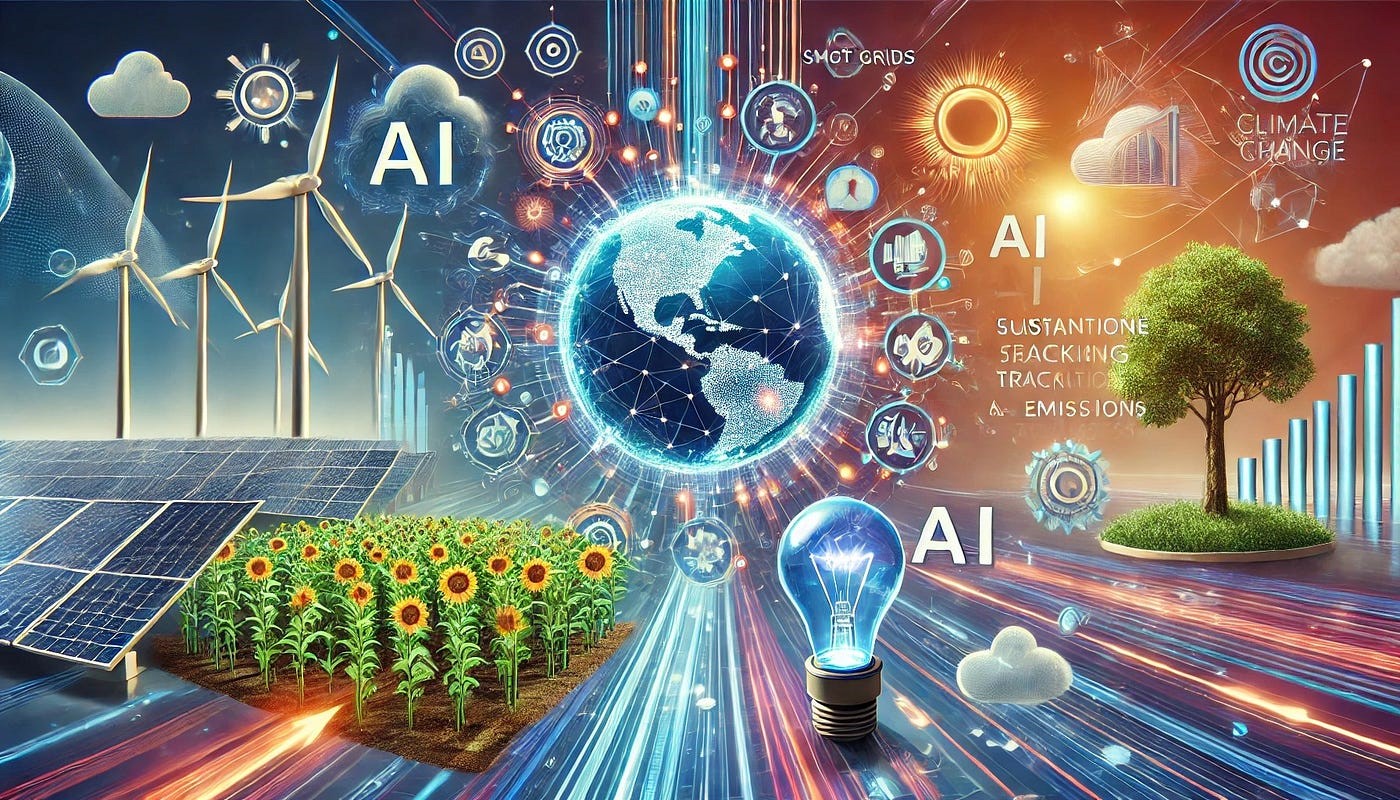
Enhancing Communication with AI: Language Translation & Grammar Checking Using LLMs
January 29, 2026

Enhancing Communication with AI: Language Translation & Grammar Checking Using LLMs

Introduction In today’s globalized world, effective communication across languages and clear, error-free writing are crucial in both personal and professional contexts. However, language barriers and grammar mistakes can hinder understanding, reduce professionalism, and slow down workflows. Manual translation and proofreading can be time-consuming, costly, and prone to inconsistencies. Large Language Models (LLMs) have revolutionized language translation and grammar correction by offering fast, accurate, and context-aware solutions. These AI systems can translate text between multiple languages while preserving meaning and tone, and they can also detect and correct grammar, spelling, and style errors automatically. This enhances communication clarity and expands global reach. By integrating LLM-powered translation and grammar tools, individuals and organizations can break language barriers and improve the quality of their written content efficiently. What Is It? Language translation and grammar checking with LLMs involves using advanced AI models trained on multilingual corporal and linguistic rules. These models understand the nuances of different languages and can convert text accurately while maintaining cultural and contextual relevance. Additionally, LLMs can analyze text for grammar, punctuation, and style issues, providing corrections and suggestions to improve readability and professionalism. How It Works LLMs are trained on diverse datasets covering multiple languages, dialects, and writing styles.When processing text, they apply sophisticated natural language understanding to: • Translate input text from a source language into a target language, preserving semantics and tone. • Detect grammatical errors, typos, awkward phrasing, or inconsistencies within the text. • Suggest corrections or automatically rewrite sentences for clarity, conciseness, and correctness. • Adapt translations and corrections to specific domains or writing styles as needed. This allows seamless multilingual communication and polished written content without extensive human intervention. Benefits of LLMs in Translation and Grammar Checking •Speed and Scalability LLMs can translate and proofread large volumes of text quickly, making them ideal for businesses handling global communications or content localization. This reduces turnaround times compared to manual efforts. •Contextual Accuracy Unlike basic dictionary-based tools, LLMs consider context, idiomatic expressions, and cultural nuances, resulting in more accurate and natural translations. They also understand complex grammar rules to provide precise corrections. •Improved Writing Quality By correcting grammar, spelling, and style, LLMs help users produce professional and clear documents, emails, articles, or social media posts. This enhances credibility and reduces misunderstandings. •Multi-language Support LLMs support translation across dozens of languages and dialects, enabling broader communication and collaboration across international teams and customers. •User-Friendly Integration These AI capabilities can be embedded into word processors, email clients, websites, and apps, offering users instant translation and grammar suggestions as they write. Challenges of Using LLMs for Translation and Grammar Checking •Handling Ambiguity Some phrases or words have multiple meanings depending on context, which can occasionally lead to incorrect translations or suggestions. Human review remains important for sensitive or high-stakes content. •Domain-Specific Terminology Specialized fields like legal, medical, or technical writing may require fine-tuning models to correctly translate jargon or apply grammar rules accurately. •Data Privacy Concerns Translating and proofreading confidential documents demands secure data handling and compliance with privacy regulations to protect sensitive information. •Over dependence on Automation Users might rely too heavily on AI-generated corrections and translations without critical evaluation, risking errors or awkward phrasing slipping through. Real-World Applications 1. Business Communication Global companies rely on LLM-powered translation and grammar tools to adapt emails, reports,and marketing materials for different languages and cultures. This ensures messaging remains clear, consistent, and culturally appropriate across diverse markets. Automated tools speed up localization processes, reducing the time and cost of manual translation. The result is stronger brand cohesion and improved engagement worldwide. Content Creation and Publishing Writers, journalists, and bloggers use AI to quickly proofread their work and translate content for audiences in multiple languages. This allows them to publish timely and high-quality articles without the delays of manual editing or translation. The AI helps maintain tone, style, and accuracy, ensuring the content resonates globally. It also expands reach by making information accessible to a broader audience. Customer Support Multilingual customer support teams utilize AI translation to understand inquiries and respond in the customer’s preferred language. This improves communication speed and accuracy, leading to higher customer satisfaction. AI tools enable support agents to handle diverse languages without needing fluency in each one. As a result, businesses can provide efficient, inclusive support around the clock. Education Language learners benefit from AI-powered grammar checking and translation tools that provide instant corrections and explanations. These tools help improve writing skills by identifying errors and suggesting improvements in real time. Translations support comprehension and enable learners to engage with content in new languages. This technology fosters faster and more confident language acquisition. Software Localization Developers integrate AI translation tools to convert user interface text, help guides, and manuals into multiple languages efficiently. This accelerates the release of software products in global markets by reducing localization bottlenecks. AI ensures that translations are consistent and contextually accurate, improving user experience. It also lowers costs by automating much of the repetitive translation work. Conclusion Language translation and grammar checking powered by LLMs are reshaping how individuals and organizations communicate across languages and cultures. These technologies enable faster,more accurate, and context-aware translations alongside polished and error-free writing. While human oversight remains necessary for nuanced or specialized content, AI tools significantly enhance communication efficiency and quality. As these models continue to advance, they will play a pivotal role in bridging language gaps and elevating written communication worldwide. AICommunication #LLMTechnology #LanguageTranslation #GrammarChecker #AIWritingTools #MultilingualAI #NaturalLanguageProcessing #SmartTranslation #ContentLocalization #GlobalCommunication Reach us at: hello@Bluechiptech.asia

Read More →

Blockchain in Humanitarian Aid: Delivering Trust, Speed, and Impact
January 29, 2026

Blockchain in Humanitarian Aid: Delivering Trust, Speed, and Impact

Blockchain and the Future of Humanitarian Aid Humanitarian aid is critical for responding to crises like natural disasters, conflict, and poverty. However, traditional aid systems face delays, corruption, and inefficiencies that hinder impact. Blockchain offers a transparent, secure way to deliver and track aid in real time. It brings speed, trust, and accountability to lifesaving efforts around the world. What is Blockchain? A Quick Dive into Aid with Integrity Blockchain is a decentralized digital ledger that records transactions in an immutable, transparent format. In humanitarian contexts, it logs aid disbursement, identity verification, and service delivery with precision. Each transaction is secure, time-stamped, and tamper-proof. It ensures that every resource reaches those who need it most without delay or loss. Article content The Struggles of Traditional Aid Systems 1. Mismanagement and Corruption In crisis zones, aid can be lost due to fraud, theft, or bureaucracy. Funds are often untraceable once distributed. Blockchain provides full visibility of every dollar and its destination. It reduces corruption by making every step public and accountable. Delayed Response and Distribution Aid delivery can take days or weeks due to intermediaries, paperwork, and broken infrastructure. Speed is essential in emergencies. Blockchain enables direct, digital, and fast transactions to affected populations. It turns emergency aid into real-time relief. Lack of Identity for Displaced People Refugees and displaced individuals often lack legal identity, preventing access to aid, banking, or healthcare. Blockchain offers self-sovereign digital identities that can’t be lost or forged. It restores access to essential services and human dignity. Poor Transparency and Donor Trust Donors often don’t know where their contributions go or what impact they have. This erodes trust and reduces future funding. Blockchain offers open, verifiable data on fund usage and outcomes. It builds confidence through radical transparency. Blockchain in Action: Smarter, Safer Aid Delivery 1. Direct Cash Transfers – Fast, traceable support Blockchain allows organizations to send digital aid directly to beneficiaries' mobile wallets. Funds can be spent locally, tracked securely, and verified instantly. This cuts out middlemen and speeds up help. Aid becomes direct, empowering, and data driven. Smart Contracts for Relief Operations – Automation with trust Relief agencies can use smart contracts to release funds or supplies automatically based on conditions, like confirmed delivery or impact. This ensures aid only flows when verified needs are met. It reduces waste and enforces accountability. Every action is tracked on-chain. Transparent Aid Tracking – Full visibility from source to site Blockchain records every transaction, delivery, and outcome in real time. Donors, NGOs, and governments can monitor progress with confidence. This prevents double-doubling and misallocation. Humanitarian supply chains become visible and verifiable. Token-Based Incentives – Empowering local participation Blockchain can distribute tokens for community work like rebuilding, cleanup, or training. These tokens can be exchanged for goods, services, or savings. It rewards participation while stimulating local economies. Recovery becomes collaborative and inclusive. Real-World Blockchain Humanitarian Success Stories World Food Programme – Building Blocks project The WFP uses blockchain to manage food aid in refugee camps, enabling secure transactions without bank access. Beneficiaries receive digital vouchers tied to biometric identity. The system has served over 1 million people. It ensures dignity, security, and efficiency. ID2020 – Digital ID for displaced populations ID2020 provides blockchain-based digital identities for refugees and the undocumented. These IDs give access to education, healthcare, and aid. Personal data is stored securely and controlled by the user. It restores legal recognition to the most vulnerable. UNICEF – Investing in blockchain startups UNICEF launched a crypto fund to support blockchain innovations focused on education, healthcare, and emergency response. Grants are given in cryptocurrency for full transparency. It supports scalable solutions for global challenges. Blockchain powers digital humanitarianism. Start Network – Crisis prediction and funding Start Network uses blockchain smart contracts to trigger early funding for disaster prevention based on data like weather or conflict alerts. This reduces response time and saves lives. Aid is proactive, not reactive. Data drives real-time resilience. Blockchain’s Unmatched Benefits 1. Full Transparency and Accountability Every aid transaction is recorded on an immutable public ledger. Donors and recipients can see how funds are used and by whom. This reduces fraud and builds confidence. Trust becomes a built-in feature of humanitarian aid. Faster Delivery of Help Blockchain enables instant cross-border payments and smart contract automation. Aid reaches crisis zones faster than traditional bank transfers. Time saved means lives saved. Speed becomes the new standard in disaster response. Protection for the Vulnerable Digital identities secured on blockchain give refugees and displaced access to services. They can prove who they are without paper documents. It safeguards dignity and rights. Identity becomes portable, secure, and empowering. Cost Reduction and Efficiency Blockchain reduces the need for intermediaries, manual record-keeping, and reconciliation. This lowers administrative costs and increases the share of aid that reaches recipients. Efficiency becomes a force multiplier. More impact, less overhead. Empowered Local Economies Token-based systems allow communities to participate in rebuilding efforts and receive fair compensation. Local businesses can accept aid tokens and boost recovery. Blockchain makes aid circular and empowering. Recovery is owned by the people it serves. Data Integrity and Security Sensitive beneficiary data and transaction records are encrypted and tamper-proof. Blockchain minimizes data loss and unauthorized access. It ensures secure information sharing among stakeholders. Privacy and safety are preserved in crisis settings. Article content Future Trends in Humanitarian Blockchain Innovation 1. Crypto-Aid Wallets – Digital finance for refugees Blockchain wallets will allow displaced individuals to store aid, savings, and identity securely. These can be accessed by phone, even without a bank. It provides financial inclusion and independence. Refugees take control of their own futures. Humanitarian DAOs – Community-driven response Decentralized Autonomous Organizations will fund and govern local relief efforts through community voting. Aid is allocated transparently and democratically. Blockchain enforces fairness and local ownership. The crisis response becomes decentralized and agile. Predictive Aid Triggers – Data-driven early response AI-powered systems will analyze data on weather, conflict, or migration and use blockchain to trigger smart contract funding. Aid arrives before disasters escalate. It shifts from reaction to prevention. Forecasting and funding merge in real time. Green Humanitarian Supply Chains – Sustainable and trackable Blockchain will enable tracking of environmental impact in humanitarian logistics—fuel use, emissions, and waste. Donors and agencies will favor greener practices. Sustainability becomes part of the aid mission. Doing good includes doing no harm. Multi-Stakeholder Platforms – Unified global action Blockchain platforms will connect donors, NGOs, governments, and communities in one shared network. Data and funds will flow with full visibility and accountability. Collaboration becomes seamless. The future of aid is unified and transparent. Conclusion: A New Model for Global Relief Blockchain is transforming humanitarian aid by solving long-standing challenges of transparency, speed, and control. It ensures that every dollar, every meal, and every intervention is tracked, verified, and accountable. Aid becomes faster, smarter, and fairer. For displaced populations, blockchain restores identity, dignity, and access to basic services. For donors and NGOs, it delivers trust and visibility at every step. From direct cash transfers to token-based incentives, blockchain rebuilds aid around people, not processes. As the world faces more frequent crises, blockchain offers a resilient, scalable system for relief. It empowers communities, protects the vulnerable, and ensures that help gets where it’s needed most. This is not just a better tool for aid, it’s a new blueprint for global humanity. Reach us at: hello@Bluechiptech.asia

Read More →
Importance of AI in Library Science and Information Management
January 29, 2026

Importance of AI in Library Science and Information Management

Artificial Intelligence (AI) is revolutionizing the field of Library Science and Information Management by enhancing information discovery, streamlining administrative processes, and improving user experiences. AI tools and technologies enable libraries to organize and manage vast amounts of data more effectively, automate routine tasks, and provide personalized services to users. This transformation helps librarians to focus more on strategic activities while ensuring that users have access to the right information at the right time. Overall, AI integration in Library Science and Information Management is essential for improving operational efficiency, enhancing resource management, and delivering a superior user experience. AI's Role in Enhancing Information Discovery Improved Search and Retrieval: AI-powered search engines use natural language processing (NLP) and machine learning to understand the context and intent behind search queries, leading to more accurate and relevant results. This makes it easier for users to find specific resources quickly, enhancing their overall research experience. Automatic Metadata Generation: AI algorithms can analyze digital content and automatically generate metadata, such as keywords, tags, and summaries. This improves the organization of digital collections and facilitates more effective cataloging, reducing the time librarians spend on manual indexing. Content Recommendation Systems: AI-driven recommendation systems analyze user behavior and preferences to suggest relevant books, articles, or digital resources. This personalization enhances user engagement and satisfaction by providing tailored content recommendations based on their interests and past activities. Streamlining Administrative Processes Automated Cataloging and Classification: AI systems automate the cataloging and classification of library materials, reducing human errors and increasing accuracy. Machine learning algorithms can learn from existing classifications to improve over time, ensuring consistent and efficient cataloging practices. Resource Management: AI optimizes resource allocation by predicting demand for specific materials, suggesting when to acquire new resources, and automating inventory management. This ensures that libraries maintain a balanced and up-to-date collection that meets the evolving needs of their users. Virtual Assistants and Chatbots: AI-powered virtual assistants and chatbots provide 24/7 support to users, answering frequently asked questions, assisting with catalog searches, and guiding users through library services. This reduces the workload on library staff while improving user accessibility and satisfaction. Improving User Experience and Accessibility Personalized User Interfaces: AI can create personalized user interfaces by analyzing user data to understand preferences and behavior. This allows libraries to offer customized experiences, such as tailored content displays and personalized reading lists, which enhance user engagement and satisfaction. Enhanced Accessibility: AI tools improve accessibility for users with disabilities by providing features like text-to-speech, speech-to-text, and language translation. These technologies enable all users to access and utilize library resources effectively, regardless of their physical or linguistic limitations. Adaptive Learning Resources: AI helps create adaptive learning resources that adjust to individual users' learning styles and pace. This is particularly valuable for educational libraries, where users can benefit from resources that cater to their specific needs and preferences. Facilitating Data-Driven Decision Making Analytics and Insights: AI provides powerful analytics tools that help libraries understand user behavior, preferences, and trends. This data can inform decision-making related to collection development, event planning, and service improvements. Predictive Maintenance: AI-driven predictive analytics can identify potential issues with library infrastructure, such as digital systems or physical facilities, before they become critical. This proactive approach helps maintain smooth operations and enhances the overall user experience. Collection Development: AI assists in making data-driven decisions regarding collection development by analyzing usage patterns, user feedback, and emerging trends. This ensures that libraries acquire materials that are relevant and in demand, optimizing their collection strategy. Enhancing Research and Academic Support Research Assistance: AI tools provide advanced research support by identifying relevant resources, suggesting research topics, and organizing information. These tools help users navigate complex databases and academic resources more effectively, enhancing the quality of research outcomes. Plagiarism Detection: AI-based plagiarism detection tools help maintain academic integrity by identifying instances of copied content in research papers and other documents. This is crucial for supporting ethical research practices and maintaining the credibility of academic institutions. Knowledge Discovery: AI algorithms analyze large datasets to identify patterns, correlations, and emerging trends in various fields of study. This facilitates knowledge discovery and supports interdisciplinary research by providing insights that may not be immediately evident through traditional methods. Conclusion AI is a transformative force in Library Science and Information Management, driving significant advancements in information discovery, administrative efficiency, user experience, and data-driven decision-making. By leveraging AI, libraries can enhance their services, streamline operations, and offer a more personalized and accessible experience to users. As AI technologies continue to evolve, their integration into library systems will become even more critical for ensuring that libraries remain dynamic, user-centered, and responsive to the changing needs of their communities. Contact Us email: hello@bluechiptech.asia

Read More →
Expanding Horizons: AI Summit Asia 2024
January 29, 2026

Expanding Horizons: AI Summit Asia 2024

The year began with Bluechip Technologies Asia taking a prominent role at AI Summit Asia 2024. This prestigious event brought together global leaders and innovators to discuss AI’s role in transforming industries. Our participation showcased our commitment to leveraging AI for diverse applications, from healthcare to supply chain optimization. By presenting cutting-edge solutions like predictive analytics and automation tools, we positioned ourselves as leaders in driving AI innovation across the Asia-Pacific region. This summit was instrumental in forming partnerships and gaining insights into emerging trends that would guide our subsequent initiatives. The connections established here directly influenced our strategy for other key events, such as Seamless Asia and the Aviation Festival Asia. By the end of the summit, we had laid the groundwork for a year of impactful collaborations.

Read More →