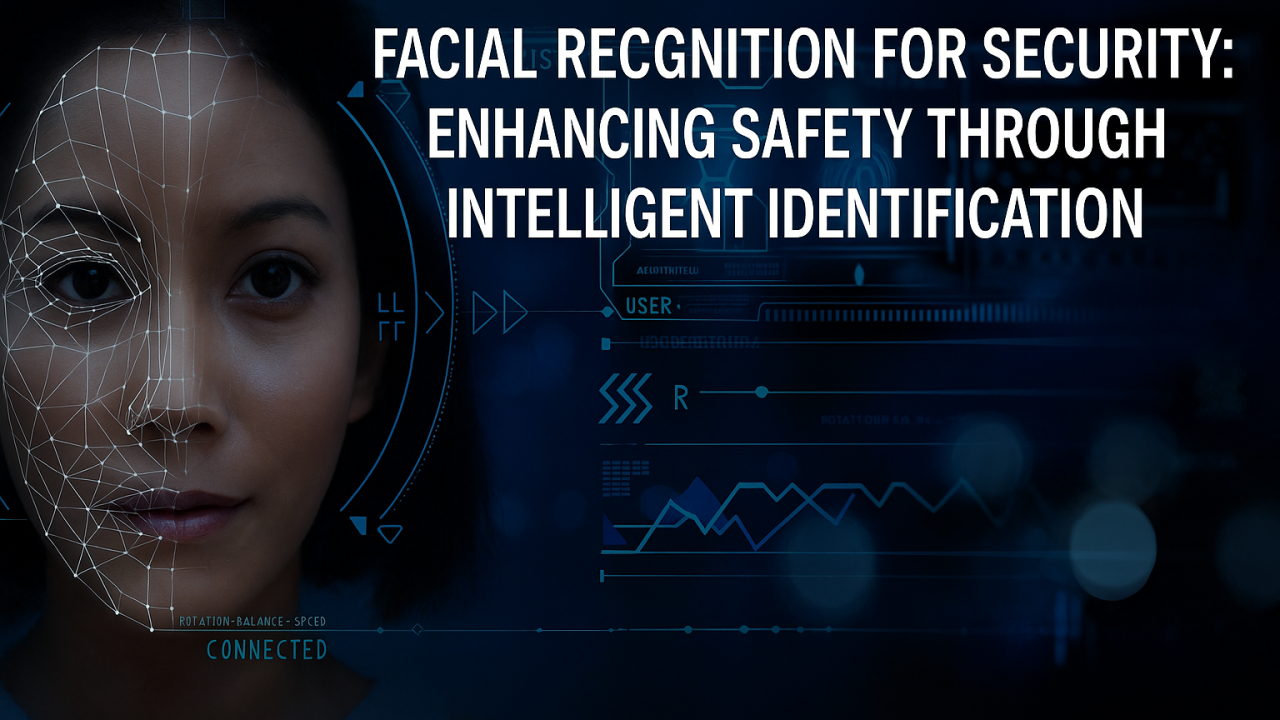
Facial recognition technology powered by artificial intelligence has, in a relatively short period, become an essential support column in modern security systems. It recognizes and verifies people based on unique facial characteristics via machine learning and computer vision. It is applied across various sectors from law enforcement and airport security to smartphones and smart home systems, making it a useful tool for enhancing public security and personal convenience.
The heart of facial recognition lies in the ability to compute visual data captured by cameras. AI programs, particularly deep neural networks, learn from huge stores of face photos to detect such patterns as between-eye distance, jawline arrangement, and contours of the face. Trained, the models can detect and match faces on the fly with high accuracy levels, even against crowded or fast-moving backgrounds. Compared to the traditional means of identification such as password or ID cards, facial recognition offers a frictionless and contactless authentication process.
Article content
The Role of AI in Facial Recognition
Artificial intelligence significantly improves the accuracy and performance of facial recognition technology. Deep learning algorithms feed facial images through multiple layers to pull out detailed features unique to each person. Facial recognition systems improve themselves by learning from new data, getting better and better at handling lighting changes, facial expressions, angles, and the aging process.
Face detection and alignment are the initial two steps, where the system identifies a face in an image and aligns its location. Feature extraction is the next, where significant data points (landmarks) are computed to determine the face. The final step is face matching, where the extracted features are compared with a database to verify identity. Advanced AI systems can accomplish all this within milliseconds, enabling real-time surveillance and access control.
Applications in Security and Beyond
Facial recognition is widely utilized in security-critical contexts. Airports and border agencies use it to verify traveler identities and detect people on watchlists. Police agencies use it for criminal investigations to match suspects from surveillance cameras or mugshot records. In public areas, it assists in monitoring for threats and situational awareness.
Facial recognition in the private industry is used for controlling access to secure buildings, where passwords or keycards are replaced with facial authentication. Facial recognition is welcomed by banks and mobile apps to authenticate identity when transacting with an additional security level of biometrics. Smart home appliances deploy facial recognition in order to customize settings and notification based on the individual entering the home.
Ethical and Privacy Considerations
While effective, facial recognition technology has sparked controversy over privacy, surveillance, and civil liberties. Some of the issues include mass collection of data without approval, abuse at the hands of authorities, and bias in algorithms that may lead to false positives or negatives particularly against minority groups. Misidentification can have serious consequences, especially if used in law enforcement.
To address these issues, governments and institutions are developing regulations that manage the collection, storage, and utilization of facial recognition information. Transparency, consent, and data protection measures are key to ensuring responsible deployment. In addition, efforts are being made to make AI models fairer by training them on more diverse and balanced datasets.
Article content
The Future of Facial Recognition in Security
As AI and computer vision technologies improve, facial recognition systems are also becoming more robust, accurate, and ethical. Emerging trends in the form of 3D facial recognition, emotion detection, and thermal imaging are expanding the scope of the technology's possible applications. With proper oversight and adherence to ethical standards, facial recognition can be at the leading edge of making environments safer, smarter, and more secure.
From opening phones to securing borders, AI-driven facial recognition is revolutionizing the way identities are verified and dangers are mitigated a glimpse into the future of intelligent security solutions.
Log in with a verified account to post comments.
Log in · Register
Comments