Introduction
Carbon emissions are one of the main causes of climate change and global warming. Carbon dioxide (CO₂) and other greenhouse gases are released into the atmosphere through activities such as burning fossil fuels, industrial production, transportation, and deforestation. These gases trap heat in the Earth’s atmosphere, causing global temperatures to rise and leading to serious environmental problems. Reducing carbon emissions has become a major global priority. Governments, organizations, and environmental groups around the world are working to monitor and reduce the amount of carbon released into the atmosphere. However, tracking carbon emissions accurately can be very challenging. Carbon emissions come from many different sources, including factories, vehicles, power plants, and even household energy use. Traditional methods of monitoring emissions often rely on manual reporting and periodic measurements. These methods may not always provide real-time information, and in some cases, the data may be incomplete or inaccurate. Because of these limitations, new technological solutions are needed to track emissions more effectively. Artificial Intelligence (AI) is now playing an important role in monitoring and managing carbon emissions. AI systems can analyze large amounts of environmental data, detect emission sources, and help organizations measure their carbon footprint more accurately. By providing better insights into emission patterns, AI helps governments and businesses take meaningful steps toward reducing their environmental impact.
Understanding Carbon Emissions
Carbon emissions are produced whenever fossil fuels such as coal, oil, and natural gas are burned. These fuels are commonly used in electricity generation, transportation, manufacturing, and heating. When fossil fuels are burned, they release carbon dioxide into the atmosphere. Other human activities also contribute to carbon emissions. Deforestation, for example, releases stored carbon from trees and reduces the number of trees available to absorb carbon dioxide. Agriculture and industrial processes can also release greenhouse gases that contribute to global warming. Because carbon emissions come from many different sources, monitoring them requires collecting large amounts of data from various industries and geographic regions. Scientists and environmental agencies need accurate information about where emissions are coming from and how much is being released. AI technologies help improve this monitoring process by analyzing emission data more efficiently and identifying patterns that may not be easily visible through traditional analysis methods.
How AI Helps Track Carbon Emissions
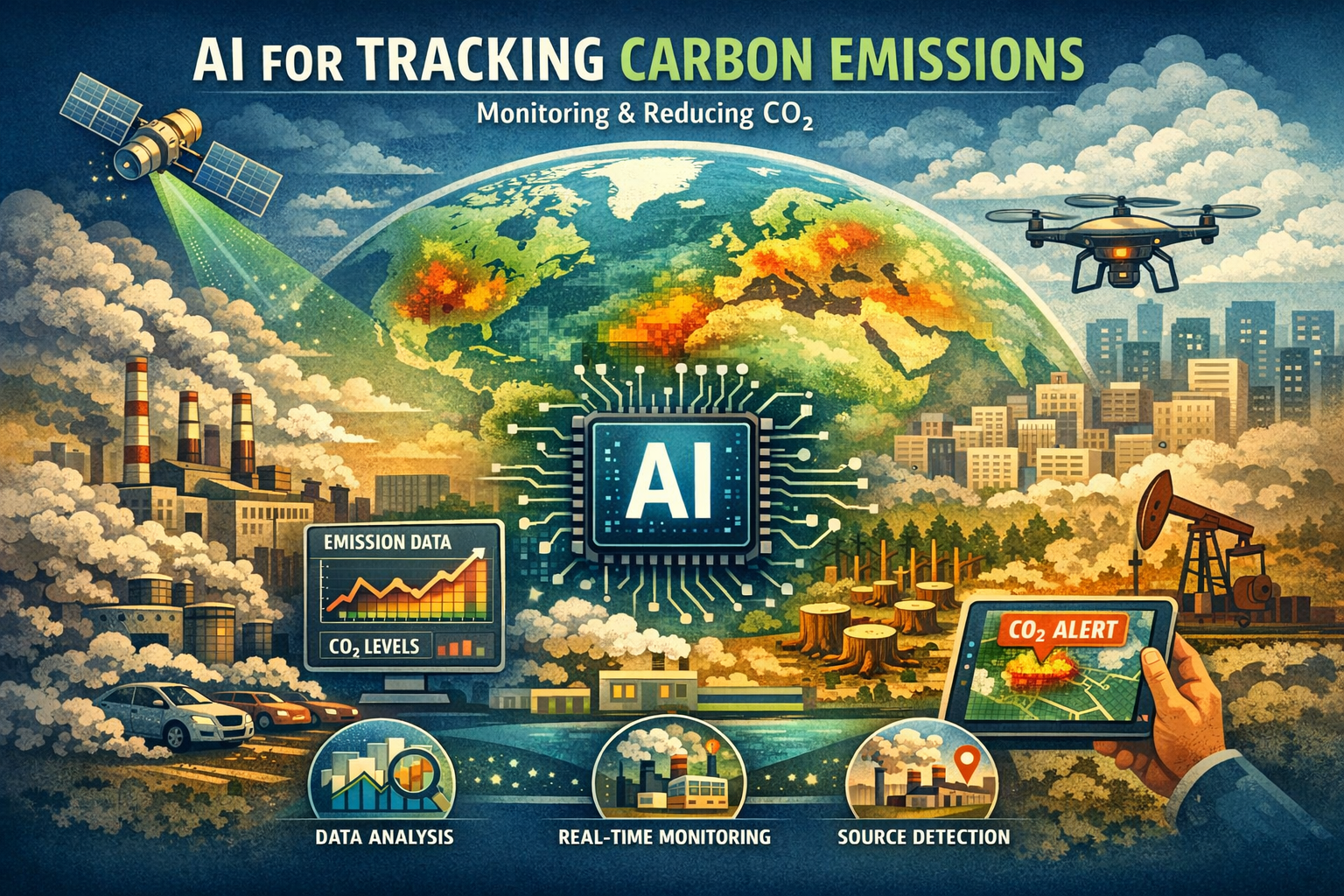
Artificial Intelligence can process large datasets from multiple sources such as satellites, environmental sensors, industrial monitoring systems, and transportation networks. By analyzing this information, AI systems can detect emission sources and estimate how much carbon is being released. Machine learning algorithms are especially useful for identifying emission patterns. These algorithms can analyze historical data and compare it with current environmental conditions to determine trends in carbon emissions. For example, AI systems can track emissions from power plants by analyzing energy production data and fuel consumption patterns. They can also estimate emissions from transportation by studying traffic data, vehicle activity, and fuel usage. Another important feature of AI is its ability to monitor emissions in real time. Instead of waiting for periodic reports, AI systems can continuously analyze environmental data and detect sudden increases in emissions. This real-time monitoring allows authorities to take immediate action if unusual emission levels are detected.
Using Satellite Technology with AI
Satellites provide valuable information about environmental conditions across the planet. They can detect changes in atmospheric gases, monitor industrial activity, and observe environmental changes from space. However, satellites generate massive amounts of data that must be analyzed quickly. AI systems are used to process satellite images and identify areas with high carbon emissions. For instance, AI algorithms can analyze satellite images to detect pollution clouds from factories or power plants. They can also monitor forest areas to identify deforestation activities that may increase carbon emissions. By combining satellite technology with AI, scientists can create detailed global maps showing where emissions are occurring and how they are changing over time. These insights help governments and organizations develop more effective climate policies.
Helping Industries Reduce Their Carbon Footprint
Many industries are responsible for large amounts of carbon emissions. Manufacturing plants, energy companies, and transportation systems all contribute to greenhouse gas emissions. Monitoring and managing these emissions is essential for achieving global climate goals. AI helps industries track their carbon footprint by analyzing operational data and identifying areas where emissions can be reduced. For example, AI systems can monitor energy consumption in factories and recommend ways to improve efficiency. In the transportation sector, AI can analyze traffic patterns and vehicle usage to identify ways to reduce fuel consumption. Smart logistics systems powered by AI can optimize delivery routes, reducing travel distances and lowering emissions. Energy companies also use AI to monitor power generation systems and identify opportunities to switch to cleaner energy sources. These improvements not only reduce emissions but also help organizations lower operational costs.
Supporting Governments and Environmental Policies
Governments need reliable data to create effective environmental policies. Without accurate emission monitoring, it is difficult to determine whether climate policies are working. AI provides governments with powerful tools for analyzing emission trends and monitoring environmental performance. By studying large datasets, AI systems can identify regions with high emission levels and evaluate the effectiveness of environmental regulations. For example, AI can monitor pollution levels in urban areas and determine whether emission reduction policies are improving air quality. It can also track changes in industrial emissions after new environmental regulations are introduced. This data-driven approach allows policymakers to make informed decisions and develop strategies that effectively reduce greenhouse gas emissions.
Encouraging Corporate Environmental Responsibility
In recent years, many companies have committed to reducing their carbon footprint as part of their sustainability goals. Businesses are increasingly expected to report their environmental impact and demonstrate efforts to reduce emissions. AI helps organizations measure and report their carbon emissions more accurately. By analyzing operational data, AI systems can calculate the total emissions generated by a company’s activities. These insights allow companies to identify areas where improvements can be made. For example, businesses may choose to adopt renewable energy sources, improve energy efficiency, or reduce waste in their operations. Transparent emission tracking also helps companies build trust with customers, investors, and regulatory agencies.
Challenges in AI-Based Carbon Monitoring
Although AI offers many advantages in tracking carbon emissions, there are also some challenges to consider. One challenge is data availability. Accurate emission tracking requires high-quality data from many different sources. In some regions, environmental monitoring systems may be limited, making it difficult to collect reliable data. Another challenge is the complexity of emission sources. Some emissions are easy to detect, such as those from large industrial facilities, but others are more difficult to measure, such as emissions from small businesses or individual households. AI systems also require advanced computing infrastructure and skilled professionals to develop and maintain them. Implementing these systems can involve significant costs and technical expertise. Despite these challenges, ongoing technological advancements are making AI-based emission monitoring more effective and accessible.
The Future of AI in Carbon Emission Tracking
As climate concerns continue to grow, the use of AI in carbon emission monitoring is expected to expand significantly. New technologies such as advanced sensors, satellite systems, and data analytics platforms will provide even more detailed environmental information. Future AI systems may be able to create real-time global emission monitoring networks. These systems could track emissions from various sources and provide immediate alerts when unusual emission levels occur. AI may also help develop predictive models that estimate future emission trends based on economic activity, energy consumption, and environmental policies. These predictions can help governments and organizations plan long-term climate strategies. By integrating AI with renewable energy systems, smart cities, and sustainable industries, it may be possible to significantly reduce global carbon emissions in the coming decades.
Conclusion
Tracking carbon emissions is essential for addressing climate change and protecting the environment. Artificial Intelligence is transforming the way scientists, governments, and organizations monitor emissions and understand their environmental impact. By analyzing large datasets, processing satellite imagery, and identifying emission patterns, AI provides valuable insights into where and how carbon emissions are produced. These insights support more effective climate policies, encourage corporate responsibility, and help industries reduce their carbon footprint. As AI technologies continue to evolve, they will play an increasingly important role in global efforts to reduce greenhouse gas emissions and create a more sustainable future for the planet.
Log in with a verified account to post comments.
Log in · Register
Comments