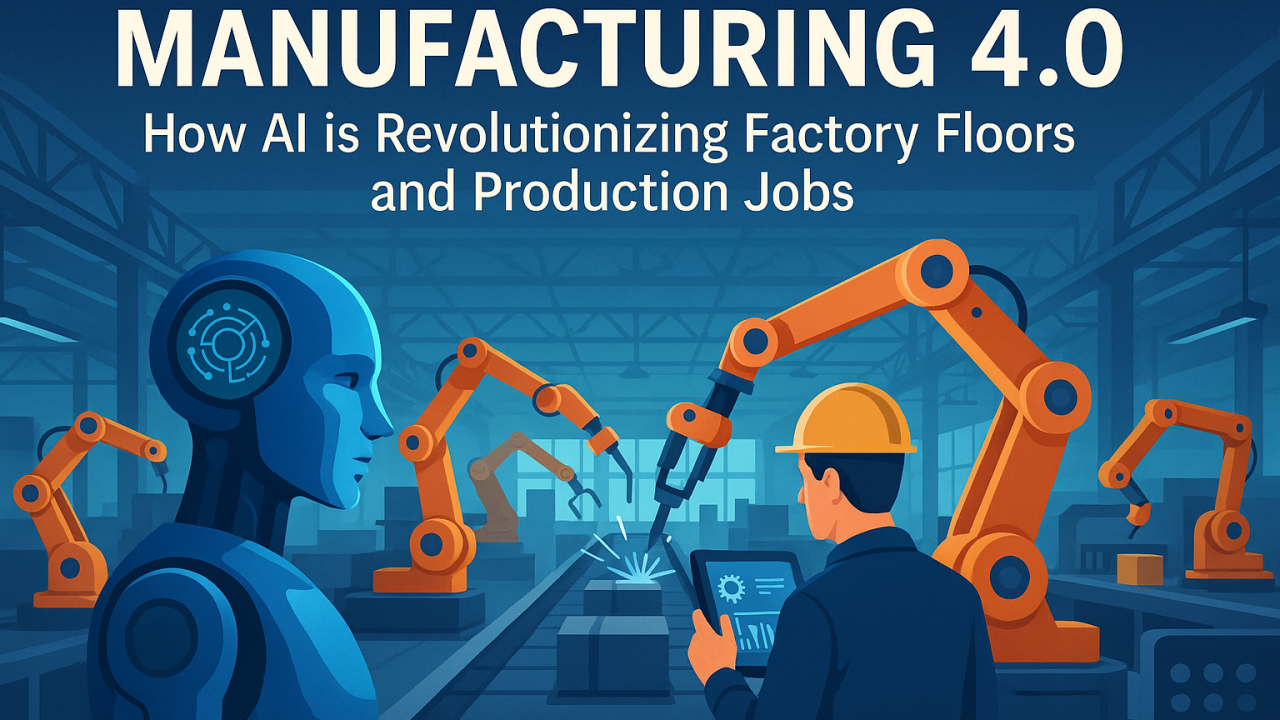
Introduction: The Fourth Industrial Awakening
We are in the midst of what many are calling the Fourth Industrial Revolution Manufacturing 4.0 where artificial intelligence, robotics, and data analytics converge to transform how goods are produced, assembled, and delivered. AI, once a niche tool in manufacturing innovation labs, is now central to operational efficiency, workforce evolution, and competitiveness on the global stage.
Article content
AI-Driven Process Optimization and Predictive Maintenance:
One of the most immediate impacts of AI on manufacturing has been in optimizing complex production processes. AI systems analyze real-time sensor data to monitor machinery, identify inefficiencies, and flag irregularities that could indicate upcoming breakdowns. Predictive maintenance enabled by machine learning helps manufacturers address issues before they escalate, reducing unplanned downtime and increasing equipment lifespan. This proactive approach minimizes disruptions and helps factories maintain continuous output even in highly dynamic production environments.
Intelligent Automation and Robotics Integration:
AI-powered robots are no longer confined to repetitive, isolated tasks. With the integration of computer vision, natural language processing, and adaptive learning, these systems can now perform more complex operations, including precision assembly, dynamic quality control, and even human-machine collaboration. These “cobots” work safely alongside human workers, augmenting their capabilities rather than replacing them outright. This synergy improves throughput and product consistency while keeping flexibility high an essential factor in today's era of mass customization.
Redefining the Role of the Factory Worker:
Contrary to fears of job elimination, AI is prompting a redefinition of factory jobs. The rise of smart factories requires a workforce skilled in overseeing automated systems, interpreting AI-generated insights, and managing technology-driven production workflows. As physical labor declines in prominence, cognitive and technical skills are taking center stage. Manufacturers are increasingly investing in upskilling programs to help workers transition into roles such as automation supervisors, data analysts, and systems integrators positions that demand both domain expertise and digital fluency.
AI in Quality Assurance and Product Customization:
AI is also playing a critical role in quality control, using computer vision systems to detect defects at speeds and accuracies beyond human capability. Whether identifying micro-fractures in metal or inconsistencies in paint coatings, these systems ensure higher quality standards with less waste. Furthermore, AI allows manufacturers to offer more personalized products by analyzing consumer demand trends and adjusting production runs in near real-time. This level of customization, once costly and time-consuming, is becoming increasingly scalable with the help of AI.
Challenges and the Road to Adoption:
Despite its promise, the transition to AI-powered manufacturing is not without challenges. Many factories, especially in developing regions, lack the digital infrastructure or data maturity required to fully leverage AI. Cybersecurity is another major concern, as increased connectivity exposes operational systems to new vulnerabilities. Manufacturers must also navigate change management hurdles balancing innovation with legacy systems, and cultural resistance with the need for speed. Addressing these challenges requires strategic leadership, strong partnerships, and an openness to iterative experimentation.
Conclusion: The Factory of the Future, Today
AI is not just making factories smarter it’s redefining how value is created in manufacturing. Those who embrace AI are seeing higher efficiency, improved agility, and a workforce empowered with new capabilities. Manufacturing 4.0 is not about replacing humans with machines it’s about elevating human potential through intelligent collaboration with technology. As AI continues to evolve, the factory floor is transforming into a hub of innovation, resilience, and possibility.
Log in with a verified account to post comments.
Log in · Register
Comments