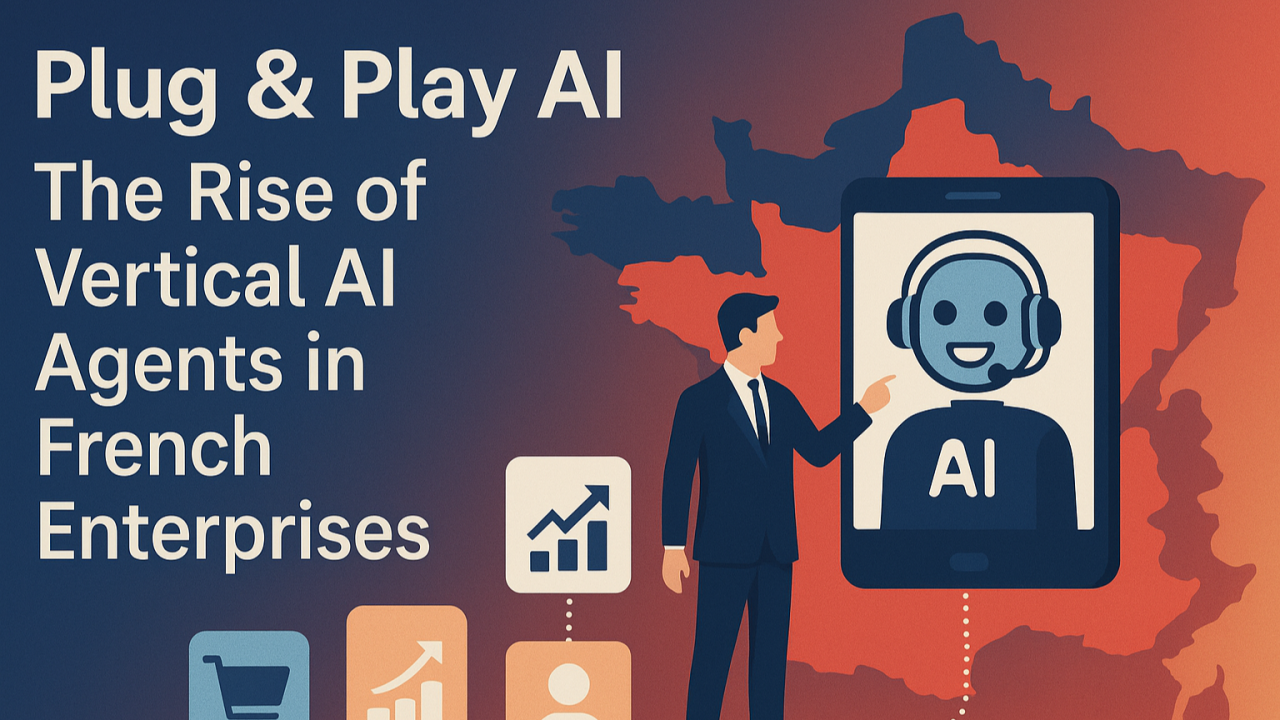
From General AI to Specialized Agents
The first wave of AI revolved around large, general-purpose models like GPT, Claude, and Gemini designed to answer almost any question, for anyone. But as French companies seek real utility, ROI, and sectoral integration, the next evolution is clear: vertical AI agents.
These AI systems are domain-specific, tailored for the workflows, vocabulary, regulations, and data needs of a particular industry. Rather than replacing human roles entirely, they act as plug-and-play collaborators automating niche tasks, offering deep expertise, and seamlessly integrating with sector-specific tools.
France, with its strong public-private ecosystem, robust regulatory frameworks, and leading industrial players, is becoming a European testbed for vertical AI agents from law and healthcare to logistics, energy, and retail.
Article content
What Are Vertical AI Agents? Vertical AI agents are task-oriented AI systems embedded into specific enterprise environments. Unlike general-purpose chatbots, these agents:
Use fine-tuned custom models or open-weight LLMs trained on sectoral data. Are integrated into existing enterprise tools like ERP, CRM, EHR, or case management systems. Are built with compliance and regulation in mind, adhering to GDPR, medical ethics, or industry safety norms. Delivery high-accuracy results in specialized domains, reducing the need for human correction.
These agents can draft legal clauses, triage patient data, recommend retail pricing strategies, or analyze factory sensor logs all with context-aware intelligence.
Legal Sector: AI Agents for Compliance and Contracting French legaltech is leading in the development of legal AI agents that assist with drafting, reviewing, and managing complex documents.
Use Cases:
Contract Review: Tools like Hyperlex and Doctrine.fr use AI agents to identify risky clauses, check for regulatory compliance, and suggest rewrites. Case Law Retrieval: Agents trained on French legal corpora rapidly locate precedents and court rulings, saving lawyers hours of research. Regulatory Monitoring: Agents can track changes to EU and French regulations and flag them for relevant departments.
Why France Leads:
Strong civil law tradition and well-structured legal databases. Public funding for legaltech AI through Bpifrance and CNRS collaborations. Tight data privacy regulations that favor in-country hosted AI models.
Healthcare: Agents for Medical Admin and Clinical Support France’s universal healthcare system and vast hospital networks are ideal environments for healthcare AI agents to enhance efficiency and quality of care.
Examples:
AP-HP is testing AI agents that pre-fill discharge letters by summarizing patient history and treatment outcomes. Doctolib integrates AI to suggest appointment slots, automate triage, and assist with billing codes. Therapixel uses agents in radiology to prioritize high-risk images and assist radiologists in interpretation.
Challenges:
High stakes in clinical environments require human-in-the-loop verification. Medical AI agents must comply with HAS (Haute Autorité de Santé) standards and strict GDPR health data handling laws.
Still, early trials show that AI agents can save physicians 20–30% of admin time, improving patient outcomes and reducing burnout.
Article content Retail: AI Assistants for Merchandising and CX Retailers in France are deploying vertical AI agents to improve customer experiences and optimize backend operations.
Use Cases:
Inventory Planning Agents: Carrefour and Decathlon use AI agents to predict product demand by season, region, and trend data. Product Copy Generation: Tools like TextMaster AI generate multilingual, SEO-optimized descriptions for e-commerce platforms. Customer Support Agents: Trained on FAQs, returns policies, and CRM logs, these agents resolve Tier-1 queries with high accuracy in natural French.
Impact:
Improved conversion rates. Reduction in customer support costs. Faster localization of global product catalogs.
These agents are often embedded in omnichannel platforms, from apps to in-store kiosks making them essential retail co-pilots.
Industrial & Energy Agents: AI for Safety, Maintenance & Optimization In sectors like nuclear, aerospace, and utilities, vertical agents are emerging as reliability and safety companions for operators and engineers.
Notable Deployments:
EDF is piloting AI agents to detect anomalies in turbine and cooling systems via predictive analytics. Airbus uses task-specific AI agents in manufacturing to analyze defect images, schedule maintenance, and assist in inspection documentation. TotalEnergies deploys AI for real-time emissions monitoring and ESG compliance reporting.
These agents are integrated with SCADA systems and sensor networks, providing real-time insights to human operators.
France’s Unique Advantage: A Sovereign, Regulated Testbed Why is France emerging as a hub for vertical AI agents?
Data Sovereignty: Sovereign cloud providers like OVHcloud and Scaleway enable companies to train and host agents securely. Government Support: Initiatives under France 2030 and Plan IA channel public funding into sectoral AI innovation zones. Skilled Sectoral Ecosystems: France has deep institutional knowledge in health, energy, aerospace, and law fertile ground for training specialized models. Regulatory Maturity: Unlike unregulated environments, France offers a stable, rules-driven AI development landscape ideal for building safe, auditable agents.
This combination of technical depth, ethical oversight, and sectoral collaboration positions France as a global model for vertical AI implementation.
Risks and Recommendations While promising, vertical AI agents pose specific challenges:
Risks:
Model brittleness when exposed to out-of-distribution data. Overreliance in high-stakes sectors (e.g., legal, medical). Data silos that prevent agents from drawing on shared insights. Lack of clear certification frameworks for mission-critical agents.
Recommendations:
Develop certification standards (akin to CE marks) for AI agents in regulated domains. Invest in interoperability protocols so agents can communicate across departments and sectors. Ensure worker upskilling and inclusion to prevent automation-related job displacement. Promote open benchmarks and auditable models to counteract proprietary opacity.
Conclusion: A Smarter, Sector-Driven Future
As the generative AI landscape matures, France is proving that bigger isn't always better smarter and more specific is. Vertical AI agents, designed for specific workflows and embedded directly into operations, are quietly transforming French enterprises from within.
From hospital corridors to courtrooms and factory floors, the rise of plug-and-play AI is not hype it’s real, responsible, and uniquely French.
This isn’t just the next step in automation. It’s the beginning of sector-savvy, human-aligned AI collaboration.
Log in with a verified account to post comments.
Log in · Register
Comments