1.Introduction: Breaking the Paris-Centric Mold
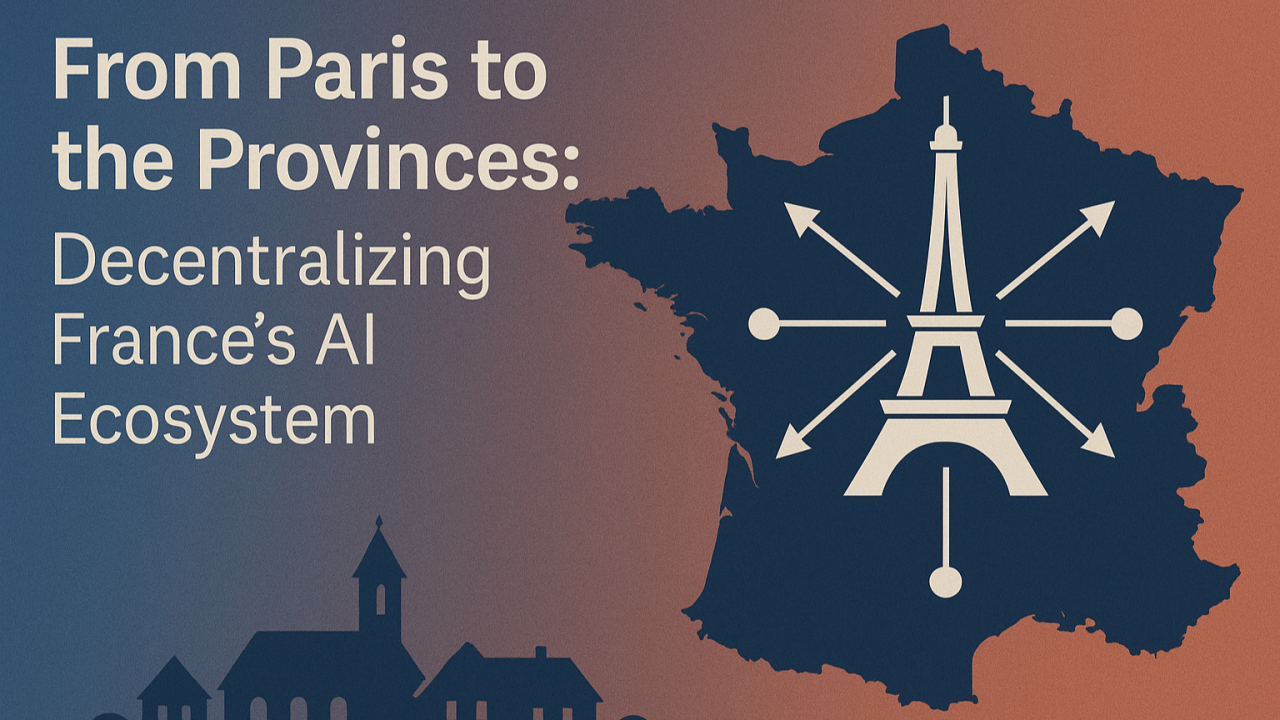
For decades, France’s innovation economy has revolved around Paris, home to the country’s largest tech firms, research labs, and venture capital. While the capital remains a vital engine for artificial intelligence (AI), a quiet decentralization is now underway.
Across France, cities like Grenoble, Toulouse, Lille, Nantes, and Strasbourg are rapidly emerging as AI powerhouses in their own right specializing in deeptech, robotics, language models, aerospace AI, and healthcare AI. Fueled by strong regional universities, dedicated AI clusters, and government support through France 2030, these cities are proving that world-class AI innovation doesn’t have to live in the shadow of the Eiffel Tower.
This article explores how regional France is redefining the national AI map one hub at a time.
Article content
2.Grenoble: The Silicon Valley of the Alps
Known historically for microelectronics and nanotech, Grenoble has evolved into a leading hub for AI-powered robotics, computer vision, and quantum computing.
Regional Strengths:
MIAI@Grenoble Alpes: One of France’s four official interdisciplinary AI institutes, focusing on explainable AI, embedded AI, and ethics. It works closely with startups and public bodies to implement AI in real-world systems.
CEA-LETI & Inria: Research centers in Grenoble are pioneers in integrating AI into semiconductors, wearables, and energy-efficient chips critical for edge AI applications.
Deeptech Startups: Companies like Prophesee (neuromorphic vision), Kalray (AI chips), and AnotherBrain (bio-inspired AI) have roots or research arms in the region.
Grenoble demonstrates how AI intersects with material science and embedded computing, making it a key player in France’s strategy for sovereign, frugal AI.
3.Toulouse: Aerospace and Autonomous Systems at the Forefront
Toulouse is home to Airbus, making it one of Europe’s leading aerospace cities. Unsurprisingly, its AI focus aligns closely with autonomous systems, flight safety, satellite data, and smart manufacturing.
Regional Highlights:
ANITI (Artificial and Natural Intelligence Toulouse Institute): Part of the government’s national AI strategy, ANITI specializes in hybrid AI systems for aerospace, mobility, and critical systems.
AI in Space & Defense: Collaborations with CNES (space agency) and the European Space Agency have birthed AI models that monitor satellites, track environmental changes, and detect space anomalies.
Aerospace Startups: Companies like Ascendance Flight Technologies and Exotrail are integrating AI in air mobility, autonomous drones, and space propulsion.
With a strong industrial backbone and a culture of engineering excellence, Toulouse is leading the charge in trustworthy, certifiable AI a must for regulated sectors like aviation and defense.
4.Lille: Retail, Language, and Health AI Hub
Located near the Belgian border, Lille is making waves in AI for retail, linguistics, smart cities, and digital health.
Key Regional Assets:
Startups & Corporates: With major headquarters like Auchan and Decathlon nearby, Lille has become a testbed for AI-driven retail analytics, inventory optimization, and tracking of customer behavior.
Inria Lille and Université de Lille: These institutions lead projects on human-centric AI, sentiment analysis, and multilingual LLM development, positioning Lille as a player in ethical, inclusive AI.
Eurasanté BioTech Hub: AI is also revolutionizing healthcare in Lille through partnerships between researchers, hospitals, and startups like Therapixel (AI for medical imaging) and Lifen (medical data interoperability).
Lille is a model for cross-border collaboration, frequently working with Dutch, Belgian, and German researchers to scale AI across Northern Europe.
Article content
5.Other Rising AI Regions in France
While Grenoble, Toulouse, and Lille lead the regional AI story, several other cities are carving out distinct niches:
Nantes – AI & Ocean Sustainability
Home to startups like Sinay and clusters focusing on marine logistics, smart ports, and coastal climate modeling.
Strasbourg – AI in Law and Ethics
Strasbourg’s proximity to European legal institutions has led to projects on AI regulation, digital rights, and the intersection of AI with European law.
Lyon – Health Tech and Smart Urbanism
Lyon combines strengths in AI diagnostics, biosensors, and urban analytics, with public-private partnerships aiming to build sustainable “AI cities.”
These cities reflect France’s commitment to inclusive digital growth, ensuring that AI is not just concentrated in megacities but distributed across its diverse regions.
6.National Strategy: Fueling Decentralization with Purpose
The France 2030 and Plan IA initiatives are actively investing in regional ecosystems through:
€1.5 billion in regional AI cluster funding
AI doctoral and post-doc fellowships targeted at non-Parisian institutions
Innovation districts and FabLabs funded by local governments and Bpifrance
Sustainable compute infrastructure, such as regional sovereign clouds and data centers
By coupling regional identity with global technology, the government is promoting both territorial equality and technological leadership.
7.Challenges and Recommendations
Despite progress, several barriers remain:
Talent Drain to Paris: Young researchers and developers often relocate for better opportunities in the capital.
Funding Imbalance: VC funding is still largely concentrated in Île-de-France.
Infrastructure Gaps: Not all cities have the computer capacity or high-speed connectivity needed for advanced AI R&D.
To truly decentralize, France must:
Incentivize regional hiring and retention through tax credits and innovation grants.
Fund regional AI data centers to support training and inference locally.
Expand inter-city collaboration and cross-cluster knowledge-sharing.
Build more public-private accelerator programs in Tier 2 cities.
8.Conclusion: A Multi-Polar Future for French AI
France is proving that AI excellence doesn’t need a Paris postcode. From the microchips of Grenoble to the satellites of Toulouse and the smart hospitals of Lille, regional France is powering a new wave of decentralized, specialized, and community-driven AI.
If France continues to support these ecosystems with infrastructure, policy, and capital, it can build a truly polycentric AI landscape one where innovation thrives not in one city, but in many.
This is not just good for tech it’s good for France.