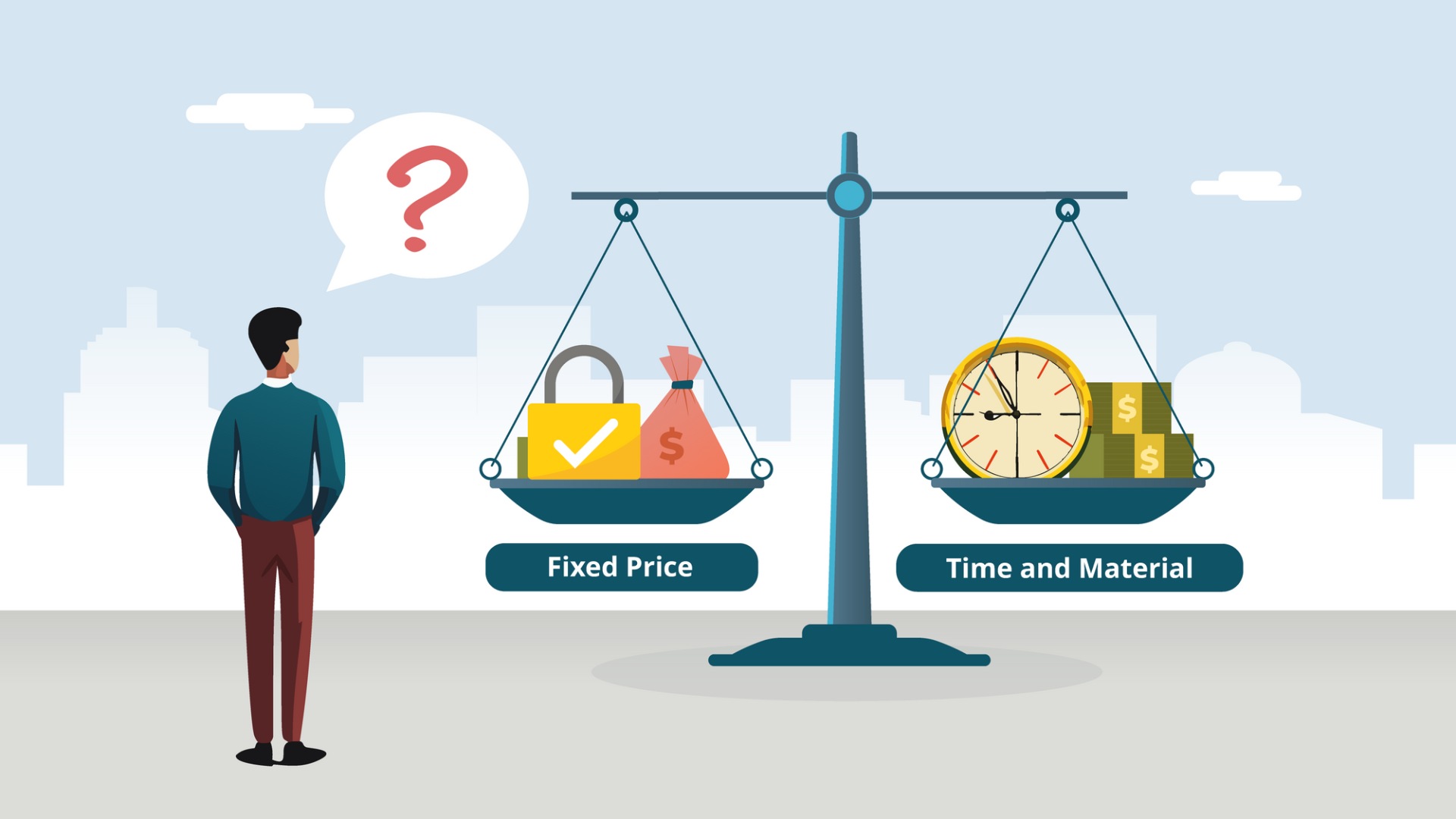
Fixed-Price vs Time-and-Materials Software Development: Which Engagement Model Suits Your Project?
Choosing the right software development engagement model is an important decision for any business investing in digital products, custom applications, or technology modernisation. Beyond selecting the right development partner, companies need to decide how the work will be scoped, delivered, managed, and paid for.
Two of the most common approaches are fixed-price software development and time-and-materials (T&M) software development. Both models can work effectively, but they serve different project requirements, levels of uncertainty, and ways of working.
A fixed-price agreement establishes a predetermined price for a clearly defined scope of work. A time-and-materials agreement charges for the actual time spent and resources used, typically at agreed rates.
Understanding the differences helps businesses select a model that balances cost control, flexibility, delivery expectations, and long-term value.
What Is Fixed-Price Software Development?
Under a fixed-price model, the client and software development partner agree on the project scope, deliverables, timeline, acceptance criteria, and total price before development begins.
The development team is responsible for delivering the agreed requirements within the established commercial terms. If the client requests additional features or significant changes to the original scope, these may require a separate change request, additional budget, or revised timeline.
This model works best when requirements are reasonably stable and the expected outcome can be defined clearly.
For example, a business may need a corporate website, a customer portal with specified features, or an internal application with a well-understood workflow. The development partner can estimate the effort based on documented requirements and provide a price for the agreed deliverables.
Advantages of the Fixed-Price Model
Predictable project costs
Businesses can establish a budget before development begins, making it easier to obtain approvals, allocate resources, and plan expenditure.
Clearly defined deliverables
The project scope, milestones, and acceptance criteria establish a shared understanding of what the development team is expected to deliver.
Simplified financial planning
A predetermined project price can make fixed-budget initiatives easier to manage, particularly when funding must be approved in advance.
Suitable for well-defined projects
When requirements are stable, the team can plan development activities, allocate resources, and establish delivery milestones with greater confidence.
Potential Limitations
The main limitation of a fixed-price arrangement is that it depends heavily on the quality of the initial requirements.
If the business discovers new needs during development, introducing them may involve additional costs and formal scope changes. An agreement that appears financially predictable can also become difficult to manage when the original scope is incomplete or ambiguous.
Another consideration is that teams may focus too heavily on delivering the documented requirements rather than exploring improvements that emerge during development.
For this reason, fixed-price projects benefit from detailed discovery, realistic estimates, clear acceptance criteria, and an agreed process for handling changes.
What Is Time-and-Materials Software Development?
Under the time-and-materials model, the client pays for the actual development effort delivered at agreed hourly, daily, or monthly rates. Depending on the arrangement, charges may include developer time, specialist expertise, and other agreed project resources.
Rather than committing to a completely fixed scope, the client and development partner can refine priorities as the project progresses.
This model is particularly useful when requirements are expected to evolve, the solution involves technical uncertainty, or development is managed through iterative delivery methods such as Agile.
For example, a company developing a new SaaS product may begin with a minimum viable product (MVP). After testing it with initial customers, the business may identify new features, integration requirements, or usability improvements. A time-and-materials arrangement allows the team to adjust its priorities without renegotiating the entire project scope every time requirements change.
Advantages of the Time-and-Materials Model
Greater flexibility
The business can adjust requirements, prioritise new features, and respond to customer feedback as the project evolves.
Continuous improvement
Development can proceed through short iterations, allowing stakeholders to review working software and provide feedback throughout the delivery process.
Better suited to uncertain requirements
When the technical solution or business requirements are not fully understood, the team can investigate, test assumptions, and refine the implementation as new information becomes available.
Access to ongoing engineering capacity
Businesses can engage developers or specialists for an extended period without defining every task in advance.
More transparent effort tracking
With appropriate reporting, clients can review the time spent on development activities, understand where resources are allocated, and make informed decisions about priorities.
Potential Limitations
The primary concern is that the final cost is not completely predetermined.
If requirements expand, priorities change frequently, or decisions are delayed, the project may require more time and budget than initially expected.
Time-and-materials arrangements therefore require active project management, clear priorities, regular progress reviews, and agreed budget controls.
Businesses should establish spending limits where appropriate, monitor completed work against planned outcomes, and ensure that development effort remains connected to measurable business objectives.
Flexibility should not mean an absence of financial discipline.
Fixed-Price vs Time-and-Materials: Key Differences
The most important distinction is how each model handles scope, cost, and change.
Scope: Fixed-price projects work best when deliverables can be defined in advance. Time-and-materials projects are more suitable when requirements are expected to evolve.
Budget: Fixed-price agreements establish a predetermined price for the agreed scope. Time-and-materials projects charge according to actual effort and agreed rates, so the total cost depends on the work performed.
Flexibility: Fixed-price projects typically require a formal process for changes outside the original scope. Time-and-materials projects generally allow priorities to be adjusted more easily.
Planning: Fixed-price projects rely heavily on upfront discovery, estimation, and documentation. Time-and-materials projects can use iterative planning, with priorities reviewed as development progresses.
Client involvement: Fixed-price projects still require stakeholder decisions and acceptance testing, but the scope is agreed in advance. Time-and-materials projects often require more continuous involvement in prioritisation and review.
Risk: Fixed-price agreements place greater responsibility on the development partner to manage delivery within the agreed price and scope, subject to the contract terms. Time-and-materials agreements make the client more directly responsible for managing expenditure as requirements and effort evolve.
Neither model eliminates project risk. Each allocates and manages risk differently.
When Should You Choose Fixed-Price Development?
A fixed-price engagement may be appropriate when your business can answer the following questions clearly:
- What problem must the software solve?
- Which features and functions must be included?
- What are the expected deliverables?
- How will successful completion be measured?
- What is the available budget and required delivery date?
- Which requirements are essential, and which are optional?
Consider a business that wants to develop an internal employee leave-management application. The organisation already understands its approval workflows, user roles, reporting needs, and integration requirements.
Because the requirements are relatively stable, the development partner can define the scope, estimate the work, agree on milestones, and establish a project price.
A fixed-price model can provide a suitable commercial structure for this type of initiative.
However, the agreement should still address assumptions, third-party dependencies, testing, deployment, post-launch support, and the procedure for handling additional requirements.
When Should You Choose Time-and-Materials Development?
Time-and-materials may be the better option when your project involves significant uncertainty or requires continuous development.
Typical scenarios include:
Building a new SaaS product: Initial assumptions about customer needs may change after the product reaches the market.
Developing AI applications: Model selection, data quality, evaluation results, system integration, and performance requirements can introduce uncertainty that is difficult to estimate precisely at the beginning.
Modernising legacy systems: Existing architecture, undocumented dependencies, and integration challenges may become apparent only after technical investigation begins.
Expanding an existing engineering team: A business may need additional developers, AI engineers, cloud specialists, or other technical resources to support a changing product roadmap.
Continuous product enhancement: A company may want to release improvements regularly based on customer feedback, usage data, and evolving commercial priorities.
In these situations, the ability to change direction can be more valuable than committing to a detailed scope before enough information is available.
The key is to combine flexibility with clear governance, including agreed rates, delivery expectations, reporting, and budget monitoring.
A Third Option: The Hybrid Engagement Model
Businesses do not always need to choose one model for the entire engagement.
A hybrid approach combines fixed-price and time-and-materials arrangements across different phases of the same project.
For example, a company developing an AI-powered customer service platform might structure the engagement as follows.
Phase 1: Discovery and technical planning
A fixed-price engagement can be used to document requirements, assess data readiness, define the solution architecture, and establish a delivery roadmap, provided the discovery deliverables are clearly specified.
Phase 2: Initial product development
A fixed-price model may suit an MVP if the essential features, integrations, and acceptance criteria are sufficiently clear. Alternatively, time-and-materials may be preferable when important technical assumptions still need to be tested.
Phase 3: Product enhancement
After the MVP is evaluated, time-and-materials can support iterative development as customer feedback informs the roadmap.
Phase 4: Maintenance and ongoing development
A continuing engineering arrangement can provide access to development capacity for bug fixes, enhancements, integrations, and new features. The commercial model should reflect the expected workload and service requirements.
This structure allows businesses to establish greater cost certainty where possible while retaining flexibility where it is needed.
The most effective arrangement depends on the project's requirements, uncertainty, governance needs, and commercial priorities.
How to Choose the Right Model for Your Business
Before agreeing to an engagement model, evaluate five important factors.
1. Requirements Maturity
If your requirements are documented, validated, and unlikely to change significantly, fixed-price development may be appropriate.
If you are still exploring the problem, testing assumptions, or defining the product through customer feedback, time-and-materials may provide greater flexibility.
2. Technical Complexity
A straightforward application with familiar technologies and clearly understood integrations is generally easier to estimate than a system involving experimental AI, complex data pipelines, or undocumented legacy infrastructure.
The more technical uncertainty a project contains, the more important it becomes to account for that uncertainty in the commercial arrangement.
3. Budget and Financial Controls
Consider whether your organisation needs a predetermined project price or can manage expenditure through monthly budgets and regular reviews.
A time-and-materials engagement can still operate within a defined budget through spending caps, agreed monthly limits, milestone reviews, and prioritised backlogs. These controls should be explicitly agreed rather than assumed.
4. Availability of Internal Stakeholders
Both models require timely decisions and access to relevant business stakeholders.
However, projects using iterative delivery generally benefit from frequent feedback, regular demonstrations, and continuous prioritisation. If key stakeholders cannot provide that input, the project may encounter delays regardless of the pricing model.
5. Long-Term Product Plans
A one-time implementation with a stable scope differs from a product expected to evolve over several years.
If you anticipate frequent enhancements, new integrations, changing user needs, or expanding technical requirements, consider how the initial engagement model will support the product after launch.
Questions to Ask Your Development Partner
Before signing an agreement, clarify the commercial and delivery arrangements.
Ask how the project scope will be documented, how estimates will be prepared, and what assumptions affect the proposed price. Understand how additional requirements will be assessed and approved.
For time-and-materials engagements, ask how effort will be tracked, how frequently progress will be reported, who approves additional work, and how budget overruns will be identified.
For fixed-price projects, confirm the acceptance criteria, milestone payments, responsibilities for third-party services, and procedures for handling scope changes.
For either model, establish who owns the source code and other deliverables, how intellectual property rights are addressed, what documentation will be provided, and whether maintenance and support are included.
It is also important to clarify communication arrangements, testing responsibilities, deployment expectations, security requirements, and access to project information.
A strong development partnership should make these details transparent before work begins.
Common Mistakes Businesses Should Avoid
One common mistake is selecting fixed-price development simply because it appears to offer greater financial certainty. If the requirements are incomplete, the initial estimate may not represent the actual work needed to achieve the desired outcome.
Another mistake is choosing time-and-materials without establishing budget controls. Flexibility is valuable, but the business still needs a clear understanding of priorities, expenditure, and progress.
Companies should also avoid comparing proposals based only on hourly rates or total quoted prices. Differences in team experience, technical architecture, testing practices, project management, documentation, and post-launch support can significantly affect the overall value of an engagement.
Finally, businesses should not treat the engagement model as a substitute for good project governance. Clear communication, realistic expectations, regular reviews, and timely decisions are essential under both approaches.
The objective is not simply to minimise the cost of development. It is to achieve the required business outcome with an appropriate balance of cost, quality, flexibility, and delivery risk.
How Bluechip Technologies Asia Can Support Your Software Development Projects
Bluechip Technologies Asia is a Sri Lankan software development and technology outsourcing company supporting businesses with custom software development, AI and machine learning solutions, cloud technologies, data engineering, and dedicated development teams.
For businesses evaluating an external engineering partnership, the right engagement structure should reflect the project's scope, technical requirements, delivery expectations, and long-term objectives.
Depending on the project, businesses can explore a clearly scoped development engagement, ongoing engineering support, or a more flexible arrangement for evolving software and AI requirements.
For example, a company with a defined web application requirement may benefit from a project scope with agreed deliverables and acceptance criteria. A business building a new AI-enabled product may need a more iterative approach to accommodate technical evaluation, integration, and ongoing refinement.
Bluechip can work with clients to understand their requirements, discuss suitable delivery approaches, and identify the technical resources needed to support their objectives. Businesses should establish the scope, responsibilities, commercial terms, ownership arrangements, and communication processes before development begins.
Whether you are planning a new software product, expanding your engineering capacity, modernising an existing application, or exploring an AI solution, selecting the right engagement model is an important first step towards a successful technology partnership.
Explore Bluechip Technologies Asia's services at Bluechip Technologies Asia.
Final Thoughts
Fixed-price and time-and-materials software development are not competing solutions where one is always better than the other. They are different commercial approaches designed to address different project conditions.
Fixed-price development can be effective when requirements are clear, deliverables are measurable, and cost predictability is a priority. Time-and-materials can be more suitable when requirements evolve, technical uncertainty is high, or continuous product development is expected.
A hybrid approach can also provide a practical balance between defined deliverables and ongoing flexibility.
Before selecting a model, assess your requirements, technical risks, budget controls, stakeholder availability, and long-term product roadmap. Discuss these factors openly with your development partner and document the resulting agreement.
The right engagement model is the one that supports your business objectives while providing appropriate control over scope, cost, quality, and change.
#SoftwareDevelopment #ITOutsourcing #FixedPriceDevelopment #TimeAndMaterials #SoftwareEngineering #OffshoreDevelopment #DedicatedDevelopmentTeams #CustomSoftwareDevelopment #TechnologyPartnership #ProjectManagement #SaaSDevelopment #AIDevelopment #DigitalTransformation
Log in with a verified account to post comments.
Log in · Register
Comments