1.Introduction: Building an AI Nation, Together
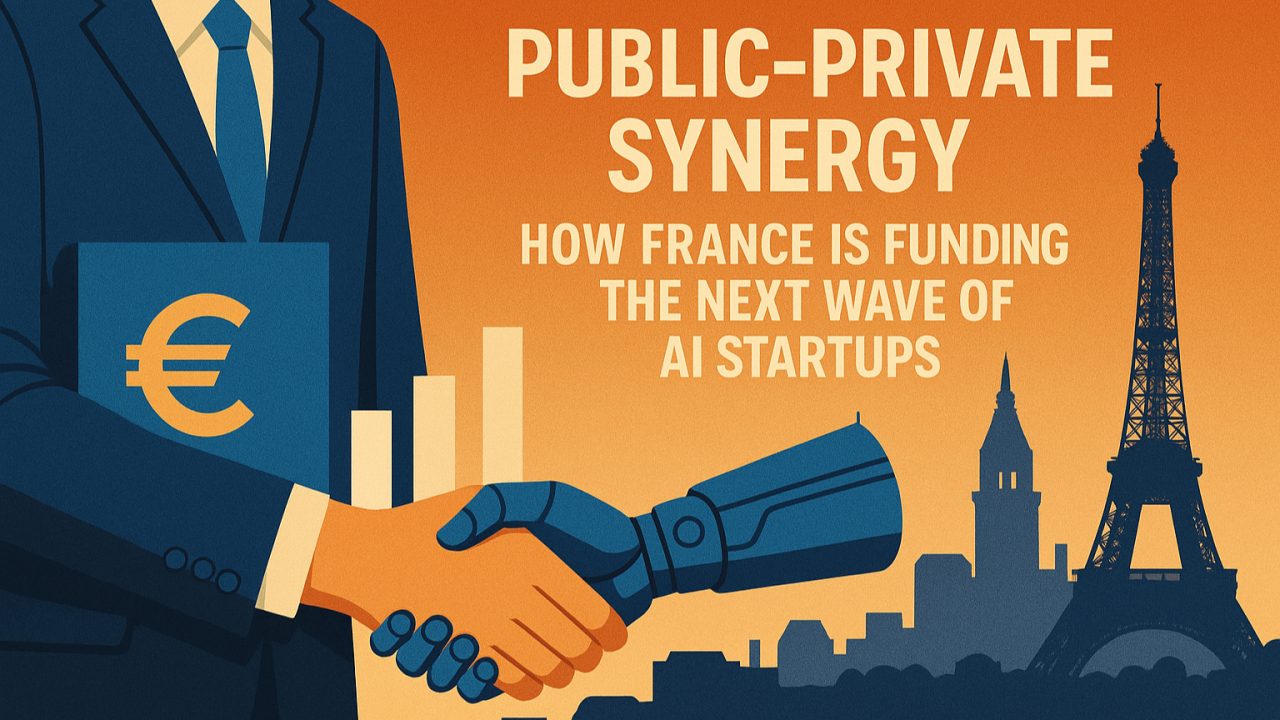
As artificial intelligence becomes a pillar of economic power and strategic sovereignty, France is betting big not just on talent or technology, but on a collaborative model of innovation.
Unlike the U.S. model dominated by Silicon Valley VCs or China’s state-centric approach, France is crafting a hybrid model where startups, government, and corporations co-invest, co-develop, and co-scale AI innovation. This public–private synergy is becoming a hallmark of France’s AI ecosystem and one of its greatest competitive advantages.
From sovereign cloud platforms to multilingual large language models (LLMs), from energy-efficient AI chips to healthcare agents, France’s AI boom is being built through shared risk and shared reward.
Article content
2.The Public Engine: Strategic State Investment
At the heart of this synergy is the French government’s active, strategic role in supporting AI innovation both financially and structurally.
Key Public Initiatives:
France 2030: A €54 billion innovation investment plan, with over €2.5 billion earmarked for AI and deeptech. Supports foundational models, industry-specific AI, quantum computing, and green AI. Bpifrance: The national public investment bank deploys equity and debt funding into early- and growth-stage AI startups, often co-investing with private VCs. ANR & CNRS Programs: Fund AI R&D labs, PhD programs, and interdisciplinary research with applied commercial relevance. Plan IA (2021–2025): Supports sector-specific AI clusters in health, transport, manufacturing, and agriculture.
Rather than just subsidizing, France’s approach is to de-risk early innovation so that private capital can confidently follow.
3.The Corporate Connection: Industry as an Innovation Platform
Large French corporates especially in sectors like energy, telecom, aerospace, and finance are increasingly acting as launchpads for AI startups, offering more than capital: real-world data, problems, and customers.
Notable Corporate Partnerships:
Orange & Mistral AI: Collaborating on sovereign LLMs with French-language specialization. Thales & CEA: Working with startups on frugal AI for defense and space applications. Carrefour & French AI Retail Startups: Joint pilots for AI-driven demand forecasting and product copywriting. Sanofi: Partnering with AI drug discovery startups via Station F and AI4Health Paris cluster. SNCF: Offering rail operation data to startups for AI-based maintenance and passenger flow prediction.
These alliances provide startups with testing grounds, market access, and operational feedback accelerating time to maturity.
4.The VC Landscape: Growing but Grounded
France’s venture capital ecosystem has matured significantly since 2018, with AI and deeptech now at the forefront of investment strategies.
Key Trends:
Rising Mega-Rounds: French AI unicorns like Mistral, Hugging Face, and Owkin have raised rounds exceeding €100M with backing from Sequoia, Lightspeed, and European VCs.
Local Champions: Firms like Eurazeo, Partech, Alven, Serena, and Elaia are focusing on LLM infrastructure, vertical AI, and applied ML. AI-Climate Convergence: New VC vehicles are emerging to fund AI startups focused on sustainability, carbon tracking, and energy optimization.
Sovereignty-Driven Investment: Public-private VC funds like Tibi 2 are channeling capital into computer infrastructure, AI chips, and open-source foundation models.
Still, compared to the U.S. and China, late-stage capital remains scarce, prompting calls for a French or European “AI Growth Fund.”
5.The Role of AI Hubs and Accelerators
France’s AI strategy includes not just capital, but physical and institutional infrastructure to help startups thrive.
Major Ecosystem Drivers:
Station F (Paris): Europe’s largest startup campus, home to dozens of AI startups and corporate programs. La French Tech Mission: Coordinates startup diplomacy, fast-tracks visas, and offers equity-free grants. PEPR Programs: Public funding for foundational research in AI ethics, frugality, and certification. Regional Innovation Clusters: Grenoble (embedded AI), Toulouse (autonomous systems), Lille (health AI), and Nantes (AI & ocean sustainability).
These institutions ensure that AI innovation isn’t confined to Paris, but spreads across France’s economic and research map.
6.Case Studies: Synergy in Action
Mistral AI
Raise over 500M in less than 12 months. Received early backing from Bpifrance, then strategic support from Orange and OVHcloud. Focuses on sovereign open-weight LLMs tailored to European contexts.
Owkin
Uses AI for drug discovery and medical imaging. Partners with Sanofi and AP-HP for real-world deployment. Combines French AI talent with a globally competitive product.
Retail Insight AI (Startup in Lille)
Built using Carrefour data and French-language models. Received grant funding from La French Tech and is now scaling into Belgium and Spain.
These startups demonstrate how France’s hybrid model creates momentum at every stage from research lab to real revenue.
Article content
7.Challenges & Recommendations
Despite momentum, this model faces a few tensions:
Challenges:
Funding Gaps at Series B/C: Many AI startups stall after seed/Series A due to lack of scale-up capital. Fragmentation: Ecosystem coordination across agencies, regions, and funding bodies can be inefficient. Talent Drain: Top founders and researchers still tempted by U.S. salaries and exit markets. Procurement Barriers: Public sector and large corporates still slow to adopt AI from younger startups.
Recommendations:
Launch a France AI Growth Fund focused on late-stage scaleups and compute-heavy startups. Streamline procurement pathways for AI solutions in the public sector. Expand open datasets and sandbox environments for startups. Incentivize AI innovation in mid-sized firms beyond the startup-corporate binary. Strengthen Pan-European AI collaboration to match U.S. scale and China’s state power.
8.Conclusion: Innovation Through Collaboration
France is proving that state intervention and entrepreneurial freedom are not incompatible they're synergistic. By blending public funding, private investment, and corporate cooperation, the country is nurturing an AI ecosystem that is ambitious, inclusive, and strategically sovereign.
As the next generation of AI startups emerges from energy to law, healthcare to agriculture France’s model offers a roadmap for nations looking to build resilient, ethical, and scalable AI economies.
The message is clear: AI leadership doesn't happen in isolation. It happens in partnership.
Log in with a verified account to post comments.
Log in · Register
Comments