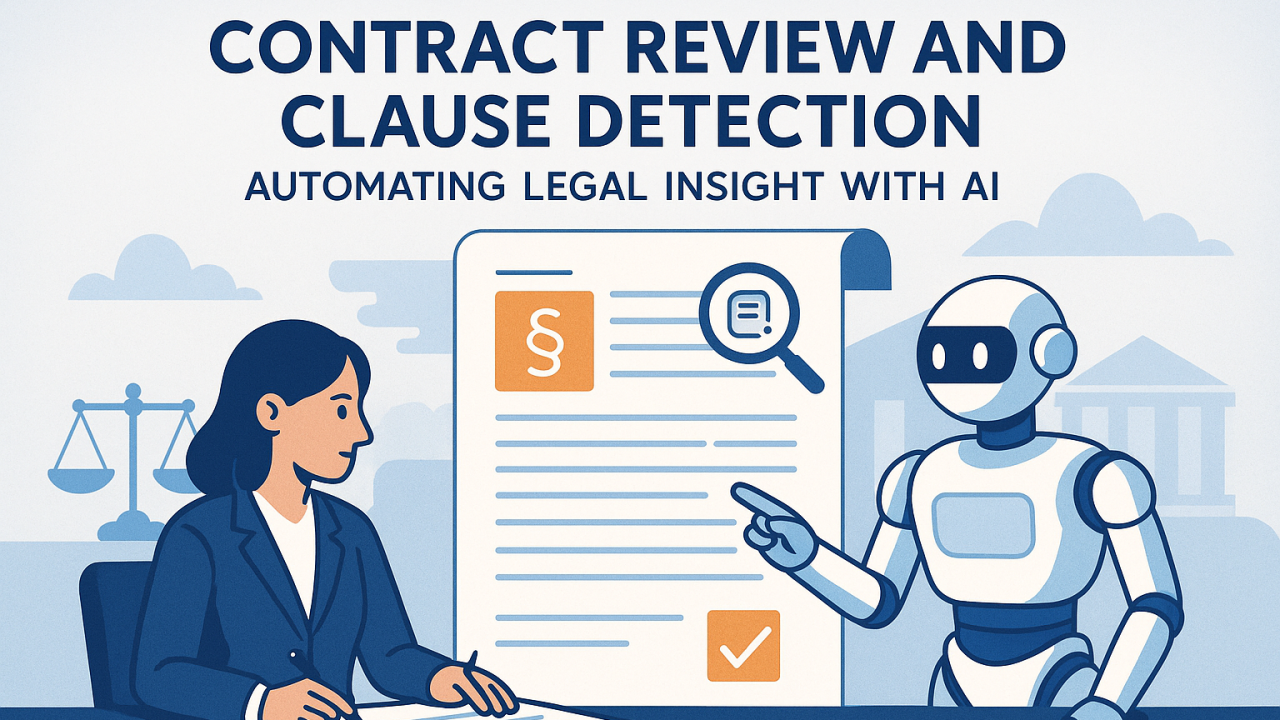
In today’s fast-paced business environment, legal teams face mounting pressure to review and manage a rapidly growing volume of contracts. Traditional contract reviews often manual, time-intensive, and prone to human error are becoming increasingly unsustainable, especially for organizations handling dozens to thousands of contracts. These outdated methods not only slow down deal cycles but also increase the risk of overlooking critical terms or compliance issues.
This is where Contract Review and Clause Detection powered by Artificial Intelligence (AI) makes a transformative impact. By leveraging natural language processing and machine learning, AI tools can quickly analyze contracts, extract key clauses, flag risks, and ensure compliance with internal policies. This streamlines the entire review process, reduces legal bottlenecks, and enables legal teams to focus on higher-value strategic activities rather than repetitive document analysis.
Article content
What is Contract Review?
Contract review is the process of examining a contract to ensure it meets legal standards, complies with internal policies, and protects an organization’s interests. This typically involves:
Verifying critical terms and clauses Checking for missing or non-standard provisions Ensuring compliance with applicable laws Identifying risks or liabilities
Manual contract review can take hours per document, often involving multiple stakeholders and rounds of revisions. When scaled across hundreds of contracts, this process becomes a bottleneck for business.
The Role of AI in Contract Review
AI tools, especially those using Natural Language Processing (NLP) and machine learning are revolutionizing contract management. These tools can:
· Extract key terms like termination dates, payment terms, indemnity clauses, or confidentiality provisions AI-powered tools can automatically identify and extract essential contract elements, such as deadlines, financial obligations, and legal protections. This eliminates manual searching and ensures nothing critical is missed. Legal teams can quickly locate and evaluate key terms for decision-making.
· Compare clauses against company standards or legal benchmarks AI systems can benchmark each clause against internal policy libraries or legal best practices. This helps ensure contractual language aligns with preferred risk profiles or regulatory requirements. Non-standard or unfavorable clauses are instantly highlighted for review or renegotiation.
· Flag anomalies or risky language in real time As contracts are reviewed, AI models detect unusual phrasing, contradictory terms, or high-risk clauses. These real-time alerts allow legal teams to intervene early and reduce exposure. This proactive approach improves legal risk management and contract quality.
· Categorize contracts by type, jurisdiction, or associated risk AI can intelligently sort contracts into categories such as NDAs, vendor agreements, or employment contracts. It also tags documents based on governing law, contract value, or risk level. This makes it easier to manage and prioritize contracts across large portfolios.
This significantly reduces review time, enhances accuracy, and lowers the risk of overlooking critical language.
Clause Detection: Precision in Every Paragraph Clause detection is a sub-task within contract review that focuses on identifying and interpreting specific clauses in legal documents. AI systems trained on thousands of contracts can quickly detect:
· Boilerplate clauses (e.g., force majeure, governing law, arbitration) AI tools are trained to recognize standard legal clauses that appear across most contracts, such as force majeure or arbitration terms. Identifying these ensures consistency and helps confirm essential protections are in place. It also saves time by quickly flagging their presence or absence.
· Deviation from standard language (e.g., non-compete terms or IP ownership clauses) AI can detect when clauses deviate from company-approved templates or legal norms. This is especially useful for sensitive terms like non-compete or intellectual property rights. Legal teams are alerted to review and adjust the language to match internal risk thresholds.
· Missing clauses that should be included based on contract type or jurisdiction Based on the contract's category or governing law, AI can recognize when critical clauses are missing. For example, a data processing agreement lacking a privacy clause can be flagged immediately. This helps ensure completeness and regulatory compliance across documents.
Advanced systems don’t just locate clauses they understand their meaning. For example, they can determine whether a non-disclosure clause is mutual or one-sided, or whether a termination clause favors one party more than the other.
Benefits for Legal and Business Teams
Implementing AI-powered contract review and clause detection brings multiple advantages:
· Speed: Review contracts in minutes rather than hours or days AI dramatically reduces the time required to analyze contracts by automating clause detection and key term extraction. What once took hours can now be completed in minutes. This speeds up the deal cycle and improves overall business agility.
· Consistency: Apply uniform standards across all contract types AI tools ensure that every contract is reviewed using the same rules and benchmarks. This eliminates human variability and reduces the chance of overlooking critical terms. It helps maintain a consistent legal and compliance posture across the organization.
· Risk Mitigation: Proactively catch red flags before contracts are signed AI can identify risky language, missing clauses, or unusual terms during the review process. Early detection allows legal teams to address issues before they escalate. This reduces the likelihood of disputes, non-compliance, or legal exposure.
· Cost Savings: Reduce dependence on external counsel for routine reviews By automating routine contract reviews, companies can reduce reliance on outside legal firms for basic tasks. This results in significant cost savings over time. Legal teams can allocate their budgets to more strategic or complex legal matters.
· Scalability: Handle surges in contract volume without adding headcount AI solutions can process large volumes of contracts simultaneously, with no need to expand legal staff. Whether you're reviewing 10 or 1,000 documents, the system handles it with the same efficiency. This makes it easier to scale legal operations as the business grows.
Use Cases Across Industries
These technologies are widely adopted in various sectors:
· Finance: Reviewing loan agreements, investment contracts, and NDAs In the finance sector, AI helps review complex documents like loan agreements, investment terms, and non-disclosure agreements. It ensures accuracy, regulatory compliance, and consistency across high-value transactions. This reduces legal risk and accelerates deal execution.
· Healthcare: Ensuring compliance in vendor and data-sharing contracts Healthcare organizations rely on AI to analyze contracts involving vendors, data sharing, and patient privacy. It ensures contracts meet HIPAA and other regulatory standards. This minimizes compliance risks and protects sensitive health data.
· Real Estate: Analyzing lease agreements and property transactions AI tools assist real estate teams in reviewing leases, purchase agreements, and zoning terms. They highlight critical clauses such as renewal options, rent escalations, and liabilities. This supports faster closings and fewer legal disputes in property deals.
· Tech: Managing SaaS agreements, SLAs, and licensing contracts Technology companies use AI to review software licensing terms, service-level agreements, and SaaS contracts. It ensures IP rights are protected, and service terms are enforceable. This streamlines contract cycles in fast-paced, innovative-driven environments.
Looking Ahead
The future of contract management is being shaped by intelligent automation, where AI-driven tools are taking on increasingly complex tasks. As these models evolve, they will offer deeper clause interpretation, identify subtle legal nuances, and perform cross-document analysis such as comparing clauses across contracts to detect inconsistencies or risks. Integration with Contract Lifecycle Management (CLM) platforms will become seamless, enabling end-of-end automation from contract creation to renewal, tracking, and compliance.
Legal teams that adopt AI early are gaining more than just efficiency they’re transforming their operations. By automating routine reviews and gaining insights on scale, these teams can shift their focus to high-impact strategic work. In doing so, they build a foundation for smarter, faster, and more agile decision-making, positioning their organizations to thrive in a rapidly changing business landscape.
Article content
In Summary
Contract Review and Clause Detection using AI enables faster, more accurate, and more scalable contract analysis. Whether you're a general counsel, procurement officer, or compliance manager, these tools are reshaping how contracts are negotiated, reviewed, and enforced, turning a legal necessity into a strategic advantage.