Introduction
Climate change has become one of the most serious global challenges of the 21st century. Rising global temperatures, melting glaciers, unpredictable weather patterns, and increasing natural disasters show that the Earth’s climate is changing rapidly. Governments, scientists, and environmental organizations around the world are working together to understand these changes and find effective solutions. However, predicting climate change is extremely complex. The Earth’s climate system involves many interconnected factors such as temperature, ocean currents, atmospheric conditions, greenhouse gas levels, and human activities. Analyzing all these factors using traditional methods can be difficult and time-consuming. This is where Artificial Intelligence (AI) plays an important role. AI technologies can analyze massive amounts of environmental data, detect patterns, and generate predictions much faster than traditional computing systems. With the help of AI, scientists can better understand climate trends and forecast future environmental changes more accurately. Today, AI is becoming an essential tool in climate science. It supports researchers in predicting climate risks, analyzing environmental data, and helping governments plan better strategies to reduce the impact of climate change.
Understanding Climate Data
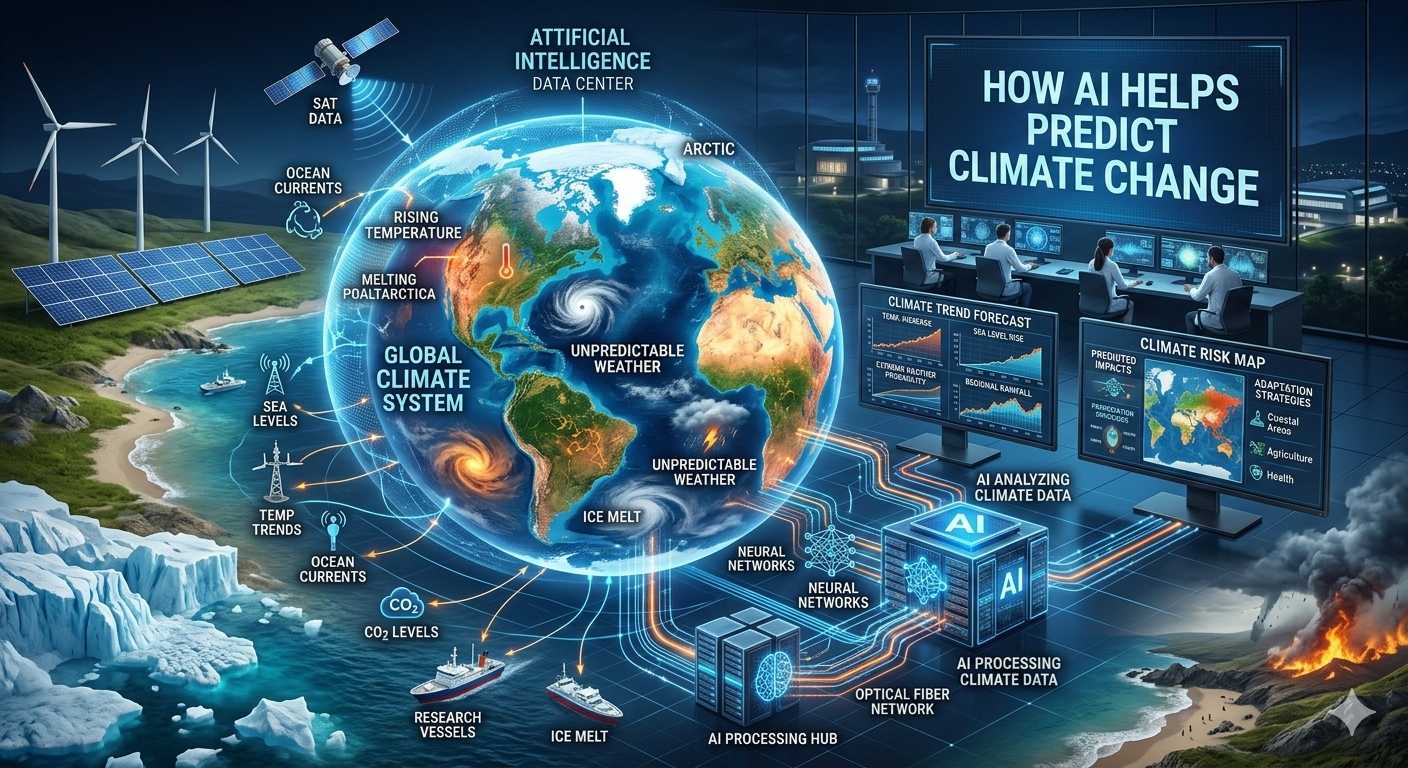
One of the biggest challenges in climate research is the huge amount of data involved. Environmental data comes from many different sources including satellites, weather stations, ocean sensors, climate monitoring systems, and scientific research institutions. Every day, these systems collect enormous volumes of information such as:
•Temperature changes across different regions •Rainfall and precipitation patterns •Carbon dioxide and greenhouse gas levels •Ocean temperatures and currents •Ice sheet thickness and glacier movement •Sea level measurements
Processing this massive amount of data using traditional analysis methods can take a long time. In addition, identifying hidden patterns within such large datasets can be very difficult for humans. AI systems, especially machine learning algorithms, are designed to work with large datasets. They can quickly analyze environmental data and identify trends that may not be immediately visible. By studying historical climate records and current environmental conditions, AI can help scientists detect early signs of climate change. This capability makes AI extremely valuable in improving climate predictions.
Improving Climate Models
Climate models are important scientific tools used to simulate how the Earth’s climate may change over time. These models use mathematical equations to represent interactions between the atmosphere, oceans, land surfaces, and ice systems. However, climate models are very complex. They involve thousands of variables and require powerful computing systems to process the calculations. Artificial Intelligence helps improve these models by making them more efficient and accurate. Machine learning algorithms can analyze previous climate simulations and compare them with real-world environmental data. By learning from this information, AI can adjust climate models and make their predictions more reliable.
For example, AI can help scientists predict:
•Future temperature increases in different regions •Changes in rainfall and drought patterns •The likelihood of extreme weather events •The speed of glacier and ice sheet melting •Future sea level rise
More accurate climate models allow scientists to better understand how the Earth’s climate might change in the coming decades.
Detecting Environmental Patterns
AI is especially powerful when it comes to pattern recognition. Climate systems often show patterns that repeat over time, but these patterns may be very complex. Machine learning algorithms can analyze historical climate data spanning several decades and detect relationships between different environmental factors. For example, AI may identify how ocean temperatures influence storm formation or how changes in atmospheric pressure affect rainfall patterns. These insights help researchers understand how different parts of the climate system interact with each other. AI can also identify unusual environmental trends. If certain climate conditions begin to change faster than expected, AI systems can detect these changes early and alert researchers. Early detection is extremely important because it allows scientists and policymakers to take action before environmental problems become severe.
Predicting Climate Risks
Another important benefit of AI is its ability to predict climate-related risks. Climate change increases the likelihood of extreme weather events such as hurricanes, floods, droughts, and heatwaves. AI systems can analyze environmental data in real time and identify warning signs of these events. By studying past disasters and current climate conditions, AI can estimate the probability of similar events occurring in the future. For example, AI models can predict: •Areas that may experience severe drought •Regions that are at high risk of flooding •Coastal areas vulnerable to rising sea levels •Regions likely to experience extreme heatwaves
These predictions help governments and communities prepare for climate risks and reduce potential damage.
Supporting Global Climate Research
Climate change is a global issue that affects every country. Scientists around the world are working together to study climate trends and develop solutions to reduce environmental damage. AI technologies support this global collaboration by helping researchers share and analyze climate data more efficiently. Many international climate organizations use AI tools to combine data from different sources and build comprehensive climate models. For example, AI can process satellite images from different countries and monitor environmental changes across the planet. It can track deforestation, monitor ice melting in polar regions, and observe ocean temperature changes. By bringing together data from multiple sources, AI helps scientists gain a clearer understanding of global climate patterns.
Helping Policymakers Make Better Decisions
Climate predictions are not only important for scientists. They are also essential for governments and policymakers who must create strategies to protect the environment. AI-generated climate forecasts provide valuable information for decision-makers. Governments can use these predictions to plan environmental policies, invest in renewable energy, and prepare for climate-related disasters. For example, if AI predicts rising sea levels in coastal regions, governments can start building protective infrastructure such as sea walls or develop relocation plans for vulnerable communities. AI-driven climate predictions also help organizations develop long-term sustainability strategies.
Challenges of Using AI in Climate Prediction
Although AI offers many advantages in climate prediction, there are also some challenges. One challenge is data quality. Climate predictions depend on accurate environmental data. If the data collected from sensors or satellites contains errors, the predictions generated by AI systems may also be inaccurate. Another challenge is the complexity of climate systems. Even advanced AI models cannot fully capture every detail of Earth’s climate. Scientists must continuously update and improve AI models to ensure accurate predictions. There are also technical challenges related to computing power and data storage, as climate analysis requires processing extremely large datasets. Despite these challenges, ongoing advancements in AI technology continue to improve the reliability of climate predictions.
The Future of AI in Climate Prediction
The future of AI in climate science looks very promising. As technology continues to advance, AI systems will become even more powerful and capable of analyzing larger datasets. New developments in deep learning and advanced data analytics will allow scientists to study climate systems in greater detail. AI will also play a major role in integrating data from satellites, drones, ocean sensors, and climate monitoring stations. In the coming years, AI could help create highly accurate climate forecasting systems that provide long-term environmental predictions. These systems may help societies better prepare for climate change and develop sustainable solutions.
Conclusion
Artificial Intelligence is transforming the way scientists study and predict climate change. By analyzing large amounts of environmental data, identifying complex patterns, and improving climate models, AI provides valuable insights into the future of our planet. AI-powered climate predictions help researchers understand environmental changes, support policymakers in making informed decisions, and enable communities to prepare for climate risks. As the world continues to face the challenges of climate change, AI will play an increasingly important role in protecting the environment and building a sustainable future.
Log in with a verified account to post comments.
Log in · Register
Comments