Introduction
Creativity has traditionally been viewed as a uniquely human capability — an expression of imagination, emotion, and experience. Artists, writers, designers, filmmakers, and musicians have long relied on inspiration, skill, and cultural context to produce original works. However, the emergence of Generative Artificial Intelligence (Generative AI) is reshaping how creativity is defined and practiced in the modern digital era. Generative AI refers to advanced artificial intelligence systems capable of producing original content such as text, images, music, videos, and even virtual environments. Unlike traditional AI systems that focus on analyzing or classifying data, generative AI creates entirely new outputs by learning patterns from large datasets. Technologies such as deep learning, transformer models, and Generative Adversarial Networks (GANs) have enabled machines to generate outputs that closely resemble human-created content.
Today, generative AI is transforming industries including marketing, media, gaming, publishing, fashion, and entertainment. It enhances productivity, enables experimentation, and opens new possibilities for artistic expression. However, alongside its benefits, generative AI raises ethical, legal, and societal concerns that must be carefully addressed.
Understanding Generative AI
Generative AI systems are built using advanced machine learning techniques, particularly deep neural networks. These models are trained on vast datasets containing images, text, music, or other content types. By analyzing patterns, structures, and relationships within the data, the AI learns how to generate similar but new content.
For example:
• Text-based models can generate essays, scripts, or marketing copy. • Image-generation models can create artwork, illustrations, and design concepts. • Music-generation models compose melodies and background scores. • Video-generation tools create animations and visual effects.
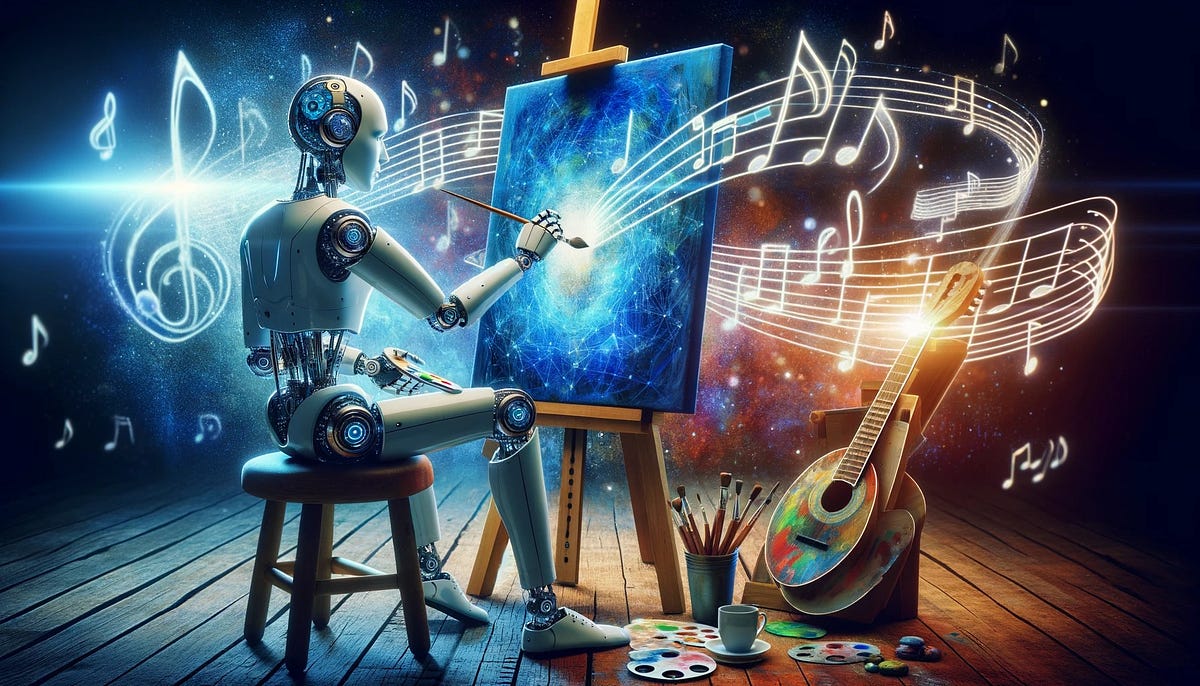
Unlike rule-based systems, generative AI does not follow fixed instructions. Instead, it predicts the most likely next element (such as a word in a sentence or a pixel in an image) based on learned patterns. This predictive capability allows it to produce outputs that feel creative and natural. Importantly, generative AI does not possess true human emotions or consciousness. Its creativity is computational — driven by data and algorithms — but the results can still be highly impressive and valuable in professional settings.
Applications in Marketing and Advertising
One of the most significant impacts of generative AI is visible in marketing and advertising. Businesses constantly require fresh content for social media, websites, email campaigns, product descriptions, and promotional materials. Generative AI dramatically speeds up content creation.
Automated Content Creation
AI tools can generate product descriptions, blog posts, ad copy, and social media captions within seconds. This reduces workload for marketing teams and allows companies to scale their campaigns efficiently. Instead of spending hours drafting variations of advertisements, marketers can generate multiple creative versions instantly and test which performs best.
Personalized Marketing
Generative AI enables hyper-personalization. By analyzing customer behavior, preferences, and browsing history, AI systems can create customized advertisements tailored to individual users. For example, an online retailer can automatically generate personalized email content recommending products based on a customer’s previous purchases.
Visual and Graphic Design
AI-powered image-generation tools help create promotional posters, digital artwork, and branding visuals. Marketing teams can experiment with different styles and concepts quickly without hiring large design teams for every campaign. This democratizes design and reduces production costs. The result is faster campaign development, increased engagement, and improved return on investment.
Impact on Media and Entertainment
Generative AI is significantly influencing film production, music composition, journalism, and gaming.
Scriptwriting and Story Development
AI tools assist writers by generating story ideas, dialogue suggestions, or plot outlines. While human writers remain essential for emotional depth and narrative coherence, AI can accelerate brainstorming and drafting processes.
Music Production
AI-based music generators compose background scores for advertisements, games, and short films. Independent creators who cannot afford professional composers can now access affordable AI-generated music. Additionally, musicians experiment with AI to explore new genres and sounds.
Gaming and Virtual Worlds
In the gaming industry, generative AI creates realistic environments, characters, and dynamic storylines. Procedural content generation allows developers to design expansive game worlds efficiently. AI can also generate non-player character (NPC) dialogues that respond intelligently to player actions.
News and Journalism
Media organizations use AI to generate financial summaries, sports reports, and weather updates automatically. This frees journalists to focus on investigative and analytical reporting. Generative AI is not replacing human creativity but augmenting it. It provides tools that enhance speed, experimentation, and accessibility in creative industries.
Empowering Independent Creators
One of the most transformative aspects of generative AI is its accessibility. Previously, high-quality content production required significant financial resources and professional expertise. Today, individuals with minimal technical skills can create professional-level graphics, videos, and written content using AI tools. For example, a small business owner can generate marketing materials without hiring a large agency. Independent filmmakers can create special effects on a limited budget. Aspiring authors can use AI assistance to refine their drafts. This democratization of creativity lowers entry barriers and encourages innovation. However, it also increases competition in creative markets. Ethical and Legal Challenges Despite its advantages, generative AI introduces complex ethical and legal concerns.
Copyright and Intellectual Property
Generative AI models are trained on large datasets that may include copyrighted material. There is ongoing debate about whether AI-generated content infringes on the rights of original creators. If an AI produces artwork similar to an existing artist’s style, questions arise about ownership and originality. Clear legal frameworks are still evolving to address these concerns.
Deepfakes and Misinformation
Generative AI can create highly realistic fake images, videos, and audio recordings — known as deepfakes. These can be misused to spread misinformation, damage reputations, or manipulate public opinion. The potential for misuse highlights the importance of regulation, transparency, and digital literacy.
Authenticity and Creative Value
Some critics argue that AI-generated content lacks genuine human emotion and authenticity. Over-reliance on AI may reduce originality or create content saturation, where creative works become repetitive and formulaic. Balancing human creativity with AI assistance is essential to maintain artistic integrity.
Human–AI Collaboration in Creativity
Rather than viewing generative AI as a replacement for artists, many experts emphasize collaboration between humans and machines. AI can act as a creative partner — generating ideas, refining drafts, or exploring alternative designs — while humans provide emotional insight, cultural understanding, and ethical judgment. For instance, a graphic designer might use AI to generate multiple design prototypes quickly, then refine the best concept manually. A writer may use AI for initial brainstorming but edit the final version to ensure tone and coherence. This collaborative model enhances productivity while preserving human creativity at the core of artistic work.
Economic and Industry Implications
Generative AI is reshaping job roles in creative industries. While some routine content production roles may decline, new positions are emerging, such as: • AI content strategists • Prompt engineers • AI ethics consultants • Digital experience designers
Organizations must invest in training programs to help creative professionals adapt to AI-enhanced workflows. Moreover, companies that adopt generative AI effectively gain competitive advantages through faster production cycles and innovative content strategies.
The Future of Generative AI in Creative Fields
As generative AI technology continues to evolve, its outputs will become increasingly sophisticated. Future systems may integrate multimodal capabilities, generating text, images, audio, and video simultaneously. Advancements in explainable AI and ethical frameworks will improve transparency and accountability. Regulatory bodies are likely to establish clearer guidelines for intellectual property and responsible AI use. Ultimately, generative AI will continue to redefine creativity — not by replacing human imagination, but by expanding its possibilities.
Conclusion
Generative AI is transforming creative industries by accelerating content production, enhancing personalization, and enabling new forms of artistic expression. From marketing and media to gaming and music, AI-driven tools empower professionals and independent creators alike. However, ethical challenges such as copyright concerns, misinformation, and authenticity must be addressed to ensure responsible adoption. The future of creativity lies not in human versus machine, but in human–AI collaboration. When balanced thoughtfully, generative AI serves as a powerful creative assistant — expanding innovation, increasing accessibility, and shaping a new era of digital creativity.